2003 FORD EXPEDITION brake light
[x] Cancel search: brake lightPage 234 of 320

Fuse/Relay
LocationFuse Amp
RatingPassenger Compartment Fuse Panel
Description
28 5A* SecuriLock transceiver
29 30A* Trailer tow electric brake controller
30 30A* BSM (door locks), Liftgate glass release
relay, Liftgate glass release motor,
Door/Liftgate locks, Parklamps relay
(BSM), Headlamps relay (BSM), Door
lock/Unlock relay (BSM)
31 25A* Radio
32 15A* CMS, Transmission solenoids
33 20A* Canister vent solenoid, EVR CC, HEGOs,
VMV solenoid, IMTV solenoid, A/C clutch
relay coil
34 20A* PCM, Fuel injectors, Idle air control (IAC)
solenoid, Mass air flow sensor
35 20A* Instrument cluster high beam indicator,
High beam headlamps
36 10A* Trailer tow right turn lamp
37 20A* Cargo area power point
38 25A* Rear wiper motor, Washer pump (rear
window wash)
39 20A* Instrument panel or floor console power
point, Rear console power point
40 20A* Headlamp switch, High beam relay coil, LH
low beam fuse # 25, LH low beam fuse #
23, BSM (autolamps headlamp relay), DRL
41 20A* Cigar lighter, OBD II Connector
42 10A* Trailer tow left turn lamp
101 30A** Starter relay, Starter solenoid
102 30A** Ignition switch, Starter solenoid
103 30A** ABS module (pump motor)
104 30A** LH 3rd row power seat
105 30A** Spare
Roadside Emergencies
234
Page 238 of 320
7. To remove the spare tire, turn the handle counterclockwise until the
tire is lowered to the ground and the cable is slightly slack.
8. Slide the retainer through the center of the spare tire wheel.
Tire change procedure
To prevent the vehicle from moving when you change a tire, be
sure the parking brake is set, then block (in both directions) the
wheel that is diagonally opposite (other side and end of the vehicle) to
the tire being changed.
If the vehicle slips off the jack, you or someone else could be
seriously injured.
On vehicles equipped with Air Suspension, turn OFF the Air
Suspension switch prior to jacking, hoisting or towing your
vehicle.
Refer to the instruction sheet (located in the rear floor compartment
behind the 3rd row seat with the jack tray tools assembly kit) for
detailed tire change instructions.
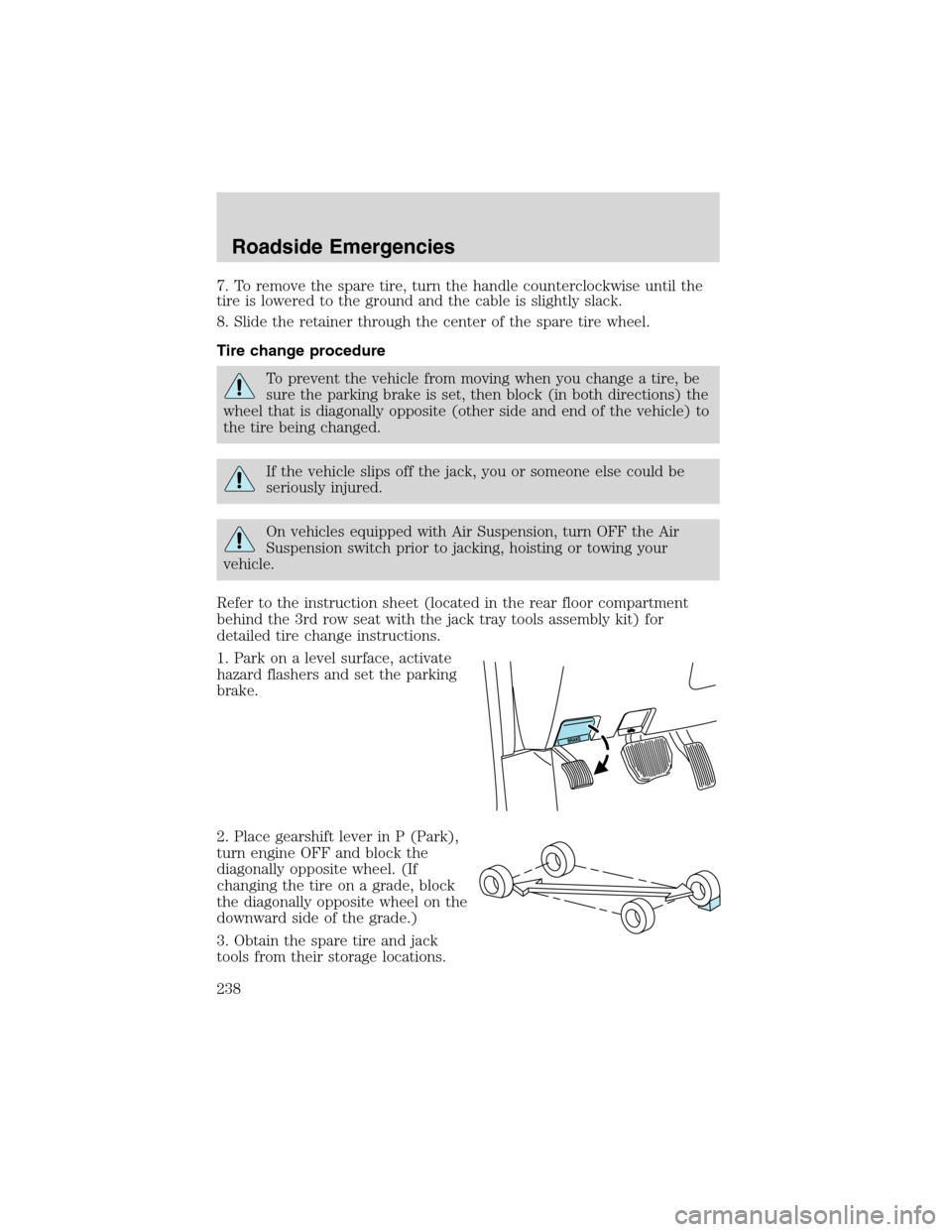
1. Park on a level surface, activate
hazard flashers and set the parking
brake.
2. Place gearshift lever in P (Park),
turn engine OFF and block the
diagonally opposite wheel. (If
changing the tire on a grade, block
the diagonally opposite wheel on the
downward side of the grade.)
3. Obtain the spare tire and jack
tools from their storage locations.
Roadside Emergencies
238
Page 242 of 320
Preparing your vehicle
When the battery is disconnected or a new battery is installed, the
transmission must relearn its shift strategy. As a result, the transmission
may have firm and/or soft shifts. This operation is considered normal and
will not affect function or durability of the transmission. Over time, the
adaptive learning process will fully update transmission operation.
1.Use only a 12–volt supply to start your vehicle.
2. Do not disconnect the battery of the disabled vehicle as this could
damage the vehicle’s electrical system.
3. Park the booster vehicle close to the hood of the disabled vehicle
making sure the two vehiclesdo nottouch. Set the parking brake on
both vehicles and stay clear of the engine cooling fan and other moving
parts.
4. Check all battery terminals and remove any excessive corrosion before
you attach the battery cables. Ensure that vent caps are tight and level.
5. Turn the heater fan on in both vehicles to protect any electrical
surges. Turn all other accessories off.
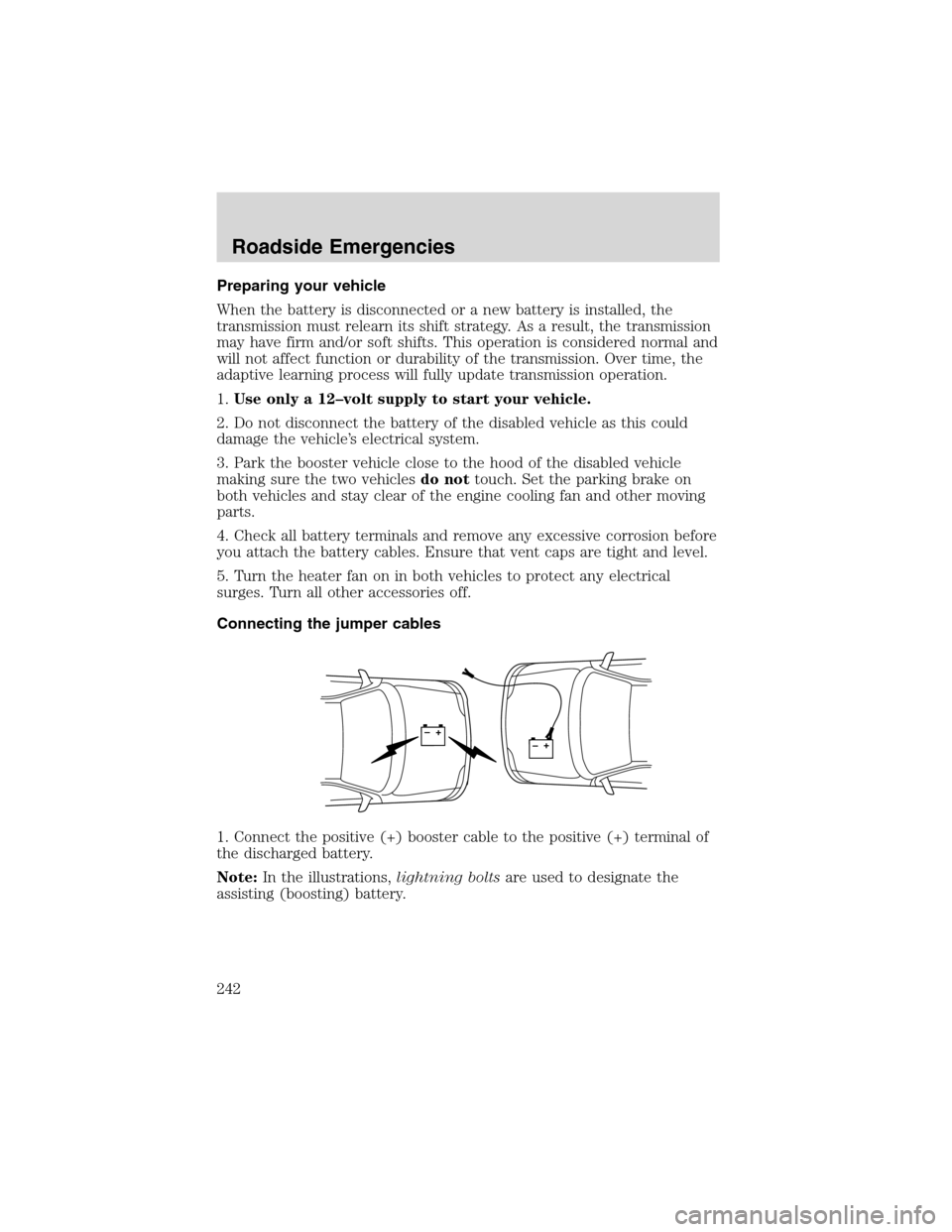
Connecting the jumper cables
1. Connect the positive (+) booster cable to the positive (+) terminal of
the discharged battery.
Note:In the illustrations,lightning boltsare used to designate the
assisting (boosting) battery.
+–+–
Roadside Emergencies
242
Page 260 of 320
PAINT CHIPS
Your dealer has touch-up paint and sprays to match your vehicle’s color.
Take your color code (printed on a sticker in the driver’s door jam) to
your dealer to ensure you get the correct color.
•Remove particles such as bird droppings, tree sap, insect deposits, tar
spots, road salt and industrial fallout before repairing paint chips.
•Always read the instructions before using the products.
ALUMINUM WHEELS AND COVERS
Aluminum wheel rims or covers are coated with a clearcoat paint finish.
In order to maintain their shine:
•Clean with Detail Wash (ZC-3–A), which is available from your dealer.
•Never apply any cleaning chemical to hot or warm wheel rims or
covers.
•Some automatic car washes may cause damage to the finish on your
wheel rims or covers. Chemical-strength cleaners, or cleaning
chemicals, in combination with brush agitation to remove brake dust
and dirt, could wear away the clearcoat finish over time.
•Do not use hydrofluoric acid-based or high caustic-based wheel
cleaners, steel wool, fuels or strong household detergent.
•To remove tar and grease, use Ford Extra Strength Tar and Road Oil
Removal (B7A-19520–AA), available from your dealer.
ENGINE
Engines are more efficient when they are clean because grease and dirt
buildup keep the engine warmer than normal. When washing:
•Take care when using a power washer to clean the engine. The
high-pressure fluid could penetrate the sealed parts and cause
damage.
•Do not spray a hot engine with cold water to avoid cracking the
engine block or other engine components.
•Spray Motorcraft Engine Shampoo and Degreaser (ZC-20) on all parts
that require cleaning and pressure rinse clean.
•Cover the highlighted areas to prevent water damage when cleaning
the engine.
Cleaning
260
Page 265 of 320
SERVICE RECOMMENDATIONS
To help you service your vehicle:
•We highlight do-it-yourself items in the engine compartment for easy
location.
•We provide a scheduled maintenance guide which makes tracking
routine service easy.
If your vehicle requires professional service, your dealership can provide
the necessary parts and service. Check yourWarranty Guideto find out
which parts and services are covered.
Use only recommended fuels, lubricants, fluids and service parts
conforming to specifications. Motorcraft parts are designed and built to
provide the best performance in your vehicle.
PRECAUTIONS WHEN SERVICING YOUR VEHICLE
•Do not work on a hot engine.
•Make sure that nothing gets caught in moving parts.
•Do not work on a vehicle with the engine running in an enclosed
space, unless you are sure you have enough ventilation.
•Keep all open flames and other lit material away from the battery and
all fuel related parts.
Working with the engine off
1. Set the parking brake and shift to P (Park).
2. Turn off the engine and remove the key.
3. Block the wheels.
Maintenance and Specifications
265
Page 287 of 320
•Revving the engine before turning it off may reduce fuel economy.
•Using the air conditioner or defroster may reduce fuel economy.
•You may want to turn off the speed control in hilly terrain if
unnecessary shifting between third and fourth gear occurs.
Unnecessary shifting of this type could result in reduced fuel
economy.
•Warming up a vehicle on cold mornings is not required and may
reduce fuel economy.
•Resting your foot on the brake pedal while driving may reduce fuel
economy.
•Combine errands and minimize stop-and-go driving.
Maintenance
•Keep tires properly inflated and use only recommended size.
•Operating a vehicle with the wheels out of alignment will reduce fuel
economy.
•Use recommended engine oil. Refer toLubricant specificationsin
this chapter.
•Perform all regularly scheduled maintenance items. Follow the
recommended maintenance schedule and owner maintenance checks
found in your vehicle scheduled maintenance guide.
Conditions
•Heavily loading a vehicle or towing a trailer may reduce fuel economy
at any speed.
•Carrying unnecessary weight may reduce fuel economy (as much as
0.4 km/L [1 mpg] is lost for every 180 kg [400 lb] of weight carried).
•Adding certain accessories to your vehicle (for example bug
deflectors, rollbars/light bars, running boards, ski/luggage racks) may
reduce fuel economy.
•Using fuel blended with alcohol may lower fuel economy.
•Fuel economy may decrease with lower temperatures during the first
12–16 km (8–10 miles) of driving.
•Driving on flat terrain offers improved fuel economy as compared to
driving on hilly terrain.
•Transmissions give their best fuel economy when operated in the top
cruise gear and with steady pressure on the gas pedal.
Maintenance and Specifications
287
Page 313 of 320
A
ABS (see Brakes) .....................195
Accessory delay ........................100
Air bag supplemental
restraint system ........168–169, 173
and child safety seats ............170
description ......................169, 173
disposal ....................................176
driver air bag ..................171, 174
indicator light ...........12, 172, 176
operation .........................171, 174
passenger air bag ...........171, 174
Air cleaner filter .......293–294, 300
Air conditioning ..........................72
auxiliary heater and air
conditioner ................................78
manual heating and air
conditioning system .................69
Air suspension
warning light .............................14
Antifreeze
(see Engine coolant) ................274
Anti-lock brake system
(see Brakes) ......................195–196
Armrests ....................................142
Audio system
(see Radio) ................19, 27, 37–38
Automatic transmission
driving an automatic
overdrive .................................203
fluid, adding ............................291
fluid, checking ........................291
fluid, refill capacities ..............300
fluid, specification ..................305
Auxiliary power point .................97Axle
lubricant
specifications ..................303, 305
refill capacities ........................300
B
Battery .......................................272
acid, treating emergencies .....272
charging system warning
light ............................................12
jumping a disabled battery ....241
maintenance-free ....................272
replacement, specifications ...300
servicing ..................................272
voltage gauge ............................16
BeltMinder .................................164
Brakes ........................................195
anti-lock ...........................195–196
anti-lock brake system
(ABS) warning light .........11, 196
brake warning light ..................11
fluid, checking and adding ....290
fluid, refill capacities ..............300
fluid, specifications .........303, 305
lubricant
specifications ..................303, 305
parking ....................................196
pedals (see Power
adjustable foot pedals) ..102, 125
shift interlock ..................202, 206
Break-in period .............................6
Bulbs ............................................86
C
Capacities for refilling fluids ....300
CD-6 disc .....................................38
CD-single premium ...............19, 27
Certification Label ....................307
Index
313
Page 316 of 320
GVWR (Gross Vehicle
Weight Rating) ..........................219
calculating .......................219, 221
definition .................................219
driving with a heavy load ......219
location ....................................219
H
Hazard flashers .........................228
Headlamps ...................................81
aiming ........................................83
autolamp system .......................81
bulb specifications ....................86
daytime running lights .............82
flash to pass ..............................82
high beam ...........................13, 82
replacing bulbs .........................87
turning on and off ....................81
warning chime ..........................14
Heating
heating and air
conditioning system ...........69, 72
HomeLink universal
transceiver (see Garage
door opener) .............108–109, 111
Hood ..........................................266
I
Ignition ...............................191, 305
Infant seats
(see Safety seats) .....................180
Inspection/maintenance
(I/M) testing ..............................289
Instrument panel
cleaning ...................................262
cluster ........................................10
lighting up panel and
interior .......................................83J
Jack ............................................236
positioning ...............................236
storage .....................................236
Jump-starting your vehicle ......241
K
Keyless entry system
locking and unlocking
doors ........................................137
programming entry code .......135
Keys ...................................137–139
key in ignition chime ...............15
positions of the ignition .........191
L
Lamps
autolamp system .......................81
bulb replacement
specifications chart ..................86
cargo lamps ...............................83
daytime running light ...............82
fog lamps ...................................81
headlamps .................................81
headlamps, flash to pass ..........82
instrument panel, dimming .....83
interior lamps ...............84–85, 87
replacing bulbs ...................86–90
Lane change indicator
(see Turn signal) ........................84
Liftgate ..............................126, 130
Lights, warning and indicator ....10
AdvanceTrac .............................12
air bag ........................................12
anti-lock brakes (ABS) ....11, 196
brake ..........................................11
charging system ........................12
check coolant ............................13
Index
316