2003 FIAT PALIO lock
[x] Cancel search: lockPage 52 of 156
51
When using the boot,
make sure the load you
are carrying does not ex-
ceed the permitted weight (see
the chapter “Technical Specifi-
cations”). Also make sure the
items in the boot are arranged
properly to prevent them being
thrown forwards and injuring pas-
sengers should you brake sharply.BOOT
OPENING/CLOSING
THE BOOT
TAILGATE
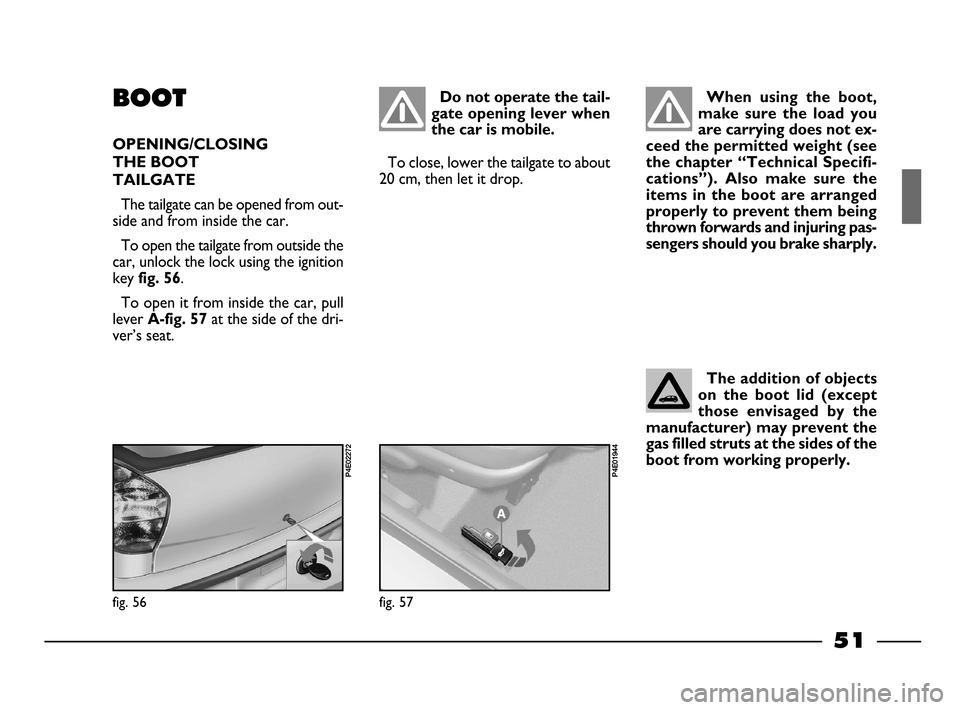
The tailgate can be opened from out-
side and from inside the car.
To open the tailgate from outside the
car, unlock the lock using the ignition
key
fig. 56.
To open it from inside the car, pull
lever
A-fig. 57at the side of the dri-
ver’s seat.
Do not operate the tail-
gate opening lever when
the car is mobile.
To close, lower the tailgate to about
20 cm, then let it drop.
fig. 56
P4E02272
fig. 57
P4E01944
The addition of objects
on the boot lid (except
those envisaged by the
manufacturer) may prevent the
gas filled struts at the sides of the
boot from working properly.
20-63 03/03/2003 06:03 PM Page 51
Page 57 of 156
56
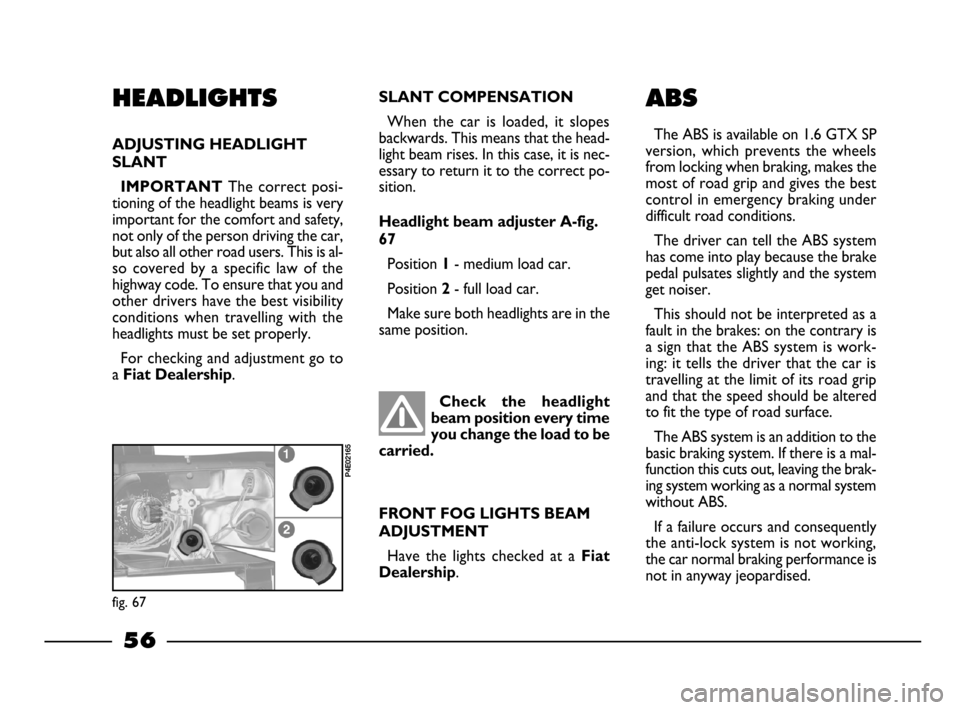
SLANT COMPENSATION
When the car is loaded, it slopes
backwards. This means that the head-
light beam rises. In this case, it is nec-
essary to return it to the correct po-
sition.
Headlight beam adjuster A-fig.
67
Position 1- medium load car.
Position
2- full load car.
Make sure both headlights are in the
same position.
Check the headlight
beam position every time
you change the load to be
carried.
FRONT FOG LIGHTS BEAM
ADJUSTMENT
Have the lights checked at a Fiat
Dealership
.
ABS
The ABS is available on 1.6 GTX SP
version, which prevents the wheels
from locking when braking, makes the
most of road grip and gives the best
control in emergency braking under
difficult road conditions.
The driver can tell the ABS system
has come into play because the brake
pedal pulsates slightly and the system
get noiser.
This should not be interpreted as a
fault in the brakes: on the contrary is
a sign that the ABS system is work-
ing: it tells the driver that the car is
travelling at the limit of its road grip
and that the speed should be altered
to fit the type of road surface.
The ABS system is an addition to the
basic braking system. If there is a mal-
function this cuts out, leaving the brak-
ing system working as a normal system
without ABS.
If a failure occurs and consequently
the anti-lock system is not working,
the car normal braking performance is
not in anyway jeopardised.
HEADLIGHTS
ADJUSTING HEADLIGHT
SLANT
IMPORTANT
The correct posi-
tioning of the headlight beams is very
important for the comfort and safety,
not only of the person driving the car,
but also all other road users. This is al-
so covered by a specific law of the
highway code. To ensure that you and
other drivers have the best visibility
conditions when travelling with the
headlights must be set properly.
For checking and adjustment go to
a
Fiat Dealership.
fig. 67
P4E02165
20-63 03/03/2003 06:03 PM Page 56
Page 58 of 156
57
If you have never driven a car with
ABS before, you should practice using
the system on slippery terrain, obvi-
ously with the necessary safety pre-
cautions and keeping to the Highway
code of the country you are in. It is al-
so a good idea to read the following
information carefully.
The advantage in using the ABS sys-
tem is that it continues to give you
maximum manoeuvrability even when
braking hard in conditions for poor
grip by preventing the wheels locking.
However, do not expect that with
ABS the braking distance will always
decrease: for example surfaces with
gravel or fresh snow on a slippery
road could infact increase the braking
distance.
To exploit the ABS system to the full
in the event of necessity, you should
take heed of the following advice:
If the brake fluid low
warning light x
comes on,
stop the car immediately
and contact the nearest Fiat Deal-
ership. Fluid leaks from the hy-
draulic system, in fact, can com-
promise the braking of both tradi-
tional systems and systems with
ABS.When the ABS is acti-
vated, you will feel the
brake pedal pulsating. Do
not remove your foot, but keep
it pressed. In doing so you will
stop in the shortest amount of
space possible under the current
road conditions.
If you follow these tips, you will be
able to brake better in any situation.
IMPORTANTCars fitted with ABS
are only to be fitted with wheel rims,
tyres and brake liners of the make and
model approved by the car manufac-
turer.
The ABS exploits the
tyre-road grip available to
the full, but it cannot im-
prove it; you should therefore
take every care when driving on
slippery surfaces, and not take
unnecessary risks. If the ABS sys-
tem cuts in it is a sign that the
grip between the tyre and the
road surface has reached the lim-
it: you must slow down to match
the speed to the road grip avail-
able
If there is a fault, the in-
strument panel warning
light
>will come on, at
this point, reduce speed and go to
a Fiat Dealership to have your car
checked and put it right imme-
diately.
Braking while cornering always re-
quires extreme care even when using
ABS.
The most important advice to follow
is this:
20-63 03/03/2003 06:03 PM Page 57
Page 64 of 156

63
PROTECTING THE
ENVIRONMENT
Protecting the environment has been
the guiding principle in the design of the
Fiat Palio right from the start. The re-
sult is the use of materials and creation
of devices that can reduce or consid-
erably curtail harmful influences on the
environment.
The devices for curtailing emission
for petrol version are:
– a three-way catalytic converter;
– Lambda sensor;
– an anti evaporation system.
The devices for curtailing emission
for diesel version are:
– Catalytic converter;
– Exhaust gas recirculation.
As a consequence Fiat Palio is ready
to travel well ahead of the most strin-
gent international pollution control
standards.
fig. 74
P4E01945
IMPORTANT If required, replace
the fuel cap with another genuine cap
to avoid affecting the efficiency of the
fuel vapour recovery system.
NEVER go close to the
tank filler with naked
flames or lit cigarettes:
Also avoid going too close to
the fuel tank filler area, to avoid
inhaling harmful vapours.FUEL FILLER CAP
To unlock the fuel filler cap flap from
inside the car, lift the lever
A-fig. 74.
The airtight seal of the filling cap may
lead to a slight increase of pressure in
the tank. A hissing sound when the
cap is removed is therefore quite nor-
mal.
20-63 03/03/2003 06:03 PM Page 63
Page 68 of 156

67
With handbrake engaged and igni-
tion key at
MAR, the instrument pan-
el warning light
x
comes on.
To disengage the handbrake:
1)Slightly lift the handbrake and
press release button
A.
2)Keep the button pressed in and
lower the lever. Warning light
x
will
go out.
3)To prevent accidental movement
of the car, this procedure should be
carried out with the brake pedal
pressed down.
HANDBRAKE fig. 1
The handbrake lever is situated be-
tween the two front seats.
Pull the handbrake lever upwards un-
til the car cannot be moved. Four or
five clicks are generally enough when
the car is on level ground while nine
or ten may be required if the car is
on a steep slope or loaded.
IMPORTANTIf this is not the
case, take the car to a
Fiat Dealer-
ship
to have the handbrake adjusted.
Never leave unsuper-
vised children in the car.
Always remove the key
from the ignition switch and take
it with you when you get out of
the car.
fig. 1
P4E02046
PARKING
Stop the engine, engage the hand-
brake and engage first gear if the car
is faced uphill or reverse gear if it is
faced downhill in compliance with the
national Highway Code and leave the
wheels steered towards the road bor-
ders or the kerb. Block the wheels
with a wedge or a stone if the car is
parked on a steep slope.
Do not leave the ignition key at
MARbecause it drains the battery.
Always remove the key when you
leave the car.
64-79 03/03/2003 06:45 PM Page 67
Page 73 of 156

72
– Remember that fog also means the
tarmac is wet and therefore manoeu-
vres of all kinds are more difficult and
stopping distances are longer.
– Keep a good distance from the ve-
hicle in front of you.
– As far as possible, avoid spurts of
speed or sudden deceleration.
– Do not overtake other vehicles if
you can help it.
– If you are forced to stop your car
(breakdown, limited visibility etc.) try
to stop off the road. Turn on the haz-
ard lights and, if possible, the dipped
beam headlights. Rhythmically sound
the horn if you realize another car is
coming.MOUNTAIN DRIVING
– When driving downhill, use the en-
gine braking by engaging a low gear, so
as not to overheat the brakes.
– Under no circumstances should
you drive downhill with the engine off
or with the car in neutral, let alone
with the ignition key out.
– Drive at a moderate speed without
cutting corners.
– Remember that overtaking while
going uphill is slower and therefore re-
quires more free road. If you are be-
ing overtaken while driving uphill,
make it easier for the other vehicle
to pass.
DRIVING ON SNOW AND
ICE
Here are some tips for driving in
these conditions:
– Before starting off make sure that
the windscreen wiper blades are not
frozen to the windscreen.
– Remove the snow from the climate
control system air vent. – Keep your speed down.
– Use chains if the roads are covered
in snow: see paragraph “Snow chains”
in this chapter.
– Do not stay parked on high snow
for too long with engine running: the
snow could divert the carbon oxide
of the exhaust gases in the passenger
compartment.
– Mainly use the braking effect of the
engine and under all circumstances
avoid braking sharply.
– When braking in a car not fitted
with ABS, reduce the possibility of the
wheels locking by varying the pressure
you exert on the brake pedal.
– Do not accelerate suddenly and
avoid swerving.
– In the winter, even apparently dry
roads may have icy patches. Be care-
ful therefore when driving over patch-
es that do not get much exposure to
sun or are lined with trees or rocks
where ice may have not have melted.
– Keep a good distance from the ve-
hicles in front.
64-79 03/03/2003 06:45 PM Page 72
Page 74 of 156

73
ECONOMICAL
RUNNING THAT
RESPECTS THE
ENVIRONMENT
Environmental protection has been
one of the guiding principles in the
production of the Fiat Palio.
It is no accident that its pollution
control equipment is much more ef-
fective than that required by current
legislation.
Nonetheless, the environment can-
not get by without a concerted effort
from everyone.
By following a few simple rules you
can avoid harming the environment
and often cut down fuel consumption
at the same time.
On this subject, a few useful tips have
been given below to supplement those
marked by symbol #
, at various points
of the handbook.
You are asked to read both the for-
mer and the latter carefully.
DRIVING WITH ABS
The ABS is a braking system that es-
sentially offers two advantages:
1)It prevents wheel lock and con-
sequent skidding in emergency stops,
particularly when the road does not
offer much grip.
2)It makes it possible to brake and
steer at the same time so you can
avoid unexpected obstacles and direct
the car where you want while braking.
The extent to which this can be done
will depend on the physical limits of
the tyre’s sideways grip.
To exploit the ABS at best:
– During emergency stops or when
grip conditions are poor, you will feel
a slight pulsation on the brake pedal.
This is the sign that the ABS is work-
ing. Do not release the brake pedal but
continue to press so as not to inter-
rupt the braking action.– ABS prevents the wheels from lock-
ing but it does not increase actual grip
conditions between tyre and road.
Therefore, even if your car is fitted
with ABS, respect the safety distance
from the car in front of you and keep
your speed down when driving into
bends.
The ABS serves to increase your
control over the car, not to enable
you to go faster.
Warning light >, with
the engine running, nor-
mally indicates a faulting
the ABS system only. In this case,
the braking system is still effi-
cient, though without the an-
tilocking device. You are advised
to go immediately to the nearest
Fiat Dealership, driving in a man-
ner to avoiding sharp braking and
get the system checked.
64-79 03/03/2003 06:45 PM Page 73
Page 86 of 156

85
10)Fit the wheel cup in order that
the biggest hole
A-fig. 8is aligned with
the bolt fixing the wheel. When fitting
the wheel cup make sure that the sym-
bol
Y, printed on the internal part of
the cup, is aligned with the inflation
valve.
11)Fit the last three bolts and tight-
en them using the wrench provided,
fig. 9.
12)Wind down the jack to lower
the vehicle and remove the jack.
13)Fasten bolts completely, work-
ing in a criss-cross fashion as shown in
fig. 10. Tightening torque: 86 Nm.
14)Arrange the punctured tyre in
the spare wheel compartment and se-
cure it with the locking device
A-fig.
11
.
fig. 7
P4E01754
15)Lower the carpet.
16)Put back the jack, the operating
handle and the wheel bolt wrench in-
to the tool bag.
17)Secure the tool bag to the in-
ternal boot wall with the relevant re-
taining belts.
fig. 8
P4E02176
fig. 9
P4E02377
IMPORTANT As soon as possible:
have the punctured tyre repaired and
mount it on the car thus limiting the
distance travelled with the spare
wheel.
IMPORTANT Check the inflation
pressure of the tyres and the spare
wheel regularly.
fig. 10
P4E02178
fig. 11
P4E02375
80-103 03/03/2003 06:49 PM Page 85