2003 DODGE RAM app
[x] Cancel search: appPage 2386 of 2895
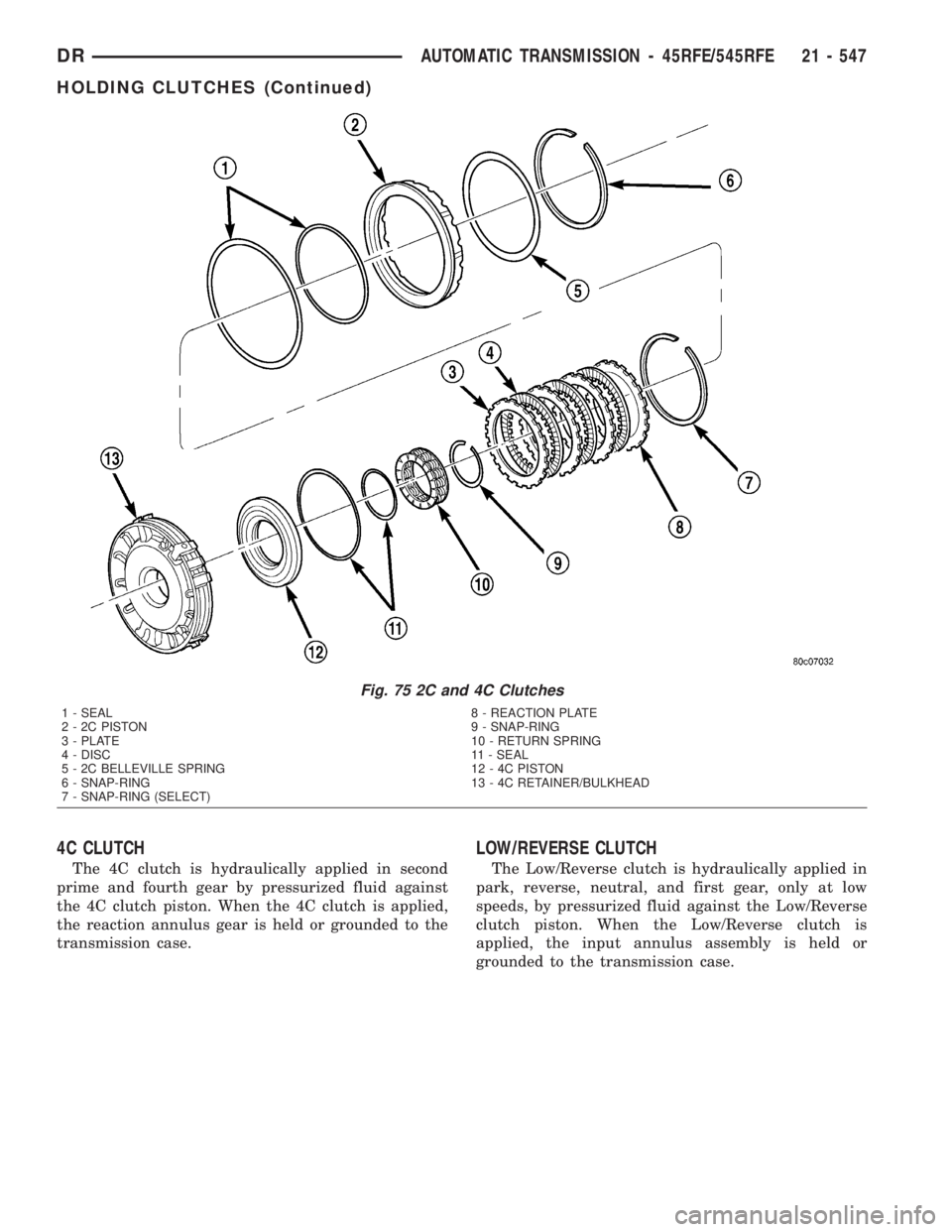
4C CLUTCH
The 4C clutch is hydraulically applied in second
prime and fourth gear by pressurized fluid against
the 4C clutch piston. When the 4C clutch is applied,
the reaction annulus gear is held or grounded to the
transmission case.
LOW/REVERSE CLUTCH
The Low/Reverse clutch is hydraulically applied in
park, reverse, neutral, and first gear, only at low
speeds, by pressurized fluid against the Low/Reverse
clutch piston. When the Low/Reverse clutch is
applied, the input annulus assembly is held or
grounded to the transmission case.
Fig. 75 2C and 4C Clutches
1 - SEAL 8 - REACTION PLATE
2 - 2C PISTON 9 - SNAP-RING
3 - PLATE 10 - RETURN SPRING
4 - DISC 11 - SEAL
5 - 2C BELLEVILLE SPRING 12 - 4C PISTON
6 - SNAP-RING 13 - 4C RETAINER/BULKHEAD
7 - SNAP-RING (SELECT)
DRAUTOMATIC TRANSMISSION - 45RFE/545RFE 21 - 547
HOLDING CLUTCHES (Continued)
Page 2388 of 2895
INPUT CLUTCH ASSEMBLY
DESCRIPTION
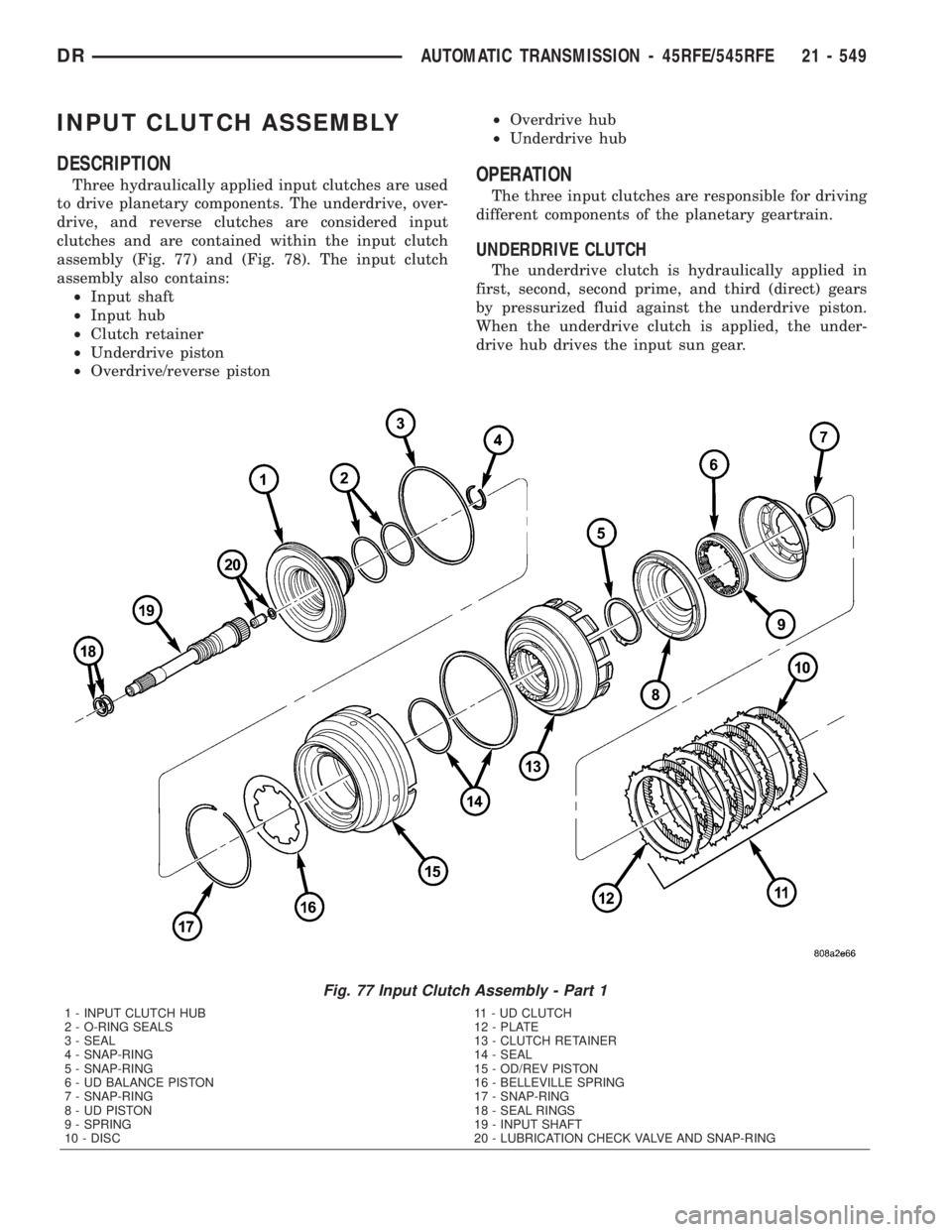
Three hydraulically applied input clutches are used
to drive planetary components. The underdrive, over-
drive, and reverse clutches are considered input
clutches and are contained within the input clutch
assembly (Fig. 77) and (Fig. 78). The input clutch
assembly also contains:
²Input shaft
²Input hub
²Clutch retainer
²Underdrive piston
²Overdrive/reverse piston²Overdrive hub
²Underdrive hubOPERATION
The three input clutches are responsible for driving
different components of the planetary geartrain.
UNDERDRIVE CLUTCH
The underdrive clutch is hydraulically applied in
first, second, second prime, and third (direct) gears
by pressurized fluid against the underdrive piston.
When the underdrive clutch is applied, the under-
drive hub drives the input sun gear.
Fig. 77 Input Clutch Assembly - Part 1
1 - INPUT CLUTCH HUB 11 - UD CLUTCH
2 - O-RING SEALS 12 - PLATE
3 - SEAL 13 - CLUTCH RETAINER
4 - SNAP-RING 14 - SEAL
5 - SNAP-RING 15 - OD/REV PISTON
6 - UD BALANCE PISTON 16 - BELLEVILLE SPRING
7 - SNAP-RING 17 - SNAP-RING
8 - UD PISTON 18 - SEAL RINGS
9 - SPRING 19 - INPUT SHAFT
10 - DISC 20 - LUBRICATION CHECK VALVE AND SNAP-RING
DRAUTOMATIC TRANSMISSION - 45RFE/545RFE 21 - 549
Page 2389 of 2895
OVERDRIVE CLUTCH
The overdrive clutch is hydraulically applied in
third (direct), fourth, and fifth gears by pressurized
fluid against the overdrive/reverse piston. When the
overdrive clutch is applied, the overdrive hub drives
the reverse carrier/input annulus assembly.
REVERSE CLUTCH
The reverse clutch is hydraulically applied in
reverse gear by pressurized fluid against the over-
drive/reverse piston. When the reverse clutch is
applied, the reaction annulus gear is driven.
DISASSEMBLY
(1) Remove the reverse reaction plate selective
snap-ring from the input clutch retainer (Fig. 79).
(2) Remove the reverse reaction plate from the
input clutch retainer.
(3) Remove the reverse hub and reverse clutch
pack from the input clutch retainer.
(4) Remove the number 4 bearing from the over-
drive hub.
(5) Remove the overdrive hub from the input
clutch retainer (Fig. 79).
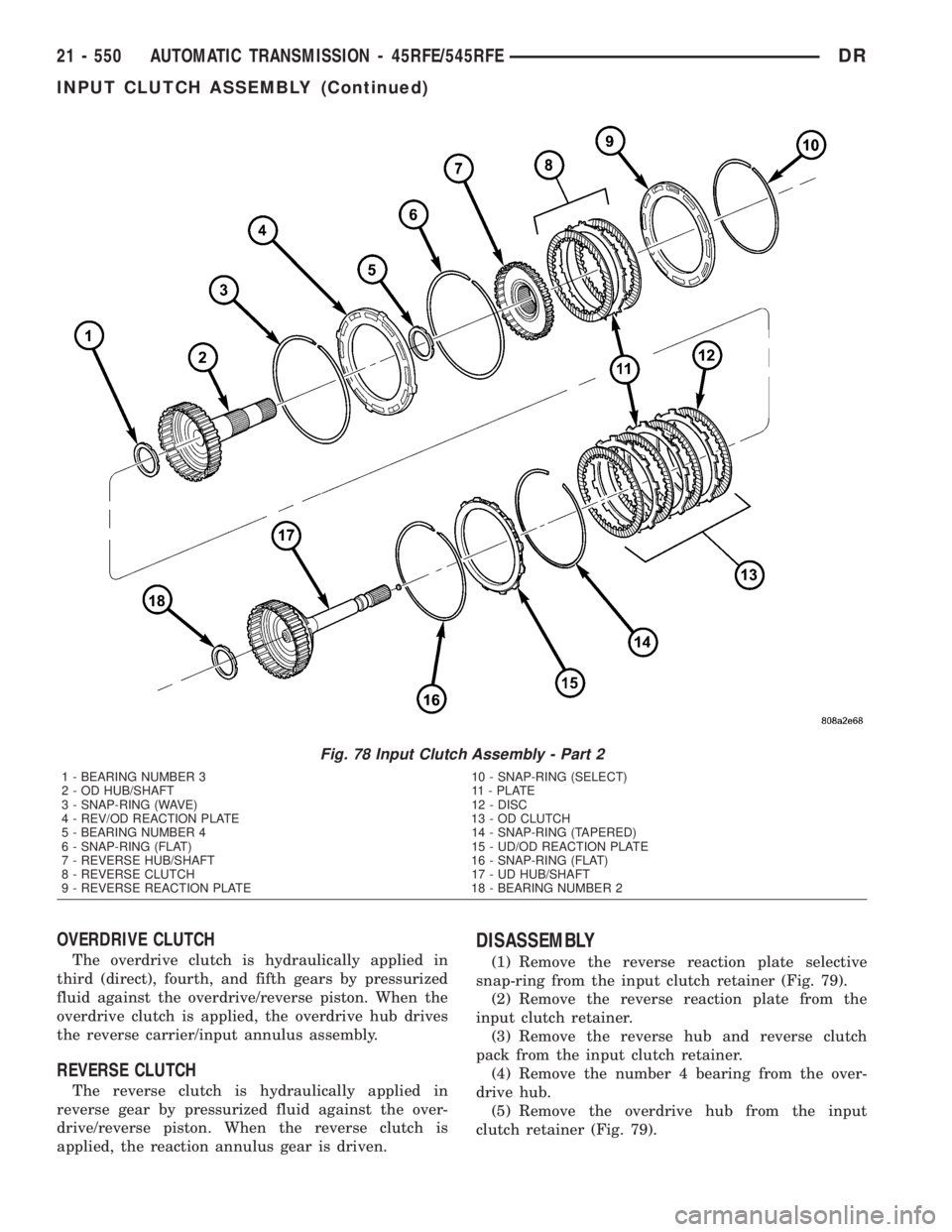
Fig. 78 Input Clutch Assembly - Part 2
1 - BEARING NUMBER 3 10 - SNAP-RING (SELECT)
2 - OD HUB/SHAFT 11 - PLATE
3 - SNAP-RING (WAVE) 12 - DISC
4 - REV/OD REACTION PLATE 13 - OD CLUTCH
5 - BEARING NUMBER 4 14 - SNAP-RING (TAPERED)
6 - SNAP-RING (FLAT) 15 - UD/OD REACTION PLATE
7 - REVERSE HUB/SHAFT 16 - SNAP-RING (FLAT)
8 - REVERSE CLUTCH 17 - UD HUB/SHAFT
9 - REVERSE REACTION PLATE 18 - BEARING NUMBER 2
21 - 550 AUTOMATIC TRANSMISSION - 45RFE/545RFEDR
INPUT CLUTCH ASSEMBLY (Continued)
Page 2396 of 2895
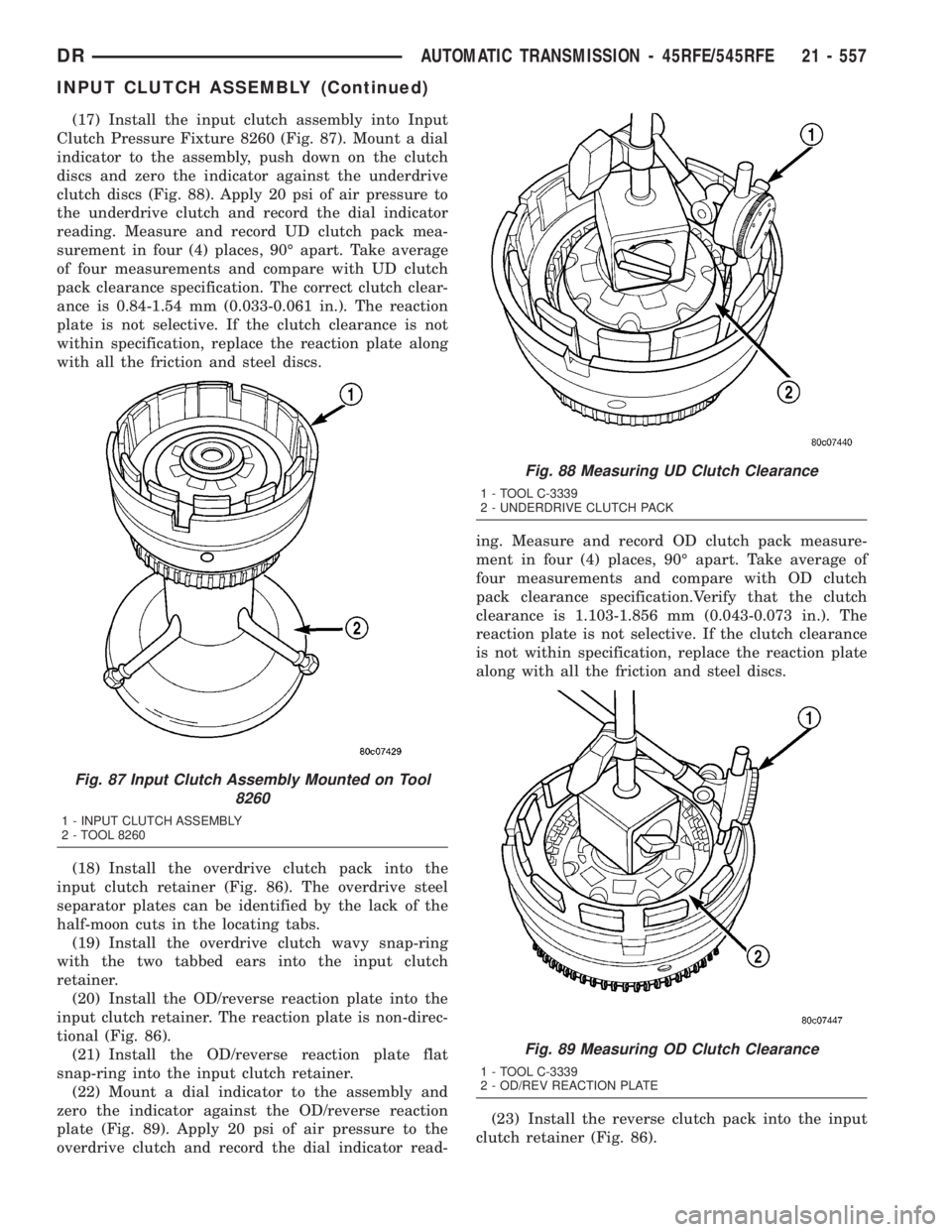
(17) Install the input clutch assembly into Input
Clutch Pressure Fixture 8260 (Fig. 87). Mount a dial
indicator to the assembly, push down on the clutch
discs and zero the indicator against the underdrive
clutch discs (Fig. 88). Apply 20 psi of air pressure to
the underdrive clutch and record the dial indicator
reading. Measure and record UD clutch pack mea-
surement in four (4) places, 90É apart. Take average
of four measurements and compare with UD clutch
pack clearance specification. The correct clutch clear-
ance is 0.84-1.54 mm (0.033-0.061 in.). The reaction
plate is not selective. If the clutch clearance is not
within specification, replace the reaction plate along
with all the friction and steel discs.
(18) Install the overdrive clutch pack into the
input clutch retainer (Fig. 86). The overdrive steel
separator plates can be identified by the lack of the
half-moon cuts in the locating tabs.
(19) Install the overdrive clutch wavy snap-ring
with the two tabbed ears into the input clutch
retainer.
(20) Install the OD/reverse reaction plate into the
input clutch retainer. The reaction plate is non-direc-
tional (Fig. 86).
(21) Install the OD/reverse reaction plate flat
snap-ring into the input clutch retainer.
(22) Mount a dial indicator to the assembly and
zero the indicator against the OD/reverse reaction
plate (Fig. 89). Apply 20 psi of air pressure to the
overdrive clutch and record the dial indicator read-ing. Measure and record OD clutch pack measure-
ment in four (4) places, 90É apart. Take average of
four measurements and compare with OD clutch
pack clearance specification.Verify that the clutch
clearance is 1.103-1.856 mm (0.043-0.073 in.). The
reaction plate is not selective. If the clutch clearance
is not within specification, replace the reaction plate
along with all the friction and steel discs.
(23) Install the reverse clutch pack into the input
clutch retainer (Fig. 86).
Fig. 87 Input Clutch Assembly Mounted on Tool
8260
1 - INPUT CLUTCH ASSEMBLY
2 - TOOL 8260
Fig. 88 Measuring UD Clutch Clearance
1 - TOOL C-3339
2 - UNDERDRIVE CLUTCH PACK
Fig. 89 Measuring OD Clutch Clearance
1 - TOOL C-3339
2 - OD/REV REACTION PLATE
DRAUTOMATIC TRANSMISSION - 45RFE/545RFE 21 - 557
INPUT CLUTCH ASSEMBLY (Continued)
Page 2397 of 2895
(24) Install the reverse reaction plate into the
input clutch retainer.
(25) Install the reverse reaction plate selective
snap-ring into the input clutch retainer.
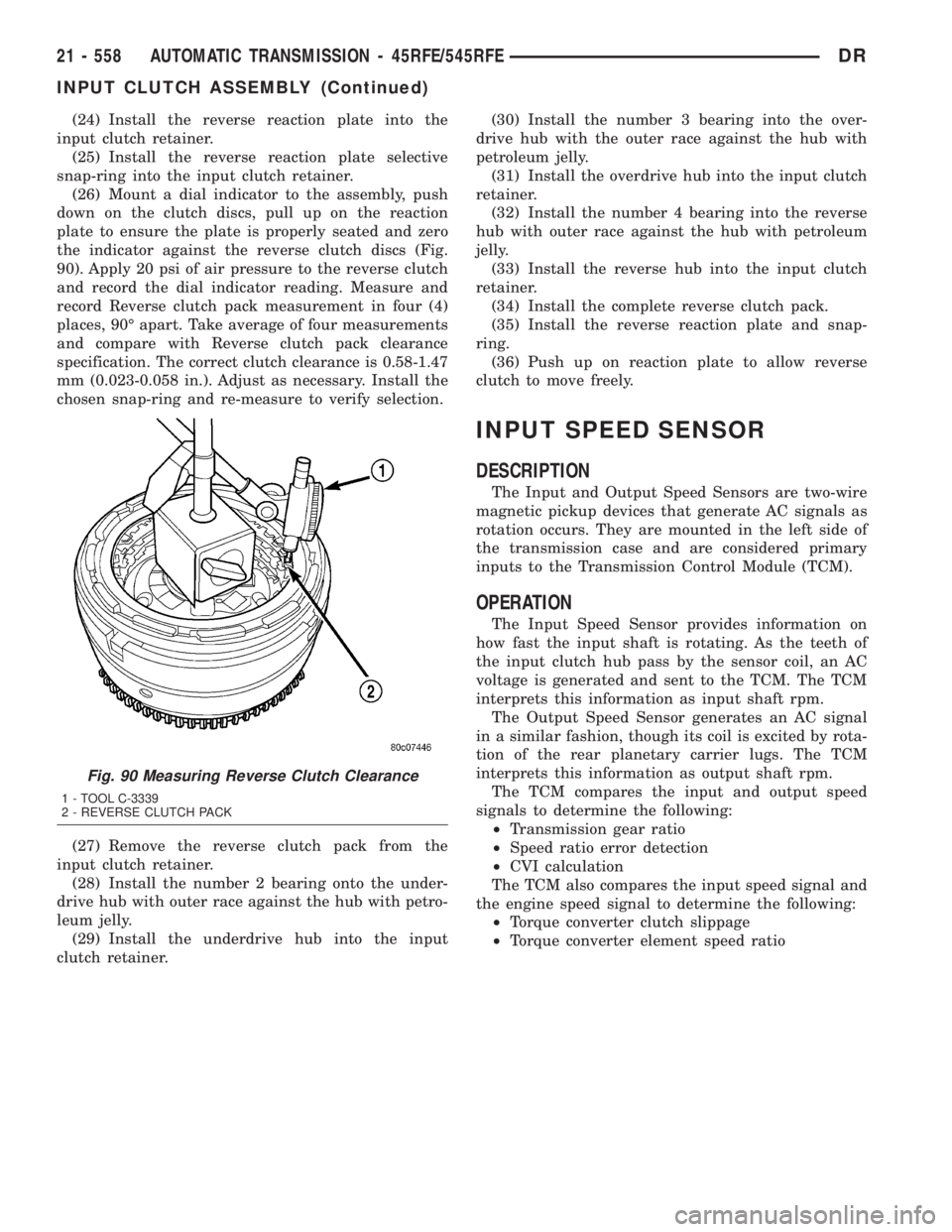
(26) Mount a dial indicator to the assembly, push
down on the clutch discs, pull up on the reaction
plate to ensure the plate is properly seated and zero
the indicator against the reverse clutch discs (Fig.
90). Apply 20 psi of air pressure to the reverse clutch
and record the dial indicator reading. Measure and
record Reverse clutch pack measurement in four (4)
places, 90É apart. Take average of four measurements
and compare with Reverse clutch pack clearance
specification. The correct clutch clearance is 0.58-1.47
mm (0.023-0.058 in.). Adjust as necessary. Install the
chosen snap-ring and re-measure to verify selection.
(27) Remove the reverse clutch pack from the
input clutch retainer.
(28) Install the number 2 bearing onto the under-
drive hub with outer race against the hub with petro-
leum jelly.
(29) Install the underdrive hub into the input
clutch retainer.(30) Install the number 3 bearing into the over-
drive hub with the outer race against the hub with
petroleum jelly.
(31) Install the overdrive hub into the input clutch
retainer.
(32) Install the number 4 bearing into the reverse
hub with outer race against the hub with petroleum
jelly.
(33) Install the reverse hub into the input clutch
retainer.
(34) Install the complete reverse clutch pack.
(35) Install the reverse reaction plate and snap-
ring.
(36) Push up on reaction plate to allow reverse
clutch to move freely.
INPUT SPEED SENSOR
DESCRIPTION
The Input and Output Speed Sensors are two-wire
magnetic pickup devices that generate AC signals as
rotation occurs. They are mounted in the left side of
the transmission case and are considered primary
inputs to the Transmission Control Module (TCM).
OPERATION
The Input Speed Sensor provides information on
how fast the input shaft is rotating. As the teeth of
the input clutch hub pass by the sensor coil, an AC
voltage is generated and sent to the TCM. The TCM
interprets this information as input shaft rpm.
The Output Speed Sensor generates an AC signal
in a similar fashion, though its coil is excited by rota-
tion of the rear planetary carrier lugs. The TCM
interprets this information as output shaft rpm.
The TCM compares the input and output speed
signals to determine the following:
²Transmission gear ratio
²Speed ratio error detection
²CVI calculation
The TCM also compares the input speed signal and
the engine speed signal to determine the following:
²Torque converter clutch slippage
²Torque converter element speed ratio
Fig. 90 Measuring Reverse Clutch Clearance
1 - TOOL C-3339
2 - REVERSE CLUTCH PACK
21 - 558 AUTOMATIC TRANSMISSION - 45RFE/545RFEDR
INPUT CLUTCH ASSEMBLY (Continued)
Page 2406 of 2895
into the appropriate oil pump valve body bore (Fig.
102) (Fig. 103).
(4) Place the separator plate onto the oil pump
body (Fig. 101).
(5) Install the screws to hold the separator plate
onto the oil pump body (Fig. 101). Tighten the screws
to 4.5 N´m (40 in.lbs.).
(6) Position the oil pump cover onto the locating
dowels (Fig. 100).
(7) Seat the two oil pump halves together and
install all bolts finger tight.
(8) Torque all bolts down slowly starting in the
center and working outward. The correct torque is
4.5 N´m (40 in.lbs.).
(9) Verify that the oil pump gears rotate freely and
smoothly.
(10) Position the reaction shaft support into the oil
pump (Fig. 100).
(11) Install and torque the bolts to hold the reac-
tion shaft support to the oil pump (Fig. 100). The cor-
rect torque is 12 N´m (105 in.lbs.).
OIL PUMP FRONT SEAL
REMOVAL
(1) Remove transmission from the vehicle.
(2) Remove the torque converter from the trans-
mission.
(3) Using a screw mounted in a slide hammer,
remove the oil pump front seal.
INSTALLATION
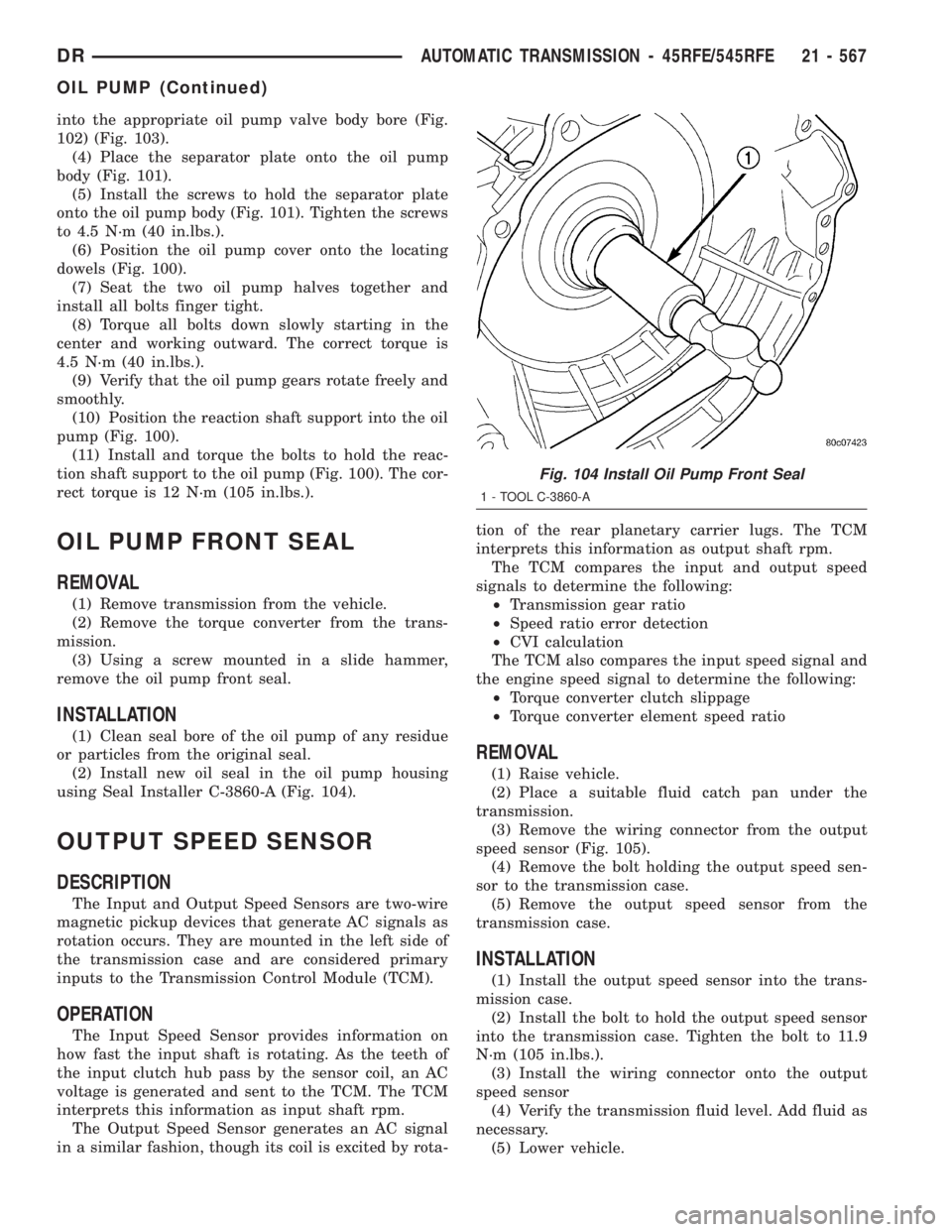
(1) Clean seal bore of the oil pump of any residue
or particles from the original seal.
(2) Install new oil seal in the oil pump housing
using Seal Installer C-3860-A (Fig. 104).
OUTPUT SPEED SENSOR
DESCRIPTION
The Input and Output Speed Sensors are two-wire
magnetic pickup devices that generate AC signals as
rotation occurs. They are mounted in the left side of
the transmission case and are considered primary
inputs to the Transmission Control Module (TCM).
OPERATION
The Input Speed Sensor provides information on
how fast the input shaft is rotating. As the teeth of
the input clutch hub pass by the sensor coil, an AC
voltage is generated and sent to the TCM. The TCM
interprets this information as input shaft rpm.
The Output Speed Sensor generates an AC signal
in a similar fashion, though its coil is excited by rota-tion of the rear planetary carrier lugs. The TCM
interprets this information as output shaft rpm.
The TCM compares the input and output speed
signals to determine the following:
²Transmission gear ratio
²Speed ratio error detection
²CVI calculation
The TCM also compares the input speed signal and
the engine speed signal to determine the following:
²Torque converter clutch slippage
²Torque converter element speed ratio
REMOVAL
(1) Raise vehicle.
(2) Place a suitable fluid catch pan under the
transmission.
(3) Remove the wiring connector from the output
speed sensor (Fig. 105).
(4) Remove the bolt holding the output speed sen-
sor to the transmission case.
(5) Remove the output speed sensor from the
transmission case.
INSTALLATION
(1) Install the output speed sensor into the trans-
mission case.
(2) Install the bolt to hold the output speed sensor
into the transmission case. Tighten the bolt to 11.9
N´m (105 in.lbs.).
(3) Install the wiring connector onto the output
speed sensor
(4) Verify the transmission fluid level. Add fluid as
necessary.
(5) Lower vehicle.
Fig. 104 Install Oil Pump Front Seal
1 - TOOL C-3860-A
DRAUTOMATIC TRANSMISSION - 45RFE/545RFE 21 - 567
OIL PUMP (Continued)
Page 2408 of 2895
INSTALLATION
NOTE: There is enough slack in the wire to pull out
the connector from the lever.
(1) Pull the connector out of the lever just enough
to grasp it.
CAUTION: Be careful not to bend the pins on the
overdrive off switch. Use care when installing the
switch, as it is not indexed, and can be accidentally
installed incorrectly.
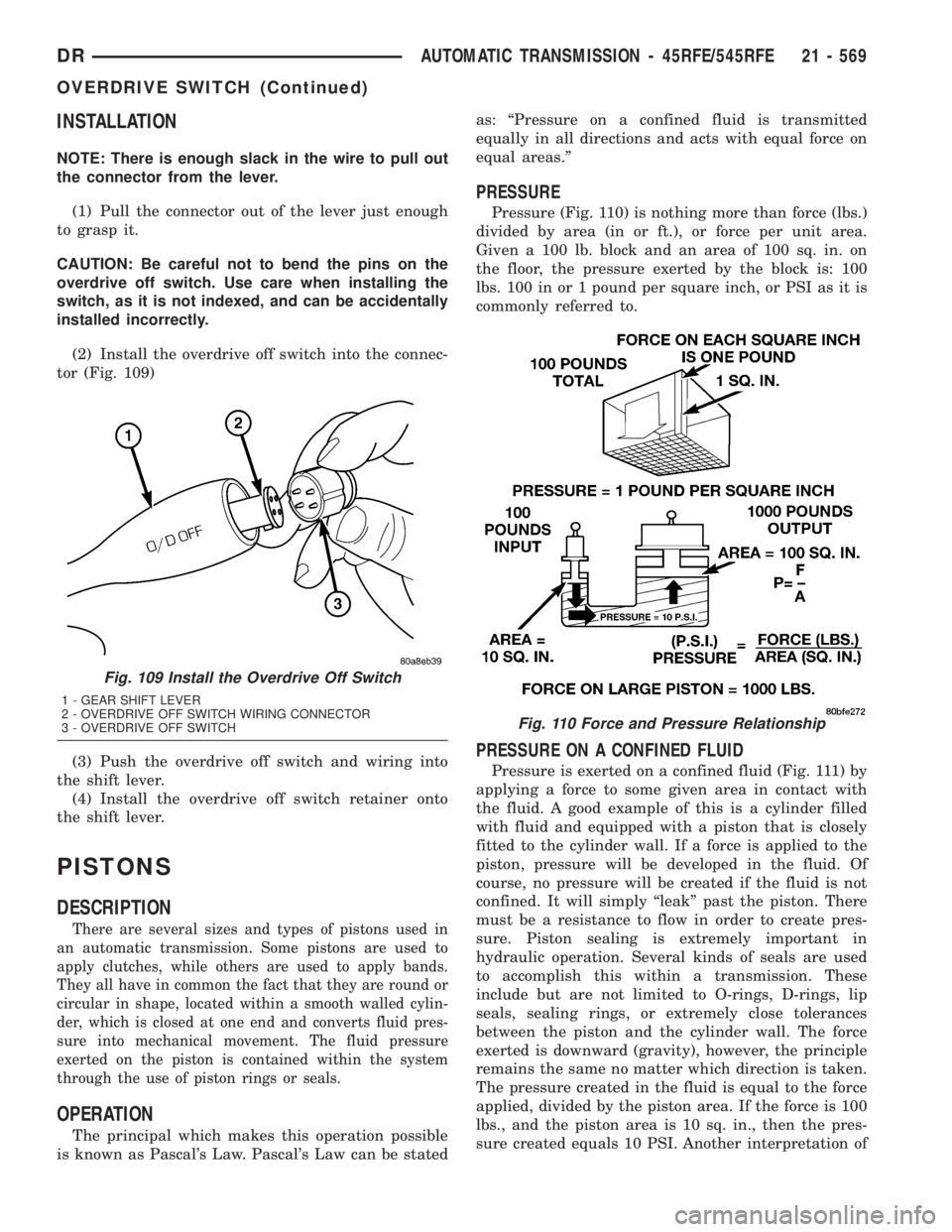
(2) Install the overdrive off switch into the connec-
tor (Fig. 109)
(3) Push the overdrive off switch and wiring into
the shift lever.
(4) Install the overdrive off switch retainer onto
the shift lever.
PISTONS
DESCRIPTION
There are several sizes and types of pistons used in
an automatic transmission. Some pistons are used to
apply clutches, while others are used to apply bands.
They all have in common the fact that they are round or
circular in shape, located within a smooth walled cylin-
der, which is closed at one end and converts fluid pres-
sure into mechanical movement. The fluid pressure
exerted on the piston is contained within the system
through the use of piston rings or seals.
OPERATION
The principal which makes this operation possible
is known as Pascal's Law. Pascal's Law can be statedas: ªPressure on a confined fluid is transmitted
equally in all directions and acts with equal force on
equal areas.º
PRESSURE
Pressure (Fig. 110) is nothing more than force (lbs.)
divided by area (in or ft.), or force per unit area.
Given a 100 lb. block and an area of 100 sq. in. on
the floor, the pressure exerted by the block is: 100
lbs. 100 in or 1 pound per square inch, or PSI as it is
commonly referred to.
PRESSURE ON A CONFINED FLUID
Pressure is exerted on a confined fluid (Fig. 111) by
applying a force to some given area in contact with
the fluid. A good example of this is a cylinder filled
with fluid and equipped with a piston that is closely
fitted to the cylinder wall. If a force is applied to the
piston, pressure will be developed in the fluid. Of
course, no pressure will be created if the fluid is not
confined. It will simply ªleakº past the piston. There
must be a resistance to flow in order to create pres-
sure. Piston sealing is extremely important in
hydraulic operation. Several kinds of seals are used
to accomplish this within a transmission. These
include but are not limited to O-rings, D-rings, lip
seals, sealing rings, or extremely close tolerances
between the piston and the cylinder wall. The force
exerted is downward (gravity), however, the principle
remains the same no matter which direction is taken.
The pressure created in the fluid is equal to the force
applied, divided by the piston area. If the force is 100
lbs., and the piston area is 10 sq. in., then the pres-
sure created equals 10 PSI. Another interpretation of
Fig. 109 Install the Overdrive Off Switch
1 - GEAR SHIFT LEVER
2 - OVERDRIVE OFF SWITCH WIRING CONNECTOR
3 - OVERDRIVE OFF SWITCH
Fig. 110 Force and Pressure Relationship
DRAUTOMATIC TRANSMISSION - 45RFE/545RFE 21 - 569
OVERDRIVE SWITCH (Continued)
Page 2409 of 2895
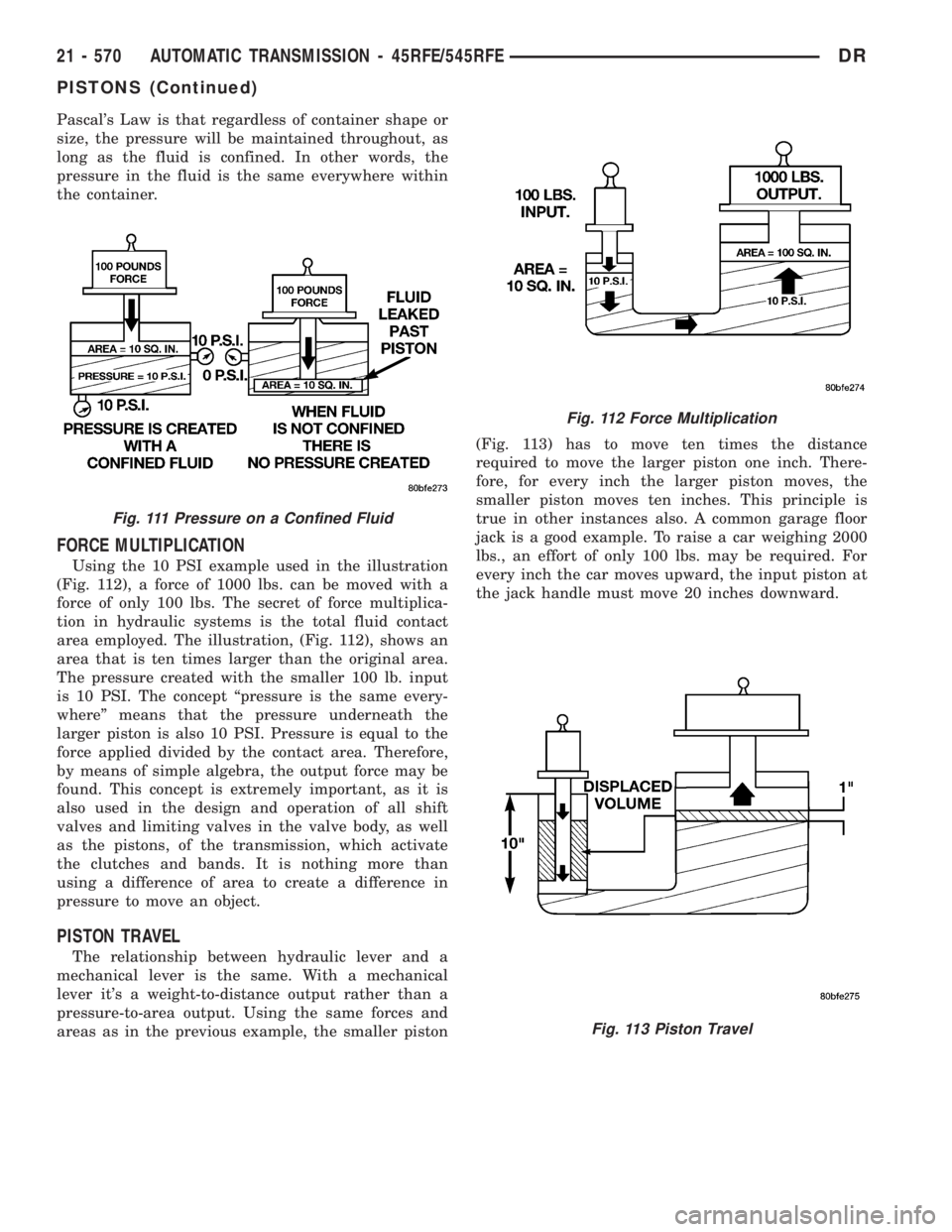
Pascal's Law is that regardless of container shape or
size, the pressure will be maintained throughout, as
long as the fluid is confined. In other words, the
pressure in the fluid is the same everywhere within
the container.
FORCE MULTIPLICATION
Using the 10 PSI example used in the illustration
(Fig. 112), a force of 1000 lbs. can be moved with a
force of only 100 lbs. The secret of force multiplica-
tion in hydraulic systems is the total fluid contact
area employed. The illustration, (Fig. 112), shows an
area that is ten times larger than the original area.
The pressure created with the smaller 100 lb. input
is 10 PSI. The concept ªpressure is the same every-
whereº means that the pressure underneath the
larger piston is also 10 PSI. Pressure is equal to the
force applied divided by the contact area. Therefore,
by means of simple algebra, the output force may be
found. This concept is extremely important, as it is
also used in the design and operation of all shift
valves and limiting valves in the valve body, as well
as the pistons, of the transmission, which activate
the clutches and bands. It is nothing more than
using a difference of area to create a difference in
pressure to move an object.
PISTON TRAVEL
The relationship between hydraulic lever and a
mechanical lever is the same. With a mechanical
lever it's a weight-to-distance output rather than a
pressure-to-area output. Using the same forces and
areas as in the previous example, the smaller piston(Fig. 113) has to move ten times the distance
required to move the larger piston one inch. There-
fore, for every inch the larger piston moves, the
smaller piston moves ten inches. This principle is
true in other instances also. A common garage floor
jack is a good example. To raise a car weighing 2000
lbs., an effort of only 100 lbs. may be required. For
every inch the car moves upward, the input piston at
the jack handle must move 20 inches downward.
Fig. 111 Pressure on a Confined Fluid
Fig. 112 Force Multiplication
Fig. 113 Piston Travel
21 - 570 AUTOMATIC TRANSMISSION - 45RFE/545RFEDR
PISTONS (Continued)