2003 DODGE RAM battery
[x] Cancel search: batteryPage 657 of 2895

WARNING: THE SIDE IMPACT AIRBAG CONTROL
MODULE CONTAINS THE IMPACT SENSOR, WHICH
ENABLES THE SYSTEM TO DEPLOY THE SIDE
CURTAIN AIRBAGS. NEVER STRIKE OR DROP THE
SIDE IMPACT AIRBAG CONTROL MODULE, AS IT
CAN DAMAGE THE IMPACT SENSOR OR AFFECT
ITS CALIBRATION. IF A SIDE IMPACT AIRBAG CON-
TROL MODULE IS ACCIDENTALLY DROPPED DUR-
ING SERVICE, THE MODULE MUST BE SCRAPPED
AND REPLACED WITH A NEW UNIT. FAILURE TO
OBSERVE THIS WARNING COULD RESULT IN ACCI-
DENTAL, INCOMPLETE, OR IMPROPER SIDE CUR-
TAIN AIRBAG DEPLOYMENT AND POSSIBLE
OCCUPANT INJURIES.
(1) Adjust the front seat to its most forward posi-
tion for easiest access to the lower B-pillar trim.
(2) Disconnect and isolate the battery negative
cable. Wait two minutes for the system capacitor to
discharge before further service.
(3) Remove the front outboard seat belt and retrac-
tor from the inside of the B-pillar. (Refer to 8 -
ELECTRICAL/RESTRAINTS/FRONT OUTBOARD
SEAT BELT & RETRACTOR - REMOVAL - QUAD
CAB).
(4) Remove the four screws that secure the Side
Impact Airbag Control Module (SIACM) mounting
bracket to the inside of the B-pillar (Fig. 52).(5) Reach through the retractor mounting hole in
the inner B-pillar to access the SIACM and lift it
upward far enough to disengage the hook on the
mounting bracket from the slot on the inner B-pillar.
(6) Pull the SIACM and mounting bracket out
through the retractor mounting hole far enough to
access and disconnect the body wire harness connec-
tor for the SIACM from the module connector recep-
tacle.
(7) Remove the SIACM and its mounting bracket
from the B-pillar as a unit.
INSTALLATION
INSTALLATION
WARNING: ON VEHICLES EQUIPPED WITH AIR-
BAGS, DISABLE THE SUPPLEMENTAL RESTRAINT
SYSTEM BEFORE ATTEMPTING ANY STEERING
WHEEL, STEERING COLUMN, DRIVER AIRBAG,
PASSENGER AIRBAG, SEAT BELT TENSIONER,
SIDE CURTAIN AIRBAG, OR INSTRUMENT PANEL
COMPONENT DIAGNOSIS OR SERVICE. DISCON-
NECT AND ISOLATE THE BATTERY NEGATIVE
(GROUND) CABLE, THEN WAIT TWO MINUTES FOR
THE SYSTEM CAPACITOR TO DISCHARGE BEFORE
PERFORMING FURTHER DIAGNOSIS OR SERVICE.
THIS IS THE ONLY SURE WAY TO DISABLE THE
SUPPLEMENTAL RESTRAINT SYSTEM. FAILURE TO
TAKE THE PROPER PRECAUTIONS COULD
RESULT IN ACCIDENTAL AIRBAG DEPLOYMENT
AND POSSIBLE PERSONAL INJURY.
WARNING: THE SIDE IMPACT AIRBAG CONTROL
MODULE CONTAINS THE IMPACT SENSOR, WHICH
ENABLES THE SYSTEM TO DEPLOY THE SIDE
CURTAIN AIRBAGS. NEVER STRIKE OR DROP THE
SIDE IMPACT AIRBAG CONTROL MODULE, AS IT
CAN DAMAGE THE IMPACT SENSOR OR AFFECT
ITS CALIBRATION. IF A SIDE IMPACT AIRBAG CON-
TROL MODULE IS ACCIDENTALLY DROPPED DUR-
ING SERVICE, THE MODULE MUST BE SCRAPPED
AND REPLACED WITH A NEW UNIT. FAILURE TO
OBSERVE THIS WARNING COULD RESULT IN ACCI-
DENTAL, INCOMPLETE, OR IMPROPER SIDE CUR-
TAIN AIRBAG DEPLOYMENT AND POSSIBLE
OCCUPANT INJURIES.
(1) Position the Side Impact Airbag Control Mod-
ule (SIACM) and its mounting bracket to the B-pillar
as a unit (Fig. 51).
(2) Reconnect the body wire harness connector for
the SIACM to the module connector receptacle.
(3) Reach through the retractor mounting hole in
the inner B-pillar to position and engage the two
Fig. 52 Side Impact Airbag Control Module
Remove/Install - Quad Cab
1 - B-PILLAR
2 - WIRE HARNESS CONNECTOR
3 - SCREW (4)
4 - HOOK
5 - BRACKET
6 - SIACM
7 - SLOT
8O - 56 RESTRAINTSDR
SIDE IMPACT AIRBAG CONTROL MODULE (Continued)
Page 658 of 2895

plastic push-in fasteners that secure the SIACM to
the inside of the B-pillar.
(4) Loosely install the four screws that secure the
SIACM mounting bracket to the base of the B-pillar.
(5) Tighten the four screws that secure the SIACM
mounting bracket to the B-pillar in the following
sequence: upper left, lower right, lower left, upper
right. Tighten the screws to 12 N´m (105 in. lbs.).
(6) Reinstall the front outboard seat belt and
retractor to the inside of the B-pillar. (Refer to 8 -
ELECTRICAL/RESTRAINTS/FRONT OUTBOARD
SEAT BELT & RETRACTOR - INSTALLATION -
STANDARD CAB).
(7) Do not reconnect the battery negative cable at
this time. The supplemental restraint system verifi-
cation test procedure should be performed following
service of any supplemental restraint system compo-
nent. (Refer to 8 - ELECTRICAL/RESTRAINTS -
STANDARD PROCEDURE - VERIFICATION TEST).
INSTALLATION
WARNING: ON VEHICLES EQUIPPED WITH AIR-
BAGS, DISABLE THE SUPPLEMENTAL RESTRAINT
SYSTEM BEFORE ATTEMPTING ANY STEERING
WHEEL, STEERING COLUMN, DRIVER AIRBAG,
PASSENGER AIRBAG, SEAT BELT TENSIONER,
SIDE CURTAIN AIRBAG, OR INSTRUMENT PANEL
COMPONENT DIAGNOSIS OR SERVICE. DISCON-
NECT AND ISOLATE THE BATTERY NEGATIVE
(GROUND) CABLE, THEN WAIT TWO MINUTES FOR
THE SYSTEM CAPACITOR TO DISCHARGE BEFORE
PERFORMING FURTHER DIAGNOSIS OR SERVICE.
THIS IS THE ONLY SURE WAY TO DISABLE THE
SUPPLEMENTAL RESTRAINT SYSTEM. FAILURE TO
TAKE THE PROPER PRECAUTIONS COULD
RESULT IN ACCIDENTAL AIRBAG DEPLOYMENT
AND POSSIBLE PERSONAL INJURY.
WARNING: THE SIDE IMPACT AIRBAG CONTROL
MODULE CONTAINS THE IMPACT SENSOR, WHICHENABLES THE SYSTEM TO DEPLOY THE SIDE
CURTAIN AIRBAGS. NEVER STRIKE OR DROP THE
SIDE IMPACT AIRBAG CONTROL MODULE, AS IT
CAN DAMAGE THE IMPACT SENSOR OR AFFECT
ITS CALIBRATION. IF A SIDE IMPACT AIRBAG CON-
TROL MODULE IS ACCIDENTALLY DROPPED DUR-
ING SERVICE, THE MODULE MUST BE SCRAPPED
AND REPLACED WITH A NEW UNIT. FAILURE TO
OBSERVE THIS WARNING COULD RESULT IN ACCI-
DENTAL, INCOMPLETE, OR IMPROPER SIDE CUR-
TAIN AIRBAG DEPLOYMENT AND POSSIBLE
OCCUPANT INJURIES.
(1) Position the Side Impact Airbag Control Mod-
ule (SIACM) and its mounting bracket to the B-pillar
as a unit (Fig. 52).
(2) Reconnect the body wire harness connector for
the SIACM to the module connector receptacle.
(3) Reach through the retractor mounting hole in
the inner B-pillar to position and engage the hook on
the SIACM mounting bracket in the slot of the inner
B-pillar.
(4) Loosely install the four screws that secure the
SIACM mounting bracket to the inner B-pillar.
(5) Tighten the four screws that secure the SIACM
mounting bracket to the B-pillar in the following
sequence: upper left, lower right, lower left, upper
right. Tighten the screws to 12 N´m (105 in. lbs.).
(6) Reinstall the front outboard seat belt and
retractor to the inside of the B-pillar. (Refer to 8 -
ELECTRICAL/RESTRAINTS/FRONT OUTBOARD
SEAT BELT & RETRACTOR - INSTALLATION -
QUAD CAB).
(7) Do not reconnect the battery negative cable at
this time. The supplemental restraint system verifi-
cation test procedure should be performed following
service of any supplemental restraint system compo-
nent. (Refer to 8 - ELECTRICAL/RESTRAINTS -
STANDARD PROCEDURE - VERIFICATION TEST).
DRRESTRAINTS 8O - 57
SIDE IMPACT AIRBAG CONTROL MODULE (Continued)
Page 662 of 2895
5.9L Diesel Engines With Automatic Trans.
If equipped with a diesel powered engine and an
automatic transmission, an electric vacuum pump
and vacuum lines are used to supply vacuum to the
speed control servo. A vacuum reservoir is not used.
DIAGNOSIS AND TESTING - ROAD TEST
Perform a vehicle road test to verify reports of
speed control system malfunction. The road test
should include attention to the speedometer. Speed-
ometer operation should be smooth and without flut-
ter at all speeds.
Flutter in the speedometer indicates a problem
which might cause surging in the speed control sys-
tem. The cause of any speedometer problems should
be corrected before proceeding. Refer to Instrument
Cluster for speedometer diagnosis.
If a road test verifies a system problem and the
speedometer operates properly, check for:
²A Diagnostic Trouble Code (DTC). If a DTC
exists, conduct tests per the Powertrain Diagnostic
Procedures service manual.
²A misadjusted brake (stop) lamp switch. This
could also cause an intermittent problem.²Loose, damaged or corroded electrical connec-
tions at the servo (if used). Corrosion should be
removed from electrical terminals and a light coating
of Mopar MultiPurpose Grease, or equivalent,
applied.
²Leaking vacuum reservoir (if used).
²Loose or leaking vacuum hoses or connections (if
used).
²Defective one-way vacuum check valve (if used).
²Secure attachment of both ends of the speed con-
trol servo cable (if used).
²Smooth operation of throttle linkage (if used)
and throttle body air valve.
²Failed speed control servo (if used). Do the servo
vacuum test.
CAUTION: When test probing for voltage or conti-
nuity at electrical connectors, care must be taken
not to damage connector, terminals or seals. If
these components are damaged, intermittent or
complete system failure may occur.
SPECIFICATIONS
TORQUE - SPEED CONTROL
DESCRIPTION N-m Ft. Lbs. In. Lbs.
Servo Mounting Bracket-
to-Servo Nuts7-60
Servo Mounting Bracket-
to-Battery Tray Screws4-30
Speed Control Switch
Mounting Screws1.7 - 15
Vacuum Reservoir
Mounting Nuts3-20
CABLE
DESCRIPTION
The speed control servo cable is connected between
the speed control vacuum servo diaphragm and the
throttle body control linkage. This cable is used with
3.7L/4.7L/5.9L/8.0L gas powered engines only. It is
also used if equipped with a 5.9L diesel engine
equipped with an automatic transmission.
A speed control servo cableis not usedif equipped
with either a 5.9L diesel engine equipped with a
manual transmission, or any 5.7L engine/transmis-
sion combinations.
OPERATION
This cable causes the throttle control linkage to
open or close the throttle valve in response to move-
ment of the vacuum servo diaphragm.
REMOVAL
3.7L / 4.7L GAS
(1) Disconnect negative battery cable at battery.
(2) Remove air intake tube at top of throttle body.
The accelerator cable must be partially removed to
gain access to speed control cable.
DRSPEED CONTROL 8P - 3
SPEED CONTROL (Continued)
Page 663 of 2895
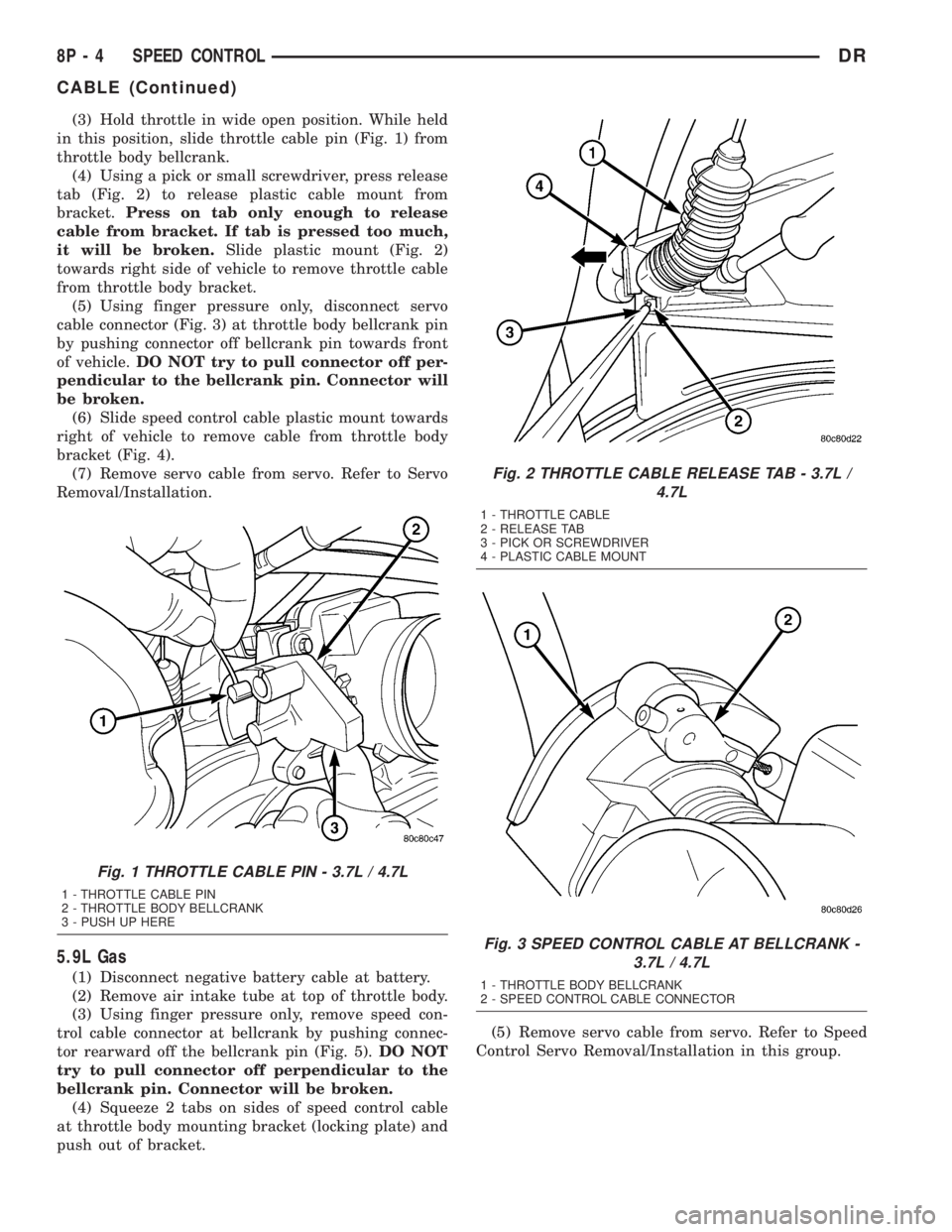
(3) Hold throttle in wide open position. While held
in this position, slide throttle cable pin (Fig. 1) from
throttle body bellcrank.
(4) Using a pick or small screwdriver, press release
tab (Fig. 2) to release plastic cable mount from
bracket.Press on tab only enough to release
cable from bracket. If tab is pressed too much,
it will be broken.Slide plastic mount (Fig. 2)
towards right side of vehicle to remove throttle cable
from throttle body bracket.
(5) Using finger pressure only, disconnect servo
cable connector (Fig. 3) at throttle body bellcrank pin
by pushing connector off bellcrank pin towards front
of vehicle.DO NOT try to pull connector off per-
pendicular to the bellcrank pin. Connector will
be broken.
(6) Slide speed control cable plastic mount towards
right of vehicle to remove cable from throttle body
bracket (Fig. 4).
(7) Remove servo cable from servo. Refer to Servo
Removal/Installation.
5.9L Gas
(1) Disconnect negative battery cable at battery.
(2) Remove air intake tube at top of throttle body.
(3) Using finger pressure only, remove speed con-
trol cable connector at bellcrank by pushing connec-
tor rearward off the bellcrank pin (Fig. 5).DO NOT
try to pull connector off perpendicular to the
bellcrank pin. Connector will be broken.
(4) Squeeze 2 tabs on sides of speed control cable
at throttle body mounting bracket (locking plate) and
push out of bracket.(5) Remove servo cable from servo. Refer to Speed
Control Servo Removal/Installation in this group.
Fig. 1 THROTTLE CABLE PIN - 3.7L / 4.7L
1 - THROTTLE CABLE PIN
2 - THROTTLE BODY BELLCRANK
3 - PUSH UP HERE
Fig. 2 THROTTLE CABLE RELEASE TAB - 3.7L /
4.7L
1 - THROTTLE CABLE
2 - RELEASE TAB
3 - PICK OR SCREWDRIVER
4 - PLASTIC CABLE MOUNT
Fig. 3 SPEED CONTROL CABLE AT BELLCRANK -
3.7L / 4.7L
1 - THROTTLE BODY BELLCRANK
2 - SPEED CONTROL CABLE CONNECTOR
8P - 4 SPEED CONTROLDR
CABLE (Continued)
Page 664 of 2895
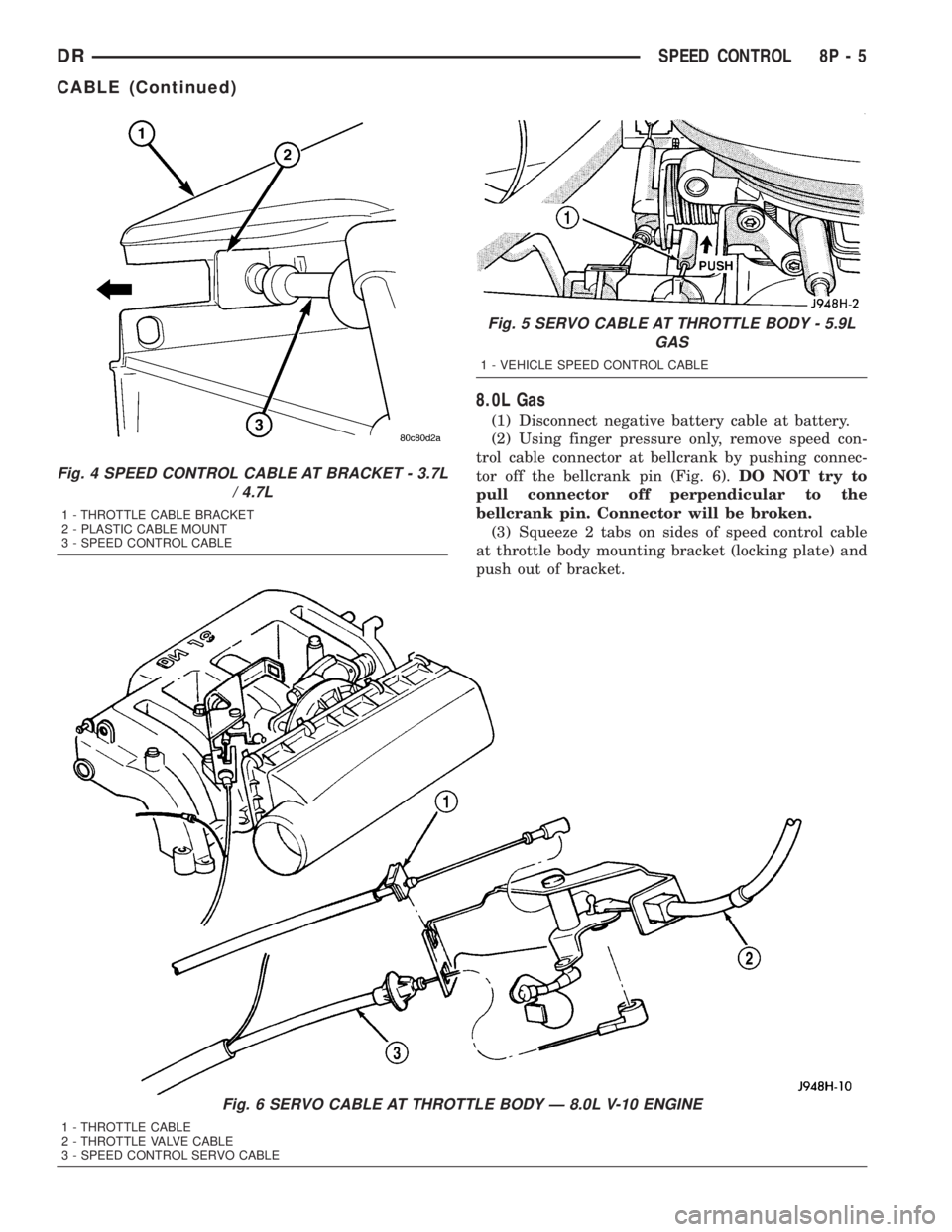
8.0L Gas
(1) Disconnect negative battery cable at battery.
(2) Using finger pressure only, remove speed con-
trol cable connector at bellcrank by pushing connec-
tor off the bellcrank pin (Fig. 6).DO NOT try to
pull connector off perpendicular to the
bellcrank pin. Connector will be broken.
(3) Squeeze 2 tabs on sides of speed control cable
at throttle body mounting bracket (locking plate) and
push out of bracket.
Fig. 6 SERVO CABLE AT THROTTLE BODY Ð 8.0L V-10 ENGINE
1 - THROTTLE CABLE
2 - THROTTLE VALVE CABLE
3 - SPEED CONTROL SERVO CABLE
Fig. 4 SPEED CONTROL CABLE AT BRACKET - 3.7L
/ 4.7L
1 - THROTTLE CABLE BRACKET
2 - PLASTIC CABLE MOUNT
3 - SPEED CONTROL CABLE
Fig. 5 SERVO CABLE AT THROTTLE BODY - 5.9L
GAS
1 - VEHICLE SPEED CONTROL CABLE
DRSPEED CONTROL 8P - 5
CABLE (Continued)
Page 665 of 2895
(4) Remove servo cable from servo. Refer to Speed
Control Servo Removal/Installation in this group.
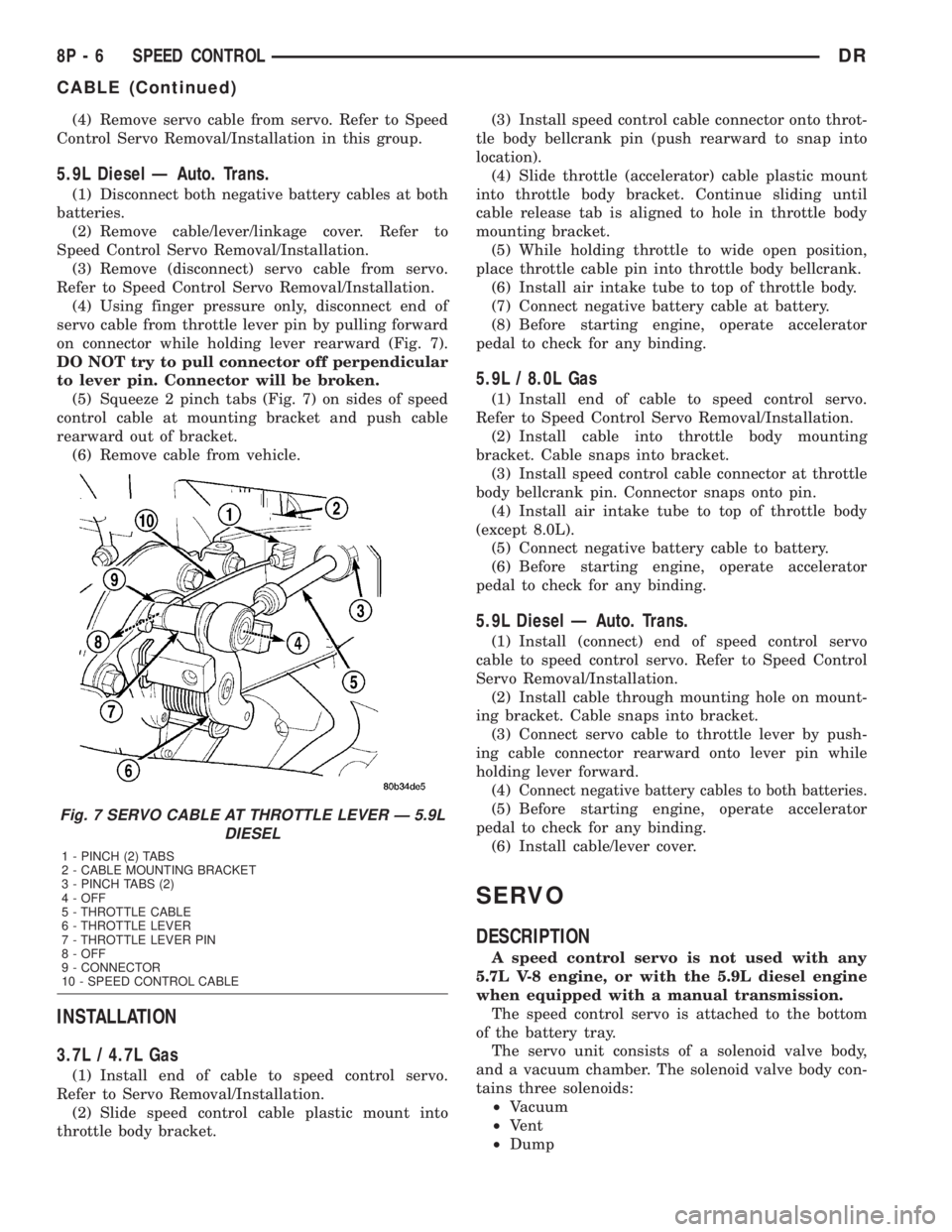
5.9L Diesel Ð Auto. Trans.
(1) Disconnect both negative battery cables at both
batteries.
(2) Remove cable/lever/linkage cover. Refer to
Speed Control Servo Removal/Installation.
(3) Remove (disconnect) servo cable from servo.
Refer to Speed Control Servo Removal/Installation.
(4) Using finger pressure only, disconnect end of
servo cable from throttle lever pin by pulling forward
on connector while holding lever rearward (Fig. 7).
DO NOT try to pull connector off perpendicular
to lever pin. Connector will be broken.
(5) Squeeze 2 pinch tabs (Fig. 7) on sides of speed
control cable at mounting bracket and push cable
rearward out of bracket.
(6) Remove cable from vehicle.
INSTALLATION
3.7L / 4.7L Gas
(1) Install end of cable to speed control servo.
Refer to Servo Removal/Installation.
(2) Slide speed control cable plastic mount into
throttle body bracket.(3) Install speed control cable connector onto throt-
tle body bellcrank pin (push rearward to snap into
location).
(4) Slide throttle (accelerator) cable plastic mount
into throttle body bracket. Continue sliding until
cable release tab is aligned to hole in throttle body
mounting bracket.
(5) While holding throttle to wide open position,
place throttle cable pin into throttle body bellcrank.
(6) Install air intake tube to top of throttle body.
(7) Connect negative battery cable at battery.
(8) Before starting engine, operate accelerator
pedal to check for any binding.
5.9L / 8.0L Gas
(1) Install end of cable to speed control servo.
Refer to Speed Control Servo Removal/Installation.
(2) Install cable into throttle body mounting
bracket. Cable snaps into bracket.
(3) Install speed control cable connector at throttle
body bellcrank pin. Connector snaps onto pin.
(4) Install air intake tube to top of throttle body
(except 8.0L).
(5) Connect negative battery cable to battery.
(6) Before starting engine, operate accelerator
pedal to check for any binding.
5.9L Diesel Ð Auto. Trans.
(1) Install (connect) end of speed control servo
cable to speed control servo. Refer to Speed Control
Servo Removal/Installation.
(2) Install cable through mounting hole on mount-
ing bracket. Cable snaps into bracket.
(3) Connect servo cable to throttle lever by push-
ing cable connector rearward onto lever pin while
holding lever forward.
(4)
Connect negative battery cables to both batteries.
(5) Before starting engine, operate accelerator
pedal to check for any binding.
(6) Install cable/lever cover.
SERVO
DESCRIPTION
A speed control servo is not used with any
5.7L V-8 engine, or with the 5.9L diesel engine
when equipped with a manual transmission.
The speed control servo is attached to the bottom
of the battery tray.
The servo unit consists of a solenoid valve body,
and a vacuum chamber. The solenoid valve body con-
tains three solenoids:
²Vacuum
²Vent
²Dump
Fig. 7 SERVO CABLE AT THROTTLE LEVER Ð 5.9L
DIESEL
1 - PINCH (2) TABS
2 - CABLE MOUNTING BRACKET
3 - PINCH TABS (2)
4 - OFF
5 - THROTTLE CABLE
6 - THROTTLE LEVER
7 - THROTTLE LEVER PIN
8 - OFF
9 - CONNECTOR
10 - SPEED CONTROL CABLE
8P - 6 SPEED CONTROLDR
CABLE (Continued)
Page 666 of 2895
The vacuum chamber contains a diaphragm with a
cable attached to control the throttle linkage.
OPERATION
A speed control servo is not used with any
5.7L V-8 engine, or with the 5.9L diesel engine
when equipped with a manual transmission.
The Powertrain Control Module (PCM) controls the
solenoid valve body. The solenoid valve body controls
the application and release of vacuum to the dia-
phragm of the vacuum servo. The servo unit cannot
be repaired and is serviced only as a complete assem-
bly.
Power is supplied to the servo's by the PCM
through the brake switch. The PCM controls the
ground path for the vacuum and vent solenoids.
The dump solenoid is energized anytime it receives
power. If power to the dump solenoid is interrupted,
the solenoid dumps vacuum in the servo. This pro-
vides a safety backup to the vent and vacuum sole-
noids.
The vacuum and vent solenoids must be grounded
at the PCM to operate. When the PCM grounds the
vacuum servo solenoid, the solenoid allows vacuum
to enter the servo and pull open the throttle plate
using the cable. When the PCM breaks the ground,
the solenoid closes and no more vacuum is allowed to
enter the servo. The PCM also operates the vent sole-
noid via ground. The vent solenoid opens and closes a
passage to bleed or hold vacuum in the servo as
required.
The PCM duty cycles the vacuum and vent sole-
noids to maintain the set speed, or to accelerate and
decelerate the vehicle. To increase throttle opening,
the PCM grounds the vacuum and vent solenoids. To
decrease throttle opening, the PCM removes the
grounds from the vacuum and vent solenoids. When
the brake is released, if vehicle speed exceeds 30
mph to resume, 35 mph to set, and the RES/ACCEL
switch has been depressed, ground for the vent and
vacuum circuits is restored.
REMOVAL
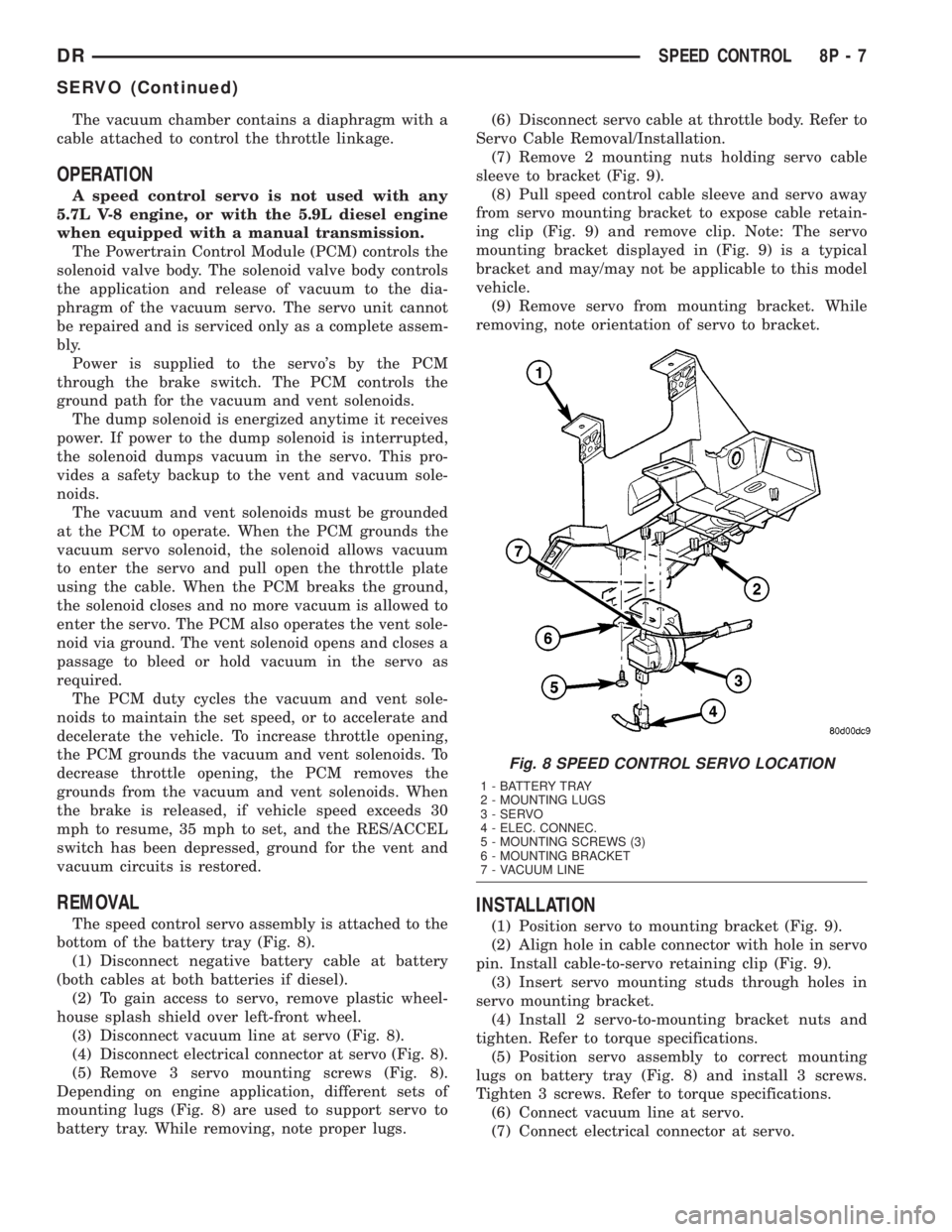
The speed control servo assembly is attached to the
bottom of the battery tray (Fig. 8).
(1) Disconnect negative battery cable at battery
(both cables at both batteries if diesel).
(2) To gain access to servo, remove plastic wheel-
house splash shield over left-front wheel.
(3) Disconnect vacuum line at servo (Fig. 8).
(4) Disconnect electrical connector at servo (Fig. 8).
(5) Remove 3 servo mounting screws (Fig. 8).
Depending on engine application, different sets of
mounting lugs (Fig. 8) are used to support servo to
battery tray. While removing, note proper lugs.(6) Disconnect servo cable at throttle body. Refer to
Servo Cable Removal/Installation.
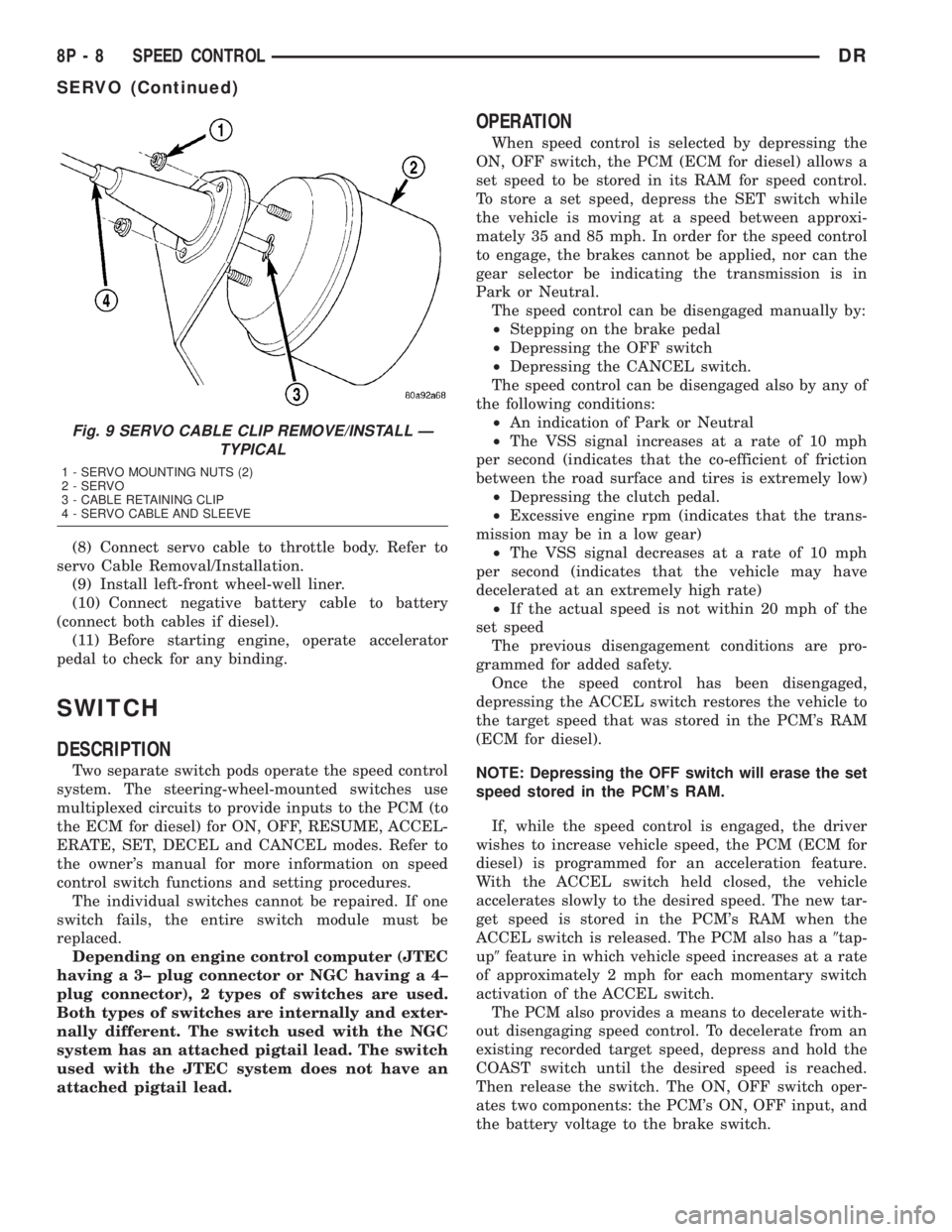
(7) Remove 2 mounting nuts holding servo cable
sleeve to bracket (Fig. 9).
(8) Pull speed control cable sleeve and servo away
from servo mounting bracket to expose cable retain-
ing clip (Fig. 9) and remove clip. Note: The servo
mounting bracket displayed in (Fig. 9) is a typical
bracket and may/may not be applicable to this model
vehicle.
(9) Remove servo from mounting bracket. While
removing, note orientation of servo to bracket.
INSTALLATION
(1) Position servo to mounting bracket (Fig. 9).
(2) Align hole in cable connector with hole in servo
pin. Install cable-to-servo retaining clip (Fig. 9).
(3) Insert servo mounting studs through holes in
servo mounting bracket.
(4) Install 2 servo-to-mounting bracket nuts and
tighten. Refer to torque specifications.
(5) Position servo assembly to correct mounting
lugs on battery tray (Fig. 8) and install 3 screws.
Tighten 3 screws. Refer to torque specifications.
(6) Connect vacuum line at servo.
(7) Connect electrical connector at servo.
Fig. 8 SPEED CONTROL SERVO LOCATION
1 - BATTERY TRAY
2 - MOUNTING LUGS
3 - SERVO
4 - ELEC. CONNEC.
5 - MOUNTING SCREWS (3)
6 - MOUNTING BRACKET
7 - VACUUM LINE
DRSPEED CONTROL 8P - 7
SERVO (Continued)
Page 667 of 2895
(8) Connect servo cable to throttle body. Refer to
servo Cable Removal/Installation.
(9) Install left-front wheel-well liner.
(10) Connect negative battery cable to battery
(connect both cables if diesel).
(11) Before starting engine, operate accelerator
pedal to check for any binding.
SWITCH
DESCRIPTION
Two separate switch pods operate the speed control
system. The steering-wheel-mounted switches use
multiplexed circuits to provide inputs to the PCM (to
the ECM for diesel) for ON, OFF, RESUME, ACCEL-
ERATE, SET, DECEL and CANCEL modes. Refer to
the owner's manual for more information on speed
control switch functions and setting procedures.
The individual switches cannot be repaired. If one
switch fails, the entire switch module must be
replaced.
Depending on engine control computer (JTEC
having a 3± plug connector or NGC having a 4±
plug connector), 2 types of switches are used.
Both types of switches are internally and exter-
nally different. The switch used with the NGC
system has an attached pigtail lead. The switch
used with the JTEC system does not have an
attached pigtail lead.
OPERATION
When speed control is selected by depressing the
ON, OFF switch, the PCM (ECM for diesel) allows a
set speed to be stored in its RAM for speed control.
To store a set speed, depress the SET switch while
the vehicle is moving at a speed between approxi-
mately 35 and 85 mph. In order for the speed control
to engage, the brakes cannot be applied, nor can the
gear selector be indicating the transmission is in
Park or Neutral.
The speed control can be disengaged manually by:
²Stepping on the brake pedal
²Depressing the OFF switch
²Depressing the CANCEL switch.
The speed control can be disengaged also by any of
the following conditions:
²An indication of Park or Neutral
²The VSS signal increases at a rate of 10 mph
per second (indicates that the co-efficient of friction
between the road surface and tires is extremely low)
²Depressing the clutch pedal.
²Excessive engine rpm (indicates that the trans-
mission may be in a low gear)
²The VSS signal decreases at a rate of 10 mph
per second (indicates that the vehicle may have
decelerated at an extremely high rate)
²If the actual speed is not within 20 mph of the
set speed
The previous disengagement conditions are pro-
grammed for added safety.
Once the speed control has been disengaged,
depressing the ACCEL switch restores the vehicle to
the target speed that was stored in the PCM's RAM
(ECM for diesel).
NOTE: Depressing the OFF switch will erase the set
speed stored in the PCM's RAM.
If, while the speed control is engaged, the driver
wishes to increase vehicle speed, the PCM (ECM for
diesel) is programmed for an acceleration feature.
With the ACCEL switch held closed, the vehicle
accelerates slowly to the desired speed. The new tar-
get speed is stored in the PCM's RAM when the
ACCEL switch is released. The PCM also has a9tap-
up9feature in which vehicle speed increases at a rate
of approximately 2 mph for each momentary switch
activation of the ACCEL switch.
The PCM also provides a means to decelerate with-
out disengaging speed control. To decelerate from an
existing recorded target speed, depress and hold the
COAST switch until the desired speed is reached.
Then release the switch. The ON, OFF switch oper-
ates two components: the PCM's ON, OFF input, and
the battery voltage to the brake switch.
Fig. 9 SERVO CABLE CLIP REMOVE/INSTALL Ð
TYPICAL
1 - SERVO MOUNTING NUTS (2)
2 - SERVO
3 - CABLE RETAINING CLIP
4 - SERVO CABLE AND SLEEVE
8P - 8 SPEED CONTROLDR
SERVO (Continued)