2003 DODGE RAM clutch replacement
[x] Cancel search: clutch replacementPage 2004 of 2895
NOTE: Do not use shop towels or rags to dry the
case (or any other transmission component) unless
they are made from lint-free materials. Lint will stick
to case surfaces and transmission components and
circulate throughout the transmission after assem-
bly. A sufficient quantity of lint can block fluid pas-
sages and interfere with valve body operation.
Lubricate transmission parts with MopartATF +4,
Automatic Transmission fluid during overhaul and
assembly. Use petroleum jelly to prelubricate seals,
O-rings, and thrust washers. Petroleum jelly can also
be used to hold parts in place during reassembly.
INSPECTION
Inspect the case for cracks, porous spots, worn
bores, or damaged threads. Damaged threads can be
repaired with Helicoil thread inserts. However, the
case will have to be replaced if it exhibits any type of
damage or wear.
Lubricate the front band adjusting screw threads
with petroleum jelly and thread the screw part-way
into the case. Be sure the screw turns freely.
Inspect the transmission bushings during overhaul.
Bushing condition is important as worn, scored bush-
ings contribute to low pressures, clutch slip and
accelerated wear of other components. However, do
not replace bushings as a matter of course. Replace
bushings only when they are actually worn, or
scored.
Use recommended tools to replace bushings. The
tools are sized and designed to remove, install, and
seat bushings correctly. The bushing replacement
tools are included in Bushing Tool Set C-3887-B.Pre-sized service bushings are available for
replacement purposes. Only the sun gear bushings
are not serviced.
The use of crocus cloth is permissible where neces-
sary, providing it is used carefully. When used on
shafts, or valves, use extreme care to avoid rounding
off sharp edges. Sharp edges are vital as they pre-
vent foreign matter from getting between the valve
and valve bore.
Do not reuse oil seals, gaskets, seal rings, or
O-rings during overhaul. Replace these parts as a
matter of course. Also do not reuse snap rings or
E-clips that are bent or distorted. Replace these parts
as well.
ASSEMBLY
Do not allow dirt, grease, or foreign material to
enter the case or transmission components during
assembly. Keep the transmission case and compo-
nents clean. Also make sure the tools and workbench
area used for reassembly operations are equally
clean.
Shop towels used for wiping off tools and your
hands must be made fromlint freematerials. Lint
will stick to transmission parts and could interfere
with valve operation or even restrict fluid passages.
Lubricate transmission clutch and gear compo-
nents with MopartATF +4, Automatic Transmission
fluid, during reassembly. Soak clutch discs in trans-
mission fluid before installation.
Use MopartDoor Ease, or Ru-GlydeŸ on piston
seals and O-rings to ease installation. Petroleum jelly
can also be used to lubricate and hold thrust washers
and plates in position during assembly.
Do not use chassis grease, bearing grease,
white grease, or similar lubricants on any part.
These types of lubricants can eventually block or
restrict fluid passages and valve operation. Use
petroleum jelly only.
Do not force parts into place. The transmission
components and sub-assemblies are easily installed
by hand when properly aligned. If a part seems dif-
ficult to install, it is either misaligned or incorrectly
assembled. Verify that thrust washers, thrust plates
and seal rings are correctly positioned.
The planetary geartrain, front/rear clutch assem-
blies and oil pump are all much easier to install
when the transmission case is upright. Either tilt the
case upward with wood blocks, or cut a hole in the
bench large enough for the intermediate shaft and
rear support. Then lower the shaft and support into
the hole and support the rear of the case directly on
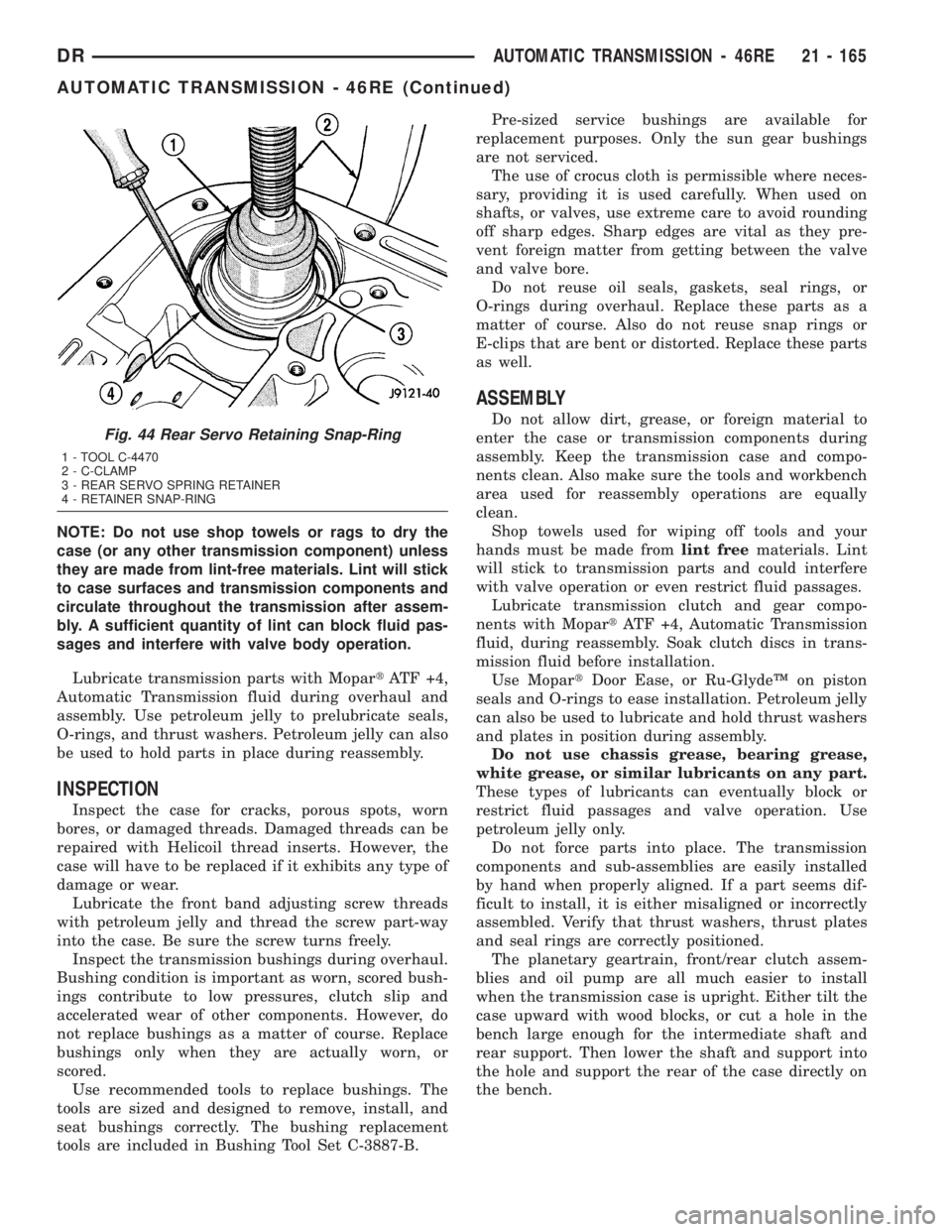
the bench.Fig. 44 Rear Servo Retaining Snap-Ring
1 - TOOL C-4470
2 - C-CLAMP
3 - REAR SERVO SPRING RETAINER
4 - RETAINER SNAP-RING
DRAUTOMATIC TRANSMISSION - 46RE 21 - 165
AUTOMATIC TRANSMISSION - 46RE (Continued)
Page 2045 of 2895
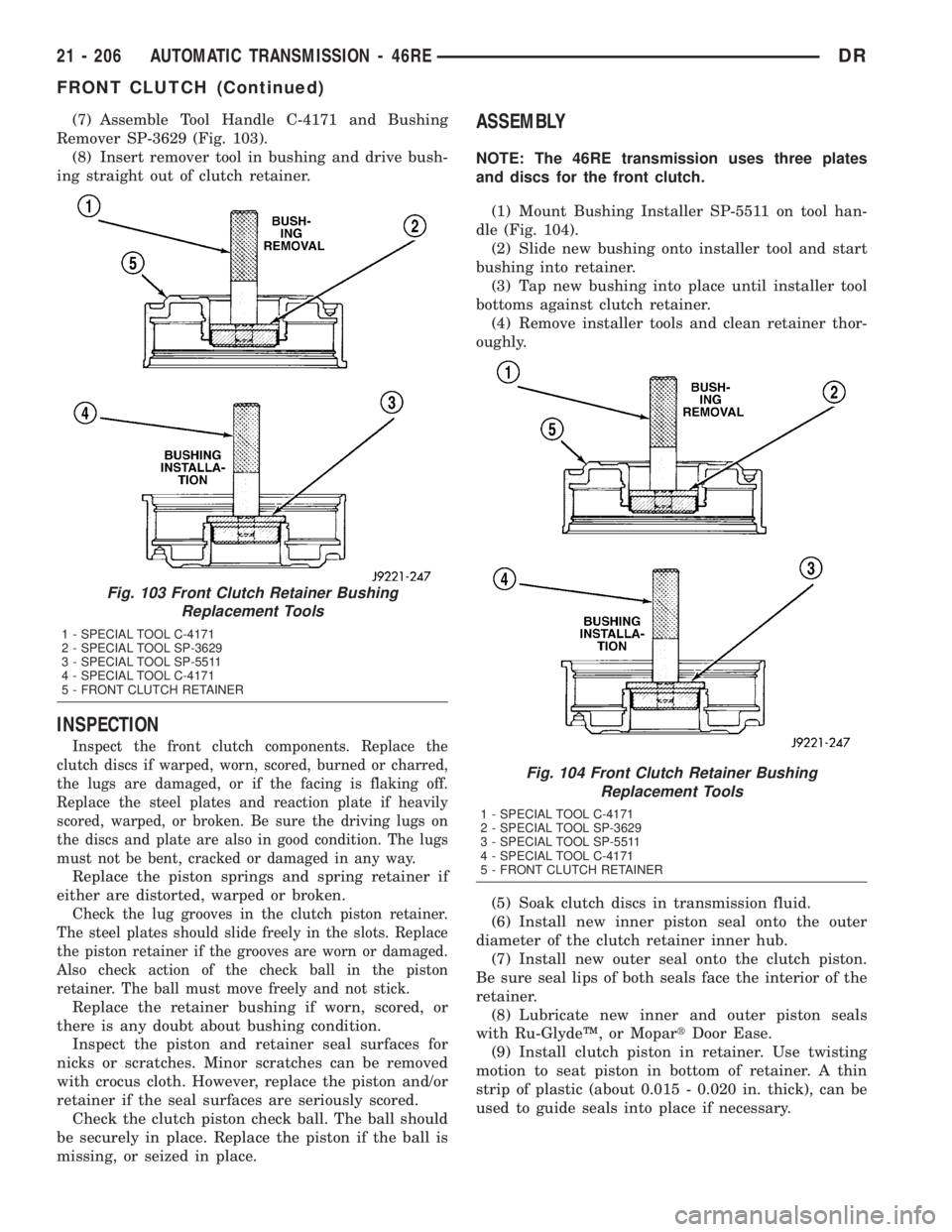
(7) Assemble Tool Handle C-4171 and Bushing
Remover SP-3629 (Fig. 103).
(8) Insert remover tool in bushing and drive bush-
ing straight out of clutch retainer.
INSPECTION
Inspect the front clutch components. Replace the
clutch discs if warped, worn, scored, burned or charred,
the lugs are damaged, or if the facing is flaking off.
Replace the steel plates and reaction plate if heavily
scored, warped, or broken. Be sure the driving lugs on
the discs and plate are also in good condition. The lugs
must not be bent, cracked or damaged in any way.
Replace the piston springs and spring retainer if
either are distorted, warped or broken.
Check the lug grooves in the clutch piston retainer.
The steel plates should slide freely in the slots. Replace
the piston retainer if the grooves are worn or damaged.
Also check action of the check ball in the piston
retainer. The ball must move freely and not stick.
Replace the retainer bushing if worn, scored, or
there is any doubt about bushing condition.
Inspect the piston and retainer seal surfaces for
nicks or scratches. Minor scratches can be removed
with crocus cloth. However, replace the piston and/or
retainer if the seal surfaces are seriously scored.
Check the clutch piston check ball. The ball should
be securely in place. Replace the piston if the ball is
missing, or seized in place.
ASSEMBLY
NOTE: The 46RE transmission uses three plates
and discs for the front clutch.
(1) Mount Bushing Installer SP-5511 on tool han-
dle (Fig. 104).
(2) Slide new bushing onto installer tool and start
bushing into retainer.
(3) Tap new bushing into place until installer tool
bottoms against clutch retainer.
(4) Remove installer tools and clean retainer thor-
oughly.
(5) Soak clutch discs in transmission fluid.
(6) Install new inner piston seal onto the outer
diameter of the clutch retainer inner hub.
(7) Install new outer seal onto the clutch piston.
Be sure seal lips of both seals face the interior of the
retainer.
(8) Lubricate new inner and outer piston seals
with Ru-GlydeŸ, or MopartDoor Ease.
(9) Install clutch piston in retainer. Use twisting
motion to seat piston in bottom of retainer. A thin
strip of plastic (about 0.015 - 0.020 in. thick), can be
used to guide seals into place if necessary.
Fig. 103 Front Clutch Retainer Bushing
Replacement Tools
1 - SPECIAL TOOL C-4171
2 - SPECIAL TOOL SP-3629
3 - SPECIAL TOOL SP-5511
4 - SPECIAL TOOL C-4171
5 - FRONT CLUTCH RETAINER
Fig. 104 Front Clutch Retainer Bushing
Replacement Tools
1 - SPECIAL TOOL C-4171
2 - SPECIAL TOOL SP-3629
3 - SPECIAL TOOL SP-5511
4 - SPECIAL TOOL C-4171
5 - FRONT CLUTCH RETAINER
21 - 206 AUTOMATIC TRANSMISSION - 46REDR
FRONT CLUTCH (Continued)
Page 2078 of 2895
ASSEMBLY
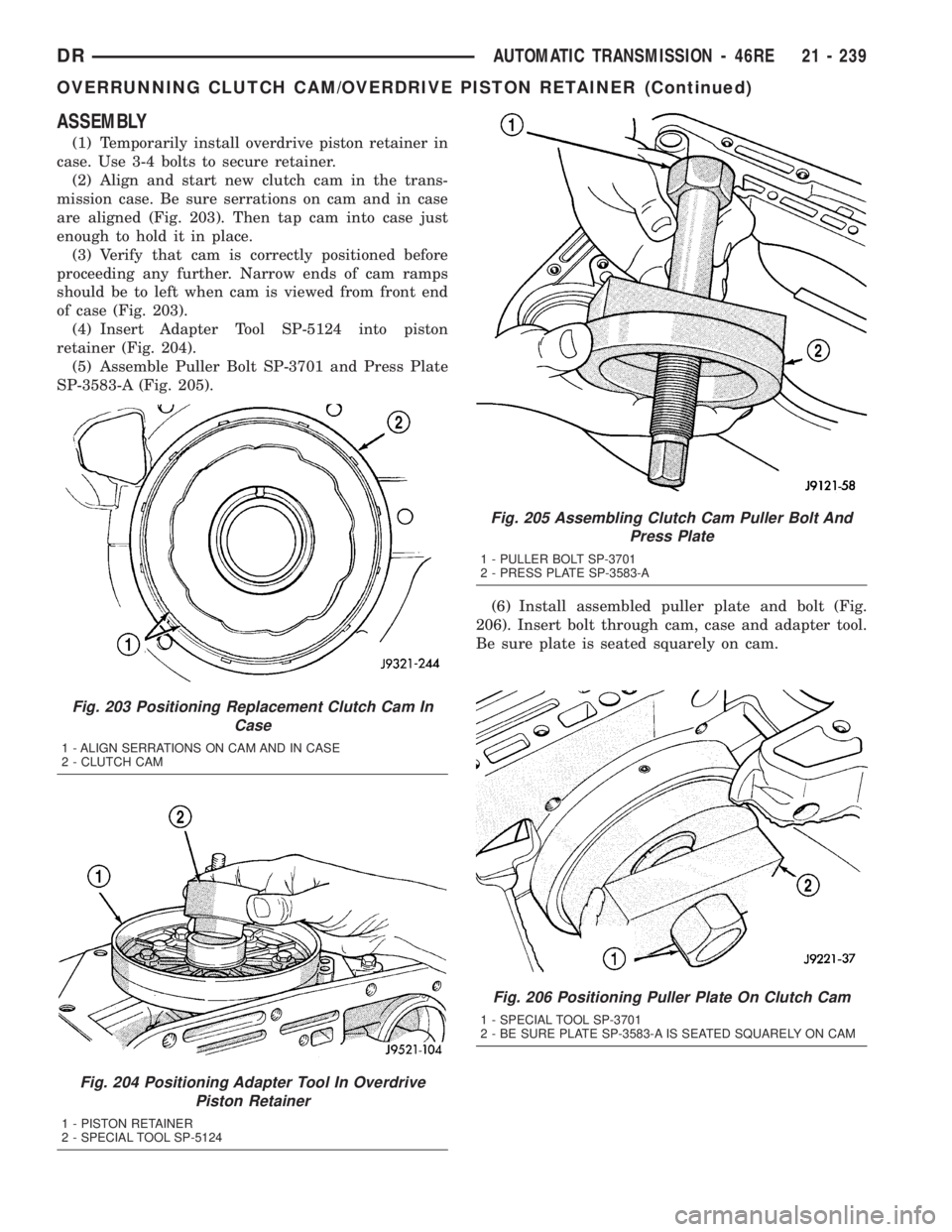
(1) Temporarily install overdrive piston retainer in
case. Use 3-4 bolts to secure retainer.
(2) Align and start new clutch cam in the trans-
mission case. Be sure serrations on cam and in case
are aligned (Fig. 203). Then tap cam into case just
enough to hold it in place.
(3) Verify that cam is correctly positioned before
proceeding any further. Narrow ends of cam ramps
should be to left when cam is viewed from front end
of case (Fig. 203).
(4) Insert Adapter Tool SP-5124 into piston
retainer (Fig. 204).
(5) Assemble Puller Bolt SP-3701 and Press Plate
SP-3583-A (Fig. 205).
(6) Install assembled puller plate and bolt (Fig.
206). Insert bolt through cam, case and adapter tool.
Be sure plate is seated squarely on cam.
Fig. 206 Positioning Puller Plate On Clutch Cam
1 - SPECIAL TOOL SP-3701
2 - BE SURE PLATE SP-3583-A IS SEATED SQUARELY ON CAM
Fig. 203 Positioning Replacement Clutch Cam In
Case
1 - ALIGN SERRATIONS ON CAM AND IN CASE
2 - CLUTCH CAM
Fig. 204 Positioning Adapter Tool In Overdrive
Piston Retainer
1 - PISTON RETAINER
2 - SPECIAL TOOL SP-5124
Fig. 205 Assembling Clutch Cam Puller Bolt And
Press Plate
1 - PULLER BOLT SP-3701
2 - PRESS PLATE SP-3583-A
DRAUTOMATIC TRANSMISSION - 46RE 21 - 239
OVERRUNNING CLUTCH CAM/OVERDRIVE PISTON RETAINER (Continued)
Page 2149 of 2895
AUTOMATIC TRANSMISSION - 48RE
TABLE OF CONTENTS
page page
AUTOMATIC TRANSMISSION - 48RE
DESCRIPTION........................312
OPERATION..........................314
DIAGNOSIS AND TESTING
DIAGNOSIS AND TESTING - AUTOMATIC
TRANSMISSION.....................320
DIAGNOSIS AND TESTING - PRELIMINARY. . 320
DIAGNOSIS AND TESTING - ROAD
TESTING...........................320
DIAGNOSIS AND TESTING - HYDRAULIC
PRESSURE TEST....................321
DIAGNOSIS AND TESTING - AIR TESTING
TRANSMISSION CLUTCH AND BAND
OPERATION........................324
DIAGNOSIS AND TESTING - CONVERTER
HOUSING FLUID LEAK................324
DIAGNOSIS AND TESTING - DIAGNOSIS
CHARTS...........................325
STANDARD PROCEDURE - ALUMINUM
THREAD REPAIR.....................337
REMOVAL............................337
DISASSEMBLY........................339
CLEANING...........................345
INSPECTION.........................345
ASSEMBLY...........................346
INSTALLATION........................353
SCHEMATICS AND DIAGRAMS
HYDRAULIC SCHEMATICS.............355
SPECIFICATIONS
TRANSMISSION.....................368
SPECIAL TOOLS
RE TRANSMISSION..................370
ACCUMULATOR
DESCRIPTION........................372
OPERATION..........................373
INSPECTION.........................373
BANDS
DESCRIPTION........................373
OPERATION..........................374
ADJUSTMENTS
ADJUSTMENT - BANDS...............374
BRAKE TRANSMISSION SHIFT INTERLOCK
SYSTEM
DESCRIPTION........................375
OPERATION..........................375
DIAGNOSIS AND TESTING - BRAKE
TRANSMISSION SHIFT INTERLOCK......375
ADJUSTMENTS - BRAKE TRANSMISSION
SHIFT INTERLOCK...................376ELECTRONIC GOVERNOR
DESCRIPTION........................376
OPERATION..........................377
REMOVAL............................378
INSTALLATION........................379
EXTENSION HOUSING SEAL
REMOVAL............................380
INSTALLATION........................380
FLUID AND FILTER
DIAGNOSIS AND TESTING
DIAGNOSIS AND TESTING - EFFECTS OF
INCORRECT FLUID LEVEL.............381
DIAGNOSIS AND TESTING - CAUSES OF
BURNT FLUID.......................381
DIAGNOSIS AND TESTING - FLUID
CONTAMINATION....................381
STANDARD PROCEDURE
STANDARD PROCEDURE - FLUID LEVEL
CHECK............................381
STANDARD PROCEDURE - FLUID AND
FILTER REPLACEMENT...............383
STANDARD PROCEDURE - TRANSMISSION
FILL...............................383
FRONT CLUTCH
DESCRIPTION........................384
OPERATION..........................384
DISASSEMBLY........................384
INSPECTION.........................385
ASSEMBLY...........................386
FRONT SERVO
DESCRIPTION........................387
OPERATION..........................387
DISASSEMBLY........................388
CLEANING...........................388
INSPECTION.........................388
ASSEMBLY...........................388
GEARSHIFT CABLE
DIAGNOSIS AND TESTING - GEARSHIFT
CABLE.............................389
REMOVAL............................389
INSTALLATION........................390
ADJUSTMENTS
GEARSHIFT CABLE..................391
OIL PUMP
DESCRIPTION........................392
OPERATION..........................392
DISASSEMBLY........................393
CLEANING...........................393
INSPECTION.........................393
ASSEMBLY...........................393
21 - 310 AUTOMATIC TRANSMISSION - 48REDR
Page 2153 of 2895
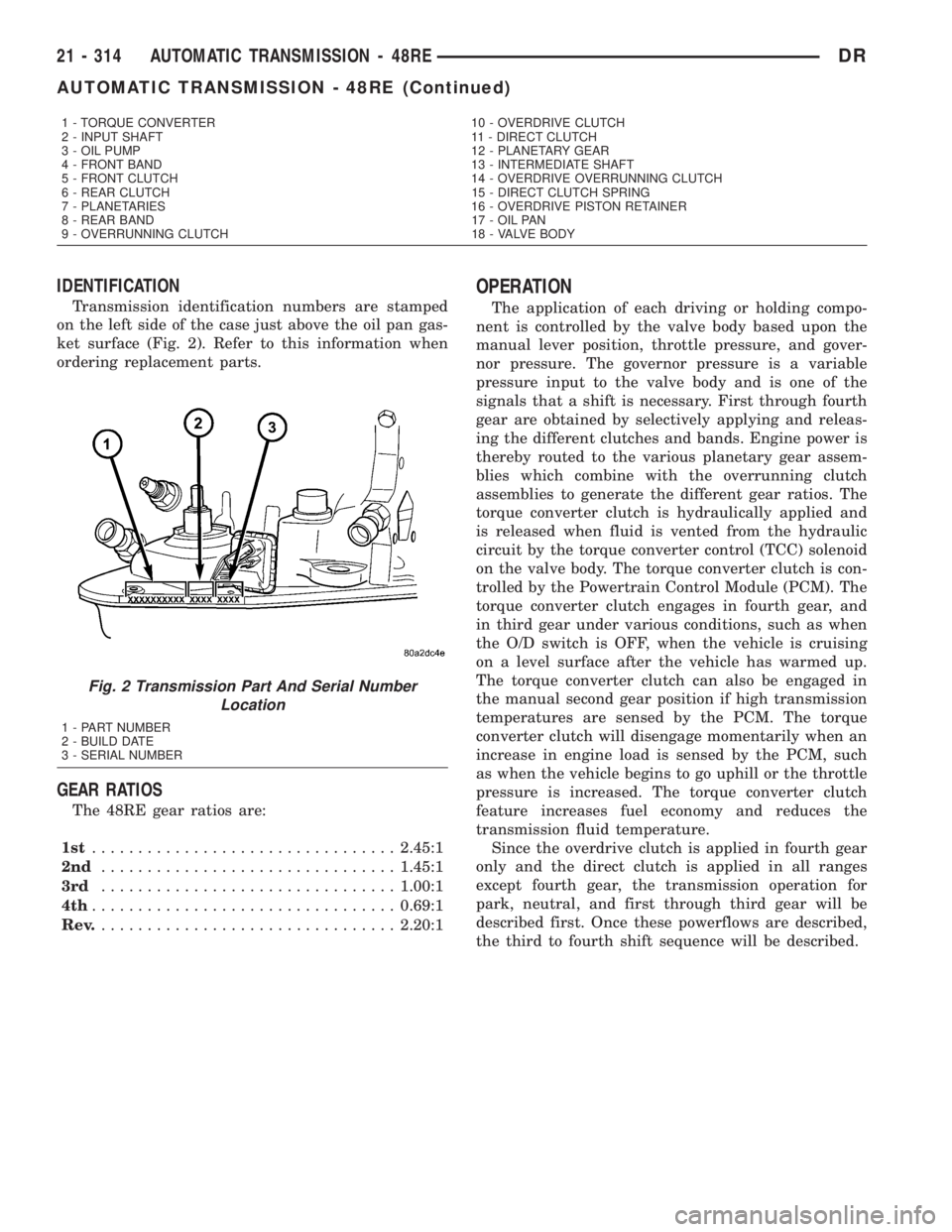
IDENTIFICATION
Transmission identification numbers are stamped
on the left side of the case just above the oil pan gas-
ket surface (Fig. 2). Refer to this information when
ordering replacement parts.
GEAR RATIOS
The 48RE gear ratios are:
1st.................................2.45:1
2nd................................1.45:1
3rd................................1.00:1
4th.................................0.69:1
Rev.................................2.20:1
OPERATION
The application of each driving or holding compo-
nent is controlled by the valve body based upon the
manual lever position, throttle pressure, and gover-
nor pressure. The governor pressure is a variable
pressure input to the valve body and is one of the
signals that a shift is necessary. First through fourth
gear are obtained by selectively applying and releas-
ing the different clutches and bands. Engine power is
thereby routed to the various planetary gear assem-
blies which combine with the overrunning clutch
assemblies to generate the different gear ratios. The
torque converter clutch is hydraulically applied and
is released when fluid is vented from the hydraulic
circuit by the torque converter control (TCC) solenoid
on the valve body. The torque converter clutch is con-
trolled by the Powertrain Control Module (PCM). The
torque converter clutch engages in fourth gear, and
in third gear under various conditions, such as when
the O/D switch is OFF, when the vehicle is cruising
on a level surface after the vehicle has warmed up.
The torque converter clutch can also be engaged in
the manual second gear position if high transmission
temperatures are sensed by the PCM. The torque
converter clutch will disengage momentarily when an
increase in engine load is sensed by the PCM, such
as when the vehicle begins to go uphill or the throttle
pressure is increased. The torque converter clutch
feature increases fuel economy and reduces the
transmission fluid temperature.
Since the overdrive clutch is applied in fourth gear
only and the direct clutch is applied in all ranges
except fourth gear, the transmission operation for
park, neutral, and first through third gear will be
described first. Once these powerflows are described,
the third to fourth shift sequence will be described.
1 - TORQUE CONVERTER 10 - OVERDRIVE CLUTCH
2 - INPUT SHAFT 11 - DIRECT CLUTCH
3 - OIL PUMP 12 - PLANETARY GEAR
4 - FRONT BAND 13 - INTERMEDIATE SHAFT
5 - FRONT CLUTCH 14 - OVERDRIVE OVERRUNNING CLUTCH
6 - REAR CLUTCH 15 - DIRECT CLUTCH SPRING
7 - PLANETARIES 16 - OVERDRIVE PISTON RETAINER
8 - REAR BAND 17 - OIL PAN
9 - OVERRUNNING CLUTCH 18 - VALVE BODY
Fig. 2 Transmission Part And Serial Number
Location
1 - PART NUMBER
2 - BUILD DATE
3 - SERIAL NUMBER
21 - 314 AUTOMATIC TRANSMISSION - 48REDR
AUTOMATIC TRANSMISSION - 48RE (Continued)
Page 2174 of 2895
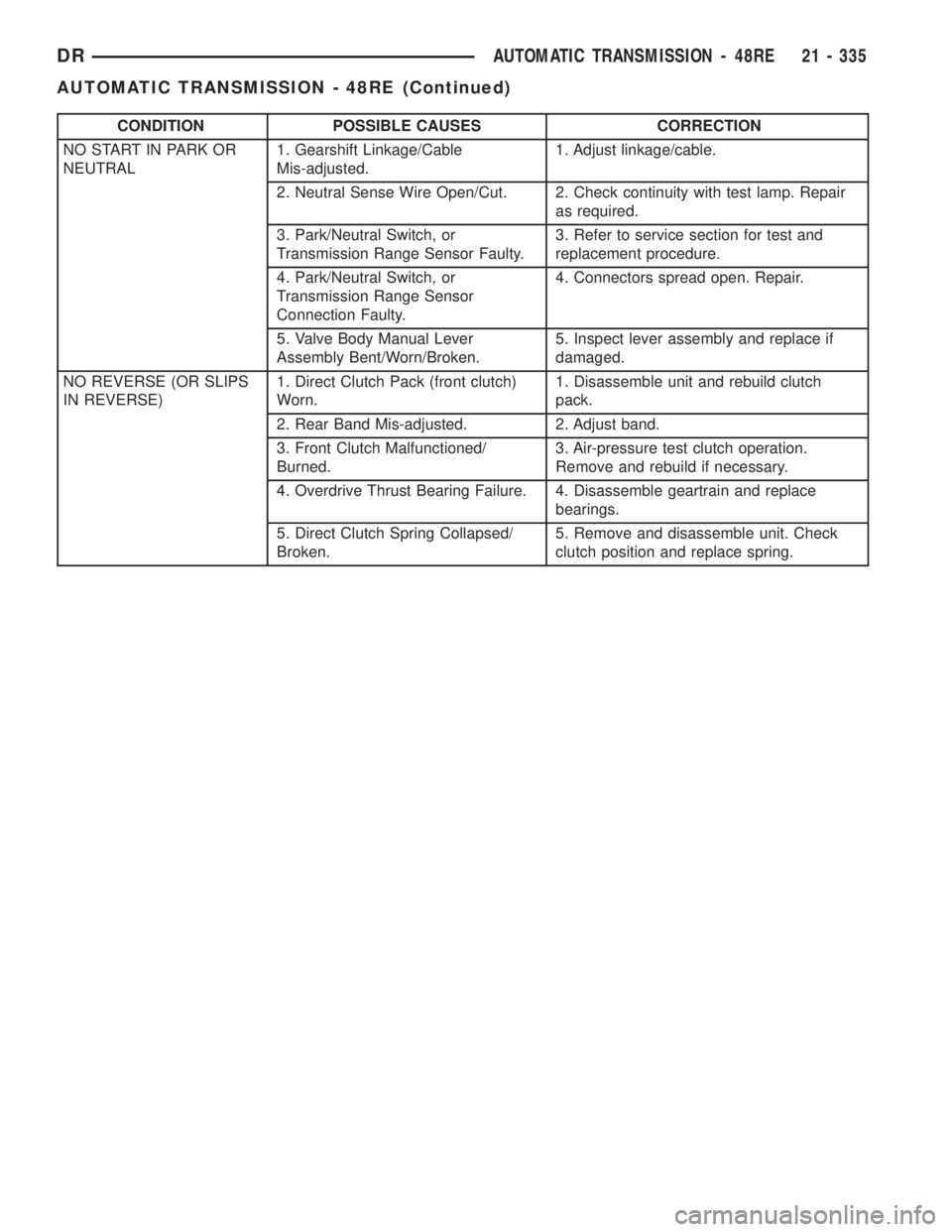
CONDITION POSSIBLE CAUSES CORRECTION
NO START IN PARK OR
NEUTRAL1. Gearshift Linkage/Cable
Mis-adjusted.1. Adjust linkage/cable.
2. Neutral Sense Wire Open/Cut. 2. Check continuity with test lamp. Repair
as required.
3. Park/Neutral Switch, or
Transmission Range Sensor Faulty.3. Refer to service section for test and
replacement procedure.
4. Park/Neutral Switch, or
Transmission Range Sensor
Connection Faulty.4. Connectors spread open. Repair.
5. Valve Body Manual Lever
Assembly Bent/Worn/Broken.5. Inspect lever assembly and replace if
damaged.
NO REVERSE (OR SLIPS
IN REVERSE)1. Direct Clutch Pack (front clutch)
Worn.1. Disassemble unit and rebuild clutch
pack.
2. Rear Band Mis-adjusted. 2. Adjust band.
3. Front Clutch Malfunctioned/
Burned.3. Air-pressure test clutch operation.
Remove and rebuild if necessary.
4. Overdrive Thrust Bearing Failure. 4. Disassemble geartrain and replace
bearings.
5. Direct Clutch Spring Collapsed/
Broken.5. Remove and disassemble unit. Check
clutch position and replace spring.
DRAUTOMATIC TRANSMISSION - 48RE 21 - 335
AUTOMATIC TRANSMISSION - 48RE (Continued)
Page 2184 of 2895
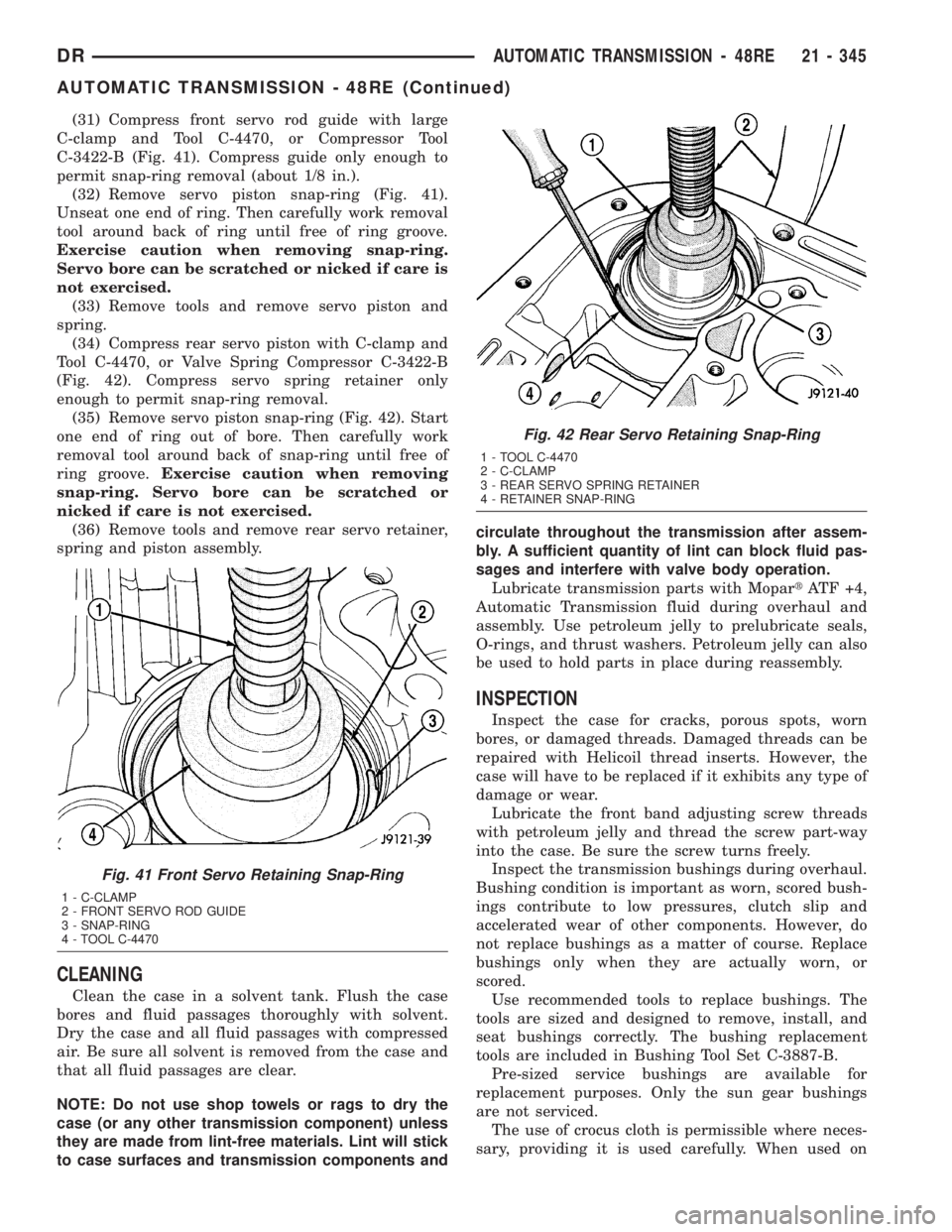
(31) Compress front servo rod guide with large
C-clamp and Tool C-4470, or Compressor Tool
C-3422-B (Fig. 41). Compress guide only enough to
permit snap-ring removal (about 1/8 in.).
(32) Remove servo piston snap-ring (Fig. 41).
Unseat one end of ring. Then carefully work removal
tool around back of ring until free of ring groove.
Exercise caution when removing snap-ring.
Servo bore can be scratched or nicked if care is
not exercised.
(33) Remove tools and remove servo piston and
spring.
(34) Compress rear servo piston with C-clamp and
Tool C-4470, or Valve Spring Compressor C-3422-B
(Fig. 42). Compress servo spring retainer only
enough to permit snap-ring removal.
(35) Remove servo piston snap-ring (Fig. 42). Start
one end of ring out of bore. Then carefully work
removal tool around back of snap-ring until free of
ring groove.Exercise caution when removing
snap-ring. Servo bore can be scratched or
nicked if care is not exercised.
(36) Remove tools and remove rear servo retainer,
spring and piston assembly.
CLEANING
Clean the case in a solvent tank. Flush the case
bores and fluid passages thoroughly with solvent.
Dry the case and all fluid passages with compressed
air. Be sure all solvent is removed from the case and
that all fluid passages are clear.
NOTE: Do not use shop towels or rags to dry the
case (or any other transmission component) unless
they are made from lint-free materials. Lint will stick
to case surfaces and transmission components andcirculate throughout the transmission after assem-
bly. A sufficient quantity of lint can block fluid pas-
sages and interfere with valve body operation.
Lubricate transmission parts with MopartATF +4,
Automatic Transmission fluid during overhaul and
assembly. Use petroleum jelly to prelubricate seals,
O-rings, and thrust washers. Petroleum jelly can also
be used to hold parts in place during reassembly.
INSPECTION
Inspect the case for cracks, porous spots, worn
bores, or damaged threads. Damaged threads can be
repaired with Helicoil thread inserts. However, the
case will have to be replaced if it exhibits any type of
damage or wear.
Lubricate the front band adjusting screw threads
with petroleum jelly and thread the screw part-way
into the case. Be sure the screw turns freely.
Inspect the transmission bushings during overhaul.
Bushing condition is important as worn, scored bush-
ings contribute to low pressures, clutch slip and
accelerated wear of other components. However, do
not replace bushings as a matter of course. Replace
bushings only when they are actually worn, or
scored.
Use recommended tools to replace bushings. The
tools are sized and designed to remove, install, and
seat bushings correctly. The bushing replacement
tools are included in Bushing Tool Set C-3887-B.
Pre-sized service bushings are available for
replacement purposes. Only the sun gear bushings
are not serviced.
The use of crocus cloth is permissible where neces-
sary, providing it is used carefully. When used on
Fig. 41 Front Servo Retaining Snap-Ring
1 - C-CLAMP
2 - FRONT SERVO ROD GUIDE
3 - SNAP-RING
4 - TOOL C-4470
Fig. 42 Rear Servo Retaining Snap-Ring
1 - TOOL C-4470
2 - C-CLAMP
3 - REAR SERVO SPRING RETAINER
4 - RETAINER SNAP-RING
DRAUTOMATIC TRANSMISSION - 48RE 21 - 345
AUTOMATIC TRANSMISSION - 48RE (Continued)
Page 2235 of 2895
INSTALLATION
(1) Place replacement bearing in position in hous-
ing.
(2) Using a suitable driver, drive bearing into
housing until the snap-ring groove is visible.
(3) Install snap-ring to hold bearing into housing
(Fig. 118).
(4) Install overdrive geartrain into housing.
(5) Install overdrive unit in vehicle.
OVERDRIVE CLUTCH
DESCRIPTION
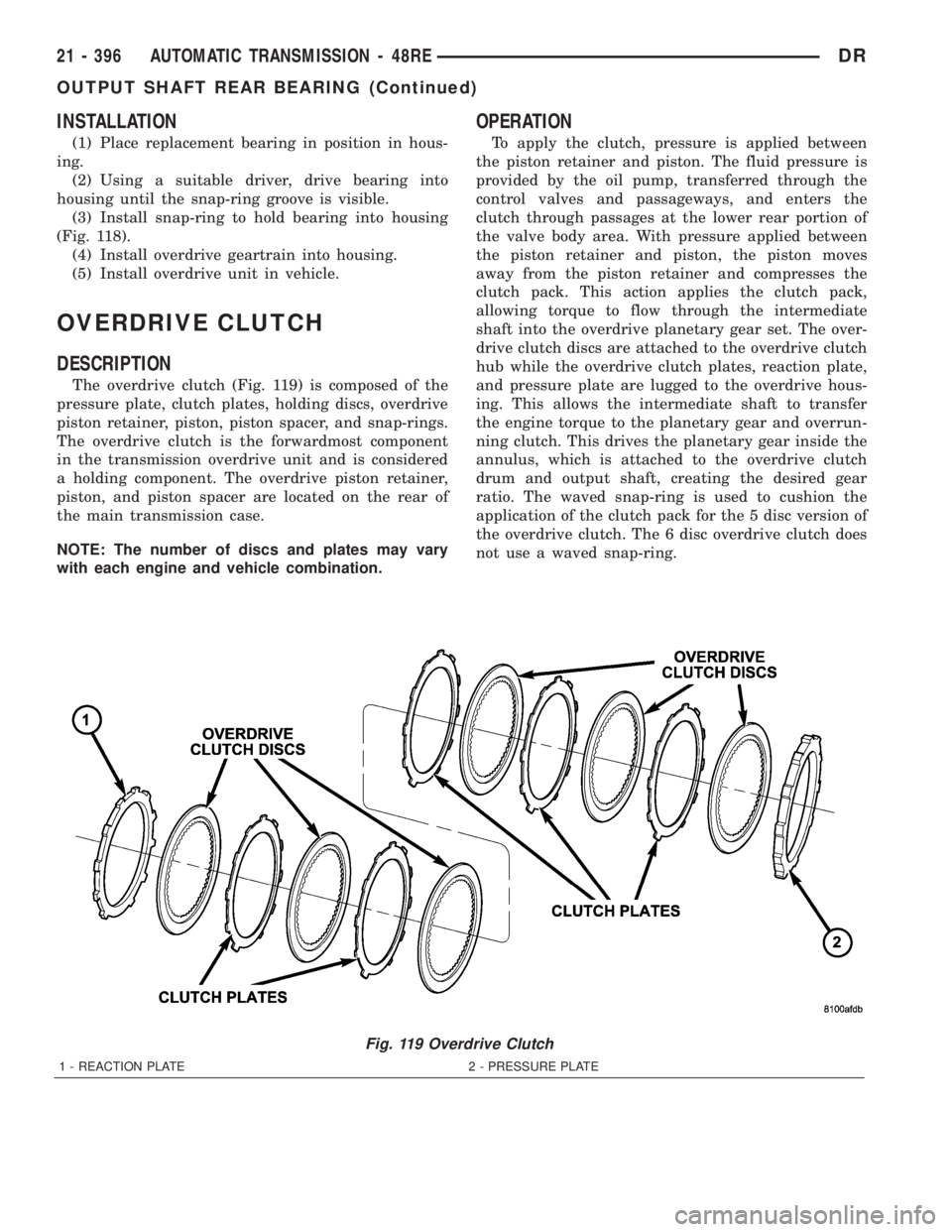
The overdrive clutch (Fig. 119) is composed of the
pressure plate, clutch plates, holding discs, overdrive
piston retainer, piston, piston spacer, and snap-rings.
The overdrive clutch is the forwardmost component
in the transmission overdrive unit and is considered
a holding component. The overdrive piston retainer,
piston, and piston spacer are located on the rear of
the main transmission case.
NOTE: The number of discs and plates may vary
with each engine and vehicle combination.
OPERATION
To apply the clutch, pressure is applied between
the piston retainer and piston. The fluid pressure is
provided by the oil pump, transferred through the
control valves and passageways, and enters the
clutch through passages at the lower rear portion of
the valve body area. With pressure applied between
the piston retainer and piston, the piston moves
away from the piston retainer and compresses the
clutch pack. This action applies the clutch pack,
allowing torque to flow through the intermediate
shaft into the overdrive planetary gear set. The over-
drive clutch discs are attached to the overdrive clutch
hub while the overdrive clutch plates, reaction plate,
and pressure plate are lugged to the overdrive hous-
ing. This allows the intermediate shaft to transfer
the engine torque to the planetary gear and overrun-
ning clutch. This drives the planetary gear inside the
annulus, which is attached to the overdrive clutch
drum and output shaft, creating the desired gear
ratio. The waved snap-ring is used to cushion the
application of the clutch pack for the 5 disc version of
the overdrive clutch. The 6 disc overdrive clutch does
not use a waved snap-ring.
Fig. 119 Overdrive Clutch
1 - REACTION PLATE 2 - PRESSURE PLATE
21 - 396 AUTOMATIC TRANSMISSION - 48REDR
OUTPUT SHAFT REAR BEARING (Continued)