2003 DODGE RAM throttle sensor
[x] Cancel search: throttle sensorPage 2315 of 2895
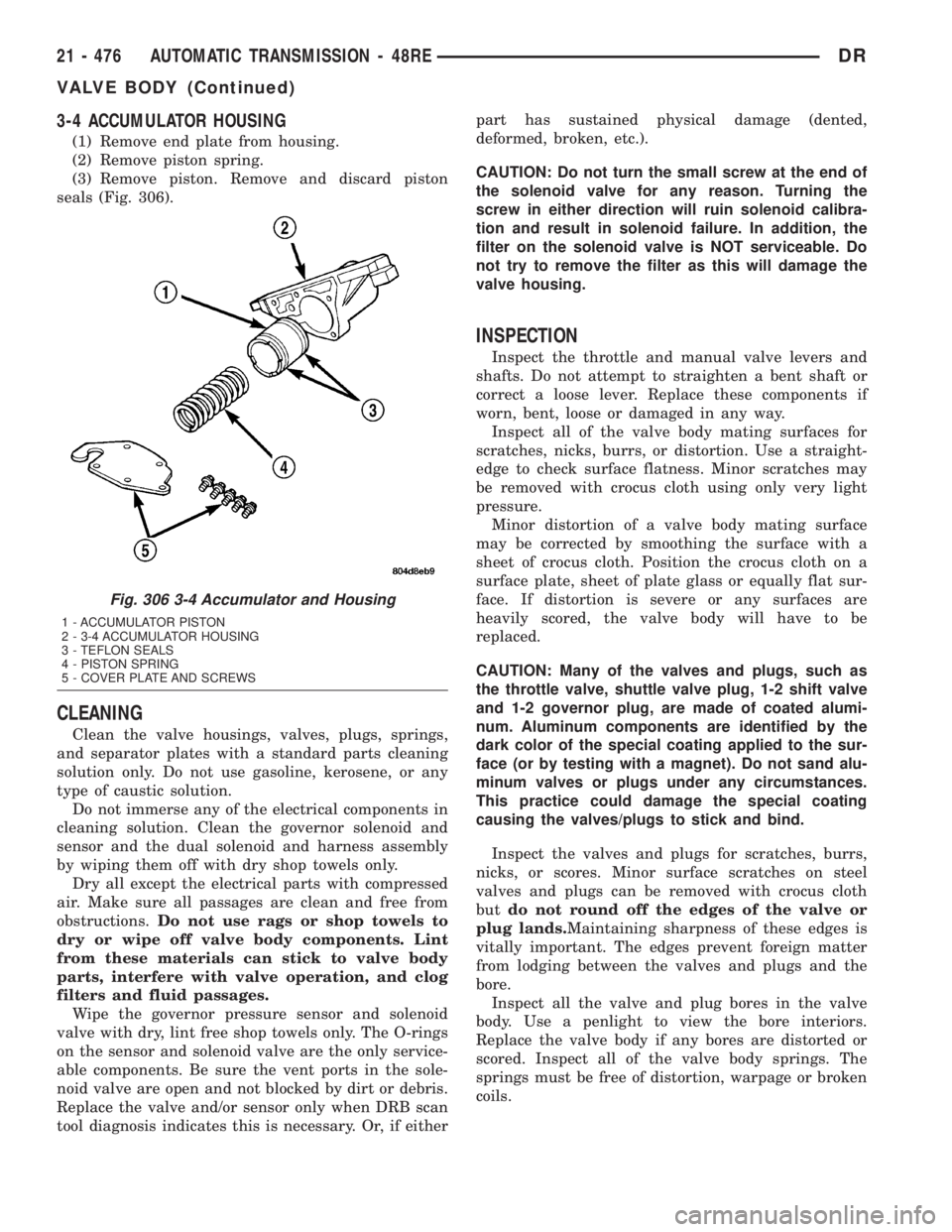
3-4 ACCUMULATOR HOUSING
(1) Remove end plate from housing.
(2) Remove piston spring.
(3) Remove piston. Remove and discard piston
seals (Fig. 306).
CLEANING
Clean the valve housings, valves, plugs, springs,
and separator plates with a standard parts cleaning
solution only. Do not use gasoline, kerosene, or any
type of caustic solution.
Do not immerse any of the electrical components in
cleaning solution. Clean the governor solenoid and
sensor and the dual solenoid and harness assembly
by wiping them off with dry shop towels only.
Dry all except the electrical parts with compressed
air. Make sure all passages are clean and free from
obstructions.Do not use rags or shop towels to
dry or wipe off valve body components. Lint
from these materials can stick to valve body
parts, interfere with valve operation, and clog
filters and fluid passages.
Wipe the governor pressure sensor and solenoid
valve with dry, lint free shop towels only. The O-rings
on the sensor and solenoid valve are the only service-
able components. Be sure the vent ports in the sole-
noid valve are open and not blocked by dirt or debris.
Replace the valve and/or sensor only when DRB scan
tool diagnosis indicates this is necessary. Or, if eitherpart has sustained physical damage (dented,
deformed, broken, etc.).
CAUTION: Do not turn the small screw at the end of
the solenoid valve for any reason. Turning the
screw in either direction will ruin solenoid calibra-
tion and result in solenoid failure. In addition, the
filter on the solenoid valve is NOT serviceable. Do
not try to remove the filter as this will damage the
valve housing.
INSPECTION
Inspect the throttle and manual valve levers and
shafts. Do not attempt to straighten a bent shaft or
correct a loose lever. Replace these components if
worn, bent, loose or damaged in any way.
Inspect all of the valve body mating surfaces for
scratches, nicks, burrs, or distortion. Use a straight-
edge to check surface flatness. Minor scratches may
be removed with crocus cloth using only very light
pressure.
Minor distortion of a valve body mating surface
may be corrected by smoothing the surface with a
sheet of crocus cloth. Position the crocus cloth on a
surface plate, sheet of plate glass or equally flat sur-
face. If distortion is severe or any surfaces are
heavily scored, the valve body will have to be
replaced.
CAUTION: Many of the valves and plugs, such as
the throttle valve, shuttle valve plug, 1-2 shift valve
and 1-2 governor plug, are made of coated alumi-
num. Aluminum components are identified by the
dark color of the special coating applied to the sur-
face (or by testing with a magnet). Do not sand alu-
minum valves or plugs under any circumstances.
This practice could damage the special coating
causing the valves/plugs to stick and bind.
Inspect the valves and plugs for scratches, burrs,
nicks, or scores. Minor surface scratches on steel
valves and plugs can be removed with crocus cloth
butdo not round off the edges of the valve or
plug lands.Maintaining sharpness of these edges is
vitally important. The edges prevent foreign matter
from lodging between the valves and plugs and the
bore.
Inspect all the valve and plug bores in the valve
body. Use a penlight to view the bore interiors.
Replace the valve body if any bores are distorted or
scored. Inspect all of the valve body springs. The
springs must be free of distortion, warpage or broken
coils.
Fig. 306 3-4 Accumulator and Housing
1 - ACCUMULATOR PISTON
2 - 3-4 ACCUMULATOR HOUSING
3 - TEFLON SEALS
4 - PISTON SPRING
5 - COVER PLATE AND SCREWS
21 - 476 AUTOMATIC TRANSMISSION - 48REDR
VALVE BODY (Continued)
Page 2316 of 2895
Check the two separator plates for distortion or
damage of any kind. Inspect the upper housing,
lower housing, 3-4 accumulator housing, and transfer
plate carefully. Be sure all fluid passages are clean
and clear. Check condition of the upper housing and
transfer plate check balls as well. The check balls
and ball seats must not be worn or damaged.
Trial fit each valve and plug in its bore to check
freedom of operation. When clean and dry, the valves
and plugs should drop freely into the bores.
Valve body bores do not change dimensionally with
use. If the valve body functioned correctly when new,
it will continue to operate properly after cleaning and
inspection. It should not be necessary to replace a
valve body assembly unless it is damaged in han-
dling.
The only serviceable valve body components are
listed below. The remaining valve body components
are serviced only as part of a complete valve body
assembly. Serviceable parts are:
²dual solenoid and harness assembly
²solenoid gasket
²solenoid case connector O-rings and shoulder
bolt
²switch valve and spring
²pressure adjusting screw and bracket assembly
²throttle lever
²manual lever and shaft seal
²throttle lever shaft seal, washer, and E-clip
²fluid filter and screws
²detent ball and spring
²valve body screws
²governor pressure solenoid
²governor pressure sensor and retaining clip
²park lock rod and E-clipASSEMBLY
CAUTION: Do not force valves or plugs into place
during reassembly. If the valve body bores, valves
and plugs are free of distortion or burrs, the valve
body components should all slide into place easily.
In addition, do not overtighten the transfer plate
and valve body screws during reassembly. Over-
tightening can distort the housings resulting in
valve sticking, cross leakage and unsatisfactory
operation. Tighten valve body screws to recom-
mended torque only.
LOWER HOUSING
(1) Lubricate valves, springs, and the housing
valve and plug bores with clean transmission fluid
(Fig. 307).
(2) Install 3-4 timing valve spring and valve in
lower housing.
(3) Install 3-4 quick fill valve in lower housing.
(4) Install 3-4 quick fill valve spring and plug in
housing.
(5) Install timing valve end plate. Tighten end
plate screws to 4 N´m (35 in. lbs.) torque.
DRAUTOMATIC TRANSMISSION - 48RE 21 - 477
VALVE BODY (Continued)
Page 2325 of 2895
(20)Install solenoid assembly and gasket. Tighten
solenoid attaching screws to 8 N´m (72 in. lbs.) torque.
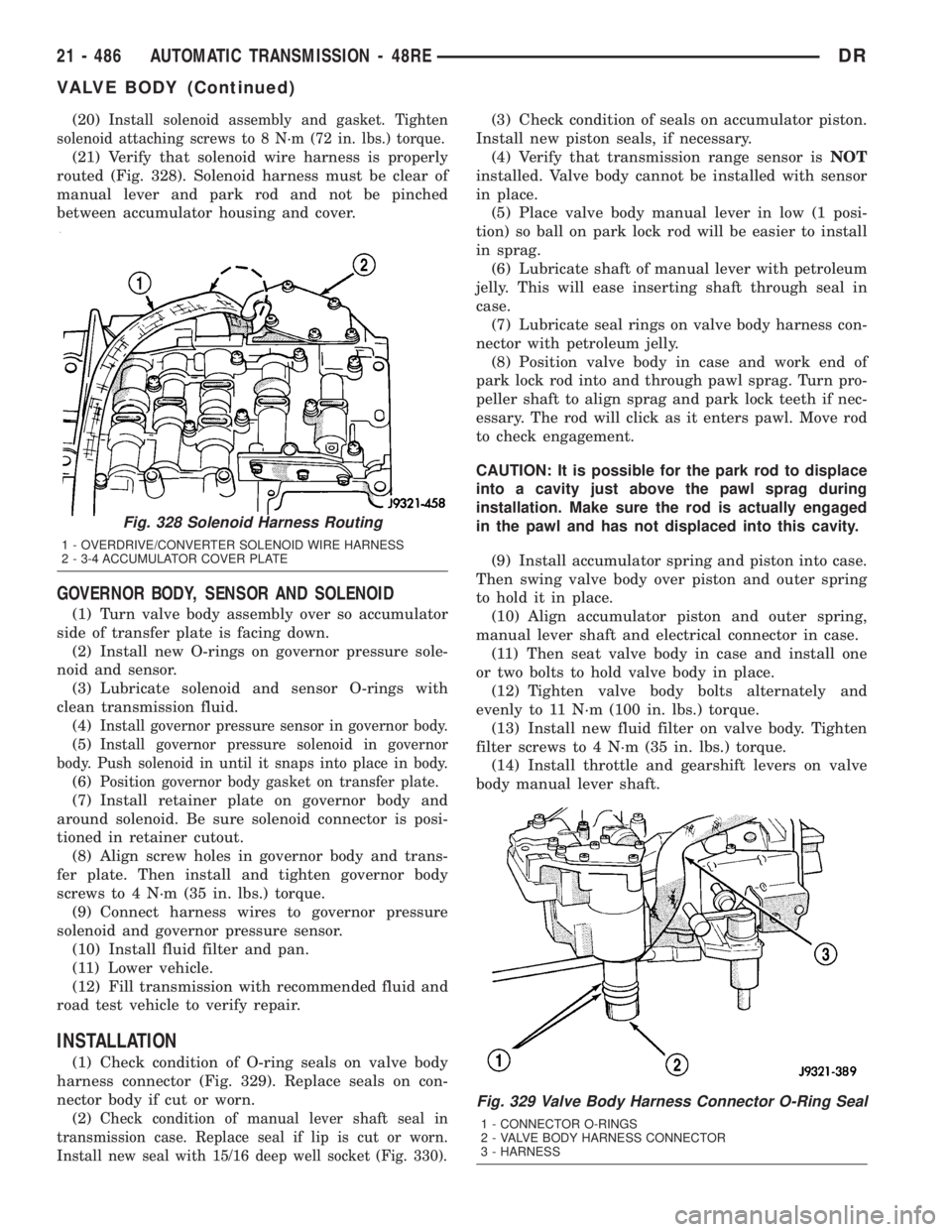
(21) Verify that solenoid wire harness is properly
routed (Fig. 328). Solenoid harness must be clear of
manual lever and park rod and not be pinched
between accumulator housing and cover.
GOVERNOR BODY, SENSOR AND SOLENOID
(1) Turn valve body assembly over so accumulator
side of transfer plate is facing down.
(2) Install new O-rings on governor pressure sole-
noid and sensor.
(3) Lubricate solenoid and sensor O-rings with
clean transmission fluid.
(4)
Install governor pressure sensor in governor body.
(5)Install governor pressure solenoid in governor
body. Push solenoid in until it snaps into place in body.
(6)Position governor body gasket on transfer plate.
(7) Install retainer plate on governor body and
around solenoid. Be sure solenoid connector is posi-
tioned in retainer cutout.
(8) Align screw holes in governor body and trans-
fer plate. Then install and tighten governor body
screws to 4 N´m (35 in. lbs.) torque.
(9) Connect harness wires to governor pressure
solenoid and governor pressure sensor.
(10) Install fluid filter and pan.
(11) Lower vehicle.
(12) Fill transmission with recommended fluid and
road test vehicle to verify repair.
INSTALLATION
(1) Check condition of O-ring seals on valve body
harness connector (Fig. 329). Replace seals on con-
nector body if cut or worn.
(2)
Check condition of manual lever shaft seal in
transmission case. Replace seal if lip is cut or worn.
Install new seal with 15/16 deep well socket (Fig. 330).
(3) Check condition of seals on accumulator piston.
Install new piston seals, if necessary.
(4) Verify that transmission range sensor isNOT
installed. Valve body cannot be installed with sensor
in place.
(5) Place valve body manual lever in low (1 posi-
tion) so ball on park lock rod will be easier to install
in sprag.
(6) Lubricate shaft of manual lever with petroleum
jelly. This will ease inserting shaft through seal in
case.
(7) Lubricate seal rings on valve body harness con-
nector with petroleum jelly.
(8) Position valve body in case and work end of
park lock rod into and through pawl sprag. Turn pro-
peller shaft to align sprag and park lock teeth if nec-
essary. The rod will click as it enters pawl. Move rod
to check engagement.
CAUTION: It is possible for the park rod to displace
into a cavity just above the pawl sprag during
installation. Make sure the rod is actually engaged
in the pawl and has not displaced into this cavity.
(9) Install accumulator spring and piston into case.
Then swing valve body over piston and outer spring
to hold it in place.
(10) Align accumulator piston and outer spring,
manual lever shaft and electrical connector in case.
(11) Then seat valve body in case and install one
or two bolts to hold valve body in place.
(12) Tighten valve body bolts alternately and
evenly to 11 N´m (100 in. lbs.) torque.
(13) Install new fluid filter on valve body. Tighten
filter screws to 4 N´m (35 in. lbs.) torque.
(14) Install throttle and gearshift levers on valve
body manual lever shaft.
Fig. 329 Valve Body Harness Connector O-Ring Seal
1 - CONNECTOR O-RINGS
2 - VALVE BODY HARNESS CONNECTOR
3 - HARNESS
Fig. 328 Solenoid Harness Routing
1 - OVERDRIVE/CONVERTER SOLENOID WIRE HARNESS
2 - 3-4 ACCUMULATOR COVER PLATE
21 - 486 AUTOMATIC TRANSMISSION - 48REDR
VALVE BODY (Continued)
Page 2326 of 2895
(15) Check and adjust front and rear bands if nec-
essary.
(16) Connect solenoid case connector wires.
(17) Install the transmission range sensor.
(18) Install oil pan and new gasket. Tighten pan
bolts to 17 N´m (13 ft. lbs.) torque.
(19) Lower vehicle and fill transmission with
MopartATF +4, Automatic Transmission fluid.
(20) Check and adjust gearshift and throttle valve
cables, if necessary.
ADJUSTMENTS - VALVE BODY
CONTROL PRESSURE ADJUSTMENTS
There are two control pressure adjustments on the
valve body;
²Line Pressure
²Throttle Pressure
Line and throttle pressures are interdependent
because each affects shift quality and timing. As a
result, both adjustments must be performed properly
and in the correct sequence. Adjust line pressure first
and throttle pressure last.
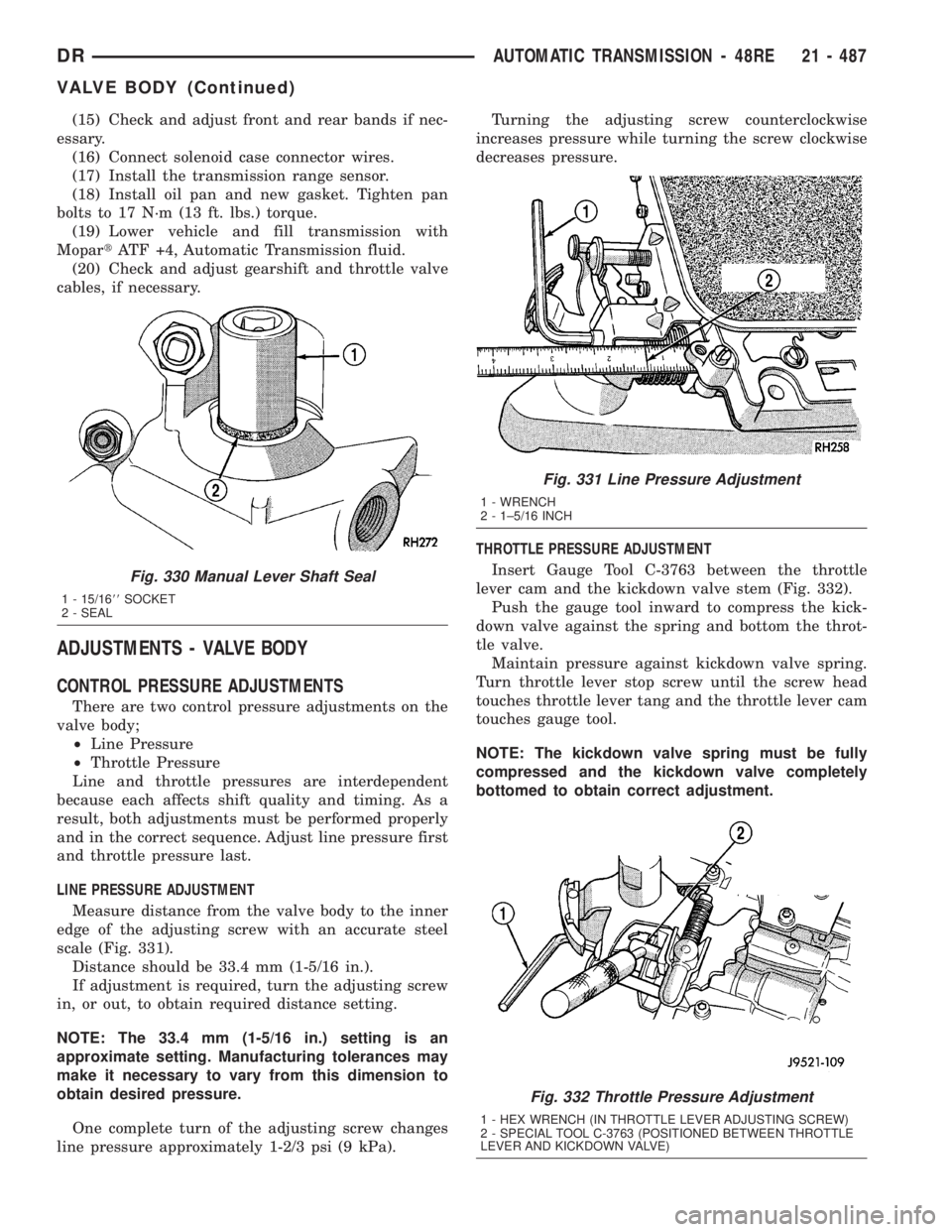
LINE PRESSURE ADJUSTMENT
Measure distance from the valve body to the inner
edge of the adjusting screw with an accurate steel
scale (Fig. 331).
Distance should be 33.4 mm (1-5/16 in.).
If adjustment is required, turn the adjusting screw
in, or out, to obtain required distance setting.
NOTE: The 33.4 mm (1-5/16 in.) setting is an
approximate setting. Manufacturing tolerances may
make it necessary to vary from this dimension to
obtain desired pressure.
One complete turn of the adjusting screw changes
line pressure approximately 1-2/3 psi (9 kPa).Turning the adjusting screw counterclockwise
increases pressure while turning the screw clockwise
decreases pressure.
THROTTLE PRESSURE ADJUSTMENT
Insert Gauge Tool C-3763 between the throttle
lever cam and the kickdown valve stem (Fig. 332).
Push the gauge tool inward to compress the kick-
down valve against the spring and bottom the throt-
tle valve.
Maintain pressure against kickdown valve spring.
Turn throttle lever stop screw until the screw head
touches throttle lever tang and the throttle lever cam
touches gauge tool.
NOTE: The kickdown valve spring must be fully
compressed and the kickdown valve completely
bottomed to obtain correct adjustment.
Fig. 330 Manual Lever Shaft Seal
1 - 15/1688SOCKET
2 - SEAL
Fig. 331 Line Pressure Adjustment
1 - WRENCH
2 - 1±5/16 INCH
Fig. 332 Throttle Pressure Adjustment
1 - HEX WRENCH (IN THROTTLE LEVER ADJUSTING SCREW)
2 - SPECIAL TOOL C-3763 (POSITIONED BETWEEN THROTTLE
LEVER AND KICKDOWN VALVE)
DRAUTOMATIC TRANSMISSION - 48RE 21 - 487
VALVE BODY (Continued)
Page 2833 of 2895
verter. The PCM calculates the A/F mixture from the
output of the O2S. A low voltage indicates high oxy-
gen content (lean mixture). A high voltage indicates a
low content of oxygen (rich mixture).
When the upstream O2S detects a lean condition,
there is an abundance of oxygen in the exhaust gas.
A functioning converter would store this oxygen so it
can use it for the oxidation of HC and CO. As the
converter absorbs the oxygen, there will be a lack of
oxygen downstream of the converter. The output of
the downstream O2S will indicate limited activity in
this condition.
As the converter loses the ability to store oxygen,
the condition can be detected from the behavior of
the downstream O2S. When the efficiency drops, no
chemical reaction takes place. This means the con-
centration of oxygen will be the same downstream as
upstream. The output voltage of the downstream
O2S copies the voltage of the upstream sensor. The
only difference is a time lag (seen by the PCM)
between the switching of the O2S's.
To monitor the system, the number of lean-to-rich
switches of upstream and downstream O2S's is
counted. The ratio of downstream switches to
upstream switches is used to determine whether the
catalyst is operating properly. An effective catalyst
will have fewer downstream switches than it has
upstream switches i.e., a ratio closer to zero. For a
totally ineffective catalyst, this ratio will be one-to-
one, indicating that no oxidation occurs in the device.
The system must be monitored so that when cata-
lyst efficiency deteriorates and exhaust emissions
increase to over the legal limit, the MIL will be illu-
minated.
DESCRIPTION - TRIP DEFINITION
The term ªTripº has different meanings depending
on what the circumstances are. If the MIL (Malfunc-
tion Indicator Lamp) is OFF, a Trip is defined as
when the Oxygen Sensor Monitor and the Catalyst
Monitor have been completed in the same drive cycle.
When any Emission DTC is set, the MIL on the
dash is turned ON. When the MIL is ON, it takes 3
good trips to turn the MIL OFF. In this case, it
depends on what type of DTC is set to know what a
ªTripº is.
For the Fuel Monitor or Mis-Fire Monitor (contin-
uous monitor), the vehicle must be operated in the
ªSimilar Condition Windowº for a specified amount of
time to be considered a Good Trip.
If a Non-Contiuous OBDII Monitor fails twice in a
row and turns ON the MIL, re-running that monitor
which previously failed, on the next start-up and
passing the monitor, is considered to be a Good Trip.
These will include the following:
²Oxygen Sensor²Catalyst Monitor
²Purge Flow Monitor
²Leak Detection Pump Monitor (if equipped)
²EGR Monitor (if equipped)
²Oxygen Sensor Heater Monitor
If any other Emission DTC is set (not an OBDII
Monitor), a Good Trip is considered to be when the
Oxygen Sensor Monitor and Catalyst Monitor have
been completed; or 2 Minutes of engine run time if
the Oxygen Sensor Monitor or Catalyst Monitor have
been stopped from running.
It can take up to 2 Failures in a row to turn on the
MIL. After the MIL is ON, it takes 3 Good Trips to
turn the MIL OFF. After the MIL is OFF, the PCM
will self-erase the DTC after 40 Warm-up cycles. A
Warm-up cycle is counted when the ECT (Engine
Coolant Temperature Sensor) has crossed 160ÉF and
has risen by at least 40ÉF since the engine has been
started.
DESCRIPTION - COMPONENT MONITORS
There are several components that will affect vehi-
cle emissions if they malfunction. If one of these com-
ponents malfunctions the Malfunction Indicator
Lamp (MIL) will illuminate.
Some of the component monitors are checking for
proper operation of the part. Electrically operated
components now have input (rationality) and output
(functionality) checks. Previously, a component like
the Throttle Position sensor (TPS) was checked by
the PCM for an open or shorted circuit. If one of
these conditions occurred, a DTC was set. Now there
is a check to ensure that the component is working.
This is done by watching for a TPS indication of a
greater or lesser throttle opening than MAP and
engine rpm indicate. In the case of the TPS, if engine
vacuum is high and engine rpm is 1600 or greater,
and the TPS indicates a large throttle opening, a
DTC will be set. The same applies to low vacuum if
the TPS indicates a small throttle opening.
All open/short circuit checks, or any component
that has an associated limp-in, will set a fault after 1
trip with the malfunction present. Components with-
out an associated limp-in will take two trips to illu-
minate the MIL.
OPERATION
OPERATION
The Powertrain Control Module (PCM) monitors
many different circuits in the fuel injection, ignition,
emission and engine systems. If the PCM senses a
problem with a monitored circuit often enough to
indicate an actual problem, it stores a Diagnostic
Trouble Code (DTC) in the PCM's memory. If the
25 - 4 EMISSIONS CONTROLDR
EMISSIONS CONTROL (Continued)
Page 2837 of 2895
²Upstream O2S VoltsÐ A live reading of the
Oxygen Sensor to indicate its performance. For
example, stuck lean, stuck rich, etc.
²SCW Time in Window (Similar Conditions
Window Time in Window)Ð A timer used by the
PCM that indicates that, after all Similar Conditions
have been met, if there has been enough good engine
running time in the SCW without failure detected.
This timer is used to increment a Good Trip.
²Fuel System Good Trip CounterÐATrip
Counter used to turn OFF the MIL for Fuel System
DTCs. To increment a Fuel System Good Trip, the
engine must be in the Similar Conditions Window,
Adaptive Memory Factor must be less than cali-
brated threshold and the Adaptive Memory Factor
must stay below that threshold for a calibrated
amount of time.
²Test Done This TripÐ Indicates that the
monitor has already been run and completed during
the current trip.
MISFIRE
²Same Misfire Warm-Up StateÐ Indicates if
the misfire occurred when the engine was warmed up
(above 160É F).
²In Similar Misfire WindowÐ An indicator
that 'Absolute MAP When Misfire Occurred' and
'RPM When Misfire Occurred' are all in the same
range when the failure occurred. Indicated by switch-
ing from 'NO' to 'YES'.
²Absolute MAP When Misfire OccurredÐ
The stored MAP reading at the time of failure.
Informs the user at what engine load the failure
occurred.
²Absolute MAPÐ A live reading of engine load
to aid the user in accessing the Similar Conditions
Window.
²RPM When Misfire OccurredÐ The stored
RPM reading at the time of failure. Informs the user
at what engine RPM the failure occurred.
²Engine RPMÐ A live reading of engine RPM
to aid the user in accessing the Similar Conditions
Window.
²Adaptive Memory FactorÐ The PCM utilizes
both Short Term Compensation and Long Term Adap-
tive to calculate the Adaptive Memory Factor for
total fuel correction.
²200 Rev CounterÐ Counts 0±100 720 degree
cycles.
²SCW Cat 200 Rev CounterÐ Counts when in
similar conditions.
²SCW FTP 1000 Rev CounterÐ Counts 0±4
when in similar conditions.
²Misfire Good Trip CounterÐ Counts up to
three to turn OFF the MIL.
²Misfire DataÐ Data collected during test.²Test Done This TripÐ Indicates YES when the
test is done.
OPERATION - NON-MONITORED CIRCUITS
The PCM does not monitor the following circuits,
systems and conditions that could have malfunctions
causing driveability problems. The PCM might not
store diagnostic trouble codes for these conditions.
However, problems with these systems may cause the
PCM to store diagnostic trouble codes for other sys-
tems or components.EXAMPLE:a fuel pressure
problem will not register a fault directly, but could
cause a rich/lean condition or misfire. This could
cause the PCM to store an oxygen sensor or misfire
diagnostic trouble code
FUEL PRESSURE
The fuel pressure regulator controls fuel system
pressure. The PCM cannot detect a clogged fuel
pump inlet filter, clogged in-line fuel filter, or a
pinched fuel supply or return line. However, these
could result in a rich or lean condition causing the
PCM to store an oxygen sensor or fuel system diag-
nostic trouble code.
SECONDARY IGNITION CIRCUIT
The PCM cannot detect an inoperative ignition coil,
fouled or worn spark plugs, ignition cross firing, or
open spark plug cables.
CYLINDER COMPRESSION
The PCM cannot detect uneven, low, or high engine
cylinder compression.
EXHAUST SYSTEM
The PCM cannot detect a plugged, restricted or
leaking exhaust system, although it may set a fuel
system fault.
FUEL INJECTOR MECHANICAL MALFUNCTIONS
The PCM cannot determine if a fuel injector is
clogged, the needle is sticking or if the wrong injector
is installed. However, these could result in a rich or
lean condition causing the PCM to store a diagnostic
trouble code for either misfire, an oxygen sensor, or
the fuel system.
EXCESSIVE OIL CONSUMPTION
Although the PCM monitors engine exhaust oxygen
content when the system is in closed loop, it cannot
determine excessive oil consumption.
THROTTLE BODY AIR FLOW
The PCM cannot detect a clogged or restricted air
cleaner inlet or filter element.
25 - 8 EMISSIONS CONTROLDR
EMISSIONS CONTROL (Continued)
Page 2860 of 2895
BRAKE SYSTEM - DIAGNOSIS AND
TESTING, BASE........................5-2
BRAKE TRANSMISSION SHIFT
INTERLOCK - ADJUSTMENTS . . . 21-195,21-376,
21-540
BRAKE TRANSMISSION SHIFT
INTERLOCK - DIAGNOSIS AND
TESTING..............21-195,21-375,21-540
BRAKE TRANSMISSION SHIFT
INTERLOCK SYSTEM - DESCRIPTION . . . 21-194,
21-375,21-540
BRAKE TRANSMISSION SHIFT
INTERLOCK SYSTEM - OPERATION.....21-194,
21-375,21-540
BRAKE/PARK BRAKE INDICATOR -
DESCRIPTION.......................8J-18
BRAKE/PARK BRAKE INDICATOR -
OPERATION.........................8J-19
BRAKES - ABS - DESCRIPTION...........5-39
BRAKES - ABS - OPERATION............5-39
BRAKES, SPECIAL TOOLS - BASE.........5-5
BREAK-IN - STANDARD PROCEDURE,
A/C COMPRESSOR CLUTCH............24-10
BREATHER - INSTALLATION,
CRANKCASE........................9-292
BREATHER - REMOVAL, CRANKCASE.....9-291
BUCKLE - INSTALLATION, FRONT
OUTBOARD SEAT BELT................8O-34
BUCKLE - REMOVAL, FRONT OUTBOARD
SEAT BELT .........................8O-33
BUILT-IN INDICATOR TEST - STANDARD
PROCEDURE........................8F-10
BUMPER - INSTALLATION, FRONT........13-2
BUMPER - INSTALLATION, JOUNCE.......2-40
BUMPER - INSTALLATION, REAR.........13-4
BUMPER - REMOVAL, FRONT............13-2
BUMPER - REMOVAL, JOUNCE...........2-40
BUMPER - REMOVAL, REAR.............13-4
BUMPERS (3500) - INSTALLATION,
AUXILIARY SPRING....................2-40
BUMPERS (3500) - REMOVAL,
AUXILIARY SPRING....................2-40
BURNT FLUID - DIAGNOSIS AND
TESTING, CAUSES OF....21-201,21-381,21-541
BUSHING - INSTALLATION.............19-18
BUSHING - INSTALLATION,
DISTRIBUTOR.......................9-258
BUSHING - INSTALLATION, EXTENSION
HOUSING..........................21-200
BUSHING - INSTALLATION, TORSION
BAR CROSS MEMBER..................2-14
BUSHING - REMOVAL.................19-18
BUSHING - REMOVAL, DISTRIBUTOR.....9-258
BUSHING - REMOVAL, EXTENSION
HOUSING..........................21-200
BUSHING - REMOVAL, TORSION BAR
CROSSMEMBER......................2-12
BUSHING AND SEAL - INSTALLATION,
EXTENSION HOUSING..........21-616,21-682
BUSHING AND SEAL - REMOVAL,
EXTENSION HOUSING..........21-616,21-682
BUSHINGS - 2WD (LD) - INSTALLATION,
LOWER CONTROL ARM................2-14
BUSHINGS - 2WD (LD) - REMOVAL,
LOWER CONTROL ARM................2-12
BUSHINGS - 4WD (LD) - INSTALLATION,
LOWER CONTROL ARM
................2-13
BUSHINGS - 4WD (LD) - REMOVAL,
LOWER CONTROL ARM
................2-12
BUSHINGS - INSTALLATION
.............2-39
BUSHINGS - REMOVAL
.................2-39
BUZZ, SQUEAK & RATTLE - STANDARD
PROCEDURE
........................23-11
BYPASS - DESCRIPTION, WATER PUMP
. . . 7-64
BYPASS - OPERATION, WATER PUMP
.....7-65
BYPASS HOSE WITH AIR CONDITIONING
- INSTALLATION, WATER PUMP
..........7-70
BYPASS HOSE WITH AIR CONDITIONING
- REMOVAL, WATER PUMP
..............7-68
BYPASS HOSE WITHOUT AIR
CONDITIONING - INSTALLATION,
WATER PUMP
........................7-70
BYPASS HOSE WITHOUT AIR
CONDITIONING - REMOVAL, WATER
PUMP
..............................7-69
C205F - ADJUSTMENTS, FRONT AXLE
.....3-21
C205F - DESCRIPTION, FRONT AXLE
......3-18C205F - DIAGNOSIS AND TESTING,
FRONT AXLE.........................3-18
C205F - INSTALLATION, FRONT AXLE.....3-21
C205F - OPERATION, FRONT AXLE........3-18
C205F - REMOVAL, FRONT AXLE.........3-21
C205F - SPECIAL TOOLS, FRONT AXLE....3-30
C205F - SPECIFICATIONS, FRONT AXLE....3-29
CAB - INSTALLATION, QUAD...........8O-32
CAB - INSTALLATION, STANDARD.......8O-31
CAB - REMOVAL, QUAD...............8O-29
CAB - REMOVAL, STANDARD...........8O-28
CAB BACK PANEL TRIM -
INSTALLATION, REAR.................23-70
CAB BACK PANEL TRIM - REMOVAL,
REAR..............................23-70
CAB CLEARANCE LAMP - INSTALLATION . . 8L-10
CAB CLEARANCE LAMP - REMOVAL.....8L-10
CABLE - ADJUSTMENTS, THROTTLE
VALVE ......................21-255,21-432
CABLE - DESCRIPTION.................8P-3
CABLE - DESCRIPTION, ANTENNA BODY . . . 8A-4
CABLE - DESCRIPTION, SPARK PLUG.....8I-33
CABLE - DESCRIPTION, THROTTLE
VALVE ......................21-254,21-432
CABLE - DIAGNOSIS AND TESTING,
ANTENNA BODY......................8A-4
CABLE - DIAGNOSIS AND TESTING,
GEARSHIFT............21-209,21-389,21-544
CABLE - INSTALLATION..................8P-6
CABLE - INSTALLATION, ANTENNA BODY . . 8A-6
CABLE - INSTALLATION, CHECK.........23-15
CABLE - INSTALLATION, FRONT
PARKING BRAKE......................5-32
CABLE - INSTALLATION, GEARSHIFT....21-210,
21-390,21-545
CABLE - INSTALLATION, INSTRUMENT
PANEL ANTENNA......................8A-7
CABLE - INSTALLATION, LEFT REAR......5-33
CABLE - INSTALLATION, REAR PARK
BRAKE..............................5-32
CABLE - INSTALLATION, RIGHT REAR.....5-32
CABLE - INSTALLATION, SPARK PLUG....8I-35
CABLE - INSTALLATION, THROTTLE
CONTROL.....................14-51,14-96
CABLE - OPERATION...................8P-3
CABLE - OPERATION, ANTENNA BODY.....8A-4
CABLE - OPERATION, SPARK PLUG.......8I-33
CABLE - REMOVAL....................8P-3
CABLE - REMOVAL, ANTENNA BODY......8A-6
CABLE - REMOVAL, CHECK.............23-15
CABLE - REMOVAL, FRONT PARKING
BRAKE..............................5-31
CABLE - REMOVAL, GEARSHIFT . 21-209,21-389,
21-544
CABLE - REMOVAL, INSTRUMENT PANEL
ANTENNA...........................8A-6
CABLE - REMOVAL, LEFT REAR..........5-32
CABLE - REMOVAL, REAR PARK BRAKE . . . 5-31
CABLE - REMOVAL, RIGHT REAR.........5-31
CABLE - REMOVAL, SPARK PLUG........8I-34
CABLE - REMOVAL, THROTTLE
CONTROL.....................14-49,14-94
CABLE, ADJUSTMENTS - GEARSHIFT . . . 21-211,
21-391,21-546
CABLE ORDER, 8.0L V-10 ENGINE -
SPARK PLUG.........................8I-5
CABLE RESISTANCE, SPECIFICATIONS -
SPARK PLUG.........................8I-5
CABLE ROUTING, 5.7L V-8 ENGINE -
FIRING ORDER........................8I-4
CABLE/HANDLE ASSEMBLY -
INSTALLATION, LATCH RELEASE........23-47
CABLE/HANDLE ASSEMBLY - REMOVAL,
LATCH RELEASE.....................23-47
CABLES - DESCRIPTION, BATTERY.......8F-14
CABLES - DIAGNOSIS AND TESTING,
BATTERY...........................8F-15
CABLES - DIAGNOSIS AND TESTING,
SPARK PLUG........................8I-33
CABLES - INSTALLATION, BATTERY......8F-17
CABLES - OPERATION, BATTERY........8F-14
CABLES - REMOVAL, BATTERY
..........8F-16
CALIBRATION - STANDARD PROCEDURE,
COMPASS
...........................8M-3
CALIPER ADAPTER MOUNT -
INSTALLATION, DISC BRAKE
............5-17
CALIPERS - DESCRIPTION, DISC BRAKE
. . . 5-11
CALIPERS - OPERATION, DISC BRAKE
.....5-12CAM BORE REPAIR - STANDARD
PROCEDURE........................9-315
CAMBER AND CASTER ADJUSTMENT -
STANDARD PROCEDURE.................2-4
CAMBER, CASTER AND TOE
ADJUSTMENT - STANDARD
PROCEDURE..........................2-4
CAM/OVERDRIVE PISTON RETAINER -
ASSEMBLY, OVERRUNNING CLUTCH....21-239,
21-416
CAM/OVERDRIVE PISTON RETAINER -
CLEANING, OVERRUNNING CLUTCH....21-238,
21-416
CAM/OVERDRIVE PISTON RETAINER -
DESCRIPTION, OVERRUNNING CLUTCH . 21-237,
21-415
CAM/OVERDRIVE PISTON RETAINER -
DISASSEMBLY, OVERRUNNING
CLUTCH.....................21-238,21-415
CAM/OVERDRIVE PISTON RETAINER -
INSPECTION, OVERRUNNING CLUTCH . . 21-238,
21-416
CAM/OVERDRIVE PISTON RETAINER -
OPERATION, OVERRUNNING CLUTCH . . . 21-237,
21-415
CAMSHAFT - INSTALLATION . 9-201,9-250,9-320,
9-381
CAMSHAFT - REMOVAL.....9-200,9-250,9-317,
9-380
CAMSHAFT BEARINGS - INSTALLATION . . 9-320,
9-381
CAMSHAFT BEARINGS - REMOVAL . 9-317,9-380
CAMSHAFT CORE HOLE PLUG -
INSTALLATION.......................9-201
CAMSHAFT CORE HOLE PLUG -
REMOVAL............................9-200
CAMSHAFT POSITION SENSOR -
DESCRIPTION.......................14-82
CAMSHAFT POSITION SENSOR -
DESCRIPTION.........................8I-8
CAMSHAFT POSITION SENSOR -
INSTALLATION.......................14-83
CAMSHAFT POSITION SENSOR -
INSTALLATION.......................8I-14
CAMSHAFT POSITION SENSOR -
OPERATION.........................14-82
CAMSHAFT POSITION SENSOR -
OPERATION..........................8I-8
CAMSHAFT POSITION SENSOR -
REMOVAL..........................14-83
CAMSHAFT POSITION SENSOR -
REMOVAL...........................8I-11
CAMSHAFT(S) - DESCRIPTION.......9-24,9-34
CAMSHAFT(S) - INSTALLATION......9-25,9-35
CAMSHAFT(S) - LEFT - DESCRIPTION....9-113
CAMSHAFT(S) - LEFT - INSTALLATION....9-114
CAMSHAFT(S) - LEFT - REMOVAL.......9-113
CAMSHAFT(S) - REMOVAL..........9-24,9-34
CAMSHAFT(S) - RIGHT - DESCRIPTION . . . 9-117
CAMSHAFT(S) - RIGHT - INSTALLATION . . 9-118
CAMSHAFT(S) - RIGHT - REMOVAL......9-117
CANISTER - DESCRIPTION, VAPOR......25-22
CANISTER - INSTALLATION, VAPOR......25-23
CANISTER - OPERATION, VAPOR........25-22
CANISTER - REMOVAL, VAPOR..........25-22
CAP - 5.9L V-8 - DIAGNOSIS AND
TESTING, DISTRIBUTOR...............8I-18
CAP - DESCRIPTION, FUEL FILLER.......25-13
CAP - DESCRIPTION, RADIATOR
PRESSURE..........................7-60
CAP - DIAGNOSIS AND TESTING,
RADIATOR...........................7-61
CAP - OPERATION, FUEL FILLER........25-13
CAP - OPERATION, RADIATOR
PRESSURE..........................7-61
CAPACITIES, SPECIFICATIONS - FLUID......0-5
CAPACITOR - DESCRIPTION, IGNITION
COIL...............................8I-33
CAPACITOR - INSTALLATION, IGNITION
COIL...............................8I-33
CAPACITOR - OPERATION, IGNITION
COIL
...............................8I-33
CAPACITOR - REMOVAL, IGNITION COIL
. . . 8I-33
CAPACITY - SPECIFICATIONS, CHARGE
. . . 24-35
CAP-TO-FILLER NECK SEAL -
DIAGNOSIS AND TESTING, RADIATOR
.....7-61
CARDAN UNIVERSAL JOINTS -
ASSEMBLY, SINGLE
.....................3-9
DRINDEX 5
Description Group-Page Description Group-Page Description Group-Page
Page 2863 of 2895
COMPUTER - INSTALLATION, COMPASS/
MINI-TRIP..........................8M-7
COMPUTER - OPERATION, COMPASS/
MINI-TRIP..........................8M-7
COMPUTER - REMOVAL, COMPASS/
MINI-TRIP..........................8M-7
CONDENSER - DESCRIPTION, A/C.......24-39
CONDENSER - OPERATION, A/C.........24-39
CONDENSER FAN (GAS ENGINE ONLY -
3.7, 4.7 & 5.7L) - INSTALLATION........24-43
CONDENSER FAN (GAS ENGINE ONLY -
3.7, 4.7 & 5.7L) - REMOVAL............24-43
CONDITIONER - DESCRIPTION, HEATER
AND AIR ............................24-1
CONDITIONER - OPERATION, HEATER
AND AIR ............................24-1
CONDITIONING - INSTALLATION, WATER
PUMP BYPASS HOSE WITH AIR..........7-70
CONDITIONING - INSTALLATION, WATER
PUMP BYPASS HOSE WITHOUT AIR......7-70
CONDITIONING - REMOVAL, WATER
PUMP BYPASS HOSE WITH AIR..........7-68
CONDITIONING - REMOVAL, WATER
PUMP BYPASS HOSE WITHOUT AIR......7-69
CONDITIONS - DIAGNOSIS AND
TESTING, CHIME......................8B-2
CONDITIONS - DIAGNOSIS AND
TESTING, SPARK PLUG................8I-27
CONFIGURING A NEW MODULE /
SWITCH OPERATING MODES,
STANDARD PROCEDURE...............8Q-3
CONNECT FITTING - DESCRIPTION,
QUICK..............................14-8
CONNECTING ROD - CLEANING, PISTON . . 9-331
CONNECTING ROD - CLEANING, PISTON . . 9-138,
9-206,9-261,9-389
CONNECTING ROD - DESCRIPTION,
PISTON....9-137,9-205,9-260,9-329,9-388,9-47
CONNECTING ROD - INSPECTION........9-332
CONNECTING ROD - INSPECTION,
PISTON.............9-138,9-206,9-261,9-389
CONNECTING ROD - INSTALLATION,
PISTON.............9-139,9-207,9-261,9-389
CONNECTING ROD - REMOVAL, PISTON . . 9-137,
9-205,9-261,9-330,9-389
CONNECTING ROD BEARING AND
CRANKSHAFT JOURNAL CLEARANCE -
STANDARD PROCEDURE...............9-321
CONNECTING ROD BEARING FITTING -
STANDARD PROCEDURE.....9-128,9-251,9-382
CONNECTING ROD BEARING FITTING,
STANDARD PROCEDURE................9-48
CONNECTOR - DESCRIPTION, DATA LINK . . 8E-3
CONNECTOR - INSTALLATION.......8W-01-11
CONNECTOR - OPERATION, DATA LINK....8E-3
CONNECTOR - REMOVAL...........8W-01-11
CONNECTOR, GROUND AND SPLICE
INFORMATION - DESCRIPTION........8W-01-7
CONNECTOR/GROUND/SPLICE LOCATION
- DESCRIPTION....................8W-91-1
CONSOLE - DESCRIPTION, OVERHEAD....8M-1
CONSOLE - DIAGNOSIS AND TESTING,
OVERHEAD..........................8M-2
CONSOLE - INSTALLATION, FLOOR......23-68
CONSOLE - OPERATION, OVERHEAD
......8M-2
CONSOLE - REMOVAL, FLOOR
..........23-68
CONSOLE REMOVAL, REMOVAL -
OVERHEAD
..........................8M-5
CONSOLE, SPECIAL TOOLS - OVERHEAD
. . 8M-6
CONTAINER-3.7L/4.7L - DESCRIPTION,
COOLANT DEGAS
.....................7-38
CONTAINER-3.7L/4.7L - INSTALLATION,
COOLANT DEGAS
.....................7-39
CONTAINER-3.7L/4.7L - OPERATION,
COOLANT DEGAS
.....................7-38
CONTAINER-3.7L/4.7L - REMOVAL,
COOLANT DEGAS
.....................7-39
CONTAINER-5.9L - DESCRIPTION,
COOLANT RECOVERY
..................7-38
CONTAINER-5.9L - INSTALLATION,
COOLANT RECOVERY
..................7-38
CONTAINER-5.9L - OPERATION,
COOLANT RECOVERY
..................7-38
CONTAINER-5.9L - REMOVAL, COOLANT
RECOVERY
..........................7-38
CONTAMINATION - DIAGNOSIS AND
TESTING, BRAKE FLUID
................5-18CONTAMINATION - DIAGNOSIS AND
TESTING, FLUID........21-201,21-381,21-541
CONTINUITY - STANDARD PROCEDURE,
TESTING.........................8W-01-9
CONTOLLED VISCOUS FAN DRIVE -
DIAGNOSIS AND TESTING,
ELECTRONICLY.......................7-56
CONTROL ACTUATOR - DESCRIPTION,
FUEL..............................14-85
CONTROL ACTUATOR - INSTALLATION,
FUEL..............................14-85
CONTROL ACTUATOR - OPERATION,
FUEL..............................14-85
CONTROL ACTUATOR - REMOVAL, FUEL . . 14-85
CONTROL ARM - INSTALLATION, UPPER . . . 2-27
CONTROL ARM - REMOVAL, UPPER......2-27
CONTROL ARM BUSHINGS - 2WD (LD) -
INSTALLATION, LOWER.................2-14
CONTROL ARM BUSHINGS - 2WD (LD) -
REMOVAL, LOWER....................2-12
CONTROL ARM BUSHINGS - 4WD (LD) -
INSTALLATION, LOWER.................2-13
CONTROL ARM BUSHINGS - 4WD (LD) -
REMOVAL, LOWER....................2-12
CONTROL CABLE - INSTALLATION,
THROTTLE.....................14-51,14-96
CONTROL CABLE - REMOVAL,
THROTTLE.....................14-49,14-94
CONTROL INFORMATION (VECI) -
DESCRIPTION, VEHICLE EMISSION.....Intro.-3
CONTROL MODULE - DESCRIPTION,
AIRBAG............................8O-10
CONTROL MODULE - DESCRIPTION,
FRONT...........................8W-97-4
CONTROL MODULE - DESCRIPTION,
FRONT..............................8E-5
CONTROL MODULE - DESCRIPTION,
SIDE IMPACT AIRBAG.................8O-53
CONTROL MODULE - DESCRIPTION,
TRANSFER CASE.....................8E-15
CONTROL MODULE - DESCRIPTION,
TRANSMISSION......................8E-19
CONTROL MODULE - DIAGNOSIS AND
TESTING, FRONT...................8W-97-5
CONTROL MODULE - DIAGNOSIS AND
TESTING, FRONT......................8E-6
CONTROL MODULE - INSTALLATION,
AIRBAG............................8O-12
CONTROL MODULE - INSTALLATION,
ENGINE.............................8E-5
CONTROL MODULE - INSTALLATION,
FRONT...........................8W-97-5
CONTROL MODULE - INSTALLATION,
FRONT..............................8E-6
CONTROL MODULE - OPERATION,
AIRBAG............................8O-10
CONTROL MODULE - OPERATION,
FRONT...........................8W-97-5
CONTROL MODULE - OPERATION,
FRONT..............................8E-5
CONTROL MODULE - OPERATION, SIDE
IMPACT AIRBAG.....................8O-54
CONTROL MODULE - OPERATION,
TRANSFER CASE.....................8E-15
CONTROL MODULE - OPERATION,
TRANSMISSION......................8E-19
CONTROL MODULE - REMOVAL, AIRBAG
. 8O-11
CONTROL MODULE - REMOVAL, ENGINE
. . . 8E-4
CONTROL MODULE - REMOVAL, FRONT
. 8W-97-5
CONTROL MODULE - REMOVAL, FRONT
. . . 8E-6
CONTROL MOTOR - DESCRIPTION, IDLE
AIR
...............................14-33
CONTROL MOTOR - INSTALLATION, IDLE
AIR
...............................14-35
CONTROL MOTOR - OPERATION, IDLE
AIR
...............................14-33
CONTROL MOTOR - REMOVAL, IDLE AIR
. . 14-34
CONTROL RELAY - DESCRIPTION,
TRANSMISSION
.....................21-581
CONTROL RELAY - OPERATION,
TRANSMISSION
.....................21-581
CONTROL SWITCH - DESCRIPTION,
LUMBAR
...........................8N-19
CONTROL SWITCH - OPERATION,
LUMBAR
...........................8N-19
CONTROL SWITCH - REMOVAL,
LUMBAR
...........................8N-19CONTROLLER ANTILOCK BRAKE -
DESCRIPTION........................8E-3
CONTROLLER ANTILOCK BRAKE -
INSTALLATION........................8E-3
CONTROLLER ANTILOCK BRAKE -
OPERATION..........................8E-3
CONTROLLER ANTILOCK BRAKE -
REMOVAL...........................8E-3
CONTROLS - DIAGNOSIS AND TESTING,
OVERDRIVE ELECTRICAL.......21-219,21-397
CONVERTER - DESCRIPTION, CATALYTIC . . . 11-4
CONVERTER - DESCRIPTION, TORQUE . . 21-257,
21-434,21-575
CONVERTER - INSTALLATION, TORQUE . . 21-262,
21-439,21-580
CONVERTER - OPERATION, CATALYTIC....11-4
CONVERTER - OPERATION, TORQUE....21-261,
21-438,21-579
CONVERTER - REMOVAL, TORQUE.....21-262,
21-439,21-580
CONVERTER DRAINBACK VALVE -
DESCRIPTION, TORQUE........21-262,21-440
CONVERTER DRAINBACK VALVE -
OPERATION, TORQUE..........21-262,21-440
CONVERTER DRAINBACK VALVE -
STANDARD PROCEDURE, TORQUE.....21-262,
21-440
CONVERTER HOUSING FLUID LEAK -
DIAGNOSIS AND TESTING......21-143,21-324,
21-495
COOLANT - DESCRIPTION, ENGINE.......7-36
COOLANT - DESCRIPTION, ENGINE........0-3
COOLANT - DESCRIPTION, HOAT...........7-37
COOLANT - STANDARD PROCEDURE,
ADDING ADDITIONAL..................7-19
COOLANT DEGAS CONTAINER-3.7L/4.7L
- DESCRIPTION.......................7-38
COOLANT DEGAS CONTAINER-3.7L/4.7L
- INSTALLATION......................7-39
COOLANT DEGAS CONTAINER-3.7L/4.7L
- OPERATION.........................7-38
COOLANT DEGAS CONTAINER-3.7L/4.7L
- REMOVAL..........................7-39
COOLANT FLOW - DIAGNOSIS AND
TESTING, RADIATOR...............7-57,7-59
COOLANT LEVEL CHECK - STANDARD
PROCEDURE.........................7-17
COOLANT RECOVERY CONTAINER-5.9L -
DESCRIPTION........................7-38
COOLANT RECOVERY CONTAINER-5.9L -
INSTALLATION........................7-38
COOLANT RECOVERY CONTAINER-5.9L -
OPERATION..........................7-38
COOLANT RECOVERY CONTAINER-5.9L -
REMOVAL...........................7-38
COOLANT TEMPERATURE SENSOR -
DESCRIPTION, ENGINE.................7-44
COOLANT TEMPERATURE SENSOR -
INSTALLATION, ENGINE................7-47
COOLANT TEMPERATURE SENSOR -
OPERATION, ENGINE...................7-44
COOLANT TEMPERATURE SENSOR -
REMOVAL, ENGINE
....................7-44
COOLANT THERMOSTAT - 3.7L/4.7L -
DESCRIPTION, ENGINE
.................7-50
COOLANT THERMOSTAT - 3.7L/4.7L -
INSTALLATION, ENGINE
................7-51
COOLANT THERMOSTAT - 3.7L/4.7L -
OPERATION, ENGINE
...................7-51
COOLANT THERMOSTAT - 3.7L/4.7L -
REMOVAL, ENGINE
....................7-51
COOLANT THERMOSTAT - 5.9L DIESEL -
DESCRIPTION, ENGINE
.................7-52
COOLANT THERMOSTAT - 5.9L DIESEL -
INSTALLATION, ENGINE
................7-53
COOLANT THERMOSTAT - 5.9L DIESEL -
OPERATION, ENGINE
...................7-52
COOLANT THERMOSTAT - 5.9L DIESEL -
REMOVAL, ENGINE
....................7-53
COOLANT THERMOSTAT-5.7L/5.9L -
DESCRIPTION, ENGINE
.................7-47
COOLANT THERMOSTAT-5.7L/5.9L -
INSTALLATION, ENGINE
................7-49
COOLANT THERMOSTAT-5.7L/5.9L -
OPERATION, ENGINE
...................7-48
COOLANT THERMOSTAT-5.7L/5.9L -
REMOVAL, ENGINE
....................7-48
8 INDEXDR
Description Group-Page Description Group-Page Description Group-Page