2003 DODGE RAM lock
[x] Cancel search: lockPage 2842 of 2895
REMOVAL
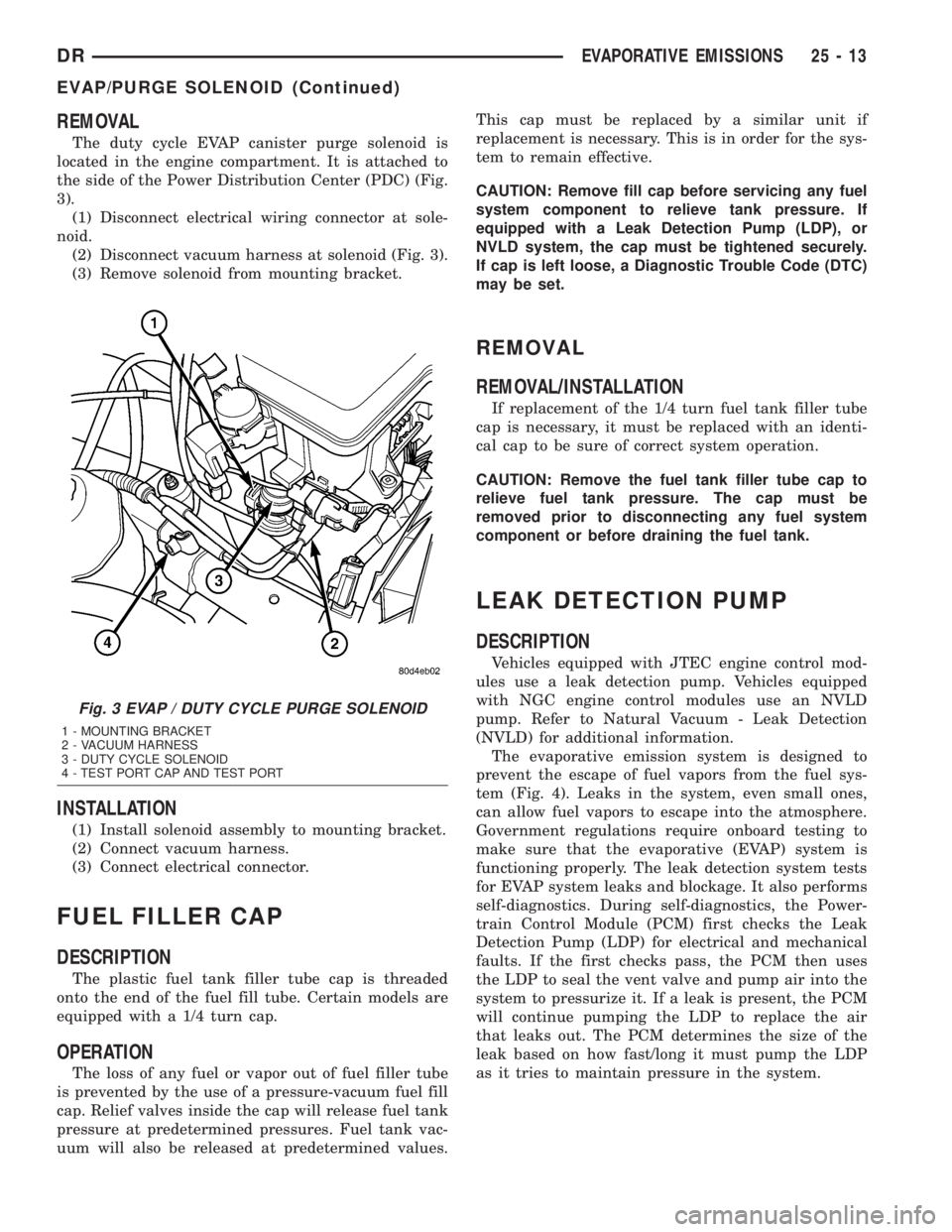
The duty cycle EVAP canister purge solenoid is
located in the engine compartment. It is attached to
the side of the Power Distribution Center (PDC) (Fig.
3).
(1) Disconnect electrical wiring connector at sole-
noid.
(2) Disconnect vacuum harness at solenoid (Fig. 3).
(3) Remove solenoid from mounting bracket.
INSTALLATION
(1) Install solenoid assembly to mounting bracket.
(2) Connect vacuum harness.
(3) Connect electrical connector.
FUEL FILLER CAP
DESCRIPTION
The plastic fuel tank filler tube cap is threaded
onto the end of the fuel fill tube. Certain models are
equipped with a 1/4 turn cap.
OPERATION
The loss of any fuel or vapor out of fuel filler tube
is prevented by the use of a pressure-vacuum fuel fill
cap. Relief valves inside the cap will release fuel tank
pressure at predetermined pressures. Fuel tank vac-
uum will also be released at predetermined values.This cap must be replaced by a similar unit if
replacement is necessary. This is in order for the sys-
tem to remain effective.
CAUTION: Remove fill cap before servicing any fuel
system component to relieve tank pressure. If
equipped with a Leak Detection Pump (LDP), or
NVLD system, the cap must be tightened securely.
If cap is left loose, a Diagnostic Trouble Code (DTC)
may be set.
REMOVAL
REMOVAL/INSTALLATION
If replacement of the 1/4 turn fuel tank filler tube
cap is necessary, it must be replaced with an identi-
cal cap to be sure of correct system operation.
CAUTION: Remove the fuel tank filler tube cap to
relieve fuel tank pressure. The cap must be
removed prior to disconnecting any fuel system
component or before draining the fuel tank.
LEAK DETECTION PUMP
DESCRIPTION
Vehicles equipped with JTEC engine control mod-
ules use a leak detection pump. Vehicles equipped
with NGC engine control modules use an NVLD
pump. Refer to Natural Vacuum - Leak Detection
(NVLD) for additional information.
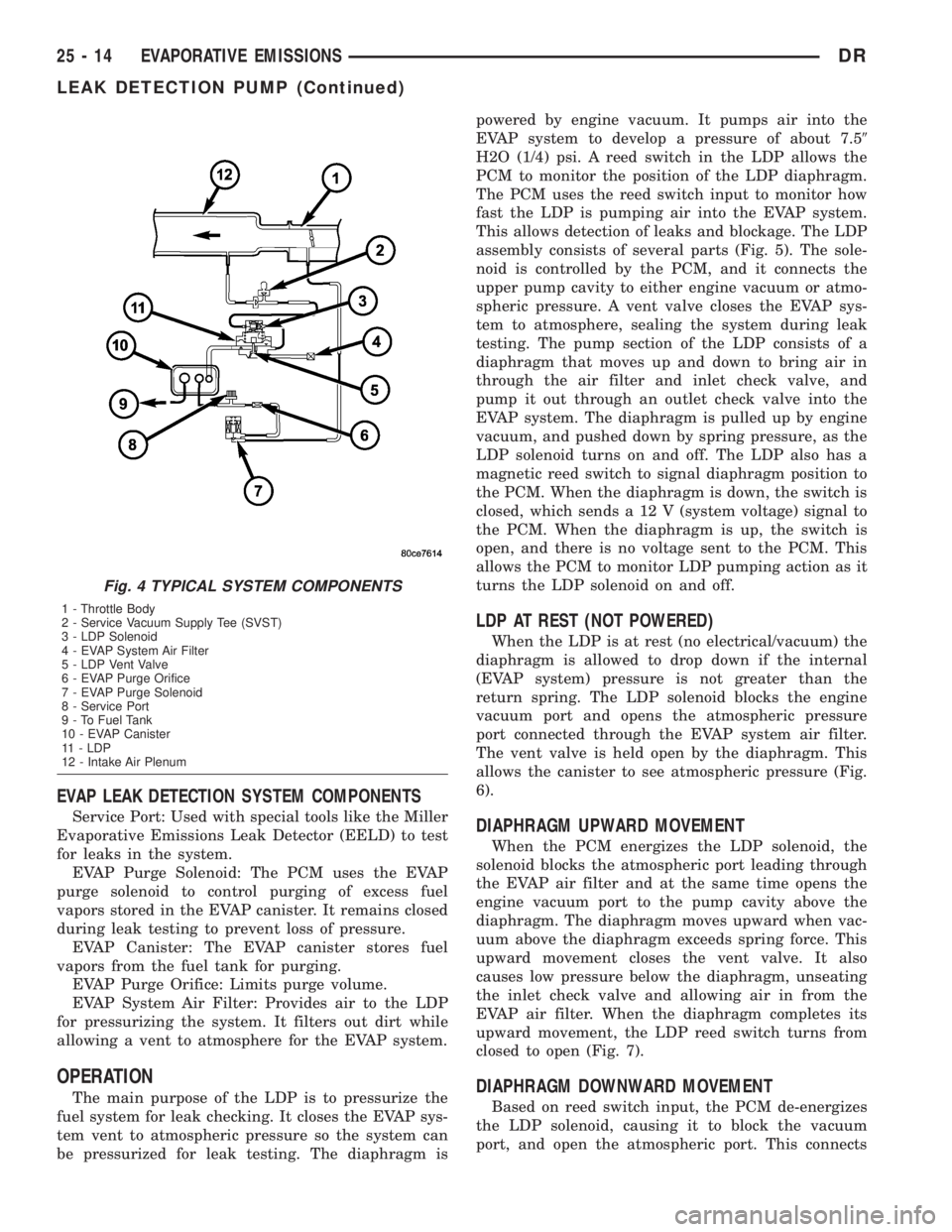
The evaporative emission system is designed to
prevent the escape of fuel vapors from the fuel sys-
tem (Fig. 4). Leaks in the system, even small ones,
can allow fuel vapors to escape into the atmosphere.
Government regulations require onboard testing to
make sure that the evaporative (EVAP) system is
functioning properly. The leak detection system tests
for EVAP system leaks and blockage. It also performs
self-diagnostics. During self-diagnostics, the Power-
train Control Module (PCM) first checks the Leak
Detection Pump (LDP) for electrical and mechanical
faults. If the first checks pass, the PCM then uses
the LDP to seal the vent valve and pump air into the
system to pressurize it. If a leak is present, the PCM
will continue pumping the LDP to replace the air
that leaks out. The PCM determines the size of the
leak based on how fast/long it must pump the LDP
as it tries to maintain pressure in the system.
Fig. 3 EVAP / DUTY CYCLE PURGE SOLENOID
1 - MOUNTING BRACKET
2 - VACUUM HARNESS
3 - DUTY CYCLE SOLENOID
4 - TEST PORT CAP AND TEST PORT
DREVAPORATIVE EMISSIONS 25 - 13
EVAP/PURGE SOLENOID (Continued)
Page 2843 of 2895
EVAP LEAK DETECTION SYSTEM COMPONENTS
Service Port: Used with special tools like the Miller
Evaporative Emissions Leak Detector (EELD) to test
for leaks in the system.
EVAP Purge Solenoid: The PCM uses the EVAP
purge solenoid to control purging of excess fuel
vapors stored in the EVAP canister. It remains closed
during leak testing to prevent loss of pressure.
EVAP Canister: The EVAP canister stores fuel
vapors from the fuel tank for purging.
EVAP Purge Orifice: Limits purge volume.
EVAP System Air Filter: Provides air to the LDP
for pressurizing the system. It filters out dirt while
allowing a vent to atmosphere for the EVAP system.
OPERATION
The main purpose of the LDP is to pressurize the
fuel system for leak checking. It closes the EVAP sys-
tem vent to atmospheric pressure so the system can
be pressurized for leak testing. The diaphragm ispowered by engine vacuum. It pumps air into the
EVAP system to develop a pressure of about 7.59
H2O (1/4) psi. A reed switch in the LDP allows the
PCM to monitor the position of the LDP diaphragm.
The PCM uses the reed switch input to monitor how
fast the LDP is pumping air into the EVAP system.
This allows detection of leaks and blockage. The LDP
assembly consists of several parts (Fig. 5). The sole-
noid is controlled by the PCM, and it connects the
upper pump cavity to either engine vacuum or atmo-
spheric pressure. A vent valve closes the EVAP sys-
tem to atmosphere, sealing the system during leak
testing. The pump section of the LDP consists of a
diaphragm that moves up and down to bring air in
through the air filter and inlet check valve, and
pump it out through an outlet check valve into the
EVAP system. The diaphragm is pulled up by engine
vacuum, and pushed down by spring pressure, as the
LDP solenoid turns on and off. The LDP also has a
magnetic reed switch to signal diaphragm position to
the PCM. When the diaphragm is down, the switch is
closed, which sends a 12 V (system voltage) signal to
the PCM. When the diaphragm is up, the switch is
open, and there is no voltage sent to the PCM. This
allows the PCM to monitor LDP pumping action as it
turns the LDP solenoid on and off.
LDP AT REST (NOT POWERED)
When the LDP is at rest (no electrical/vacuum) the
diaphragm is allowed to drop down if the internal
(EVAP system) pressure is not greater than the
return spring. The LDP solenoid blocks the engine
vacuum port and opens the atmospheric pressure
port connected through the EVAP system air filter.
The vent valve is held open by the diaphragm. This
allows the canister to see atmospheric pressure (Fig.
6).
DIAPHRAGM UPWARD MOVEMENT
When the PCM energizes the LDP solenoid, the
solenoid blocks the atmospheric port leading through
the EVAP air filter and at the same time opens the
engine vacuum port to the pump cavity above the
diaphragm. The diaphragm moves upward when vac-
uum above the diaphragm exceeds spring force. This
upward movement closes the vent valve. It also
causes low pressure below the diaphragm, unseating
the inlet check valve and allowing air in from the
EVAP air filter. When the diaphragm completes its
upward movement, the LDP reed switch turns from
closed to open (Fig. 7).
DIAPHRAGM DOWNWARD MOVEMENT
Based on reed switch input, the PCM de-energizes
the LDP solenoid, causing it to block the vacuum
port, and open the atmospheric port. This connects
Fig. 4 TYPICAL SYSTEM COMPONENTS
1 - Throttle Body
2 - Service Vacuum Supply Tee (SVST)
3 - LDP Solenoid
4 - EVAP System Air Filter
5 - LDP Vent Valve
6 - EVAP Purge Orifice
7 - EVAP Purge Solenoid
8 - Service Port
9 - To Fuel Tank
10 - EVAP Canister
11 - LDP
12 - Intake Air Plenum
25 - 14 EVAPORATIVE EMISSIONSDR
LEAK DETECTION PUMP (Continued)
Page 2846 of 2895
5.7L V-8
The 5.7L V-8 engine is equipped with a closed
crankcase ventilation system and a Positive Crank-
case Ventilation (PCV) valve.
This system consists of:
²a PCV valve mounted into the top of the intake
manifold, located to the right / rear of the throttle
body (Fig. 12). The PCV valve is sealed to the intake
manifold with 2 o-rings (Fig. 13).
²passages in the intake manifold.
²tubes and hoses to connect the system compo-
nents.
5.9L V-8
The 5.9L V-8 engine is equipped with a closed
crankcase ventilation system and a positive crank-
case ventilation (PCV) valve.
This system consists of a PCV valve mounted on
the cylinder head (valve) cover with a hose extending
from the valve to the intake manifold (Fig. 14).
Another hose connects the opposite cylinder head
(valve) cover to the air cleaner housing to provide a
source of clean air for the system. A separate crank-
case breather/filter is not used.
OPERATION
The PCV system operates by engine intake mani-
fold vacuum (Fig. 15). Filtered air is routed into the
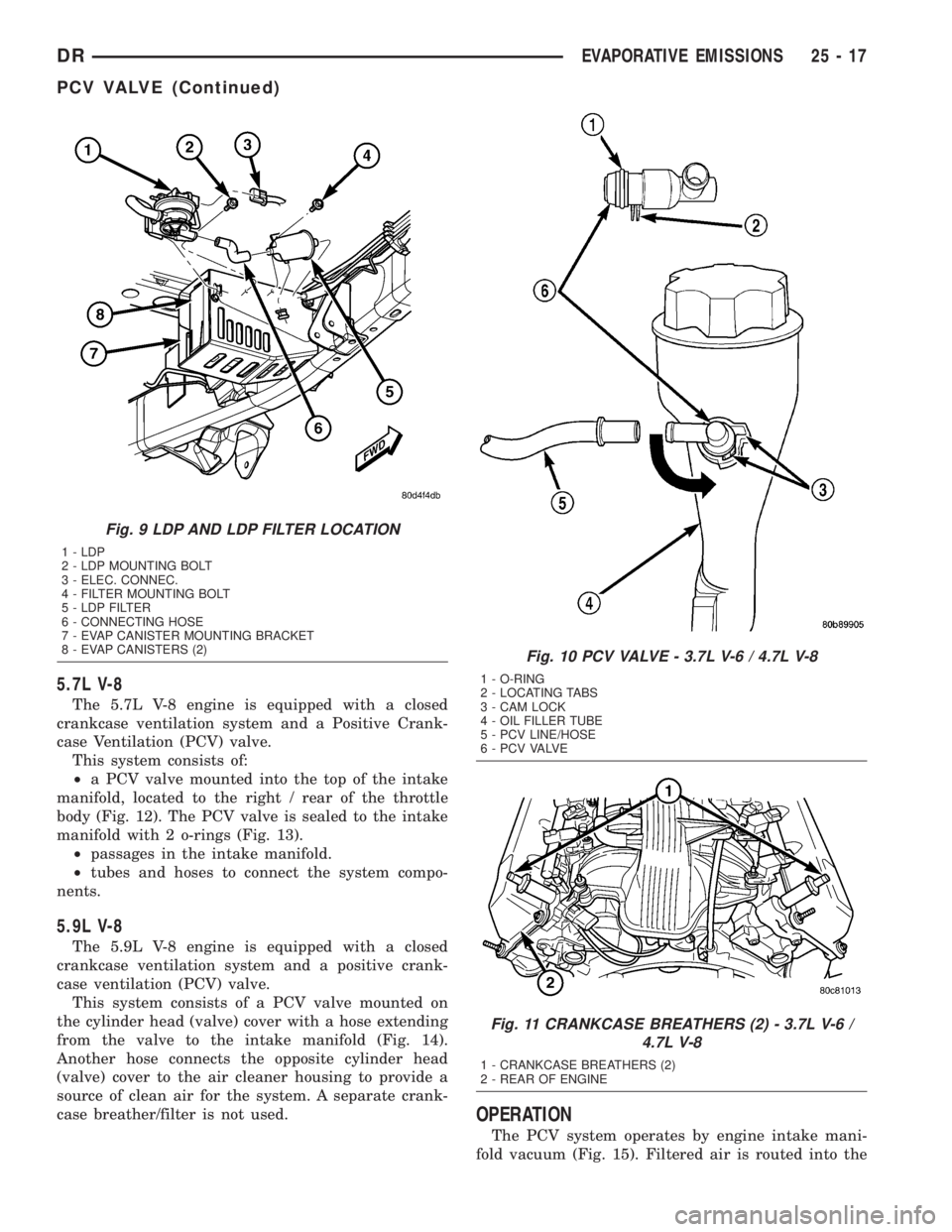
Fig. 9 LDP AND LDP FILTER LOCATION
1 - LDP
2 - LDP MOUNTING BOLT
3 - ELEC. CONNEC.
4 - FILTER MOUNTING BOLT
5 - LDP FILTER
6 - CONNECTING HOSE
7 - EVAP CANISTER MOUNTING BRACKET
8 - EVAP CANISTERS (2)
Fig. 10 PCV VALVE - 3.7L V-6 / 4.7L V-8
1 - O-RING
2 - LOCATING TABS
3 - CAM LOCK
4 - OIL FILLER TUBE
5 - PCV LINE/HOSE
6 - P C V VA LV E
Fig. 11 CRANKCASE BREATHERS (2) - 3.7L V-6 /
4.7L V-8
1 - CRANKCASE BREATHERS (2)
2 - REAR OF ENGINE
DREVAPORATIVE EMISSIONS 25 - 17
PCV VALVE (Continued)
Page 2848 of 2895
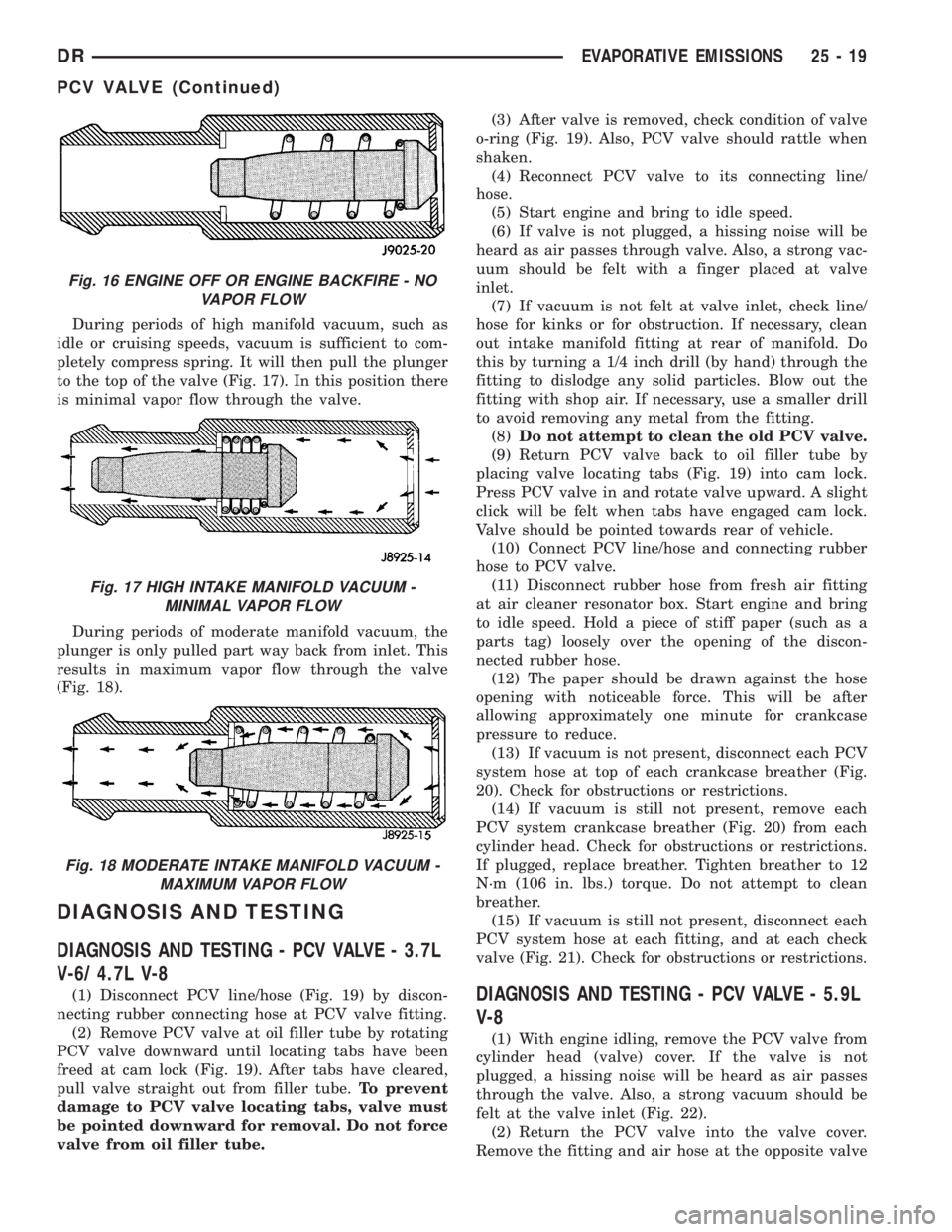
During periods of high manifold vacuum, such as
idle or cruising speeds, vacuum is sufficient to com-
pletely compress spring. It will then pull the plunger
to the top of the valve (Fig. 17). In this position there
is minimal vapor flow through the valve.
During periods of moderate manifold vacuum, the
plunger is only pulled part way back from inlet. This
results in maximum vapor flow through the valve
(Fig. 18).
DIAGNOSIS AND TESTING
DIAGNOSIS AND TESTING - PCV VALVE - 3.7L
V-6/ 4.7L V-8
(1) Disconnect PCV line/hose (Fig. 19) by discon-
necting rubber connecting hose at PCV valve fitting.
(2) Remove PCV valve at oil filler tube by rotating
PCV valve downward until locating tabs have been
freed at cam lock (Fig. 19). After tabs have cleared,
pull valve straight out from filler tube.To prevent
damage to PCV valve locating tabs, valve must
be pointed downward for removal. Do not force
valve from oil filler tube.(3) After valve is removed, check condition of valve
o-ring (Fig. 19). Also, PCV valve should rattle when
shaken.
(4) Reconnect PCV valve to its connecting line/
hose.
(5) Start engine and bring to idle speed.
(6) If valve is not plugged, a hissing noise will be
heard as air passes through valve. Also, a strong vac-
uum should be felt with a finger placed at valve
inlet.
(7) If vacuum is not felt at valve inlet, check line/
hose for kinks or for obstruction. If necessary, clean
out intake manifold fitting at rear of manifold. Do
this by turning a 1/4 inch drill (by hand) through the
fitting to dislodge any solid particles. Blow out the
fitting with shop air. If necessary, use a smaller drill
to avoid removing any metal from the fitting.
(8)Do not attempt to clean the old PCV valve.
(9) Return PCV valve back to oil filler tube by
placing valve locating tabs (Fig. 19) into cam lock.
Press PCV valve in and rotate valve upward. A slight
click will be felt when tabs have engaged cam lock.
Valve should be pointed towards rear of vehicle.
(10) Connect PCV line/hose and connecting rubber
hose to PCV valve.
(11) Disconnect rubber hose from fresh air fitting
at air cleaner resonator box. Start engine and bring
to idle speed. Hold a piece of stiff paper (such as a
parts tag) loosely over the opening of the discon-
nected rubber hose.
(12) The paper should be drawn against the hose
opening with noticeable force. This will be after
allowing approximately one minute for crankcase
pressure to reduce.
(13) If vacuum is not present, disconnect each PCV
system hose at top of each crankcase breather (Fig.
20). Check for obstructions or restrictions.
(14) If vacuum is still not present, remove each
PCV system crankcase breather (Fig. 20) from each
cylinder head. Check for obstructions or restrictions.
If plugged, replace breather. Tighten breather to 12
N´m (106 in. lbs.) torque. Do not attempt to clean
breather.
(15) If vacuum is still not present, disconnect each
PCV system hose at each fitting, and at each check
valve (Fig. 21). Check for obstructions or restrictions.DIAGNOSIS AND TESTING - PCV VALVE - 5.9L
V-8
(1) With engine idling, remove the PCV valve from
cylinder head (valve) cover. If the valve is not
plugged, a hissing noise will be heard as air passes
through the valve. Also, a strong vacuum should be
felt at the valve inlet (Fig. 22).
(2) Return the PCV valve into the valve cover.
Remove the fitting and air hose at the opposite valve
Fig. 16 ENGINE OFF OR ENGINE BACKFIRE - NO
VAPOR FLOW
Fig. 17 HIGH INTAKE MANIFOLD VACUUM -
MINIMAL VAPOR FLOW
Fig. 18 MODERATE INTAKE MANIFOLD VACUUM -
MAXIMUM VAPOR FLOW
DREVAPORATIVE EMISSIONS 25 - 19
PCV VALVE (Continued)
Page 2849 of 2895
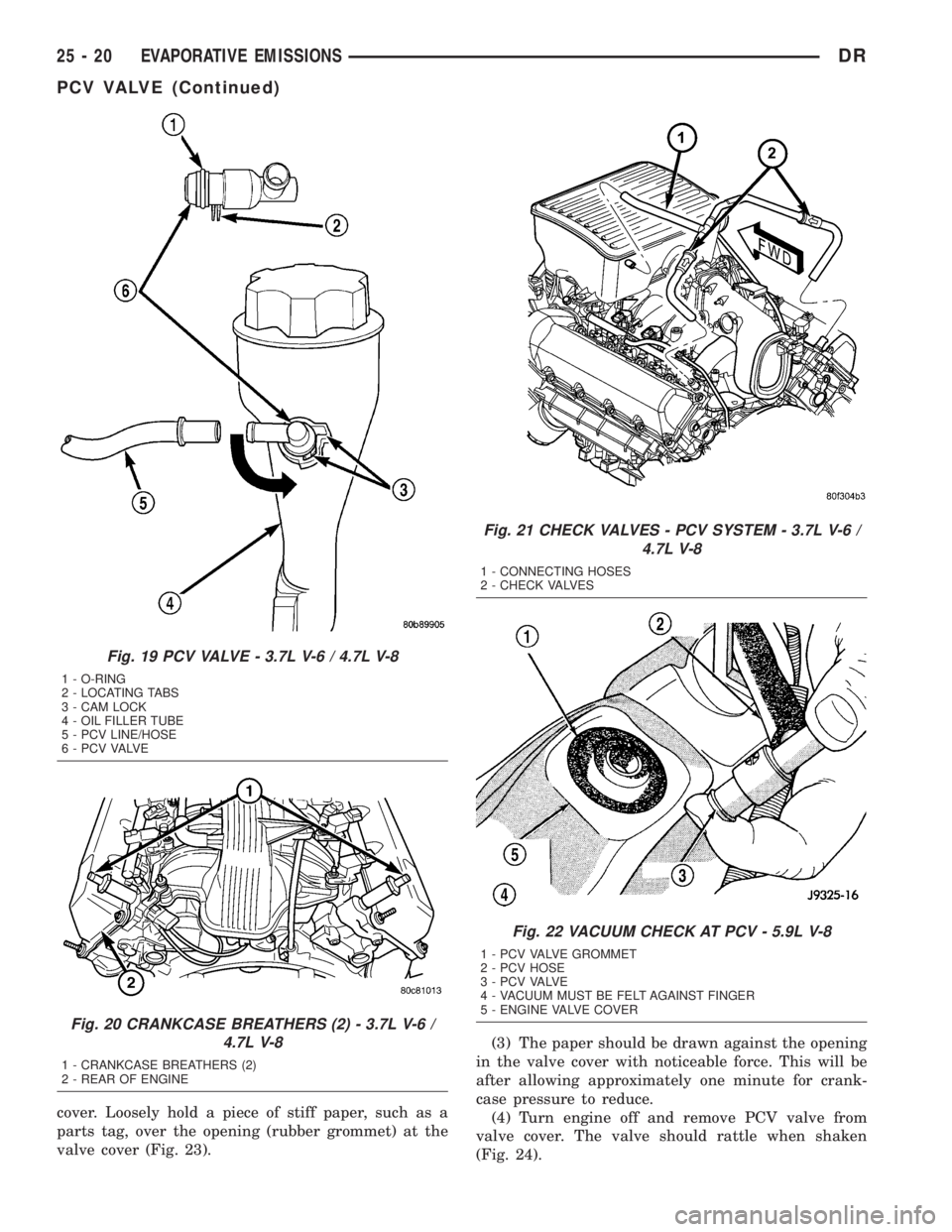
cover. Loosely hold a piece of stiff paper, such as a
parts tag, over the opening (rubber grommet) at the
valve cover (Fig. 23).(3) The paper should be drawn against the opening
in the valve cover with noticeable force. This will be
after allowing approximately one minute for crank-
case pressure to reduce.
(4) Turn engine off and remove PCV valve from
valve cover. The valve should rattle when shaken
(Fig. 24).
Fig. 19 PCV VALVE - 3.7L V-6 / 4.7L V-8
1 - O-RING
2 - LOCATING TABS
3 - CAM LOCK
4 - OIL FILLER TUBE
5 - PCV LINE/HOSE
6 - P C V VA LV E
Fig. 20 CRANKCASE BREATHERS (2) - 3.7L V-6 /
4.7L V-8
1 - CRANKCASE BREATHERS (2)
2 - REAR OF ENGINE
Fig. 21 CHECK VALVES - PCV SYSTEM - 3.7L V-6 /
4.7L V-8
1 - CONNECTING HOSES
2 - CHECK VALVES
Fig. 22 VACUUM CHECK AT PCV - 5.9L V-8
1 - PCV VALVE GROMMET
2 - PCV HOSE
3 - P C V VA LV E
4 - VACUUM MUST BE FELT AGAINST FINGER
5 - ENGINE VALVE COVER
25 - 20 EVAPORATIVE EMISSIONSDR
PCV VALVE (Continued)
Page 2850 of 2895
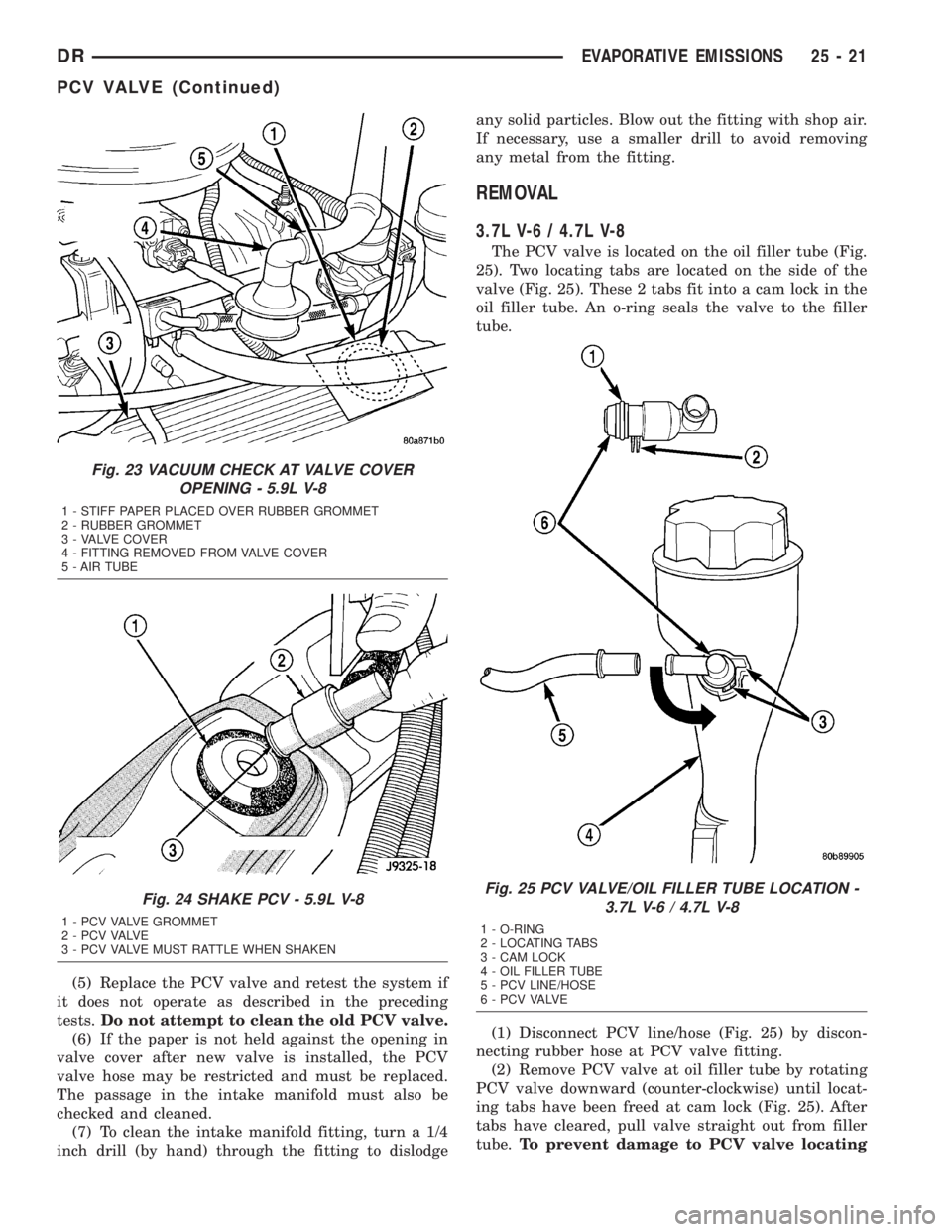
(5) Replace the PCV valve and retest the system if
it does not operate as described in the preceding
tests.Do not attempt to clean the old PCV valve.
(6) If the paper is not held against the opening in
valve cover after new valve is installed, the PCV
valve hose may be restricted and must be replaced.
The passage in the intake manifold must also be
checked and cleaned.
(7) To clean the intake manifold fitting, turn a 1/4
inch drill (by hand) through the fitting to dislodgeany solid particles. Blow out the fitting with shop air.
If necessary, use a smaller drill to avoid removing
any metal from the fitting.
REMOVAL
3.7L V-6 / 4.7L V-8
The PCV valve is located on the oil filler tube (Fig.
25). Two locating tabs are located on the side of the
valve (Fig. 25). These 2 tabs fit into a cam lock in the
oil filler tube. An o-ring seals the valve to the filler
tube.
(1) Disconnect PCV line/hose (Fig. 25) by discon-
necting rubber hose at PCV valve fitting.
(2) Remove PCV valve at oil filler tube by rotating
PCV valve downward (counter-clockwise) until locat-
ing tabs have been freed at cam lock (Fig. 25). After
tabs have cleared, pull valve straight out from filler
tube.To prevent damage to PCV valve locating
Fig. 23 VACUUM CHECK AT VALVE COVER
OPENING - 5.9L V-8
1 - STIFF PAPER PLACED OVER RUBBER GROMMET
2 - RUBBER GROMMET
3 - VALVE COVER
4 - FITTING REMOVED FROM VALVE COVER
5 - AIR TUBE
Fig. 24 SHAKE PCV - 5.9L V-8
1 - PCV VALVE GROMMET
2 - P C V VA LV E
3 - PCV VALVE MUST RATTLE WHEN SHAKEN
Fig. 25 PCV VALVE/OIL FILLER TUBE LOCATION -
3.7L V-6 / 4.7L V-8
1 - O-RING
2 - LOCATING TABS
3 - CAM LOCK
4 - OIL FILLER TUBE
5 - PCV LINE/HOSE
6 - P C V VA LV E
DREVAPORATIVE EMISSIONS 25 - 21
PCV VALVE (Continued)
Page 2851 of 2895

tabs, valve must be pointed downward for
removal. Do not force valve from oil filler tube.
(3) After valve is removed, check condition of valve
o-ring (Fig. 25).
5.7L V-8
The PCV valve is mounted into the top of the
intake manifold, located to the right / rear of the
throttle body (Fig. 12). The PCV valve is sealed to
the intake manifold with 2 o-rings (Fig. 13).
(1) Remove PCV valve by rotating counter-clock-
wise 90 degrees until locating tabs have been freed.
After tabs have cleared, pull valve straight up from
intake manifold.
(2) After valve is removed, check condition of 2
valve o-rings.
INSTALLATION
3.7L V6 / 4.7L V-8
The PCV valve is located on the oil filler tube. Two
locating tabs are located on the side of the valve.
These 2 tabs fit into a cam lock in the oil filler tube.
An o-ring seals the valve to the filler tube.
(1) Return PCV valve back to oil filler tube by
placing valve locating tabs into cam lock. Press PCV
valve in and rotate valve upward. A slight click will
be felt when tabs have engaged cam lock. Valve
should be pointed towards rear of vehicle.
(2) Connect PCV line/hose and rubber hose to PCV
valve.
5.7L V-8
(1) Clean out intake manifold opening.
(2) Check condition of 2 o-rings on PCV valve.
(3) Apply engine oil to 2 o-rings.
(4) Place PCV valve into intake manifold and
rotate 90 degrees clockwise for installation.
VACUUM LINES
DESCRIPTION
A vacuum schematic for emission related items can
be found on the vehicles VECI label. Refer to Vehicle
Emission Control Information (VECI) Label for label
location.
VAPOR CANISTER
DESCRIPTION
Two, maintenance free, EVAP canisters are used.
Both canisters are mounted into a two-piece support
bracket located near the front of the fuel tank (Fig.
26).
OPERATION
Two, maintenance free, EVAP canisters are
used.The EVAP canisters are filled with granules of
an activated carbon mixture. Fuel vapors entering
the EVAP canisters are absorbed by the charcoal
granules.
Fuel tank pressure vents into the EVAP canisters.
Fuel vapors are temporarily held in the canisters
until they can be drawn into the intake manifold.
The duty cycle EVAP canister purge solenoid allows
the EVAP canisters to be purged at predetermined
times and at certain engine operating conditions.
REMOVAL
Two, maintenance free, EVAP canisters are used.
Both canisters are mounted into a two-piece support
bracket located near the front of the fuel tank (Fig.
26).
(1) Raise and support vehicle.
(2) Remove fuel tubes/lines at each EVAP canister.
Note location of tubes/lines before removal for easier
installation.
(3) Remove lower support bracket (Fig. 27).
(4) Remove mounting nuts at top of each canister
(Fig. 27).
Fig. 26 LOCATION, EVAP CANISTERS
1 - LDP
2 - LDP MOUNTING BOLT
3 - ELEC. CONNEC.
4 - FILTER MOUNTING BOLT
5 - LDP FILTER
6 - CONNECTING HOSE
7 - EVAP CANISTER MOUNTING BRACKET
8 - EVAP CANISTERS (2)
25 - 22 EVAPORATIVE EMISSIONSDR
PCV VALVE (Continued)
Page 2857 of 2895
AIRBAG CONTROL MODULE -
INSTALLATION......................8O-12
AIRBAG CONTROL MODULE -
OPERATION.........................8O-10
AIRBAG CONTROL MODULE -
OPERATION, SIDE IMPACT.............8O-54
AIRBAG CONTROL MODULE - REMOVAL . . 8O-11
AIRBAG INDICATOR - DESCRIPTION......8J-18
AIRBAG INDICATOR - OPERATION.......8J-18
AIRBAG ON/OFF SWITCH -
DESCRIPTION, PASSENGER............8O-38
AIRBAG ON/OFF SWITCH -
INSTALLATION, PASSENGER...........8O-39
AIRBAG ON/OFF SWITCH - OPERATION,
PASSENGER........................8O-38
AIRBAG ON/OFF SWITCH - REMOVAL,
PASSENGER........................8O-39
AJAR INDICATOR - DESCRIPTION, DOOR . . 8J-23
AJAR INDICATOR - OPERATION, DOOR . . . 8J-23
AJAR SWITCH - DESCRIPTION, DOOR....8L-25
AJAR SWITCH - OPERATION, DOOR......8L-25
ALIGNMENT - DESCRIPTION, WHEEL.......2-1
ALIGNMENT - OPERATION, WHEEL........2-2
ALIGNMENT - SPECIAL TOOLS,
HEADLAMP..........................8L-7
ALIGNMENT LINK/COIL SUSPENSION -
STANDARD PROCEDURE.................2-5
ALIGNMENT, SPECIAL TOOLS - WHEEL.....2-7
ALIGNMENT, SPECIFICATIONS............2-6
ALUMINUM THREAD REPAIR -
STANDARD PROCEDURE . . 21-156,21-337,21-495
AMBIENT TEMP SENSOR - DESCRIPTION . 8M-10
AMBIENT TEMP SENSOR - OPERATION . . 8M-10
AMBIENT TEMPERATURE SENSOR -
DIAGNOSIS AND TESTING.............8M-11
AMBIENT TEMPERATURE SENSOR
CIRCUIT - DIAGNOSIS AND TESTING....8M-11
AMPLIFIER - DESCRIPTION.............8A-3
AMPLIFIER - INSTALLATION.............8A-4
AMPLIFIER - OPERATION...............8A-3
AMPLIFIER - REMOVAL................8A-3
ANCHOR - DESCRIPTION, CHILD
RESTRAINT.........................8O-14
ANCHOR - INSTALLATION, CHILD
RESTRAINT.........................8O-17
ANCHOR - OPERATION, CHILD
RESTRAINT.........................8O-16
ANCHOR - REMOVAL, CHILD RESTRAINT . 8O-16
ANCHOR & RIGHT OUTBOARD -
INSTALLATION, CENTER...............8O-45
ANCHOR & RIGHT OUTBOARD -
REMOVAL, CENTER...................8O-43
ANTENNA BODY & CABLE -
DESCRIPTION........................8A-4
ANTENNA BODY & CABLE -
INSTALLATION.......................8A-6
ANTENNA BODY & CABLE - OPERATION . . . 8A-4
ANTENNA BODY & CABLE - REMOVAL.....8A-6
ANTENNA BODY AND CABLE -
DIAGNOSIS AND TESTING..............8A-4
ANTENNA CABLE - INSTALLATION,
INSTRUMENT PANEL..................8A-7
ANTENNA CABLE - REMOVAL,
INSTRUMENT PANEL..................8A-6
ANTILOCK - DIAGNOSIS AND TESTING,
REAR WHEEL........................5-42
ANTILOCK BRAKE - DESCRIPTION,
CONTROLLER........................8E-3
ANTILOCK BRAKE - INSTALLATION,
CONTROLLER........................8E-3
ANTILOCK BRAKE - OPERATION,
CONTROLLER........................8E-3
ANTILOCK BRAKE - REMOVAL,
CONTROLLER........................8E-3
A-PILLAR TRIM/GRAB HANDLE -
INSTALLATION.......................23-64
A-PILLAR TRIM/GRAB HANDLE -
REMOVAL..........................23-64
A-PILLAR WEATHERSTRIP RETAINER -
INSTALLATION
.......................23-91
A-PILLAR WEATHERSTRIP RETAINER -
REMOVAL
..........................23-91
APPLICATION TABLE, SPECIFICATIONS -
A/C
................................24-7
AREA LEAKS - DIAGNOSIS AND
TESTING, REAR SEAL
........9-135,9-204,9-64
ARM / ADJUSTER ASSEMBLY -
DESCRIPTION, ROCKER
...............9-124ARM / ADJUSTER ASSEMBLY -
INSTALLATION, ROCKER..........9-124,9-249
ARM / ADJUSTER ASSEMBLY -
REMOVAL, ROCKER.............9-124,9-249
ARM / ADJUSTER ASSY - CLEANING,
ROCKER............................9-310
ARM / ADJUSTER ASSY - DESCRIPTION,
ROCKER............................9-310
ARM / ADJUSTER ASSY - INSPECTION,
ROCKER............................9-311
ARM / ADJUSTER ASSY -
INSTALLATION, ROCKER.....9-198,9-312,9-379
ARM / ADJUSTER ASSY - REMOVAL,
ROCKER.................9-198,9-310,9-379
ARM - DESCRIPTION, ROCKER......9-30,9-36
ARM - DESCRIPTION, WIPER...........8R-18
ARM - INSTALLATION, LOWER
SUSPENSION.........................2-35
ARM - INSTALLATION, PITMAN.........19-36
ARM - INSTALLATION, ROCKER..........9-30
ARM - INSTALLATION, UPPER CONTROL . . . 2-27
ARM - INSTALLATION, WIPER..........8R-19
ARM - OPERATION, WIPER............8R-18
ARM - REMOVAL, LOWER SUSPENSION . . . 2-35
ARM - REMOVAL, PITMAN.............19-35
ARM - REMOVAL, ROCKER..........9-30,9-36
ARM - REMOVAL, UPPER CONTROL......2-27
ARM - REMOVAL, WIPER..............8R-18
ARM BUSHINGS - 2WD (LD) -
INSTALLATION, LOWER CONTROL..........2-14
ARM BUSHINGS - 2WD (LD) -
REMOVAL, LOWER CONTROL............2-12
ARM BUSHINGS - 4WD (LD) -
INSTALLATION, LOWER CONTROL........2-13
ARM BUSHINGS - 4WD (LD) -
REMOVAL, LOWER CONTROL............2-12
ARMREST / SEAT BACK - INSTALLATION,
CENTER............................23-78
ARMREST / SEAT BACK - REMOVAL,
CENTER............................23-77
ASD AND FUEL PUMP RELAYS -
DIAGNOSIS AND TESTING...............8I-7
ASD SENSE - PCM INPUT - OPERATION....8I-6
ASH RECEIVER - INSTALLATION.........23-52
ASH RECEIVER - REMOVAL............23-51
AUDIO - DESCRIPTION.................8A-1
AUDIO - DIAGNOSIS AND TESTING.......8A-2
AUDIO - OPERATION...................8A-1
AUTOMATIC DAY / NIGHT MIRROR -
DESCRIPTION.......................8N-12
AUTOMATIC DAY / NIGHT MIRROR -
DIAGNOSIS AND TESTING.............8N-12
AUTOMATIC DAY / NIGHT MIRROR -
OPERATION.........................8N-12
AUTOMATIC DAY / NIGHT MIRROR -
REMOVAL..........................8N-13
AUTOMATIC LOCKING RETRACTOR -
DESCRIPTION.......................8O-13
AUTOMATIC LOCKING RETRACTOR -
OPERATION.........................8O-14
AUTOMATIC TRANSMISSION -
45RFE/545RFE - DESCRIPTION.........21-489
AUTOMATIC TRANSMISSION -
45RFE/545RFE - OPERATION...........21-490
AUTOMATIC TRANSMISSION - 46RE -
DESCRIPTION......................21-131
AUTOMATIC TRANSMISSION - 46RE -
OPERATION........................21-133
AUTOMATIC TRANSMISSION - 48RE -
DESCRIPTION......................21-312
AUTOMATIC TRANSMISSION - 48RE -
OPERATION........................21-314
AUTOMATIC TRANSMISSION -
DIAGNOSIS AND TESTING......21-139,21-320,
21-491
AUTOMATIC TRANSMISSION FLUID -
DESCRIPTION.........................0-4
AUTOMATIC TRANSMISSION FLUID -
OPERATION...........................0-5
AUXILIARY SPRING BUMPERS (3500) -
INSTALLATION
........................2-40
AUXILIARY SPRING BUMPERS (3500) -
REMOVAL
...........................2-40
AXLE - 10 1/2 AA - ADJUSTMENTS,
REAR
..............................3-104
AXLE - 10 1/2 AA - DESCRIPTION, REAR
. . 3-100
AXLE - 10 1/2 AA - DIAGNOSIS AND
TESTING, REAR
......................3-100AXLE - 10 1/2 AA - INSTALLATION,
REAR..............................3-103
AXLE - 10 1/2 AA - OPERATION, REAR . . . 3-100
AXLE - 10 1/2 AA - REMOVAL, REAR.....3-103
AXLE - 10 1/2 AA - SPECIAL TOOLS,
REAR..............................3-108
AXLE - 10 1/2 AA - SPECIFICATIONS,
REAR..............................3-108
AXLE - 11 1/2 AA - ADJUSTMENTS,
REAR..............................3-131
AXLE - 11 1/2 AA - DESCRIPTION, REAR . . 3-127
AXLE - 11 1/2 AA - DIAGNOSIS AND
TESTING, REAR......................3-127
AXLE - 11 1/2 AA - INSTALLATION,
REAR..............................3-130
AXLE - 11 1/2 AA - OPERATION, REAR . . . 3-127
AXLE - 11 1/2 AA - REMOVAL, REAR.....3-130
AXLE - 11 1/2 AA - SPECIAL TOOLS,
REAR..............................3-135
AXLE - 11 1/2 AA - SPECIFICATIONS,
REAR..............................3-135
AXLE - 9 1/4 - ADJUSTMENTS, REAR.....3-74
AXLE - 9 1/4 - DESCRIPTION, REAR......3-69
AXLE - 9 1/4 - DIAGNOSIS AND
TESTING, REAR.......................3-69
AXLE - 9 1/4 - INSTALLATION, REAR......3-74
AXLE - 9 1/4 - OPERATION, REAR........3-69
AXLE - 9 1/4 - REMOVAL, REAR..........3-74
AXLE - 9 1/4 - SPECIAL TOOLS, REAR.....3-80
AXLE - 9 1/4 - SPECIFICATIONS, REAR......3-79
AXLE - 9 1/4 AA - ADJUSTMENTS,
FRONT..............................3-49
AXLE - 9 1/4 AA - DESCRIPTION, FRONT . . . 3-45
AXLE - 9 1/4 AA - DIAGNOSIS AND
TESTING, FRONT......................3-45
AXLE - 9 1/4 AA - INSTALLATION,
FRONT..............................3-48
AXLE - 9 1/4 AA - OPERATION, FRONT....3-45
AXLE - 9 1/4 AA - REMOVAL, FRONT......3-48
AXLE - 9 1/4 AA - SPECIAL TOOLS,
FRONT..............................3-53
AXLE - 9 1/4 AA - SPECIFICATIONS,
FRONT..............................3-53
AXLE - C205F - ADJUSTMENTS, FRONT....3-21
AXLE - C205F - DESCRIPTION, FRONT.....3-18
AXLE - C205F - DIAGNOSIS AND
TESTING, FRONT......................3-18
AXLE - C205F - INSTALLATION, FRONT....3-21
AXLE - C205F - OPERATION, FRONT......3-18
AXLE - C205F - REMOVAL, FRONT........3-21
AXLE - C205F - SPECIAL TOOLS, FRONT . . . 3-30
AXLE - C205F - SPECIFICATIONS, FRONT . . . 3-29
AXLE - DESCRIPTION...................0-4
AXLE BEARINGS - INSTALLATION . . 3-112,3-139,
3-34,3-84
AXLE BEARINGS - REMOVAL . . 3-112,3-138,3-33,
3-84
AXLE SHAFT SEALS - INSTALLATION . 3-33,3-58,
3-84
AXLE SHAFT SEALS - REMOVAL . 3-33,3-58,3-84
AXLE SHAFTS - ASSEMBLY.............3-58
AXLE SHAFTS - DISASSEMBLY...........3-56
AXLE SHAFTS - INSTALLATION....3-111,3-138,
3-33,3-58,3-83
AXLE SHAFTS - REMOVAL
....3-111,3-138,3-33,
3-56,3-83
BACK - INSTALLATION, CENTER
ARMREST / SEAT
....................23-78
BACK - REAR - INSTALLATION, SEAT
.....23-84
BACK - REAR - REMOVAL, SEAT
........23-84
BACK - REMOVAL, CENTER ARMREST /
SEAT
..............................23-77
BACK CUSHION / COVER - FRONT -
INSTALLATION, SEAT
.................23-83
BACK CUSHION / COVER - FRONT -
REMOVAL, SEAT
.....................23-83
BACK CUSHION / COVER - REAR -
INSTALLATION, SEAT
.................23-85
BACK CUSHION / COVER - REAR -
REMOVAL, SEAT
.....................23-85
BACK HINGE - INSTALLATION, CENTER
SEAT
..............................23-80
BACK HINGE - REMOVAL, CENTER SEAT
. . 23-79
BACK INERTIA HINGE COVER -
INSTALLATION, CENTER SEAT
..........23-78
BACK INERTIA HINGE COVER -
REMOVAL, CENTER SEAT
..............23-78
2 INDEXDR
Description Group-Page Description Group-Page Description Group-Page