Page 405 of 486
Secondary Latch System
Your vehicle may have an underbody mounted tire hoist
assembly equipped with a secondary latch system.
It's designed to stop a tire from suddenly falling off your
vehicle if the cable holding the spare tire is damaged.
For the secondary latch to work, the tire must be stowed
with the valve stem pointing down.
Front-wheel-drive vehicles use the underbody tire hoist
assembly to store either the compact spare or a ¯at
road tire. See ªStoring a Flat or Spare Tire and Toolsº
later in this section for instructions on storing the
spare or ¯at tire correctly.
If your vehicle is equipped with all-wheel-drive, the
underbody tire hoist assembly stores only the compact
spare tire. See ªStoring the Spare Tire and Toolsº
later in this section for instructions. To store a ¯at
full-size tire correctly, see ªStoring the Flat Tire on an
All-Wheel-Drive Vehicleº later in this section.{CAUTION:
Before beginning this procedure read all the
instructions. Failure to read and follow the
instructions could damage the hoist assembly
and you and others could get hurt. Read and
follow the instructions listed below.
To release the spare tire from the secondary latch, do
the following:
{CAUTION:
Someone standing too close during the
procedure could be injured by the jack. If the
spare tire does not slide off the jack
completely, make sure no one is behind you or
on either side of you as you pull the jack out
from the spare.
5-75
Page 406 of 486
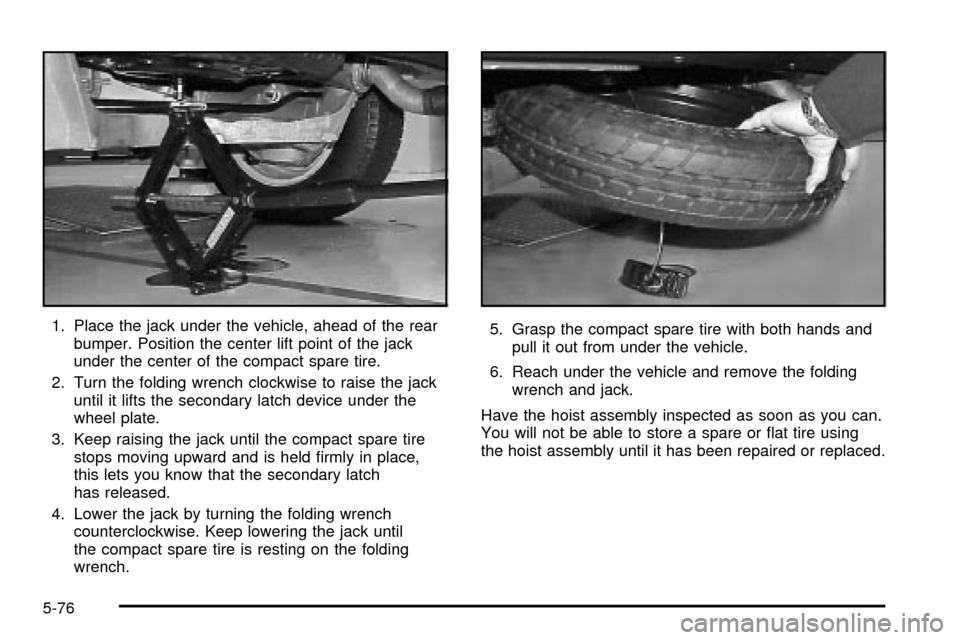
1. Place the jack under the vehicle, ahead of the rear
bumper. Position the center lift point of the jack
under the center of the compact spare tire.
2. Turn the folding wrench clockwise to raise the jack
until it lifts the secondary latch device under the
wheel plate.
3. Keep raising the jack until the compact spare tire
stops moving upward and is held ®rmly in place,
this lets you know that the secondary latch
has released.
4. Lower the jack by turning the folding wrench
counterclockwise. Keep lowering the jack until
the compact spare tire is resting on the folding
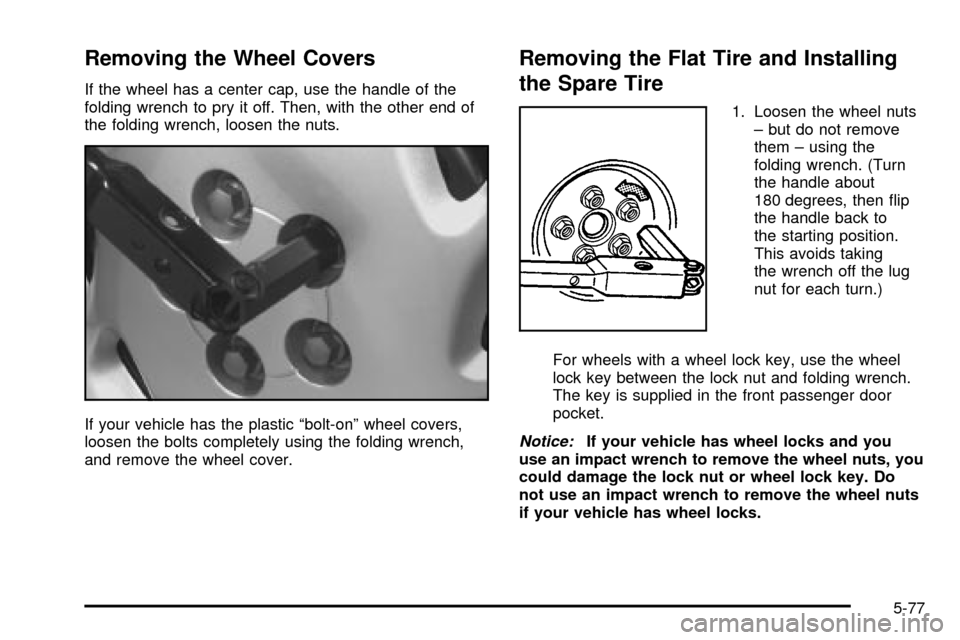
wrench.5. Grasp the compact spare tire with both hands and
pull it out from under the vehicle.
6. Reach under the vehicle and remove the folding
wrench and jack.
Have the hoist assembly inspected as soon as you can.
You will not be able to store a spare or ¯at tire using
the hoist assembly until it has been repaired or replaced.
5-76
Page 407 of 486
Removing the Wheel Covers
If the wheel has a center cap, use the handle of the
folding wrench to pry it off. Then, with the other end of
the folding wrench, loosen the nuts.
If your vehicle has the plastic ªbolt-onº wheel covers,
loosen the bolts completely using the folding wrench,
and remove the wheel cover.
Removing the Flat Tire and Installing
the Spare Tire
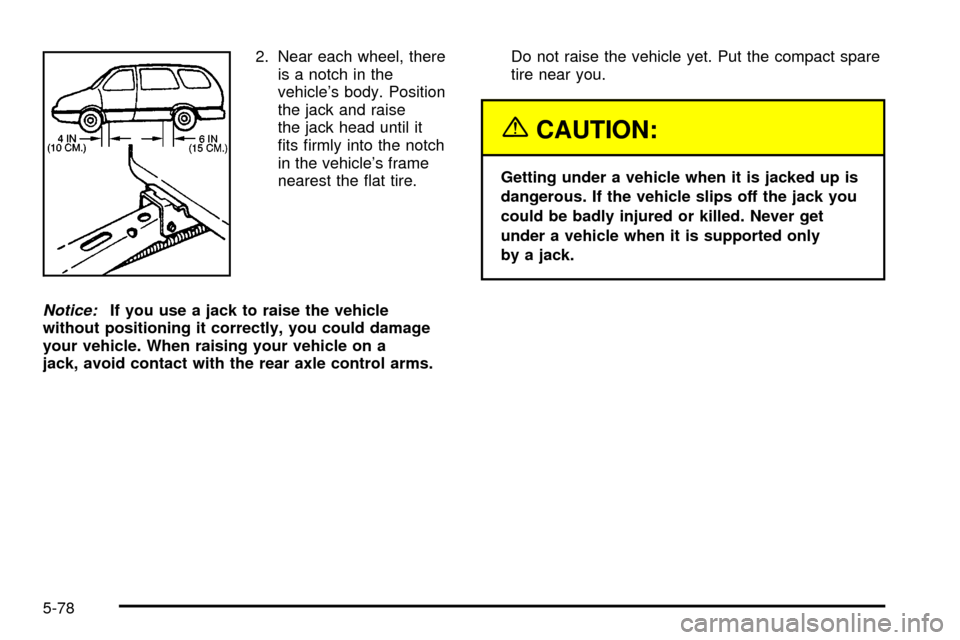
1. Loosen the wheel nuts
± but do not remove
them ± using the
folding wrench. (Turn
the handle about
180 degrees, then ¯ip
the handle back to
the starting position.
This avoids taking
the wrench off the lug
nut for each turn.)
For wheels with a wheel lock key, use the wheel
lock key between the lock nut and folding wrench.
The key is supplied in the front passenger door
pocket.
Notice:If your vehicle has wheel locks and you
use an impact wrench to remove the wheel nuts, you
could damage the lock nut or wheel lock key. Do
not use an impact wrench to remove the wheel nuts
if your vehicle has wheel locks.
5-77
Page 408 of 486
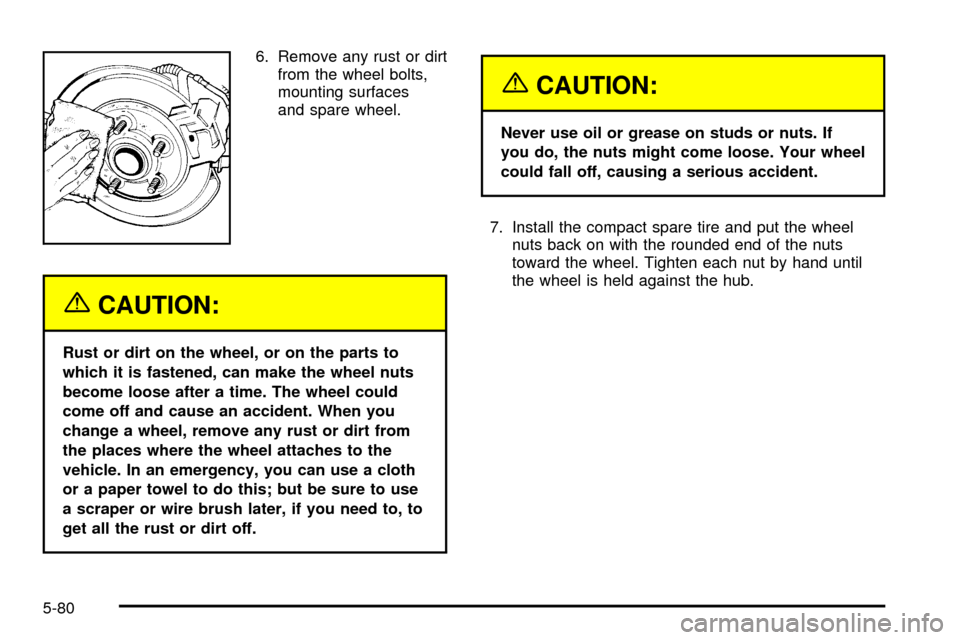
2. Near each wheel, there
is a notch in the
vehicle's body. Position
the jack and raise
the jack head until it
®ts ®rmly into the notch
in the vehicle's frame
nearest the ¯at tire.
Notice:If you use a jack to raise the vehicle
without positioning it correctly, you could damage
your vehicle. When raising your vehicle on a
jack, avoid contact with the rear axle control arms.Do not raise the vehicle yet. Put the compact spare
tire near you.
{CAUTION:
Getting under a vehicle when it is jacked up is
dangerous. If the vehicle slips off the jack you
could be badly injured or killed. Never get
under a vehicle when it is supported only
by a jack.
5-78
Page 409 of 486
{CAUTION:
Raising your vehicle with the jack improperly
positioned can damage the vehicle and even
make the vehicle fall. To help avoid personal
injury and vehicle damage, be sure to ®t the
jack lift head into the proper location before
raising the vehicle.3. Attach the folding
wrench to the jack, and
turn the wrench
clockwise to raise the
jack head a few
inches.
4. Raise the vehicle by turning the folding wrench
clockwise in the jack. Raise the vehicle far
enough off the ground so there is enough room
for the compact spare tire to ®t under the
wheel well.
5. Remove all the wheel nuts and take off the ¯at tire.
5-79
Page 410 of 486
6. Remove any rust or dirt
from the wheel bolts,
mounting surfaces
and spare wheel.
{CAUTION:
Rust or dirt on the wheel, or on the parts to
which it is fastened, can make the wheel nuts
become loose after a time. The wheel could
come off and cause an accident. When you
change a wheel, remove any rust or dirt from
the places where the wheel attaches to the
vehicle. In an emergency, you can use a cloth
or a paper towel to do this; but be sure to use
a scraper or wire brush later, if you need to, to
get all the rust or dirt off.
{CAUTION:
Never use oil or grease on studs or nuts. If
you do, the nuts might come loose. Your wheel
could fall off, causing a serious accident.
7. Install the compact spare tire and put the wheel
nuts back on with the rounded end of the nuts
toward the wheel. Tighten each nut by hand until
the wheel is held against the hub.
5-80
Page 411 of 486
8. Lower the vehicle by attaching the folding wheel
wrench to the jack and turning the wrench
counterclockwise. Lower the jack completely.9. Tighten the wheel nuts
®rmly in a crisscross
sequence, as shown.
{CAUTION:
Incorrect wheel nuts or improperly tightened
wheel nuts can cause the wheel to come loose
and even come off. This could lead to an
accident. Be sure to use the correct wheel
nuts. If you have to replace them, be sure to
get new GM original equipment wheel nuts.
Stop somewhere as soon as you can and have
the nuts tightened with a torque wrench to the
proper torque speci®cation. See ªCapacities
and Speci®cationsº in the Index for wheel nut
torque speci®cation.
5-81
Page 412 of 486
Notice:Improperly tightened wheel nuts can lead
to brake pulsation and rotor damage. To avoid
expensive brake repairs, evenly tighten the wheel
nuts in the proper sequence and to the proper
torque speci®cation. See ªCapacities and
Speci®cationsº in the index for the wheel nut torque
speci®cation.
10. Don't try to put a wheel cover on the compact spare
tire. It won't ®t. Store the wheel cover securely in
the rear of the vehicle until you have the ¯at
tire repaired or replaced.
Notice:Wheel covers will not ®t on your compact
spare. If you try to put a wheel cover on the compact
spare, you could damage the cover or the spare.
Storing a Flat or Spare Tire and Tools
{CAUTION:
Storing a jack, a tire, or other equipment in the
passenger compartment of the vehicle could
cause injury. In a sudden stop or collision,
loose equipment could strike someone. Store
all these in the proper place.
{CAUTION:
The underbody-mounted spare tire needs to be
stored with the valve stem pointing down. If
the spare tire is stored with the valve stem
pointing upwards, its secondary latch won't
work properly and the spare tire could loosen
and suddenly fall from your vehicle. If this
happened when your vehicle was being driven,
the tire might contact a person or another
vehicle, causing injury and, of course, damage
to itself as well. Be sure the
underbody-mounted spare tire is stored with
its valve stem pointing down.
5-82