Page 33 of 486
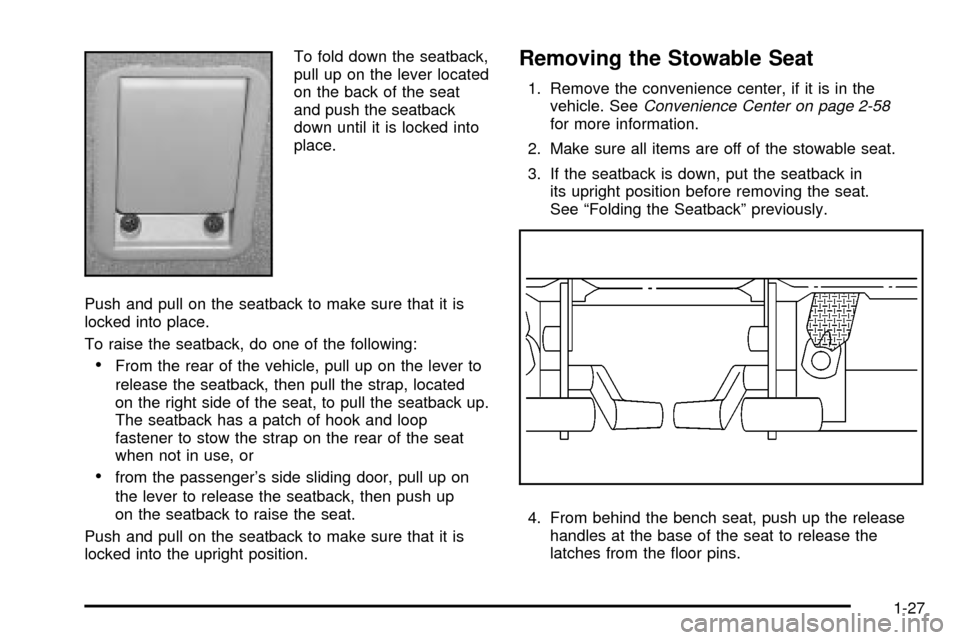
To fold down the seatback,
pull up on the lever located
on the back of the seat
and push the seatback
down until it is locked into
place.
Push and pull on the seatback to make sure that it is
locked into place.
To raise the seatback, do one of the following:
·From the rear of the vehicle, pull up on the lever to
release the seatback, then pull the strap, located
on the right side of the seat, to pull the seatback up.
The seatback has a patch of hook and loop
fastener to stow the strap on the rear of the seat
when not in use, or
·from the passenger's side sliding door, pull up on
the lever to release the seatback, then push up
on the seatback to raise the seat.
Push and pull on the seatback to make sure that it is
locked into the upright position.
Removing the Stowable Seat
1. Remove the convenience center, if it is in the
vehicle. SeeConvenience Center on page 2-58for more information.
2. Make sure all items are off of the stowable seat.
3. If the seatback is down, put the seatback in
its upright position before removing the seat.
See ªFolding the Seatbackº previously.
4. From behind the bench seat, push up the release
handles at the base of the seat to release the
latches from the ¯oor pins.
1-27
Page 34 of 486
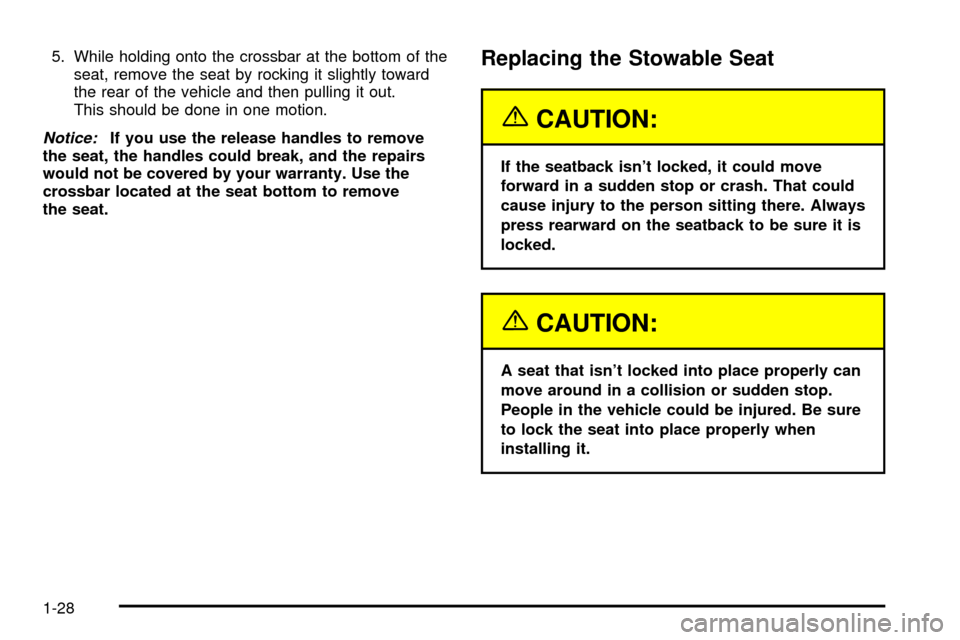
5. While holding onto the crossbar at the bottom of the
seat, remove the seat by rocking it slightly toward
the rear of the vehicle and then pulling it out.
This should be done in one motion.
Notice:If you use the release handles to remove
the seat, the handles could break, and the repairs
would not be covered by your warranty. Use the
crossbar located at the seat bottom to remove
the seat.
Replacing the Stowable Seat
{CAUTION:
If the seatback isn't locked, it could move
forward in a sudden stop or crash. That could
cause injury to the person sitting there. Always
press rearward on the seatback to be sure it is
locked.
{CAUTION:
A seat that isn't locked into place properly can
move around in a collision or sudden stop.
People in the vehicle could be injured. Be sure
to lock the seat into place properly when
installing it.
1-28
Page 35 of 486
{CAUTION:
A safety belt that is improperly routed, not
properly attached, or twisted won't provide the
protection needed in a crash. The person
wearing the belt could be seriously injured.
After installing the seat, always check to be
sure that the safety belts are properly routed
and attached, and are not twisted.
Do not put the stowable seat in so it faces rearward
because it will not latch that way. The stowable seat has
to go in before the convenience center. See
Convenience Center on page 2-58for more information.
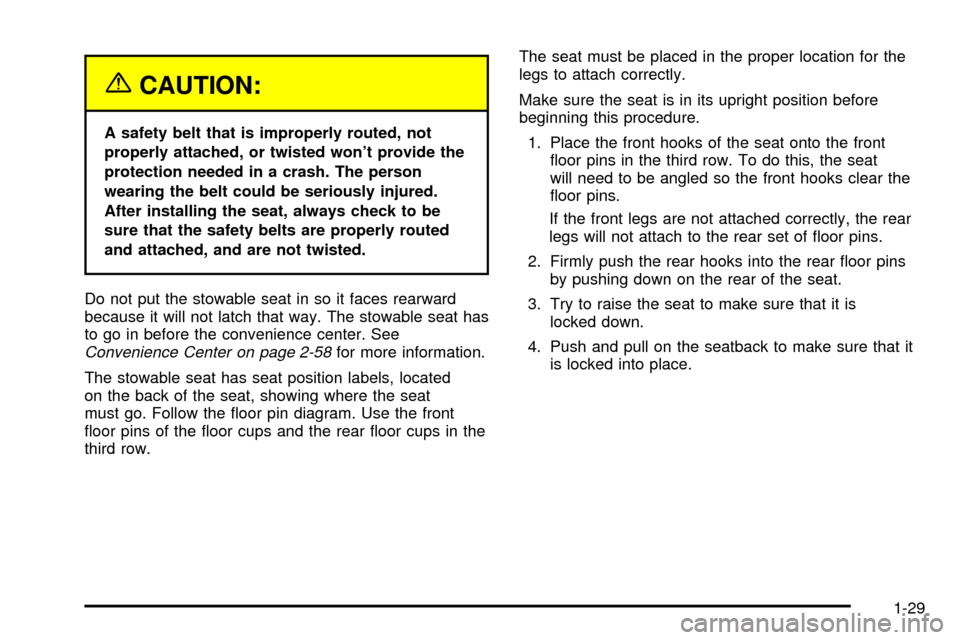
The stowable seat has seat position labels, located
on the back of the seat, showing where the seat
must go. Follow the ¯oor pin diagram. Use the front
¯oor pins of the ¯oor cups and the rear ¯oor cups in the
third row.The seat must be placed in the proper location for the
legs to attach correctly.
Make sure the seat is in its upright position before
beginning this procedure.
1. Place the front hooks of the seat onto the front
¯oor pins in the third row. To do this, the seat
will need to be angled so the front hooks clear the
¯oor pins.
If the front legs are not attached correctly, the rear
legs will not attach to the rear set of ¯oor pins.
2. Firmly push the rear hooks into the rear ¯oor pins
by pushing down on the rear of the seat.
3. Try to raise the seat to make sure that it is
locked down.
4. Push and pull on the seatback to make sure that it
is locked into place.
1-29
Page 62 of 486
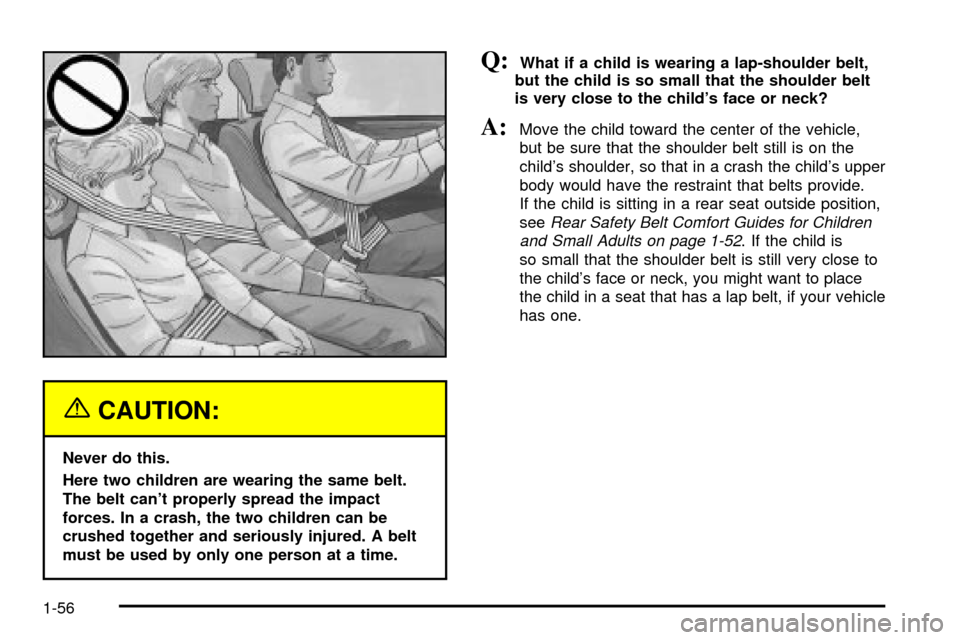
{CAUTION:
Never do this.
Here two children are wearing the same belt.
The belt can't properly spread the impact
forces. In a crash, the two children can be
crushed together and seriously injured. A belt
must be used by only one person at a time.
Q:What if a child is wearing a lap-shoulder belt,
but the child is so small that the shoulder belt
is very close to the child's face or neck?
A:Move the child toward the center of the vehicle,
but be sure that the shoulder belt still is on the
child's shoulder, so that in a crash the child's upper
body would have the restraint that belts provide.
If the child is sitting in a rear seat outside position,
see
Rear Safety Belt Comfort Guides for Children
and Small Adults on page 1-52
. If the child is
so small that the shoulder belt is still very close to
the child's face or neck, you might want to place
the child in a seat that has a lap belt, if your vehicle
has one.
1-56
Page 67 of 486
{CAUTION:
The body structure of a young child is quite
unlike that of an adult or older child, for whom
the safety belts are designed. A young child's
hip bones are still so small that the vehicle's
regular safety belt may not remain low on the
hip bones, as it should. Instead, it may settle
up around the child's abdomen. In a crash, the
belt would apply force on a body area that's
unprotected by any bony structure. This alone
could cause serious or fatal injuries. Young
children always should be secured in
appropriate child restraints.
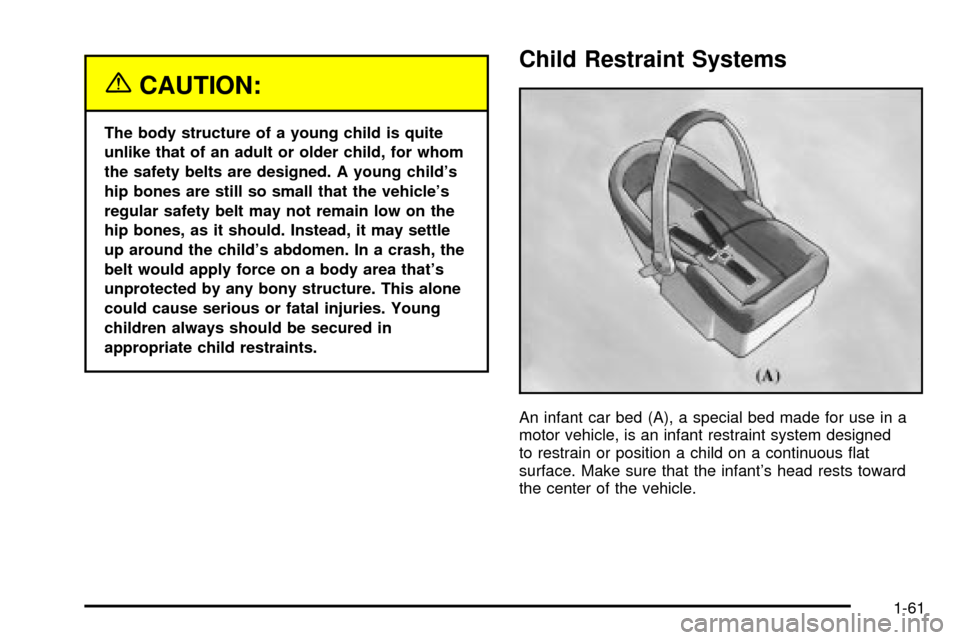
Child Restraint Systems
An infant car bed (A), a special bed made for use in a
motor vehicle, is an infant restraint system designed
to restrain or position a child on a continuous ¯at
surface. Make sure that the infant's head rests toward
the center of the vehicle.
1-61
Page 74 of 486
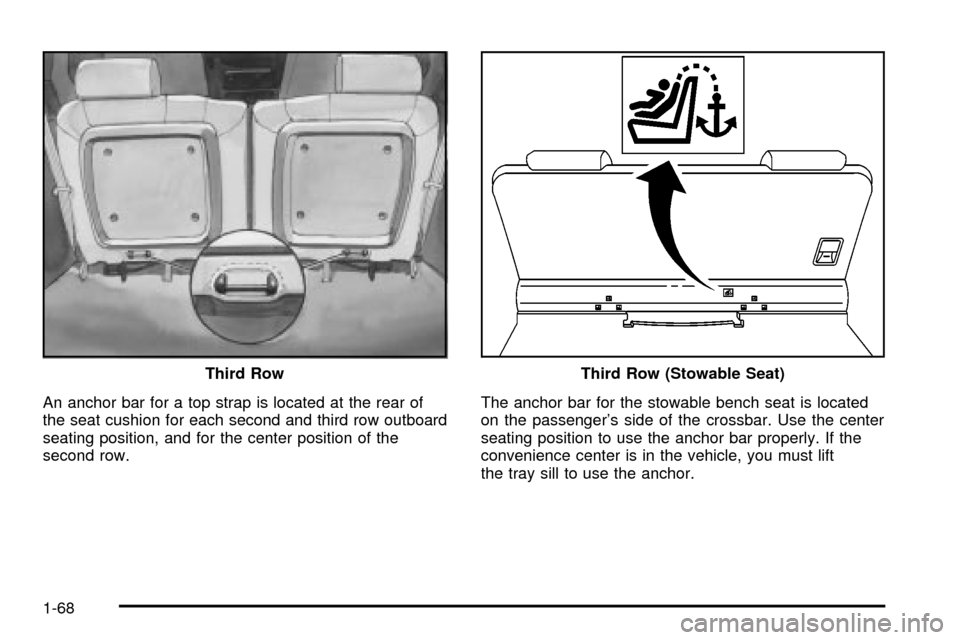
An anchor bar for a top strap is located at the rear of
the seat cushion for each second and third row outboard
seating position, and for the center position of the
second row.The anchor bar for the stowable bench seat is located
on the passenger's side of the crossbar. Use the center
seating position to use the anchor bar properly. If the
convenience center is in the vehicle, you must lift
the tray sill to use the anchor. Third Row
Third Row (Stowable Seat)
1-68
Page 105 of 486

What Makes an Air Bag In¯ate?
In an impact of sufficient severity, the air bag sensing
system detects that the vehicle is in a crash. For
both frontal and side impact air bags, the sensing
system triggers a release of gas from the in¯ator, which
in¯ates the air bag. The in¯ator, the air bag and
related hardware are all part of the air bag modules.
Frontal air bag modules are located inside the steering
wheel and instrument panel. For vehicles with side
impact air bags, the air bag modules are located in the
seatback closest to the driver's and/or right front
passenger's door.
How Does an Air Bag Restrain?
In moderate to severe frontal or near frontal collisions,
even belted occupants can contact the steering wheel or
the instrument panel. In moderate to severe side
collisions, even belted occupants can contact the inside
of the vehicle. The air bag supplements the protection
provided by safety belts. Air bags distribute the force of
the impact more evenly over the occupant's upper
body, stopping the occupant more gradually. But the
frontal air bags would not help you in many types
of collisions, including rollovers, rear impacts, and many
side impacts, primarily because an occupant's motion
is not toward the air bag. Side impact air bags would not
help you in many types of collisions, including frontal
or near frontal collisions, rollovers, and rear impacts,
primarily because an occupant's motion is not toward
those air bags. Air bags should never be regarded
as anything more than a supplement to safety belts, and
then only in moderate to severe frontal or near-frontal
collisions for the driver's and right front passenger's
frontal air bags, and only in moderate to severe
side collisions for vehicles with a driver's and right front
passenger's side impact air bag.
1-99
Page 120 of 486
To unlock the driver's door from the outside with the
key, insert the key and turn it toward the front of
the vehicle. If your vehicle has power door locks, you
can unlock all of the doors and the liftgate by inserting
the key, turning it toward the front of the vehicle
and holding it there for one second. To lock the driver's
door from the outside with your key, insert the key
and turn it toward the rear of the vehicle. If your vehicle
has power door locks, all of the doors will lock when
you insert the key and turn it toward the rear of
the vehicle.
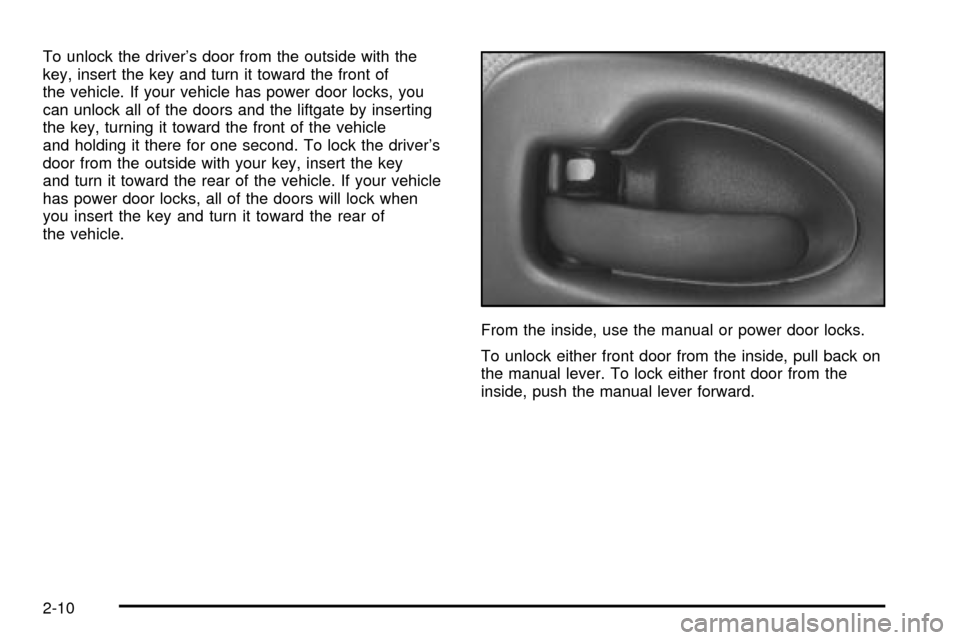
From the inside, use the manual or power door locks.
To unlock either front door from the inside, pull back on
the manual lever. To lock either front door from the
inside, push the manual lever forward.
2-10