2003 CHEVROLET VENTURE fuel cap
[x] Cancel search: fuel capPage 339 of 486
When you put the fuel cap back on, turn it to the right
(clockwise) until you hear a clicking sound. Make
sure you fully install the cap. The diagnostic system can
determine if the fuel cap has been left off or improperly
installed. This would allow fuel to evaporate into the
atmosphere. See
Malfunction Indicator Lamp on
page 3-45.
The malfunction indicator lamp (SERVICE ENGINE
SOON or CHECK ENGINE light) will come on if the fuel
cap is not properly installed.
Notice:If you need a new fuel cap, be sure to get
the right type. Your dealer can get one for you.
If you get the wrong type, it may not ®t properly.
This may cause your malfunction indicator lamp to
light and may damage your fuel tank and emissions
system. See ªMalfunction Indicator Lampº in
the Index.
Filling a Portable Fuel Container
{CAUTION:
Never ®ll a portable fuel container while it is in
your vehicle. Static electricity discharge from
the container can ignite the gasoline vapor.
You can be badly burned and your vehicle
damaged if this occurs. To help avoid injury to
you and others:
·Dispense gasoline only into approved
containers.
·Do not ®ll a container while it is inside a
vehicle, in a vehicle's trunk, pickup bed or
on any surface other than the ground.
·Bring the ®ll nozzle in contact with the
inside of the ®ll opening before operating
the nozzle. Contact should be maintained
until the ®lling is complete.
·Do not smoke while pumping gasoline.
5-9
Page 391 of 486

In¯ation - Tire Pressure
The Certi®cation/Tire label, which is on the rear edge of
the driver's door, shows the correct in¯ation pressures
for your tires when they're cold. ªColdº means your
vehicle has been sitting for at least three hours or driven
no more than 1 mile (1.6 km).
Notice:Don't let anyone tell you that underin¯ation
or overin¯ation is all right. It's not. If your tires
don't have enough air (underin¯ation), you can get
the following:
·Too much ¯exing
·Too much heat
·Tire overloading
·Bad wear
·Bad handling
·Bad fuel economyIf your tires have too much air (overin¯ation), you
can get the following:
·Unusual wear
·Bad handling
·Rough ride
·Needless damage from road hazards
When to Check
Check your tires once a month or more.
Don't forget your compact spare tire. It should be at
60 psi (420 kPa).
How to Check
Use a good quality pocket-type gage to check tire
pressure. You can't tell if your tires are properly in¯ated
simply by looking at them. Radial tires may look
properly in¯ated even when they're underin¯ated.
Be sure to put the valve caps back on the valve stems.
They help prevent leaks by keeping out dirt and
moisture.
5-61
Page 433 of 486
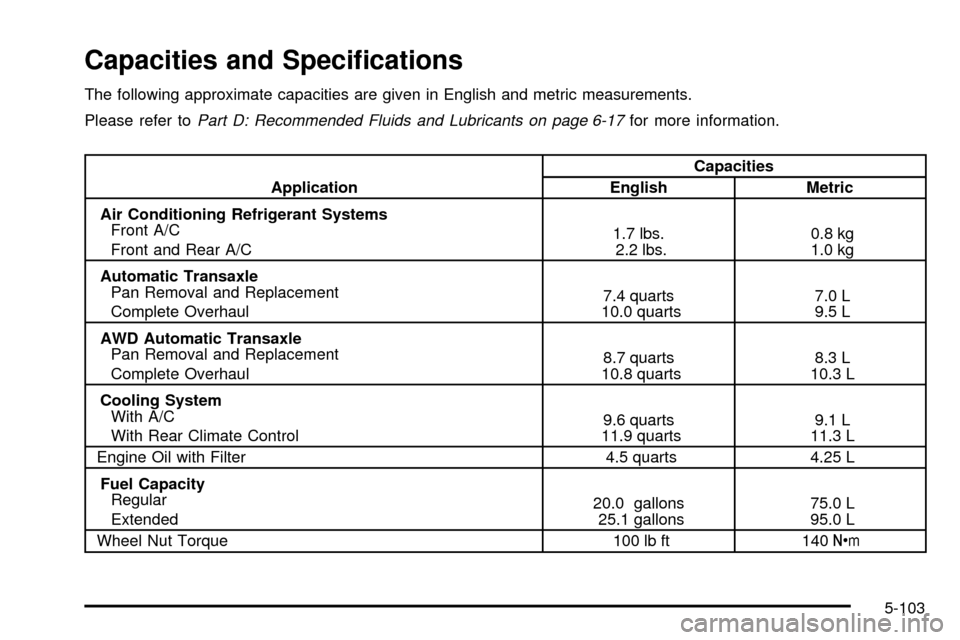
Capacities and Speci®cations
The following approximate capacities are given in English and metric measurements.
Please refer to
Part D: Recommended Fluids and Lubricants on page 6-17for more information.
ApplicationCapacities
English Metric
Air Conditioning Refrigerant Systems
Front A/C
Front and Rear A/C1.7 lbs.
2.2 lbs.0.8 kg
1.0 kg
Automatic Transaxle
Pan Removal and Replacement
Complete Overhaul7.4 quarts
10.0 quarts7.0 L
9.5 L
AWD Automatic Transaxle
Pan Removal and Replacement
Complete Overhaul8.7 quarts
10.8 quarts8.3 L
10.3 L
Cooling System
With A/C
With Rear Climate Control9.6 quarts
11.9 quarts9.1 L
11.3 L
Engine Oil with Filter 4.5 quarts 4.25 L
Fuel Capacity
Regular
Extended20.0 gallons
25.1 gallons75.0 L
95.0 L
Wheel Nut Torque 100 lb ft 140Y
5-103
Page 450 of 486

Fuel System Inspection
Inspect the complete fuel system for damage or leaks.
Engine Cooling System Inspection
Inspect the hoses and have them replaced if they
are cracked, swollen or deteriorated. Inspect all pipes,
®ttings and clamps; replace as needed. Clean the
outside of the radiator and air conditioning condenser.
To help ensure proper operation, a pressure test of
the cooling system and pressure cap is recommended
at least once a year.
Throttle System Inspection
Inspect the throttle system for interference or binding,
and for damaged or missing parts. Replace parts
as needed. Replace any components that have high
effort or excessive wear. Do not lubricate accelerator
and cruise control cables.
All-Wheel Drive Inspection
Inspect the transfer case (power transfer unit) and
carrier assembly-differential (rear drive module) every
12 months or at engine oil change intervals, check rear
differential and transfer case and add lubricant when
necessary. A ¯uid loss could indicate a problem; check
and have it repaired, if needed. Check vent hoses at
transfer case and differential for kinks and proper
installation.
Brake System Inspection
Inspect the complete system. Inspect brake lines and
hoses for proper hook-up, binding, leaks, cracks,
cha®ng, etc. Inspect disc brake pads for wear and rotors
for surface condition. Also inspect drum brake linings
for wear and cracks. Inspect other brake parts, including
drums, wheel cylinders, calipers, parking brake, etc.
Check parking brake adjustment. You may need to have
your brakes inspected more often if your driving
habits or conditions result in frequent braking.
6-16
Page 469 of 486

A
Accessory In¯ator...........................................5-68
Accessory Power Outlets.................................3-24
Adding Washer Fluid.......................................5-39
Additional Program Information........................... 7-9
Additives, Fuel................................................. 5-6
Add-On Electrical Equipment............................5-96
Adjusting the Bucket Seats...............................1-16
Adjusting the Captain's Chairs
(Second Row).............................................1-22
Adjusting the Speakers
(Balance/Fade)....................3-64, 3-67, 3-74, 3-84
Adjusting the Split Bench Seats
(Second Row)............................................... 1-9
Air Bag Systems.............................................1-93
How Does an Air Bag Restrain?....................1-99
Servicing Your Air Bag-Equipped Vehicle.......1-102
What Makes an Air Bag In¯ate?....................1-99
What Will You See After an Air
Bag In¯ates?.........................................1-100
When Should an Air Bag In¯ate?...................1-98
Where Are the Air Bags?..............................1-96
Air Bag .........................................................3-40
Readiness Light..........................................3-40
Air Cleaner/Filter, Engine.................................5-18
All-Wheel Drive Disable Warning Message..........3-57
All-Wheel Drive......................................5-50, 5-86
All-Wheel-Drive (AWD) System.........................4-10AM-FM Radio.................................................3-62
AM .............................................................3-104
Antenna, Fixed Mast......................................3-105
Anti-lock Brake System (ABS)............................ 4-6
Anti-Lock Brake, System Warning Light..............3-42
Appearance Care............................................5-87
Care of Safety Belts and Built-in Child
Restraint Harness.....................................5-90
Chemical Paint Spotting...............................5-93
Cleaning the Inside of Your Vehicle................5-87
Cleaning the Outside of Your Vehicle..............5-90
Finish Damage............................................5-93
Sheet Metal Damage...................................5-93
Underbody Maintenance...............................5-93
Vehicle Care/Appearance Materials................5-94
Weatherstrips..............................................5-90
Arming and Disarming the Content
Theft-Deterrent System.................................2-68
Arming Con®rmation........................................2-28
Arming with the Power Lock Switch...................2-27
Arming with the Remote Keyless Entry
Transmitter.................................................2-28
Arming with Your Key......................................2-28
Audio Speakers..............................................3-94
Audio System(s).............................................3-61
AM-FM Radio.............................................3-62
Care of Your Cassette Tape Player...............3-104
Care of Your CD and DVD Player................3-105
Care of Your CDs and DVDs.......................3-105
1
Page 471 of 486

C
California Fuel.................................................. 5-5
Canada ± Customer Assistance.......................... 7-4
Canadian Owners................................................ ii
Canadian Roadside Assistance........................... 7-7
Canceling the Sliding Door
Security Lock..............................................2-16
Capacities and Speci®cations..........................5-103
Captain Chairs, Rear.......................................1-22
Carbon Monoxide...................4-26, 4-36, 2-22, 2-42
Care of.........................................................5-90
Safety Belts and Built-in Child
Restraint Harness.....................................5-90
Your Cassette Tape Player..........................3-104
Your CD and DVD Player...........................3-105
Your CDs and DVDs..................................3-105
Cargo Lamp...................................................3-20
Carrier Assembly-Differential
(Rear Drive Module)....................................5-51
Cassette Tape Messages.................................3-79
Cassette Tape Player Service...........................6-10
CD Adapter Kits.............................................3-79
Center Passenger Position, Safety Belts.....1-45, 1-47
Chains, Tires..................................................5-67
Change Engine Oil Message............................3-54
Charging System Indicator Message..................3-52
Checking Coolant............................................5-24Checking Engine Oil........................................5-14
Checking Things Under the Hood......................5-10
Checking Your Restraint Systems....................1-103
Check...........................................................3-45
Engine Light...............................................3-45
Chemical Paint Spotting...................................5-93
Child Restraints..............................................1-82
Built-In Child Restraint..................................1-82
Child Restraint Systems...............................1-61
Infants and Young Children...........................1-58
Lower Anchorages and Top Tethers for
Children (LATCH System)..........................1-69
Older Children.............................................1-55
Securing a Child Restraint Designed
for the LATCH System..............................1-71
Securing a Child Restraint in a Center
Seat Position...................................1-75, 1-77
Securing a Child Restraint in a Rear
Outside Seat Position...............................1-71
Securing a Child Restraint in the Right
Front Seat Position...................................1-79
Top Strap Anchor Location............................1-67
Top Strap...................................................1-66
Where to Put the Restraint...........................1-65
Cleaning Aluminum Wheels..............................5-92
Cleaning Built-In Child Restraint Pad.................5-90
Cleaning Exterior Lamps/Lenses.......................5-91
Cleaning Fabric/Carpet....................................5-88
3