Page 274 of 372
Rear Combination Lamps
A. Turn Signal Lamp
B. Back-Up Lamp
C. Brake LampTo remove the rear combination bulbs, do the following:
1. Remove the two screws from the combination
lamps. Gently pull the housing away from the
vehicle.
2. Turn the bulb socket counterclockwise and pull it
out of the lamp housing.
3. Pull the bulb straight out of the socket.
4. Reverse the previous steps to install a new bulb.
5. Reinstall the housing and the screws.
Driver's SidePassenger's Side
5-58
Page 276 of 372

In¯ation - Tire Pressure
The Tire-Loading Information label, which is on the
driver's door lock pillar, shows the correct in¯ation
pressures for your tires when they're cold. ªColdº means
your vehicle has been sitting for at least three hours
or driven no more than 1 mile (1.6 km).
Notice:Don't let anyone tell you that underin¯ation
or overin¯ation is all right. It's not. If your tires
don't have enough air (underin¯ation), you can get
the following:
·Too much ¯exing
·Too much heat
·Tire overloading
·Bad wear
·Bad handling
·Bad fuel economy
If your tires have too much air (overin¯ation),
you can get the following:
·Unusual wear
·Bad handling
·Rough ride
·Needless damage from road hazards
When to Check
Check your tires once a month or more.
Also, check the tire pressure of the spare tire.
How to Check
Use a good quality pocket-type gage to check tire
pressure. You can't tell if your tires are properly in¯ated
simply by looking at them. Radial tires may look
properly in¯ated even when they're underin¯ated.
Be sure to put the valve caps back on the valve stems.
They help prevent leaks by keeping out dirt and moisture.
Tire Inspection and Rotation
Tires should be rotated every 6,000 to 8,000 miles
(10 000 to 13 000 km).
Any time you notice unusual wear, rotate your tires as
soon as possible and check wheel alignment. Also check
for damaged tires or wheels. See
When It Is Time for
New Tires on page 5-62andWheel Replacement on
page 5-64for more information.
The purpose of regular rotation is to achieve more
uniform wear for all tires on the vehicle. The ®rst rotation
is the most important. See ªPart A: Scheduled
Maintenance Services,º in Section 6, for scheduled
rotation intervals.
5-60
Page 283 of 372
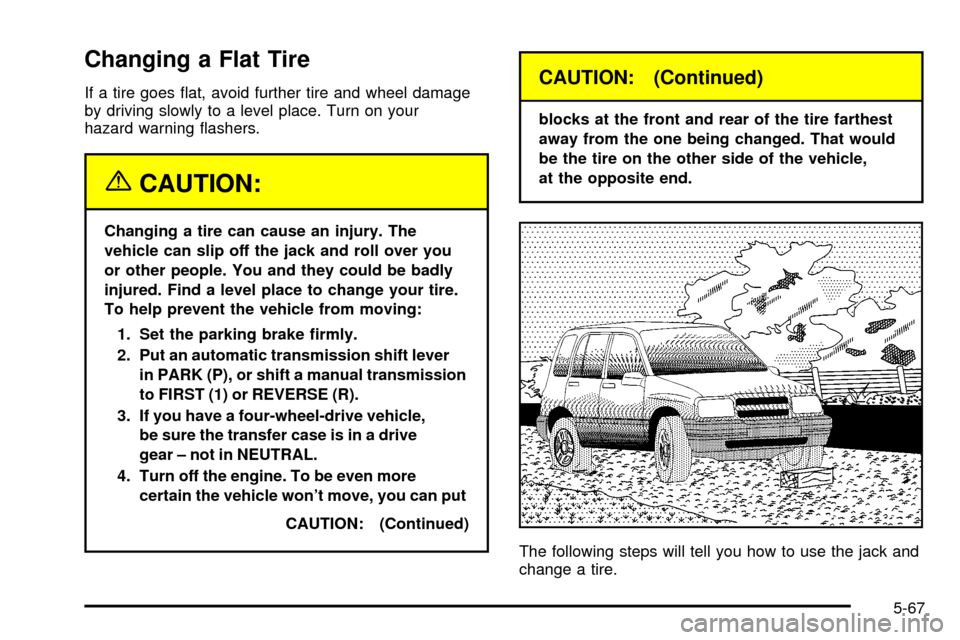
Changing a Flat Tire
If a tire goes ¯at, avoid further tire and wheel damage
by driving slowly to a level place. Turn on your
hazard warning ¯ashers.
{CAUTION:
Changing a tire can cause an injury. The
vehicle can slip off the jack and roll over you
or other people. You and they could be badly
injured. Find a level place to change your tire.
To help prevent the vehicle from moving:
1. Set the parking brake ®rmly.
2. Put an automatic transmission shift lever
in PARK (P), or shift a manual transmission
to FIRST (1) or REVERSE (R).
3. If you have a four-wheel-drive vehicle,
be sure the transfer case is in a drive
gear ± not in NEUTRAL.
4. Turn off the engine. To be even more
certain the vehicle won't move, you can put
CAUTION: (Continued)
CAUTION: (Continued)
blocks at the front and rear of the tire farthest
away from the one being changed. That would
be the tire on the other side of the vehicle,
at the opposite end.
The following steps will tell you how to use the jack and
change a tire.
5-67
Page 284 of 372
Removing the Spare Tire and Tools
The jack, wheel wrench and jack handle are stowed in
the rear left corner of the luggage compartment.1. To open the jacking tool storage compartment, turn
the knob counterclockwise. Open the cover two
inches and pull the entire cover towards the front of
the vehicle.
2. Turn the jack screw to
remove the jack from
the clamps. If the screw
is too tight, use the jack
handle to loosen it.
5-68
Page 285 of 372
The tools you'll be using include the jack (A), jack
handle (B) and wheel wrench (C).
The spare tire is mounted on your tailgate. Your
vehicle may be equipped with either a soft,
vinyl cover or a hard cover.3. To remove the hard
cover from the spare
tire, insert your key into
the wheel lock and
pull the wheel lock off.
Hard Cover
5-69
Page 286 of 372
4. Using the wheel wrench, remove the wheel cover
nut. Gently pry the spare tire cover off the wheel.5. If your vehicle is equipped with a vinyl cover, unzip
the cover to ®nd the wheel lock. Insert the key into
the wheel lock and pull it off.
6. Using the wheel wrench, remove the wheel nut
under the lock.Vinyl Cover
5-70
Page 287 of 372
7. Remove the remaining wheel nuts with the wheel
wrench.
8. Remove the spare tire from the mounting bracket
and place it near your ¯at tire.
Removing the Flat Tire and Installing
the Spare Tire
1. If your vehicle has wheel nut caps, remove them
by turning the wheel wrench counterclockwise.
5-71
Page 289 of 372

3. Under the vehicle near each wheel, there are knobs
in the vehicle's frame. Raise the jack 2 inches
(51 mm) before positioning the jack. Raise the jack
lift head until it ®ts ®rmly onto the knobs nearest
to the ¯at tire.
{CAUTION:
Getting under a vehicle when it is jacked up is
dangerous. If the vehicle slips off the jack you
could be badly injured or killed. Never get under
a vehicle when it is supported only by a jack.
{CAUTION:
Raising your vehicle with the jack improperly
positioned can cause personal injury and
damage to the vehicle. If you try to use the
jack when it hasn't been raised at least
2 inches (51 mm), the jack may not hold up the
vehicle, and you or others could be injured.
CAUTION: (Continued)
CAUTION: (Continued)
To help avoid personal injury and vehicle
damage, be sure to open the jack at least
2 inches (51 mm) before you ®t the lift head
into the proper location.
4. Raise the vehicle by turning the jack handle
clockwise. Raise the vehicle far enough off the
ground so there is enough room for the spare tire
to ®t underneath the wheel well.
5-73


