Page 205 of 372

Stop towing every 200 miles (300 km) and start the
engine. Leave the transfer case shift lever in NEUTRAL.
Shift your automatic transmission to DRIVE (D);
leave a manual transmission in SECOND (2) with the
clutch engaged. Run the engine at 2,000 rpm for
one minute to circulate oil in the transfer case. Turn the
ignition key to ACC. Now, you can continue towing
your vehicle.
Notice:Locking the steering column when towing
your vehicle may damage the steering column.
Always unlock the steering column before towing.
Notice:If you exceed 55 mph (90 km/h) while
towing your vehicle, it could be damaged. Never
exceed 55 mph (90 km/h) while towing your vehicle.
{CAUTION:
Shifting a four-wheel-drive vehicle's transfer
case into NEUTRAL can cause your vehicle to
roll even if the transmission is in Park (P) for
an automatic transmission, or if your vehicle is
in gear, for a manual transmission. You or
others could be injured. Make sure the parking
brake is ®rmly set before you shift the transfer
case to NEUTRAL.
4-49
Page 207 of 372
Loading Your Vehicle
Two labels on your vehicle show how much weight it
may properly carry. The tire-loading information
label found on the driver's door lock pillar tells you the
proper size and recommended in¯ation pressures for the
tires on your vehicle.The other label is the certi®cation label, also found on
the driver's door lock pillar. It tells you the gross weight
capacity of your vehicle, called the Gross Vehicle
Weight Rating (GVWR). The GVWR includes the weight
of the vehicle, all occupants, fuel and cargo. Never
exceed the GVWR for your vehicle, or the Gross Axle
Weight Rating (GAWR) for either the front or rear axle.
4-51
Page 223 of 372
The fuel cap is located behind a hinged door on the
passenger's side of your vehicle.While refueling, place the fuel cap in the holder
provided.
To remove the fuel cap, turn it slowly to the left
(counterclockwise).
5-7
Page 224 of 372

{CAUTION:
If you get fuel on yourself and then something
ignites it, you could be badly burned. Fuel can
spray out on you if you open the fuel cap too
quickly. This spray can happen if your tank is
nearly full, and is more likely in hot weather.
Open the fuel cap slowly and wait for any
ªhissº noise to stop. Then unscrew the cap
all the way.
Be careful not to spill fuel. Clean fuel from painted
surfaces as soon as possible. See
Cleaning the Outside
of Your Vehicle on page 5-82. When ®lling the tank
do not over®ll by squeezing in much more fuel after the
pump shuts off.When you put the fuel cap back on, turn it to the right
(clockwise) until you hear a clicking sound. Make sure
you fully install the cap. The diagnostic system can
determine if the fuel cap has been left off or improperly
installed. This would allow fuel to evaporate into the
atmosphere. See
Malfunction Indicator Lamp on
page 3-31.
Notice:If you need a new fuel cap, be sure to get
the right type. Your dealer can get one for you.
If you get the wrong type, it may not ®t properly.
This may cause your malfunction indicator lamp to
light and may damage your fuel tank and emissions
system. See ªMalfunction Indicator Lampº in the
Index.
5-8
Page 229 of 372
A. Engine Compartment Fuse Block. See ªEngine
Compartment Fuse Blockº underFuses and Circuit
Breakers on page 5-89.
B. Engine Air Cleaner/Filter. See
Engine Air
Cleaner/Filter on page 5-20.
C. Battery. See
Battery on page 5-45.
D. Power Steering Fluid Reservoir. See
Power Steering
Fluid on page 5-40.
E. Automatic Transmission Dipstick (If Equipped).
See
Automatic Transmission Fluid on page 5-23.F. Radiator Pressure Cap. See
Radiator Pressure Cap
on page 5-30.
G. Engine Oil Dipstick. See
Engine Oil on page 5-16.
H. Engine Oil Fill Cap. See
Engine Oil on page 5-16.
I. Brake Fluid Reservoir. See
Brakes on page 5-42.
J. Engine Coolant Recovery Tank. See
Engine Coolant
on page 5-28.
K. Windshield Washer Reservoir. See
Windshield
Washer Fluid on page 5-41.
5-13
Page 231 of 372
A. Engine Compartment Fuse Block. See ªEngine
Compartment Fuse Blockº underFuses and Circuit
Breakers on page 5-89.
B. Engine Air Cleaner/Filter. See
Engine Air
Cleaner/Filter on page 5-20.
C. Battery. See
Battery on page 5-45.
D. Radiator Pressure Cap. See
Radiator Pressure Cap
on page 5-30.
E. Engine Oil Fill Cap. See
Engine Oil on page 5-16.
F. Automatic Transmission Dipstick. See
Automatic
Transmission Fluid on page 5-23.G. Engine Oil Dipstick. See
Engine Oil on page 5-16.
H. Power Steering Fluid Reservoir. See
Power Steering
Fluid on page 5-40.
I. Brake Fluid Reservoir. See
Brakes on page 5-42.
J. Engine Coolant Recovery Tank. See
Engine Coolant
on page 5-28.
K. Windshield Washer Reservoir. See
Windshield
Washer Fluid on page 5-41.
5-15
Page 253 of 372
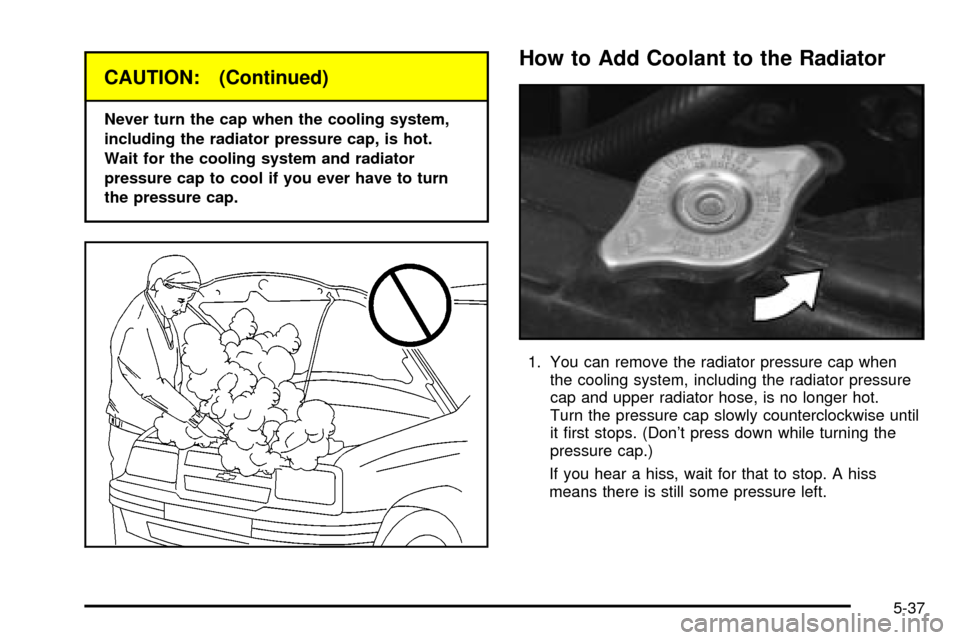
CAUTION: (Continued)
Never turn the cap when the cooling system,
including the radiator pressure cap, is hot.
Wait for the cooling system and radiator
pressure cap to cool if you ever have to turn
the pressure cap.
How to Add Coolant to the Radiator
1. You can remove the radiator pressure cap when
the cooling system, including the radiator pressure
cap and upper radiator hose, is no longer hot.
Turn the pressure cap slowly counterclockwise until
it ®rst stops. (Don't press down while turning the
pressure cap.)
If you hear a hiss, wait for that to stop. A hiss
means there is still some pressure left.
5-37
Page 273 of 372
Front Turn Signal and Parking Lamps
To replace the parking and turn signal bulb, do the
following:
1. See ªHeadlampsº for location.
2. Locate the turn signal bulb.
3. Turn the bulb socket counterclockwise and pull it
out of the lamp housing.
4. Push the bulb in, turn it counterclockwise and pull
the bulb straight out of the socket.
5. Reverse the steps to install a new bulb.
Sidemarker Lamps
To replace the sidemarker bulb, do the following:
1. Remove the two screws
holding the sidemarker
lamp assembly.
The assembly should
pull away from the
vehicle.
2. Turn the socket counterclockwise and pull it out
of the housing.
3. Pull the bulb out of the socket.
4. Reverse the steps to install a new bulb.
5-57