2003 CHEVROLET SILVERADO air condition
[x] Cancel search: air conditionPage 512 of 556
82,500 Miles (137 500 km)
qCheck rear/front axle ¯uid level and add ¯uid as
needed. Check constant velocity joints and axle seals
for leaking.
qRotate tires. See
Tire Inspection and Rotation on
page 5-71for proper rotation pattern and additional
information.(See footnote +.)
90,000 Miles (150 000 km)
qCheck rear/front axle ¯uid level and add ¯uid as
needed. Check constant velocity joints and axle seals
for leaking.
qReplace fuel ®lter.
An Emission Control Service.
(See Footnote ².)
qReplace engine air cleaner ®lter on vehicles without
a restriction indicator. If equipped with a change
indicator, inspect the indicator. If necessary, replacethe ®lter. If vehicle is driven in dusty/dirty conditions,
inspect the change indicator (if equipped) at every
engine oil change. See
Engine Air Cleaner/Filter
on page 5-21for more information.An Emission
Control Service. (See footnote ².)
qRotate tires. SeeTire Inspection and Rotation on
page 5-71for proper rotation pattern and additional
information.(See footnote +.)
97,500 Miles (162 500 km)
qCheck rear/front axle ¯uid level and add ¯uid as
needed. Check constant velocity joints and axle seals
for leaking.
qRotate tires. See
Tire Inspection and Rotation on
page 5-71for proper rotation pattern and additional
information.(See footnote +.)
6-10
Page 519 of 556
Part C: Periodic
MaintenanceInspections
Listed in this part are inspections and services which
should be performed at least twice a year (for instance,
each spring and fall).
You should let your dealer's
service department do these jobs. Make sure any
necessary repairs are completed at once.
Proper procedures to perform these services may be
found in a service manual. SeeService Publications
Ordering Information on page 7-9.
Steering and Suspension Inspection
Inspect the front and rear suspension and steering
system for damaged, loose or missing parts, signs of
wear or lack of lubrication. Inspect the power steering
lines and hoses for proper hook-up, binding, leaks,
cracks, cha®ng, etc.
Exhaust System Inspection
Inspect the complete exhaust system. Inspect the body
near the exhaust system. Look for broken, damaged,
missing or out-of-position parts as well as open seams,
holes, loose connections or other conditions which
could cause a heat build-up in the ¯oor pan or could let
exhaust fumes into the vehicle. See
Engine Exhaust
on page 2-51.
Fuel System Inspection
Inspect the complete fuel system for damage or leaks.
Engine Cooling System Inspection
Inspect the hoses and have them replaced if they
are cracked, swollen or deteriorated. Inspect all pipes,
®ttings and clamps; replace as needed. Clean the
outside of the radiator and air conditioning condenser.
To help ensure proper operation, a pressure test of
the cooling system and pressure cap is recommended
at least once a year.
6-17
Page 520 of 556
Throttle System Inspection
(V6 Only)
Inspect the throttle system for interference or binding,
and for damaged or missing parts. Replace parts
as needed. Replace any components that have high
effort or excessive wear. Do not lubricate accelerator
and cruise control cables.
Transfer Case and Front Axle
(All-Wheel Drive) Inspection
Every 12 months, or at engine oil change intervals,
check front axle and transfer case and add lubricant
when necessary. A ¯uid loss could indicate a problem.
Check and have it repaired, if needed. Check vent
hose at transfer case for kinks and proper installation.
Transfer Case and Front Axle
(Four-Wheel Drive) Inspection
Every 12 months or at engine oil change intervals,
check front axle and transfer case and add lubricant
when necessary. A ¯uid loss could indicate a problem;
check and have it repaired, if needed. On manual
shift transfer case, oil the control lever pivot point. Check
vent hose at transfer case for kinks and proper
installation. More frequent lubrication may be required
on off-road use.
Brake System Inspection
Inspect the complete system. Inspect brake lines and
hoses for proper hook-up, binding, leaks, cracks,
cha®ng, etc. Inspect disc brake pads for wear and rotors
for surface condition. Inspect other brake parts,
including calipers, parking brake, etc. You may need to
have your brakes inspected more often if your driving
habits or conditions result in frequent braking.
6-18
Page 534 of 556
Courtesy Rental Vehicle
When your vehicle is unavailable due to overnight
warranty repairs, your dealer may arrange to provide
you with a courtesy rental vehicle or reimburse you for a
rental vehicle you obtained, at actual cost, up to a
maximum of $30.00 per day supported by receipts. This
requires that you sign and complete a rental agreement
and meet state, local and rental vehicle provider
requirements. Requirements vary and may include
minimum age requirements, insurance coverage, credit
card, etc. You are responsible for fuel usage charges
and may also be responsible for taxes, levies,
usage fees, excessive mileage or rental usage beyond
the completion of the repair.
Generally it is not possible to provide a like-vehicle as a
courtesy rental.
Additional Program Information
Courtesy Transportation is available during the
Bumper-to-Bumper warranty coverage period, but itis
notpart of the New Vehicle Limited Warranty. A
separate booklet entitled ªWarranty and Owner
Assistance Informationº furnished with each new vehicle
provides detailed warranty coverage information.
Courtesy Transportation is available only at participating
dealers and all program options, such as shuttle
service, may not be available at every dealer. Pleasecontact you dealer for speci®c information about
availability. All Courtesy Transportation arrangements
will be administered by appropriate dealer personnel.
Canadian Vehicles:For warranty repairs during
the Complete Vehicle Coverage period of the General
Motors of Canada New Vehicle Limited Warranty,
alternative transportation may be available under the
Courtesy Transportation Program. Please consult
your dealer for details.
General Motors reserves the right to unilaterally modify,
change or discontinue Courtesy Transportation at
any time and to resolve all questions of claim eligibility
pursuant to the terms and conditions described
herein at its sole discretion.
Reporting Safety Defects
Reporting Safety Defects to the
United States Government
If you believe that your vehicle has a defect which could
cause a crash or could cause injury or death, you
should immediately inform the National Highway Traffic
Safety Administration (NHTSA), in addition to notifying
General Motors.
7-8
Page 537 of 556
A
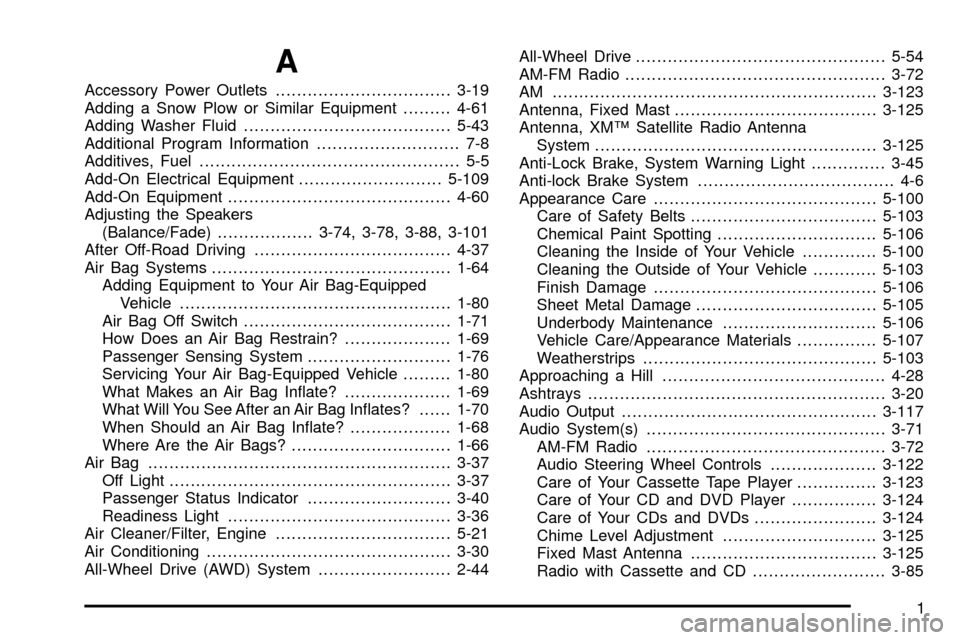
Accessory Power Outlets.................................3-19
Adding a Snow Plow or Similar Equipment.........4-61
Adding Washer Fluid.......................................5-43
Additional Program Information........................... 7-8
Additives, Fuel................................................. 5-5
Add-On Electrical Equipment...........................5-109
Add-On Equipment..........................................4-60
Adjusting the Speakers
(Balance/Fade)..................3-74, 3-78, 3-88, 3-101
After Off-Road Driving.....................................4-37
Air Bag Systems.............................................1-64
Adding Equipment to Your Air Bag-Equipped
Vehicle...................................................1-80
Air Bag Off Switch.......................................1-71
How Does an Air Bag Restrain?....................1-69
Passenger Sensing System...........................1-76
Servicing Your Air Bag-Equipped Vehicle.........1-80
What Makes an Air Bag In¯ate?....................1-69
What Will You See After an Air Bag In¯ates?......1-70
When Should an Air Bag In¯ate?...................1-68
Where Are the Air Bags?..............................1-66
Air Bag .........................................................3-37
Off Light.....................................................3-37
Passenger Status Indicator...........................3-40
Readiness Light..........................................3-36
Air Cleaner/Filter, Engine.................................5-21
Air Conditioning..............................................3-30
All-Wheel Drive (AWD) System.........................2-44All-Wheel Drive...............................................5-54
AM-FM Radio.................................................3-72
AM .............................................................3-123
Antenna, Fixed Mast......................................3-125
Antenna, XMŸ Satellite Radio Antenna
System.....................................................3-125
Anti-Lock Brake, System Warning Light..............3-45
Anti-lock Brake System..................................... 4-6
Appearance Care..........................................5-100
Care of Safety Belts...................................5-103
Chemical Paint Spotting..............................5-106
Cleaning the Inside of Your Vehicle..............5-100
Cleaning the Outside of Your Vehicle............5-103
Finish Damage..........................................5-106
Sheet Metal Damage..................................5-105
Underbody Maintenance.............................5-106
Vehicle Care/Appearance Materials...............5-107
Weatherstrips............................................5-103
Approaching a Hill..........................................4-28
Ashtrays........................................................3-20
Audio Output................................................3-117
Audio System(s).............................................3-71
AM-FM Radio.............................................3-72
Audio Steering Wheel Controls....................3-122
Care of Your Cassette Tape Player...............3-123
Care of Your CD and DVD Player................3-124
Care of Your CDs and DVDs.......................3-124
Chime Level Adjustment.............................3-125
Fixed Mast Antenna...................................3-125
Radio with Cassette and CD.........................3-85
1