2003 CHEVROLET SILVERADO weight
[x] Cancel search: weightPage 299 of 556

At slower speeds the front and rear wheels will turn in
opposite directions. This helps the vehicle make
tighter turns, such as during parking, cornering and
turning into tight spaces.At higher speeds the front and rear wheels will turn in
the same direction. This improves stability of the vehicle
during lane changes and sweeping turns.
_(4 Wheel Steer tow mode):When towing a
trailer the 4 wheel steer tow mode provides enhanced
stability allowing the trailer to follow the path of the
tow vehicle more closely, especially during lane
changes.
In this mode the system operates much like the 4 mode,
but is enhanced for trailer towing. It is recommended
for all types and weights of trailers. Slower Speeds (below 40 m.p.h./ 64 km/h )
Higher Speeds (40 m.p.h./64 km/h, and above)
4-17
Page 316 of 556

Driving Across an Incline
Sooner or later, an off-road trail will probably go across
the incline of a hill. If this happens, you have to
decide whether to try to drive across the incline. Here
are some things to consider:
·A hill that can be driven straight up or down may be
too steep to drive across. When you go straight up
or down a hill, the length of the wheel base (the
distance from the front wheels to the rear wheels)
reduces the likelihood the vehicle will tumble
end over end. But when you drive across an incline,
the much more narrow track width (the distance
between the left and right wheels) may not prevent
the vehicle from tilting and rolling over. Also,
driving across an incline puts more weight on the
downhill wheels. This could cause a downhill
slide or a rollover.
·Surface conditions can be a problem when you drive
across a hill. Loose gravel, muddy spots, or even wet
grass can cause your tires to slip sideways, downhill.
If the vehicle slips sideways, it can hit something that
will trip it (a rock, a rut, etc.) and roll over.
·Hidden obstacles can make the steepness of the
incline even worse. If you drive across a rock with the
uphill wheels, or if the downhill wheels drop into a rut
or depression, your vehicle can tilt even more.For reasons like these, you need to decide carefully
whether to try to drive across an incline. Just because
the trail goes across the incline doesn't mean you
have to drive it. The last vehicle to try it might have
rolled over.
{CAUTION:
Driving across an incline that is too steep will
make your vehicle roll over. You could be
seriously injured or killed. If you have any
doubt about the steepness of the incline, do
not drive across it. Find another route instead.
Q:What if I'm driving across an incline that's not
too steep, but I hit some loose gravel and start
to slide downhill. What should I do?
A:If you feel your vehicle starting to slide sideways,
turn downhill. This should help straighten out the
vehicle and prevent the side slipping. However,
a much better way to prevent this is to get out and
²walk the course²so you know what the surface
is like before you drive it.
4-34
Page 340 of 556

Loading Your Vehicle
The Certi®cation/Tire label is found on the rear edge of
the driver's door or in the Incomplete Vehicle
Document in the cab.
The label shows the size of your original tires and the
in¯ation pressures needed to obtain the gross weight
capacity of your vehicle. This is called the GVWR (Gross
Vehicle Weight Rating). The GVWR includes the
weight of the vehicle, all occupants, fuel and cargo.The Certi®cation/Tire label also tells you the maximum
weights for the front and rear axles, called Gross
Axle Weight Rating (GAWR). To ®nd out the actual loads
on your front and rear axles, you need to go to a
weigh station and weigh your vehicle. Your dealer can
help you with this. Be sure to spread out your load
equally on both sides of the centerline.
Never exceed the GVWR for your vehicle, or the GAWR
for either the front or rear axle.
The Certi®cation/Tire label also contains information
about your Front Axle Reserve Capacity. See ªFront
Axle Reserve Capacity²later in this section.
And, if you do have a heavy load, you should spread
it out.{CAUTION:
In the case of a sudden stop or collision,
things carried in the bed of your truck could
shift forward and come into the passenger
area, injuring you and others. If you put things
in the bed of your truck, you should make sure
they are properly secured.
4-58
Page 341 of 556
{CAUTION:
Do not load your vehicle any heavier than the
GVWR, or either the maximum front or rear
GAWR. If you do, parts on your vehicle can
break, and it can change the way your vehicle
handles. These could cause you to lose
control and crash. Also, overloading can
shorten the life of your vehicle.
Notice:Your warranty does not cover parts or
components that fail because of overloading.
This will help you decide how much cargo and installed
equipment your truck can carry.
Using heavier suspension components to get added
durability might not change your weight ratings. Ask your
dealer to help you load your vehicle the right way.
If you put things inside your vehicle ± like suitcases,
tools, packages, or anything else ± they go as fast
as the vehicle goes. If you have to stop or turn quickly,
or if there is a crash, they'll keep going.
{CAUTION:
Things you put inside your vehicle can strike
and injure people in a sudden stop or turn, or
in a crash.
·Put things in the trunk of your vehicle. In a
trunk, put them as far forward as you can.
Try to spread the weight evenly.
·Never stack heavier things, like suitcases,
inside the vehicle so that some of them
are above the tops of the seats.
·Don't leave an unsecured child restraint in
your vehicle.
·When you carry something inside the
vehicle, secure it whenever you can.
There's also important loading information for off-road
driving in this manual. See ªLoading Your Vehicle
for Off-Road Drivingº under
Off-Road Driving with Your
Four-Wheel-Drive Vehicle on page 4-22.
4-59
Page 342 of 556
Payload
Payload capacity is the maximum load capacity that your
vehicle can carry. Be sure to include the weight of the
occupants as part of your load. If you added any
accessories or equipment after your vehicle left the
factory, remember to subtract the weight of these things
from the payload. Your dealer can help you with this.
Remember not to exceed the Gross Axle Weight Rating
(GAWR) of the front or rear axle. See
Loading Your
Vehicle on page 4-58.
2-Tiered Loading
By positioning four 2º x 6º wooden planks across the
width of the pickup box, you can create an upper load
platform. The planks must be inserted in the pickup box
depressions. The length of the planks must allow for at
least a 3/4 inch (2 cm) bearing surface on each end of the
plank.
When using this upper load platform, be sure the load is
securely tied down to prevent it from shifting. The load's
center of gravity should be positioned in a zone over the
rear axle. The zone is located in the area between the
front of each wheel well and the rear of each wheel well.
The center of gravity height must not extend above the
top of the pickup box ¯areboard.
Any load that extends beyond the vehicle's taillamp
area must be properly marked according to local laws
and regulations.Remember not to exceed the Gross Axle Weight Rating
(GAWR) of the front or rear axle. See
Loading Your
Vehicle on page 4-58.
Add-On Equipment
When you carry removable items, you may need to put
a limit on how many people you carry inside your
vehicle. Be sure to weigh your vehicle before you buy
and install the new equipment.
Notice:Your warranty does not cover parts or
components that fail because of overloading.
Remember not to exceed the Gross Axle Weight Rating
(GAWR) of the front or rear axle. See
Loading Your
Vehicle on page 4-58.
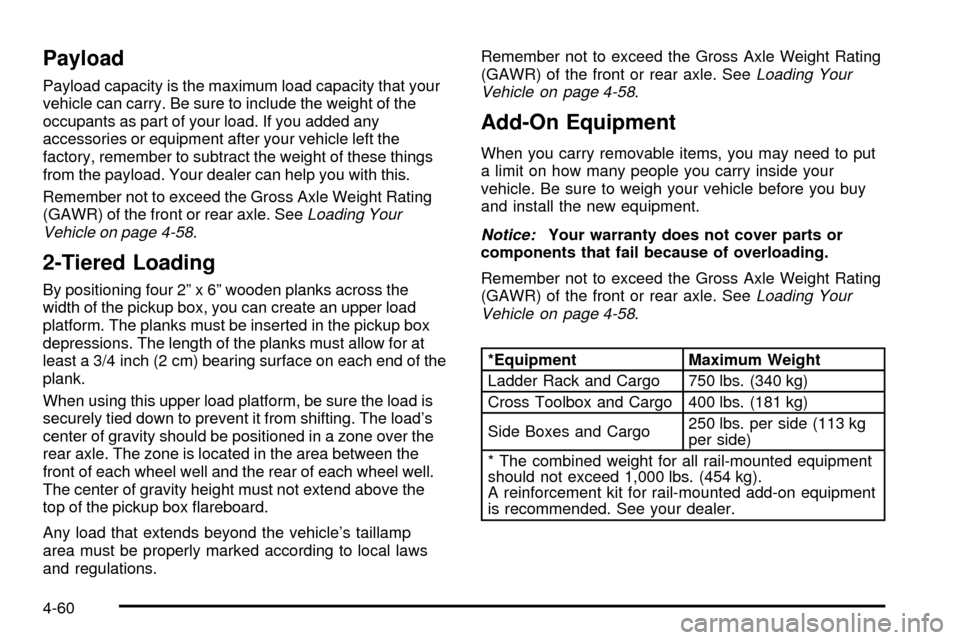
*Equipment Maximum Weight
Ladder Rack and Cargo 750 lbs. (340 kg)
Cross Toolbox and Cargo 400 lbs. (181 kg)
Side Boxes and Cargo250 lbs. per side (113 kg
per side)
* The combined weight for all rail-mounted equipment
should not exceed 1,000 lbs. (454 kg).
A reinforcement kit for rail-mounted add-on equipment
is recommended. See your dealer.
4-60
Page 343 of 556

Adding a Snow Plow or Similar
Equipment
Before installing a snow plow on your vehicle, here are
some things you'll need to know:
Notice:If your vehicle does not have the snow
plow prep package, adding a plow can damage your
vehicle, and the repairs would not be covered by
warranty. Unless your vehicle was built to carry
a snow plow, do not add one to your vehicle. If your
vehicle has the snow plow option called RPO VYU
(snow plow prep package), then the payload
your vehicle can carry will be reduced when a snow
plow is installed. Your vehicle can be damaged if
either the front or rear axle ratings, or the GVW, are
exceeded.
Q:How do I know if my vehicle can handle a
snow plow?
A:Some vehicles are built with a special package,
called RPO VYU (snow plow prep package). If
your vehicle has this option, you can add a plow to
it, provided certain weights, such as the weights
on the vehicle's axles and the GVW, aren't
exceeded.
Q:How heavy can a snow plow safely be?
A:The plow your vehicle can carry depends on many
things, such as:
·The options your vehicle came with, and the weight
of those options,
·The weight and number of passengers you intend
to carry,
·The weight of items you've added to your vehicle,
like a tool box or truck cap,
·The total weight of any additional cargo you intend
to carry.
Say, for example, you have a 700 lb. (318 kg) snow plow.
The total weight of all occupants and cargo inside the cab
should not exceed 300 lb. (135 kg). This means that you
may only be able to carry one passenger. But, even this
may be too much if you've got other equipment already
adding to the weight of your vehicle.
4-61
Page 344 of 556

Here are some guidelines for safely carrying a snow
plow on your vehicle:
·Make sure the weight on the front and rear axles
doesn't exceed the axle rating for each.
·For the front axle, if more cargo or passengers
must be carried, appropriate counter ballast must be
installed rear of the rear axle. Counter ballast
must be properly secured so it won't move during
driving.
·Follow the snow plow manufacturer's
recommendations regarding rear ballast. Rear
ballast may be required to ensure a proper front and
rear weight distribution ratio, even though the
actual weight at the front axle may be less than the
front axle rating.
·The snow plow manufacturer or installer can assist
you in determining the amount of rear ballast
required, to help make sure your snowplow/vehicle
combination does not exceed the GVW rating,
the front and rear axle ratings, and the front and
rear weight distribution ratio.
·The total vehicle must not exceed the GVW rating.
Q:What is front axle reserve capacity, and how do
I calculate it?
A:Front axle reserve capacity is the difference
between your front GAWR and the front axle weight
of your truck with full fuel and passengers.
Basically, it's the amount of weight you can add to
your front axle before reaching your front GAWR.
The front axle reserve capacity for your vehicle can be
found in the lower right corner of the Certi®cation/Tire
label, as shown.
United States
Canada
4-62
Page 345 of 556

In order to calculate the amount of weight any front
accessory, such as a snow plow, is adding to the front
axle, use the following formula:(W x (A + W.B.)) /W.B.= Weight the accessory is adding
to the front axle.
Where:
W = Weight of added accessory
A = Distance that the accessory is in front of the
front axle
W.B. = Vehicle Wheelbase
For example, adding a 700 lb. (318 kg) snow plow
actually adds more than 700 lb. (318 kg) to the front
axle. Using the formula, if the snow plow is 4 ft. (122 cm)
in front of the front axle and the wheel base is 10 ft.
(305 cm), then:
W = 700 lb. (318 kg)
A = 4 ft. (122 cm)
W.B. = 10 ft. (305 cm)
(W x (A + W.B.))/W.B. = (700 x (4 + 10))/10 =
980 lb. (445 kg)
So, if your truck's front axle reserve capacity is more
than 980 lb. (445 kg), you could add the snow plow
without exceeding the front GAWR.
4-63