Page 216 of 326
Engine Overheating
You will ®nd a coolant temperature gage and a low
coolant level warning light on your vehicle's instrument
panel. See
Engine Coolant Temperature Gage on
page 3-29andLow Coolant Warning Light on page 3-29.
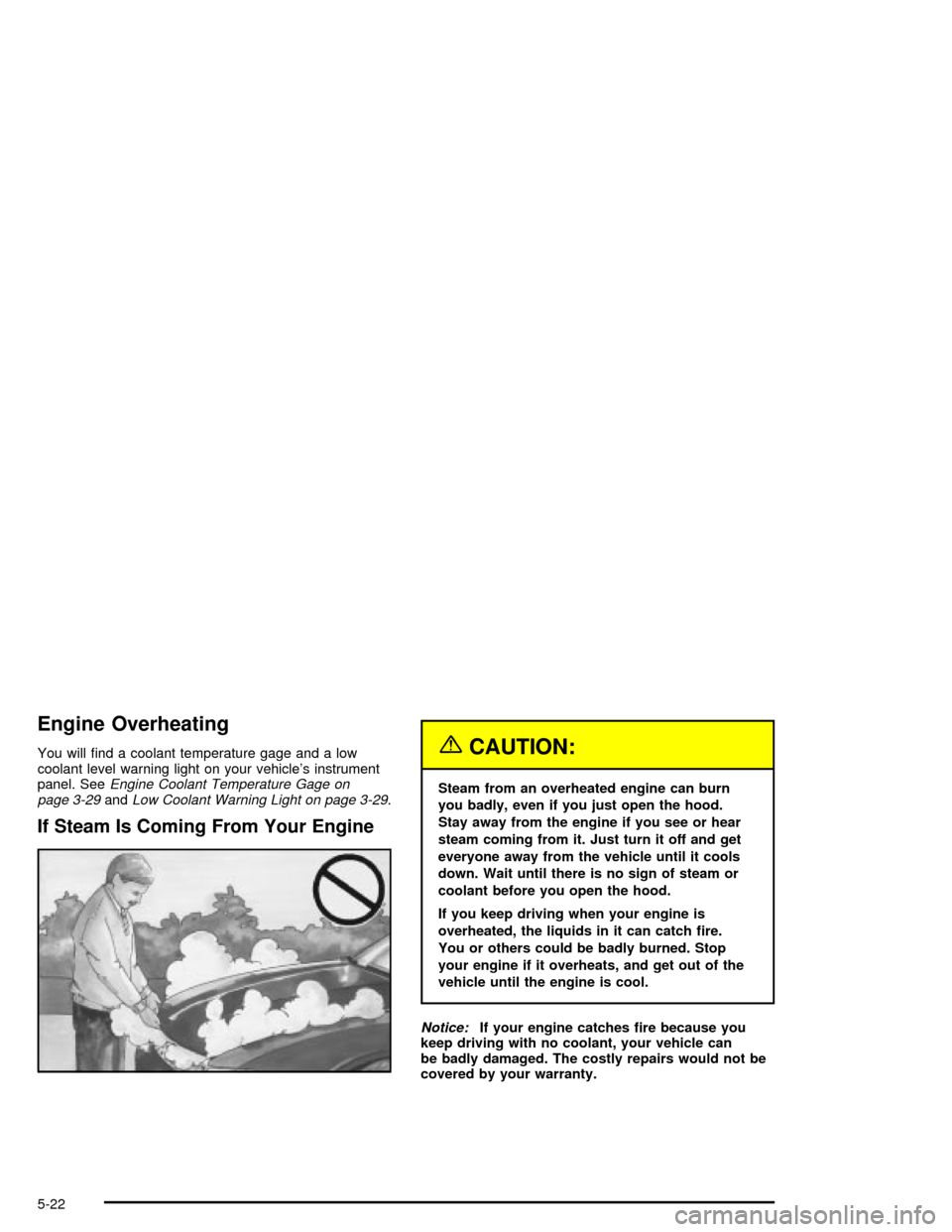
If Steam Is Coming From Your Engine
{CAUTION:
Steam from an overheated engine can burn
you badly, even if you just open the hood.
Stay away from the engine if you see or hear
steam coming from it. Just turn it off and get
everyone away from the vehicle until it cools
down. Wait until there is no sign of steam or
coolant before you open the hood.
If you keep driving when your engine is
overheated, the liquids in it can catch ®re.
You or others could be badly burned. Stop
your engine if it overheats, and get out of the
vehicle until the engine is cool.
Notice:If your engine catches ®re because you
keep driving with no coolant, your vehicle can
be badly damaged. The costly repairs would not be
covered by your warranty.
5-22
Page 264 of 326
Cleaning the Top of the Instrument
Panel
Use only mild soap and water to clean the top surfaces
of the instrument panel. Sprays containing silicones
or waxes may cause annoying re¯ections in the
windshield and even make it difficult to see through the
windshield under certain conditions.
Cleaning Interior Plastic Components
Use only a mild soap and water solution on a soft
cloth or sponge. Commercial cleaners may affect the
surface ®nish.
Cleaning Glass Surfaces
Glass should be cleaned often. GM Glass Cleaner or a
liquid household glass cleaner will remove normal
tobacco smoke and dust ®lms on interior glass. See
Vehicle Care/Appearance Materials on page 5-73.
Notice:Don't use abrasive cleaners on glass,
because they may cause scratches. Avoid placing
decals on the inside rear window, since they may
have to be scraped off later. If abrasive cleaners are
used on the inside of the rear window, an electric
defogger element may be damaged. Any temporary
license should not be attached across the
defogger grid.
Care of Safety Belts
Keep belts clean and dry.
{CAUTION:
Do not bleach or dye safety belts. If you do,
it may severely weaken them. In a crash,
they might not be able to provide adequate
protection. Clean safety belts only with mild
soap and lukewarm water.
Weatherstrips
Silicone grease on weatherstrips will make them last
longer, seal better, and not stick or squeak. Apply
silicone grease with a clean cloth at least every six
months. During very cold, damp weather more frequent
application may be required. See
Part D: Recommended
Fluids and Lubricants on page 6-21.
5-70
Page 269 of 326
Vehicle Identi®cation
Vehicle Identi®cation Number (VIN)
This is the legal identi®er for your vehicle. It appears on
a plate in the front corner of the instrument panel, on
the driver's side. You can see it if you look through the
windshield from outside your vehicle. The VIN also
appears on the Vehicle Certi®cation and Service Parts
labels and the certi®cates of title and registration.
Engine Identi®cation
The 8th character in your VIN is the engine code. This
code will help you identify your engine, speci®cations
and replacement parts.
Service Parts Identi®cation Label
You'll ®nd this label on the bottom of your spare
tire cover. It's very helpful if you ever need to order
parts. On this label is:
·your VIN,
·the model designation,
·paint information and
·a list of all production options and special
equipment.
Be sure that this label is not removed from the vehicle.
5-75
Page 271 of 326
Fuses and Circuit Breakers
The wiring circuits in your vehicle are protected from
short circuits by a combination of fuses, circuit breakers
and fusible thermal links in the wiring itself.
Look at the silver-colored band inside the fuse. If the
band is broken or melted, replace the fuse. Be sure you
replace a bad fuse with a new one of the identical
size and rating.
If you ever have a problem on the road and don't have
a spare fuse, you can borrow one that has the same
amperage. Just pick a feature of your vehicle that
you can get along without ± like the radio or cigarette
lighter ± and use its fuse, if it is the correct amperage.
Replace it as soon as you can.
There are three fuse blocks in your vehicle: two
instrument panel fuse blocks and the engine
compartment fuse block.
There is a fuse puller located on the engine
compartment fuse block. It can be used to easily
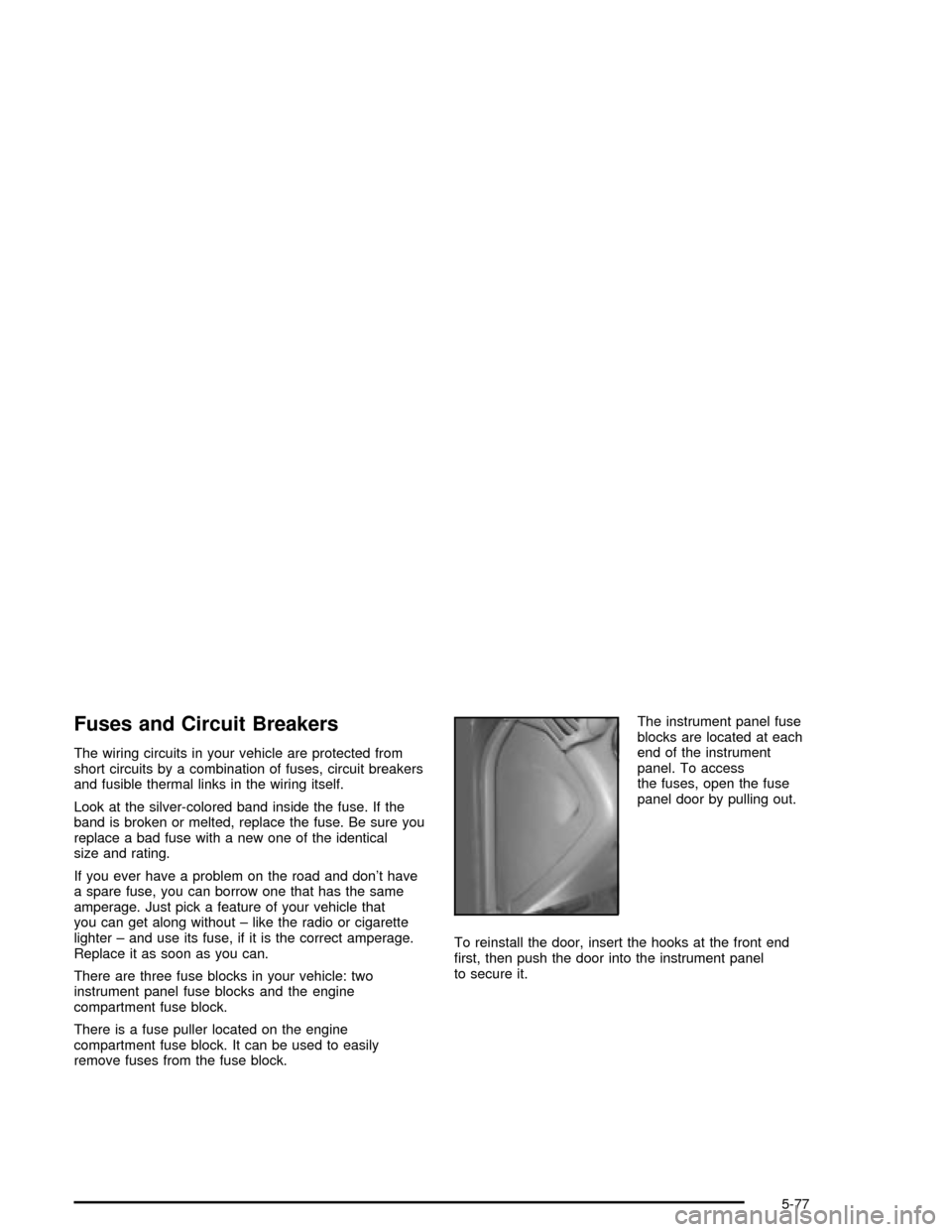
remove fuses from the fuse block.The instrument panel fuse
blocks are located at each
end of the instrument
panel. To access
the fuses, open the fuse
panel door by pulling out.
To reinstall the door, insert the hooks at the front end
®rst, then push the door into the instrument panel
to secure it.
5-77
Page 272 of 326
Instrument Panel Fuse Block
(Driver's Side)
Fuses Usage
A Wipers
BTrunk Release and Remote Keyless
Entry
C Turn Signals
D Power MirrorsFuses Usage
E Air Bag
F Body Function Control Module
G Powertrain Control Module (PCM)
H Door Locks
JBody Function Control
Module/Instrument Panel Cluster
MICRO RELAY
TRUNK RELRemote Trunk Release
CIRCUIT
BRKR
PWR SEATSPower Seats
MICRO RELAY
DR UNLOCKDoor Locks
MICRO RELAY
DR LOCKDoor Locks
MICRO RELAY
DRIVERS
DR UNLOCKDoor Locks
STOP LPS Stoplamps
HAZARD LPS Hazard Lamps
IPC/HVAC
BATTInstrument Panel Cluster,
Climate Control
5-78
Page 273 of 326
Instrument Panel Fuse Block
(Passenger's Side)Fuses Usage
AInstrument Panel Lights,
Brightness Control
B Cruise Control Switches
C Climate Control System
D Cruise Control
E Fog Lamps
FInterior Lamps, Body Function
Control Module
G Radio
H Sunroof
CIRCUIT BRKR
PWR WNDWSPower Windows
MICRO RELAY
FOG LPSFog Lamps
5-79
Page 304 of 326

Customer Assistance
Information
Customer Satisfaction Procedure
Your satisfaction and goodwill are important to
your dealer and to Chevrolet. Normally, any concerns
with the sales transaction or the operation of your
vehicle will be resolved by your dealer's sales or service
departments. Sometimes, however, despite the best
intentions of all concerned, misunderstandings can
occur. If your concern has not been resolved to your
satisfaction, the following steps should be taken:
STEP ONE:Discuss your concern with a member of
dealership management. Normally, concerns can
be quickly resolved at that level. If the matter has
already been reviewed with the sales, service or parts
manager, contact the owner of the dealership or
the general manager.
STEP TWO:If after contacting a member of dealership
management, it appears your concern cannot be
resolved by the dealership without further help, contact
the Chevrolet Customer Assistance Center by calling
1-800-222-1020. In Canada, contact GM of Canada
Customer Communication Centre in Oshawa by calling
1-800-263-3777 (English) or 1-800-263-7854 (French).We encourage you to call the toll-free number in order
to give your inquiry prompt attention. Please have
the following information available to give the Customer
Assistance Representative:
·Vehicle Identi®cation Number (This is available from
the vehicle registration or title, or the plate at the
top left of the instrument panel and visible through
the windshield.)
·Dealership name and location
·Vehicle delivery date and present mileage
When contacting Chevrolet, please remember that your
concern will likely be resolved at a dealer's facility.
That is why we suggest you follow Step One ®rst if you
have a concern.
STEP THREE:Both General Motors and your dealer
are committed to making sure you are completely
satis®ed with your new vehicle. However, if you continue
to remain unsatis®ed after following the procedure
outlined in Steps One and Two, you should ®le with the
GM/BBB Auto Line Program to enforce any additional
rights you may have. Canadian owners refer to
your Warranty and Owner Assistance Information
booklet for information on the Canadian Motor Vehicle
Arbitration Plan (CAMVAP).
7-2
Page 315 of 326

Charging System Light....................................3-27
Check...........................................................3-30
Engine Light...............................................3-30
Check Engine Light.........................................3-30
Checking Coolant............................................5-20
Checking Engine Oil........................................5-13
Checking Things Under the Hood....................... 5-9
Checking Your Restraint Systems......................1-54
Chemical Paint Spotting...................................5-73
Child Restraints..............................................1-35
Child Restraint Systems...............................1-35
Infants and Young Children...........................1-31
Lower Anchorages and Top Tethers for
Children (LATCH System)..........................1-40
Older Children.............................................1-28
Securing a Child Restraint Designed
for the LATCH System..............................1-41
Securing a Child Restraint in a Center
Rear Seat Position...................................1-44
Securing a Child Restraint in a Rear
Outside Seat Position...............................1-42
Securing a Child Restraint in the Right
Front Seat Position...................................1-46
Top Strap...................................................1-38
Top Strap Anchor Location............................1-39
Where to Put the Restraint...........................1-38
Chime Level Adjustment..................................3-59Cigarette Lighter.............................................3-17
Cleaning........................................................5-68
Inside of Your Vehicle..................................5-68
Outside of Your Vehicle................................5-71
Underbody Maintenance...............................5-73
Weatherstrips..............................................5-70
Cleaning Aluminum Wheels..............................5-72
Cleaning Exterior Lamps/Lenses.......................5-71
Cleaning Fabric/Carpet....................................5-68
Cleaning Glass Surfaces..................................5-70
Cleaning Interior Plastic Components.................5-70
Cleaning Leather............................................5-69
Cleaning the Top of the Instrument Panel...........5-70
Cleaning Tires................................................5-72
Cleaning Vinyl................................................5-69
Cleaning Windshield and Wiper Blades..............5-72
Climate Control System...................................3-17
Outlet Adjustment........................................3-21
Compact Disc Messages.................3-41, 3-47, 3-56
Compact Spare Tire........................................5-66
Control of a Vehicle.......................................... 4-5
Coolant.........................................................3-29
Engine Temperature Gage............................3-29
Heater, Engine............................................2-19
Low Warning Light.......................................3-29
Surge Tank Pressure Cap.............................5-21
Cooling System..............................................5-24
3