2003 CHEVROLET MALIBU fog light
[x] Cancel search: fog lightPage 97 of 326

The main components of your instrument panel are the
following:
A. Side Window Defogger Vents. See ªDefogging and
Defrostingº in
Climate Control System on
page 3-17.
B. Vent Outlets. See
Outlet Adjustment on page 3-21.
C. Instrument Panel Brightness Thumbwheel. See
Interior Lamps on page 3-15.
D. Fog Lamp Button (If Equipped). See ªFog Lampsº in
Exterior Lamps on page 3-12.
E. Turn Signal/Multifunction Lever. See
Turn
Signal/Multifunction Lever on page 3-5.
F. Cruise Control Buttons (If Equipped). See ªCruise
Controlº in
Turn Signal/Multifunction Lever on
page 3-5.
G. Instrument Panel Cluster. See
Instrument Panel
Cluster on page 3-23.
H. Windshield Wiper/Washer Lever. See ªWindshield
Wipersº in
Turn Signal/Multifunction Lever on
page 3-5.
I. Ignition Switch. See
Ignition Positions on
page 2-17.J. Hazard Warning Flashers Button. See
Hazard
Warning Flashers on page 3-4.
K. Instrument Panel Fuse Blocks. See
Fuses and
Circuit Breakers on page 5-77.
L. Instrument Panel Cupholder. See
Cupholder(s) on
page 2-30.
M. Remote Trunk Release Button. See ªRemote Trunk
Releaseº in
Trunk on page 2-11.
N. Hood Release. See
Hood Release on page 5-10.
O. Tilt Wheel Lever. See
Tilt Wheel on page 3-5.
P. Parking Brake. See
Parking Brake on page 2-23.
Q. Horn. See
Horn on page 3-5.
R. Audio System. See
Audio System(s) on page 3-36.
S. Cigarette Lighter. See
Ashtrays and Cigarette
Lighter on page 3-17.
T. Ashtray. See
Ashtrays and Cigarette Lighter on
page 3-17.
U. Accessory Power Outlet. See
Accessory Power
Outlets on page 3-16.
V. Climate Control System. See
Climate Control
System on page 3-17.
3-3
Page 108 of 326
Headlamps Off in Park (P)
This feature works when the ignition is on and it is dark
outside. To turn the headlamps off when it is dark
outside, turn the exterior lamp control to the parking
lamp position. In this position, the parking lamps,
sidemarker lamps, taillamps, license plate lamps and
instrument panel lights will be on, but the headlamps will
be off.
To turn on the headlamps along with the other lamps
when it is dark outside, turn the exterior lamp control to
the AUTO or headlamp position.
Delayed Headlamps
The delayed headlamps feature will continue to
illuminate the headlamps for 20 seconds after the key is
turned to OFF at night. Then the headlamps will
automatically turn off.
To override the 20 second delayed headlamp feature
while it is active turn the switch at the end of the
turn signal/multifunction lever up one position and then
back to AUTO.
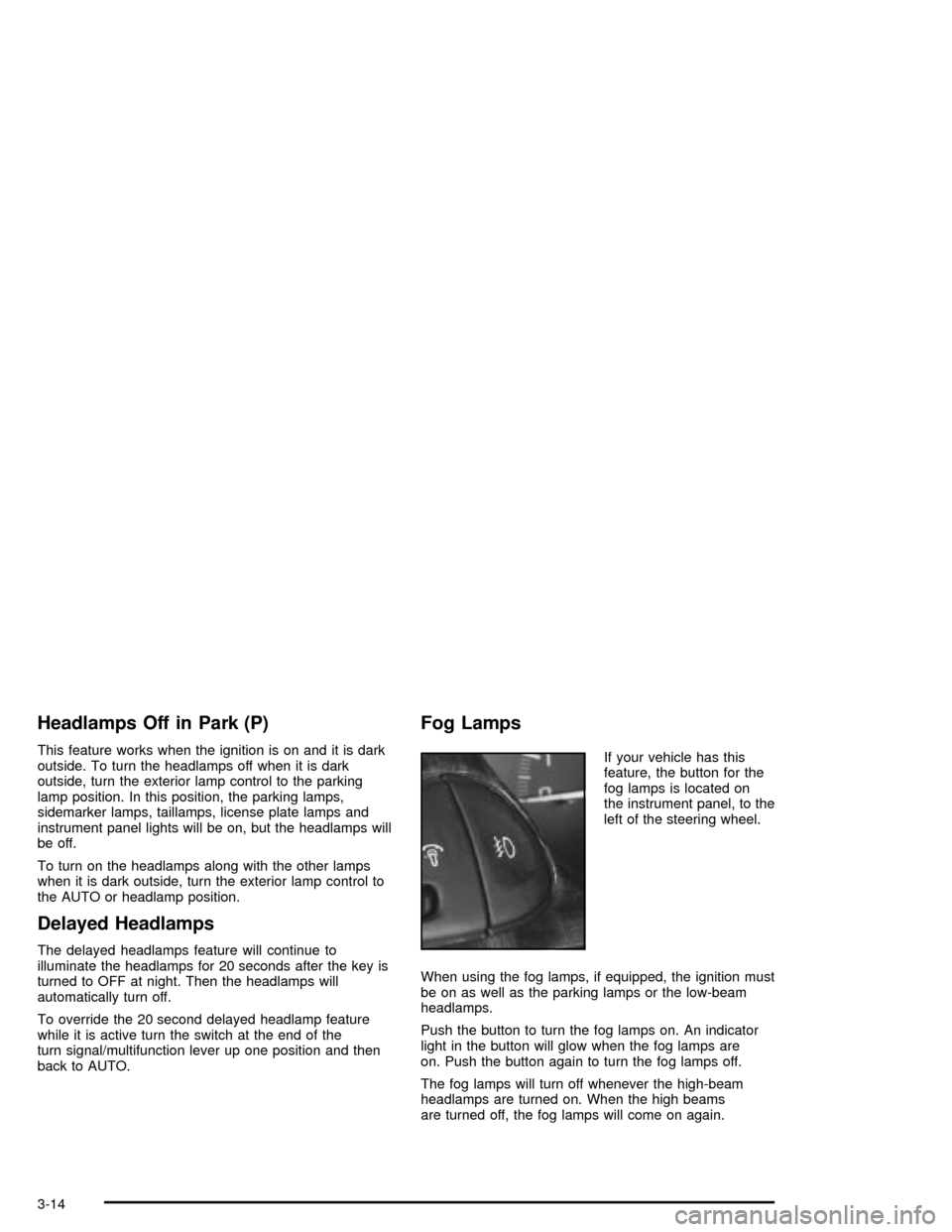
Fog Lamps
If your vehicle has this
feature, the button for the
fog lamps is located on
the instrument panel, to the
left of the steering wheel.
When using the fog lamps, if equipped, the ignition must
be on as well as the parking lamps or the low-beam
headlamps.
Push the button to turn the fog lamps on. An indicator
light in the button will glow when the fog lamps are
on. Push the button again to turn the fog lamps off.
The fog lamps will turn off whenever the high-beam
headlamps are turned on. When the high beams
are turned off, the fog lamps will come on again.
3-14
Page 112 of 326

)(Bi-Level):This mode directs half of the air to the
instrument panel outlets, and then directs most of
the remaining air to the ¯oor outlets. Some air may be
directed toward the side windows.
A(Floor):This mode directs most of the air to the
¯oor outlets with some air directed to the side window
outlets.
The right knob can also be used to select defog or
defrost modes. Information on defogging and defrosting
can be found later in this section.
9(Fan):Turn the left knob clockwise or
counterclockwise to increase or decrease the fan speed.
The fan must be on to run the air-conditioning
compressor.
:(Outside Air):Press this button to turn the
outside air mode on or off. When this mode is on,
outside air will circulate throughout your vehicle. When
the button is pressed, an indicator light in the button
will come on to let you know that it is activated.
The outside air mode can be used with all modes, but it
cannot be used with the recirculation mode. Pressing
this button will cancel the recirculation mode.
?(Recirculation):This mode keeps outside air from
coming in the vehicle. It can be used to prevent outside
air and odors from entering your vehicle or to help heat or
cool the air inside your vehicle more quickly. Press this
button to turn the recirculation mode on or off. When the
button is pressed, an indicator light in the button will come
on to let you know that it is activated. The air-conditioning
compressor comes on. The recirculation mode can be
used with vent, bi-level, or ¯oor modes, but it cannot be
used with the defog or defrost modes. Pressing this
button will cancel the outside air mode. When you switch
to the defog or defrost modes the system will
automatically move from recirculation to outside air.
When you move the mode knob back to another mode,
the system will move back into recirculation. When the
car is turned off and back on the system will default to
outside air automatically.
Temperature Control:Turn the center knob clockwise
or counterclockwise to increase or decrease the
temperature inside your vehicle.
3-18
Page 113 of 326

When it's cold outside 0ÉF (-18ÉC) or lower, use the
engine coolant heater, if equipped, to provide warmer air
faster to your vehicle. An engine coolant heater warms
the coolant that the engine uses to provide heat to
warm the inside of your vehicle. For more information,
see
Engine Coolant Heater on page 2-19.
#A/C (Air Conditioning):Press this button to turn
the air-conditioning system on or off. When A/C is
pressed, an indicator light in the button will come on to
let you know that air conditioning is activated.
On hot days, open the windows to let hot inside air
escape; then close them. This helps to reduce the time
it takes for your vehicle to cool down. It also helps
the system to operate more efficiently.
For quick cool down on hot days, do the following:
1. Select the vent mode.
2. Select the highest fan speed.
3. Select A/C.
4. Select the recirculation mode.
5. Select the coolest temperature.Using these settings together for long periods of time
may cause the air inside of your vehicle to become too
dry. To prevent this from happening, after the air in
your vehicle has cooled, turn the recirculation mode off.
The air-conditioning system removes moisture from
the air, so you may sometimes notice a small amount of
water dripping underneath your vehicle while idling or
after turning off the engine. This is normal.
Defogging and Defrosting
Fog on the inside of windows is a result of high humidity
(moisture) condensing on the cool window glass. This
can be minimized if the climate control system is
used properly. There are two modes to choose from to
clear fog or frost from your windshield. Use the
defog mode to clear the windows of fog or moisture and
warm the passengers. Use the defrost mode to
remove fog or frost from the windshield more quickly.
3-19
Page 114 of 326

Turn the right knob to select the defog or defrost mode.
-(Defog):This mode directs half of the air to the
windshield and half to the ¯oor outlets with a small
amount directed to the side windows. When you select
this mode, the system turns off recirculation
automatically and runs the air-conditioning compressor
unless the outside temperature is at or below freezing.
The recirculation mode cannot be selected while in
the defog mode. Do not drive the vehicle until all the
windows are clear.
1(Defrost):This mode directs most of the air to the
windshield with some air directed to the ¯oor vents.
In this mode, the system will automatically force outside
air into your vehicle and run the air-conditioning
compressor. Recirculation cannot be selected while in
the defrost mode.
Rear Window Defogger
The rear window defogger uses a warming grid to
remove fog or frost from the rear window.
will come on to let your know that the rear window
defogger is activated. Be sure to clear as much snow
from the rear window as possible.
The rear window defogger will turn off approximately
10 minutes after the button is pressed. If turned on
again, the defogger will only run for approximately
®ve minutes before turning off. The defogger can also
be turned off by pressing the button again or by turning
off the engine.
Notice:Don't use anything sharp on the inside of
the rear window. If you do, you could cut or damage
the warming grid, and the repairs wouldn't be
covered by your warranty. Do not attach a temporary
vehicle license, tape, a decal or anything similar
to the defogger grid.
3-20
Page 273 of 326

Instrument Panel Fuse Block
(Passenger's Side)Fuses Usage
AInstrument Panel Lights,
Brightness Control
B Cruise Control Switches
C Climate Control System
D Cruise Control
E Fog Lamps
FInterior Lamps, Body Function
Control Module
G Radio
H Sunroof
CIRCUIT BRKR
PWR WNDWSPower Windows
MICRO RELAY
FOG LPSFog Lamps
5-79
Page 275 of 326

Relays Usage
20 Automatic Headlamp System
21 Horn
22 Daytime Running Lamps (DRL)
Fuses Usage
23±32 Spare Fuse Holder
33 Rear Defogger
34Accessory Power Outlets,
Cigar Lighter
35 Generator
36 Not Used
37Air Conditioning Compressor,
Body Function Control Module
38 Automatic Transaxle
39Powertrain Control Module (PCM),
Ignition
40 Anti-Lock Brakes (ABS)
41 Ignition System
42Back-Up Lamps, Automatic
Transaxle Shift Lock Control SystemFuses Usage
43 Horn
44 PCM
45 Parking Lamps
46 Climate Control System
47Canister Purge Valve, PCM, Exhaust
Gas Recirculation, Heated Oxygen
Sensor
48 Fuel Pump Injectors
49 Not Used
50 Right Headlamp
51 Left Headlamp
52 Cooling Fan
53 HVAC Blower (Climate Control)
54 Not Used
55 Cooling Fan #2 Ground
56 Fuse Puller
57 Not Used
5-81
Page 316 of 326

Cruise Control.................................................. 3-9
Cupholder(s)..................................................2-30
Current and Past Model Order Forms................7-10
Customer Assistance Information........................ 7-7
Courtesy Transportation.................................. 7-7
Customer Assistance for Text
Telephone (TTY) Users............................... 7-4
Customer Assistance Offices........................... 7-4
Customer Satisfaction Procedure..................... 7-2
GM Mobility Program for Persons
with Disabilities.......................................... 7-5
Reporting Safety Defects to
General Motors.......................................... 7-9
Reporting Safety Defects to the
Canadian Government................................ 7-9
Reporting Safety Defects to the
United States Government.......................... 7-8
Roadside Assistance Program......................... 7-5
Service Publications Ordering Information......... 7-9
Customizing the Automatic Door Locks................ 2-9
D
Daytime Running Lamps (DRL).........................3-12
Defensive Driving............................................. 4-2
Defogging and Defrosting.................................3-19
Delayed Headlamps........................................3-14
Delayed Locking............................................... 2-8Dinghy Towing................................................4-29
Doing Your Own Service Work........................... 5-3
Dolly Towing..................................................4-30
Dome Lamp...................................................3-15
Door.............................................................3-34
Ajar Light...................................................3-34
Delayed Locking........................................... 2-8
Door Ajar Reminder....................................... 2-8
Locks.......................................................... 2-7
Power Door Locks......................................... 2-8
Programmable Automatic Door Locks............... 2-9
Rear Door Security Locks.............................2-10
Driver............................................................1-12
Position, Safety Belt.....................................1-12
Six-Way Power Seat...................................... 1-3
Driving..........................................................4-14
At Night.....................................................4-14
City...........................................................4-18
Defensive..................................................... 4-2
Drunken....................................................... 4-2
Freeway.....................................................4-19
Hill and Mountain Roads..............................4-21
In Rain and on Wet Roads...........................4-15
Winter........................................................4-23
Driving On Grades..........................................4-39
Driving on Snow or Ice....................................4-24
Driving Through Deep Standing Water...............4-17
Driving Through Flowing Water.........................4-17
Driving with a Trailer.......................................4-37
4