2003 CHEVROLET EXPRESS CARGO VAN steering
[x] Cancel search: steeringPage 269 of 386

If NHTSA receives similar complaints, it may open an
investigation, and if it ®nds that a safety defect exists in
a group of vehicles, it may order a recall and remedy
campaign. However, NHTSA cannot become involved in
individual problems between you, your dealer or
General Motors.
To contact NHTSA, you may either call the Auto Safety
Hotline toll-free at 1-800-424-9393 (or 366-0123 in
the Washington, D.C. area) or write to:
NHTSA, U.S. Department of Transportation
Washington, D.C. 20590
You can also obtain other information about motor
vehicle safety from the hotline.
Reporting Safety Defects to the
Canadian Government
If you live in Canada, and you believe that your vehicle
has a safety defect, you should immediately notify
Transport Canada, in addition to notifying General
Motors of Canada Limited. You may write to:
Transport Canada
330 Sparks Street
Tower C
Ottawa, Ontario K1A 0N5
Reporting Safety Defects to General
Motors
In addition to notifying NHTSA (or Transport Canada) in
a situation like this, we certainly hope you'll notify us.
Please call us at 1-800-222-1020, or write:
Chevrolet Motor Division
Chevrolet Customer Assistance Center
P.O. Box 33170
Detroit, MI 48232-5170
In Canada, please call us at 1-800-263-3777 (English)
or 1-800-263-7854 (French). Or, write:
General Motors of Canada Limited
Customer Communication Centre, 163-005
1908 Colonel Sam Drive
Oshawa, Ontario L1H 8P7
Service Publications Ordering
Information
Service Manuals
Service Manuals have the diagnosis and repair
information on engines, transmission, axle, suspension,
brakes, electrical, steering, body, etc.
RETAIL SELL PRICE: $120.00
7-9
Page 271 of 386

Service............................................................5-3
Doing Your Own Service Work.........................5-3
Adding Equipment to the Outside of Your
Vehicle......................................................5-4
Fuel................................................................5-4
Gasoline Octane............................................5-4
Gasoline Speci®cations....................................5-5
California Fuel...............................................5-5
Additives.......................................................5-6
Fuels in Foreign Countries...............................5-6
Filling Your Tank............................................5-7
Filling a Portable Fuel Container.......................5-9
Checking Things Under
the Hood......................................................5-9
Hood Release..............................................5-10
Engine Compartment Overview.......................5-12
Engine Oil...................................................5-13
Engine Air Cleaner/Filter................................5-17
Automatic Transmission Fluid.........................5-19
Engine Coolant.............................................5-21
Radiator Pressure Cap..................................5-24
Engine Overheating.......................................5-24Cooling System............................................5-26
Engine Fan Noise.........................................5-34
Power Steering Fluid.....................................5-34
Windshield Washer Fluid................................5-35
Brakes........................................................5-37
Battery........................................................5-40
Jump Starting...............................................5-41
All-Wheel Drive..............................................5-46
Rear Axle.......................................................5-47
Front Axle......................................................5-48
Noise Control System.....................................5-49
Tampering with Noise Control System
Prohibited.................................................5-49
Bulb Replacement..........................................5-50
Halogen Bulbs..............................................5-50
Headlamps..................................................5-50
Front Turn Signal, Sidemarker and Parking
Lamps.....................................................5-52
Taillamps.....................................................5-52
Replacement Bulbs.......................................5-54
Section 5 Service and Appearance Care
5-1
Page 283 of 386
A. Battery
B. Radiator Pressure Cap
C. Coolant Recovery Tank
D. Transmission Fluid Dipstick
E. Engine Oil Fill
F. Engine Oil Dipstick
G. Air Filter Restriction Indicator
H. Engine Air Cleaner/Filter
I. Power Steering Reservoir
J. Brake Master Cylinder
K. Windshield Washer Fluid
Engine Oil
Checking Engine Oil
It's a good idea to check your engine oil every time you
get fuel. In order to get an accurate reading, the oil
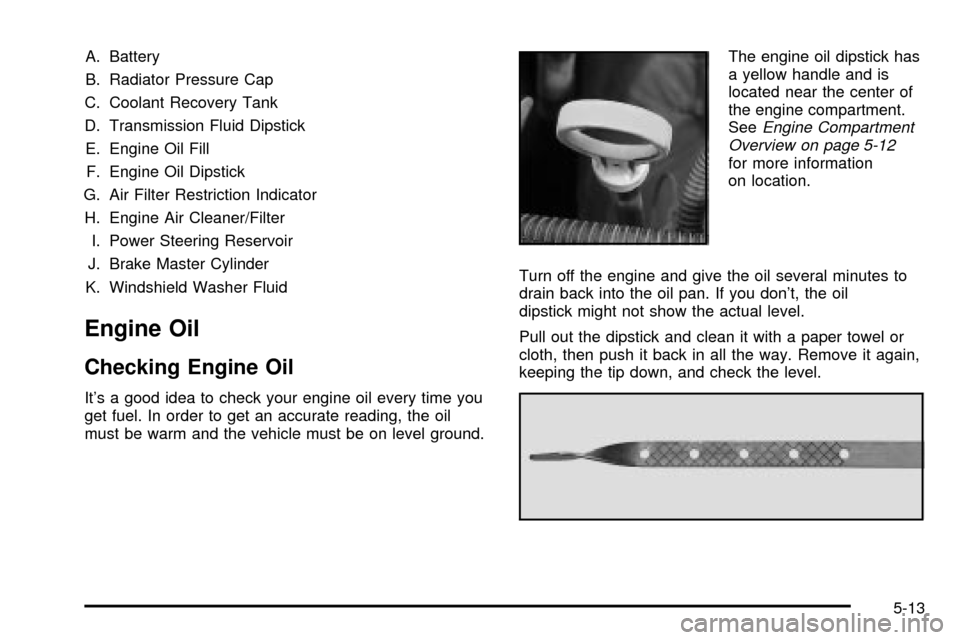
must be warm and the vehicle must be on level ground.The engine oil dipstick has
a yellow handle and is
located near the center of
the engine compartment.
See
Engine Compartment
Overview on page 5-12
for more information
on location.
Turn off the engine and give the oil several minutes to
drain back into the oil pan. If you don't, the oil
dipstick might not show the actual level.
Pull out the dipstick and clean it with a paper towel or
cloth, then push it back in all the way. Remove it again,
keeping the tip down, and check the level.
5-13
Page 304 of 386
Engine Fan Noise
Your vehicle has a clutched engine cooling fan. When
the clutch is engaged, the fan spins faster to provide
more air to cool the engine. In most everyday driving
conditions, the fan is spinning slower and the clutch is
not fully engaged. This improves fuel economy and
reduces fan noise. Under heavy vehicle loading, trailer
towing and/or high outside temperatures, the fan
speed increases as the clutch more fully engages. So
you may hear an increase in fan noise. This is
normal and should not be mistaken as the transmission
slipping or making extra shifts. It is merely the cooling
system functioning properly. The fan will slow down
when additional cooling is not required and the clutch
partially disengages.
You may also hear this fan noise when you start the
engine. It will go away as the fan clutch partially
disengages.
Power Steering Fluid
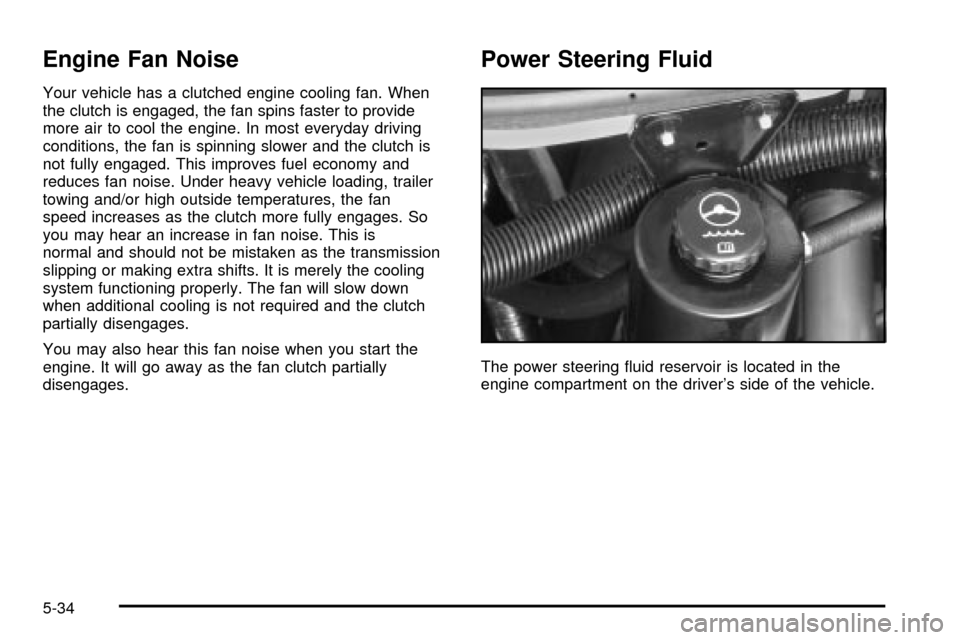
The power steering ¯uid reservoir is located in the
engine compartment on the driver's side of the vehicle.
5-34
Page 305 of 386

When to Check Power Steering Fluid
It is not necessary to regularly check power steering ¯uid
unless you suspect there is a leak in the system or
you hear an unusual noise. A ¯uid loss in this system
could indicate a problem. Have the system inspected
and repaired.
How to Check Power Steering Fluid
Turn the key off, let the engine compartment cool down,
wipe the cap and the top of the reservoir clean, then
unscrew the cap and wipe the dipstick with a clean rag.
Replace the cap and completely tighten it. Then
remove the cap again and look at the ¯uid level on the
dipstick.
The level should be at the COLD FILL mark. If
necessary, add only enough ¯uid to bring the level
up to the mark.
To prevent contamination of brake ¯uid, never check or
®ll the power steering reservoir with the brake master
cylinder cover off.
What to Use
To determine what kind of ¯uid to use, seePart D: Recommended Fluids and Lubricants on
page 6-18. Always use the proper ¯uid. Failure to use
the proper ¯uid can cause leaks and damage hoses and
seals.
Windshield Washer Fluid
What to Use
When you need windshield washer ¯uid, be sure to read
the manufacturer's instructions before use. If you will
be operating your vehicle in an area where the
temperature may fall below freezing, use a ¯uid that has
sufficient protection against freezing.
5-35
Page 334 of 386
If a Tire Goes Flat
It's unusual for a tire to ªblowoutº while you're driving,
especially if you maintain your tires properly. If air goes
out of a tire, it's much more likely to leak out slowly.
But if you should ever have a ªblowout,º here are a few
tips about what to expect and what to do:
If a front tire fails, the ¯at tire will create a drag that
pulls the vehicle toward that side. Take your foot off the
accelerator pedal and grip the steering wheel ®rmly.
Steer to maintain lane position, and then gently brake to
a stop well out of the traffic lane.
A rear blowout, particularly on a curve, acts much like a
skid and may require the same correction you'd use
in a skid. In any rear blowout, remove your foot from the
accelerator pedal. Get the vehicle under control by
steering the way you want the vehicle to go. It may be
very bumpy and noisy, but you can still steer. Gently
brake to a stop, well off the road if possible.{CAUTION:
Lifting a vehicle and getting under it to do
maintenance or repairs is dangerous without
the appropriate safety equipment and training.
The jack provided with your vehicle is
designed only for changing a ¯at tire. If it is
used for anything else, you or others could be
badly injured or killed if the vehicle slips off
the jack. Use the jack provided with your
vehicle only for changing a ¯at tire.
If a tire goes ¯at, the next part shows how to use your
jacking equipment to change a ¯at tire safely.
5-64
Page 376 of 386

F
Filter.............................................................5-17
Engine Air Cleaner......................................5-17
Finding a PTY Station.............................3-52, 3-63
Finding a Station....................3-42, 3-44, 3-49, 3-60
Finish Care....................................................5-84
Finish Damage...............................................5-86
Fixed Mast Antenna........................................3-75
Flash-To-Pass Feature....................................... 3-9
Flat Tire, Changing.........................................5-65
Flat Tire........................................................5-64
Floor Console Fuse Block................................5-92
Fluid.............................................................5-19
Automatic Transmission................................5-19
Power Steering...........................................5-34
Windshield Washer......................................5-35
FM ...............................................................3-73
Following Distance..........................................4-41
Footnotes........................................................ 6-5
Front Axle......................................................5-48
Fuel Regulator................................................2-22
Fuel............................................................... 5-4
Additives...................................................... 5-6
California Fuel.............................................. 5-5
Filling a Portable Fuel Container..................... 5-9Fuel (cont.)
Filling Your Tank........................................... 5-7
Fuels in Foreign Countries.............................. 5-6
Gage.........................................................3-39
Gasoline Octane........................................... 5-4
Gasoline Speci®cations.................................. 5-5
System Inspection.......................................6-16
Fuses...........................................................5-92
Fuses and Circuit Breakers...........................5-92
Windshield Wiper.........................................5-91
G
Gage............................................................3-38
Check Gages Warning Light..........................3-38
Engine Coolant Temperature.........................3-32
Fuel..........................................................3-39
Oil Pressure...............................................3-36
Speedometer..............................................3-25
Voltmeter Gage...........................................3-30
Gasoline......................................................... 5-4
Octane........................................................ 5-4
Speci®cations............................................... 5-5
GM Mobility Program for Persons with
Disabilities.................................................... 7-5
6
Page 377 of 386

H
Hazard Warning Flashers................................... 3-5
Headlamp High/Low Beam Changer.................... 3-8
Headlamp Wiring............................................5-91
Headlamps....................................................5-50
Bulb Replacement.......................................5-50
Front Turn Signal, Sidemarker and Parking
Lamps....................................................5-52
Halogen Bulbs............................................5-50
Highway Hypnosis...........................................4-21
Hill and Mountain Roads..................................4-22
Hitches..........................................................4-39
Hood.............................................................. 5-9
Checking Things Under.................................. 5-9
Release.....................................................5-10
Horn............................................................... 3-6
How to Add Coolant to the Coolant
Recovery Tank............................................5-28
How to Add Coolant to the Radiator..................5-31
How to Add Fluid............................................5-21
How to Check Lubricant...................................5-47
How to Check Power Steering Fluid..................5-35
How to Check........................................5-19, 5-57
How to Inspect the Engine Air Cleaner/Filter.......5-18How to Reset the CHANGE ENGINE
OIL Light....................................................5-16
How to Use This Manual...................................... ii
How to Wear Safety Belts Properly...................1-15
Hydroplaning..................................................4-16
I
If No Steam Is Coming From Your Engine..........5-25
If Steam Is Coming From Your Engine...............5-24
If the Light Is Flashing.....................................3-34
If the Light Is On Steady.................................3-35
If You Are Stuck in Sand, Mud, Ice or Snow.......4-28
If You Do Decide To Pull A Trailer.....................4-32
If You're Caught in a Blizzard...........................4-26
Ignition Positions.............................................2-20
Ignition Transmission Lock Check......................6-14
Infants and Young Children, Restraints...............1-36
In¯ation -- Tire Pressure..................................5-56
Inside Day/Night Rearview Mirror......................2-31
Inspection......................................................6-17
Brake System.............................................6-17
Engine Cooling System................................6-16
Exhaust System..........................................6-16
Fuel System...............................................6-16
Part C - Periodic Maintenance.......................6-16
7