2003 CHEVROLET CORVETTE display
[x] Cancel search: displayPage 137 of 368

?(Recirculation):This mode keeps outside air
from coming in the vehicle. It can be used to prevent
outside air and odors from entering your vehicle or
to help cool the air inside your vehicle more quickly.
Press this button to turn the recirculation mode on or off.
When the button is pressed, an indicator light will
come on. The air-conditioning compressor also comes
on. The recirculation mode cannot be used with the
outside air mode.
When in the AUTO mode, the system automatically
selects recirculation to cool the vehicle's temperature.
By pressing this button, the system will lock into
recirculation mode. Any adjustment to the air intake
must then be made manually. Recirculation is not
available when using the defrost or defog mode because
outside air is needed to reduce moisture inside of the
vehicle.
Operating the system in the recirculation mode may
cause fogging of the vehicle's windows when the
weather is cold and damp. To clear the fog, switch the
system to either the defog or defrost mode and
increase the fan speed. To avoid re-fogging of the
windows, operate the system in the outside air mode.
Temperature Control:The DRIVER knob changes the
temperature on the driver's and passenger's side of
the vehicle. Turn the knob clockwise or counterclockwise
to manually increase or decrease the temperature
inside your vehicle. Whenever you turn this knob, thetemperature will be displayed for approximately ®ve
seconds along with the current fan speed and air
delivery mode.
The PASSENGER knob changes the temperature on
the passenger's side of the vehicle. When the knob is in
the 12 o'clock position, the passenger's temperature
is the same as the driver's. Turn the knob clockwise for
warmer air on the passenger's side or counterclockwise
for cooler air. If the driver-set temperature is set at
full cold 60ÉF (16ÉC) or full hot 90ÉF (32ÉC), turning the
PASSENGER knob has no effect because the system
is locked at a maximum setting.
#A/C (Air Conditioning):Press this button to
override the automatic system and turn the
air-conditioning system on or off. When A/C is pressed,
an indicator light in the button will come on to let you
know that the air conditioning is activated. When
in AUTO, the air-conditioning compressor will come on
automatically, as necessary.
Air conditioning does not operate at temperatures below
approximately 35ÉF to 40ÉF (2ÉC to 4ÉC). The air
conditioning cannot be turned off in defrost and defog,
as it helps to remove moisture from the vehicle. It
also helps to keep the windows clear.
3-25
Page 138 of 368

You may notice a slight change in engine performance
when the air-conditioning compressor shuts off and
turns on again. This is normal. The system is designed
to make adjustments to help with fuel economy while
still maintaining the selected temperature.
On hot days, open the windows to let hot inside air
escape; then close them. This helps to reduce the time
it takes for your vehicle to cool down. It also helps
the system to operate more efficiently.
For quick cool down on hot days, do the following:
1. Select the vent mode.
2. Select recirculate mode.
3. Select the A/C.
4. Select the coolest temperature.
5. Select the highest fan speed.
Using these settings together for long periods of time
may cause the air inside of your vehicle to become too
dry. To prevent this from happening, after the air in
your vehicle has cooled, turn the recirculation mode off.
The air-conditioning system removes moisture from
the air, so you may sometimes notice a small amount of
water dripping underneath your vehicle while idling or
after turning off the engine. This is normal.Sensors
The solar sensor on your vehicle monitors the solar
radiation and uses the information to maintain the
selected temperature when operating in AUTO mode by
initiating needed adjustments to the temperature, the
fan speed and the air delivery system. The system may
also supply cooler air to the side of the vehicle facing
the sun. The recirculation mode will also be activated, as
necessary. Do not cover the solar sensor located on
the top right side of the instrument panel near the
windshield or the system will not work properly.
There is also a sensor located behind the front bumper.
This sensor reads the outside air temperature and
helps to maintain the temperature inside the vehicle.
Any cover on the front of the vehicle could give a false
reading in the temperature.
If the outside temperature goes up, the displayed
temperature will not change until:
·The vehicle's speed is above 16 mph (26 km/h) for
one and a half minutes.
·The vehicle's speed is above 45 mph (72 km/h) for
one minute.
These delays prevent false readings. If the temperature
goes down, the outside temperature will be shown
when you start the vehicle. If it has been turned off for
less than three hours, the temperature will be recalled
from the previous vehicle operation.
3-26
Page 139 of 368

There is also an inside temperature sensor located to
the left of the ignition switch. The automatic climate
control system uses this sensor to receive information,
so if you block or cover it, the system will not function
properly.
Defogging and Defrosting
Fog on the inside of windows is a result of high humidity
(moisture) condensing on the cool window glass. This
can be minimized if the climate control system is
used properly. There are two modes to clear fog or frost
from your windshield. Use the defog mode to clear
the windows of fog or moisture and warm the
passengers. Use FRONT to remove fog or frost from
the windshield more quickly.
Press the MODE button until the defog mode appears
on the display.
-(Defog):This mode directs the air equally between
the windshield and the ¯oor outlets with a small
amount to the side window outlets. When you select this
mode, the system turns off recirculation and runs the
air-conditioning compressor unless the outside
temperature is at or below freezing. An indicator light in
the A/C button will come on to let you know that the
air-conditioning compressor is activated. The
recirculation mode cannot be selected while in the
defog mode.
1FRONT:Pressing this button directs most of the
air to the windshield, with a small amount directed to the
side window outlets. The light on the button will come
on and the digital display will show the defrost mode
symbol and fan speed when the front defrost mode is
being used. In this mode, the system will automatically
turn off the recirculation and run the air-conditioning
compressor, unless the outside temperature is at
or below freezing. An indicator light in the A/C button
will come on to let you know that the air-conditioning
compressor is activated. Recirculation cannot be
selected while in the defrost mode. Pressing this button
again will return the system to the last operating
mode and the air intake mode will be in outside air.
If the system is in FRONT defrost when you shut the
engine off, it will restart in FRONT defrost unless
the engine is off for longer than 40 minutes. If the engine
is off longer than 40 minutes, the system will restart in
the operating mode that was set prior to FRONT defrost
and the air intake mode will be in outside air. Do not
drive until all windows are clear.
Rear Window Defogger
The rear window defogger uses a warming grid to
remove fog or frost from the rear window.
The rear window defogger will only work when the
engine is running.
3-27
Page 143 of 368

Speedometer and Odometer
Your speedometer lets you see your speed in either
miles per hour (mph) or kilometers per hour (km/h).
There is only one scale for mph and km/h. When you
press the E/M (English/metric) button on the Driver
Information Center (DIC), the cluster will calculate the
proper speed and move the needle to the correct
position. Either the MPH or the km/h telltale will
illuminate, depending on which measurement you
choose.
To read the odometer with the ignition off, turn on the
parking lamps.
You may wonder what happens if your vehicle needs a
new odometer installed. The mileage total of the
new odometer will be set to the original miles
(kilometers) of the old odometer. See your dealer if the
odometer must be replaced in your vehicle.
Tachometer
The tachometer displays the engine speed in thousands
of revolutions per minute (rpm).
Fuel will shut off at about 6200 rpm (6500 rpm for Z06).
If you continue to drive your vehicle at the fuel shut
off rpm, you could damage your engine. Be sure
to operate your vehicle below the fuel shut off rpm or
reduce your rpm quickly when the fuel shuts off.
Safety Belt Reminder Light
When the key is turned to ON or START, a chime will
come on for several seconds to remind people to fasten
their safety belts, unless the driver's safety belt is
already buckled.
The safety belt light will
also come on and stay on
until the driver's belt is
buckled.
3-31
Page 149 of 368

Active Handling System Light
The Active Handling System light will come on brie¯y as
you start the engine. If the light does not come on
then, have it ®xed so it will be ready to warn you if there
is a problem. The light will also come on while the
system warms up and the ACT HNDLING WARMING
UP message will be displayed in the Driver Information
Center (DIC).
If the light stays on or
comes on while you are
driving, a chime sounds
and a SERVICE ACTIVE
HNDLG message appears
on the DIC, there is a
problem with your Active
Handling System and
your vehicle needs service.
The driver can acknowledge this message by pressing
the RESET button. When the SERVICE ACTIVE
HNDLG message is displayed, the Active Handling
System will not assist you in controlling the vehicle. You
should have the system serviced as soon as possible.
Adjust your driving accordingly.When the system is working, you will see the ACTIVE
HANDLING message displayed in the DIC. You
may also feel or hear the system working. This is
normal.
If the driver turns off the Active Handling System by
pressing the button on the console, the Active Handling
System light will come on, a chime will sound, and
the TRAC/ACT HNDLG OFF message will be displayed
in the DIC. The Traction Control System will also be
turned off. See
DIC Warnings and Messages on
page 3-53for more information.
If the Active Handling System and the Traction Control
System are off, pressing the console button momentarily
will turn both systems on. The DIC will display the
TRAC/ACT HNDLG ON message, the instrument cluster
light will be off, and a chime will sound. See
DIC
Warnings and Messages on page 3-53for more
information.
3-37
Page 153 of 368
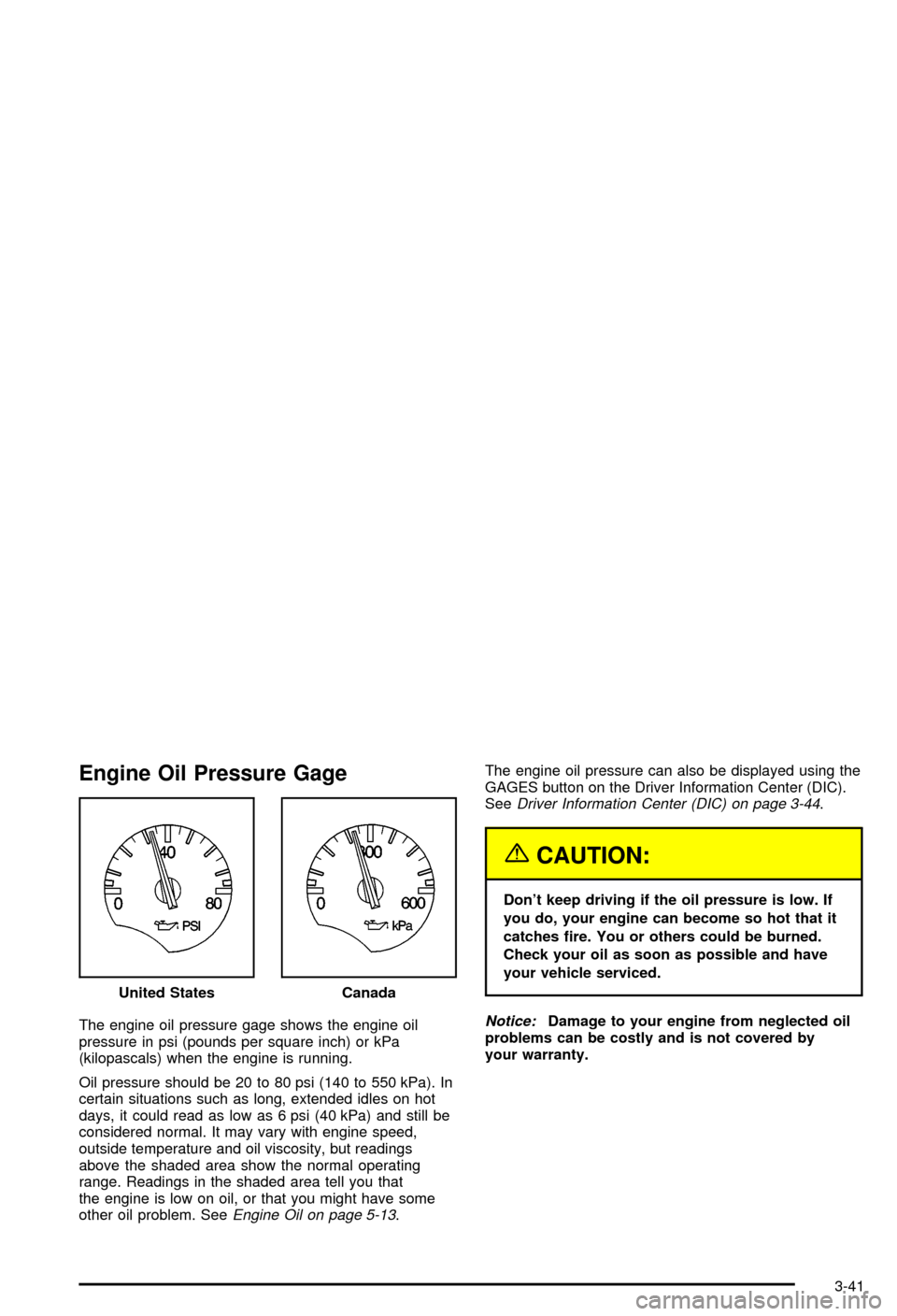
Engine Oil Pressure Gage
The engine oil pressure gage shows the engine oil
pressure in psi (pounds per square inch) or kPa
(kilopascals) when the engine is running.
Oil pressure should be 20 to 80 psi (140 to 550 kPa). In
certain situations such as long, extended idles on hot
days, it could read as low as 6 psi (40 kPa) and still be
considered normal. It may vary with engine speed,
outside temperature and oil viscosity, but readings
above the shaded area show the normal operating
range. Readings in the shaded area tell you that
the engine is low on oil, or that you might have some
other oil problem. See
Engine Oil on page 5-13.The engine oil pressure can also be displayed using the
GAGES button on the Driver Information Center (DIC).
See
Driver Information Center (DIC) on page 3-44.
{CAUTION:
Don't keep driving if the oil pressure is low. If
you do, your engine can become so hot that it
catches ®re. You or others could be burned.
Check your oil as soon as possible and have
your vehicle serviced.
Notice:Damage to your engine from neglected oil
problems can be costly and is not covered by
your warranty. United States
Canada
3-41
Page 154 of 368

Security Light
This light comes on to
remind you to arm your
theft-deterrent system. If it
comes on and stays on
when your ignition is
on, there may be a
problem with your
theft-deterrent system.
See
Theft-Deterrent System on page 2-16andPASS-Keyžon page 2-17.
Check Gages Warning Light
This light will come on
brie¯y when you are
starting the engine. If the
light comes on and
stays on while you are
driving, check your gages
to see if they are in the
warning areas.This light can come on for the following reasons:
·Low Oil Pressure
·High Coolant Temperature
·High or Low Battery Voltage
·Low Fuel Level
Fuel Gage
Your fuel gage tells you
about how much fuel you
have left when the
ignition is on.
When the needle approaches the red zone, RESERVE
FUEL will appear on the Driver Information Center (DIC)
display. When the needle approaches the E, LOW
FUEL will appear on the display. At this time, you still
have a little fuel left, but you should get more soon.
3-42
Page 155 of 368

Press RESET to acknowledge a DIC message(s).
Pressing RESET will also turn off a DIC message but
the LOW FUEL message will come on again in
10 minutes if you have not added fuel to the vehicle.
Here are ®ve things that some owners ask about.
All these things are normal and do not indicate that
anything is wrong with the fuel gage.
·At the gas station, the gas pump shuts off before
the gage reads F (full).
·It takes more (or less) fuel to ®ll up than the gage
reads. For example, the gage reads half full, but it
took more (or less) than half of the tank's
capacity to ®t it.
·The gage pointer may move while cornering,
braking or speeding up.
·The gage may not indicate E (empty) when the
ignition is turned off.
·The gage reading may change slightly within the
®rst several minutes after starting the vehicle.You can use the Driver Information Center (DIC) to
display more detailed fuel information. Each time you
press FUEL, one of the following will appear in the
Driver Information Center (DIC).
·AVERAGE:The fuel economy calculated for the
current tank of fuel, or since you last reset the
display.
·INST (Instant):The fuel economy calculated for
your current driving conditions.
·RANGE:The distance you can drive before
refueling.
You should reset the fuel information display every time
you refuel. To reset the display, press FUEL until
AVERAGE appears. Then, press RESET on the Driver
Information Center (DIC).
3-43