2003 CHEVROLET CORVETTE seats
[x] Cancel search: seatsPage 42 of 368
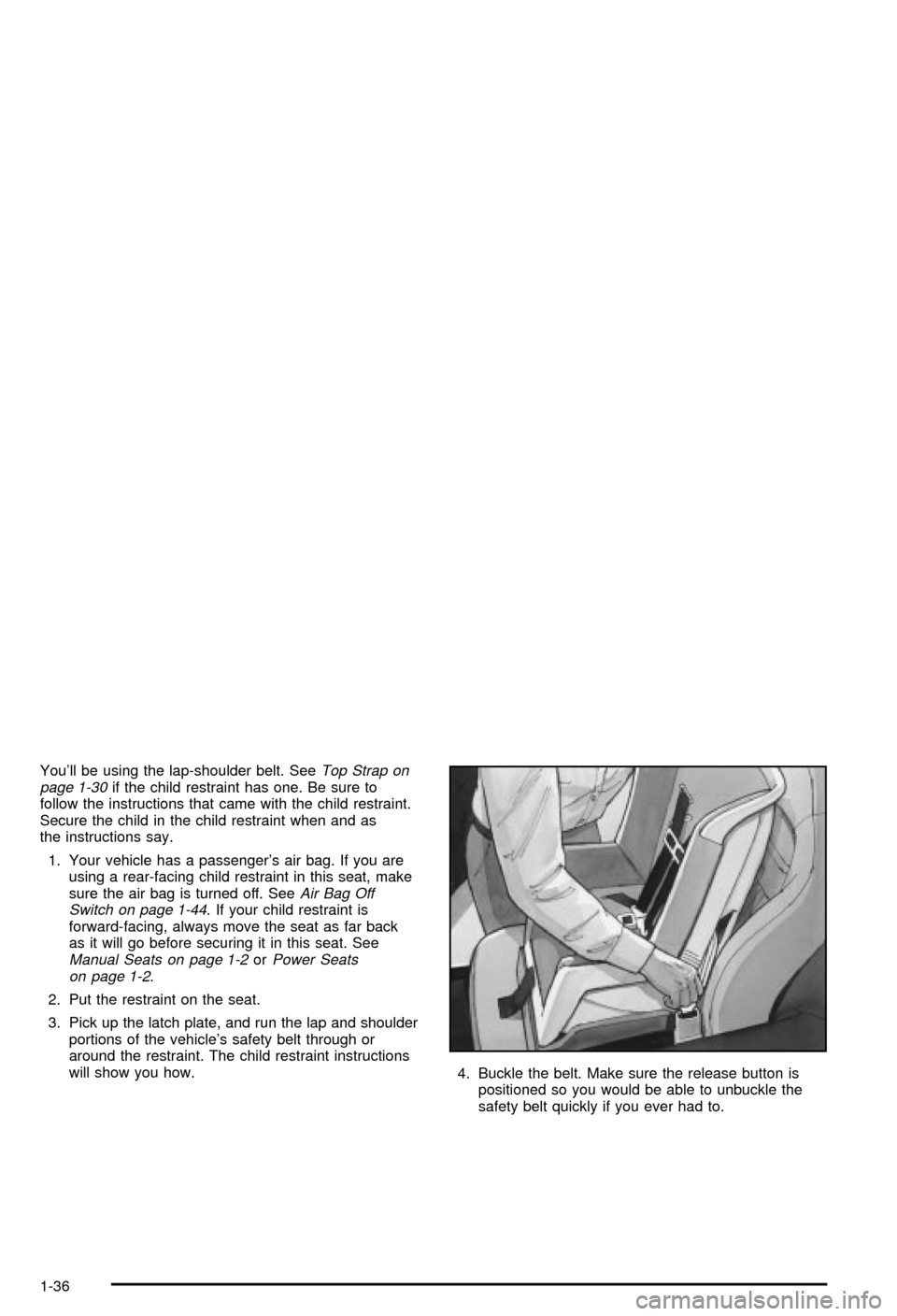
You'll be using the lap-shoulder belt. SeeTop Strap on
page 1-30if the child restraint has one. Be sure to
follow the instructions that came with the child restraint.
Secure the child in the child restraint when and as
the instructions say.
1. Your vehicle has a passenger's air bag. If you are
using a rear-facing child restraint in this seat, make
sure the air bag is turned off. See
Air Bag Off
Switch on page 1-44. If your child restraint is
forward-facing, always move the seat as far back
as it will go before securing it in this seat. See
Manual Seats on page 1-2orPower Seats
on page 1-2.
2. Put the restraint on the seat.
3. Pick up the latch plate, and run the lap and shoulder
portions of the vehicle's safety belt through or
around the restraint. The child restraint instructions
will show you how.
4. Buckle the belt. Make sure the release button is
positioned so you would be able to unbuckle the
safety belt quickly if you ever had to.
1-36
Page 108 of 368
If the vehicle has lost battery power, you can still
open the storage compartment lid (C) using
the manual release cable.
The cable is located underneath the carpeting
behind the driver's and passenger's seats, in the
center of the vehicle. When using the manual
release, you must ®rst open the doors to prevent
damage to the seals. To access the cable, lift
and pull back the carpeting. Then pull the cable to
release the storage compartment lid if needed.Notice:Be sure that the rear edge (B) of the
convertible top is in the full-down position before
lowering the top into the storage compartment
or damage to the top may occur.
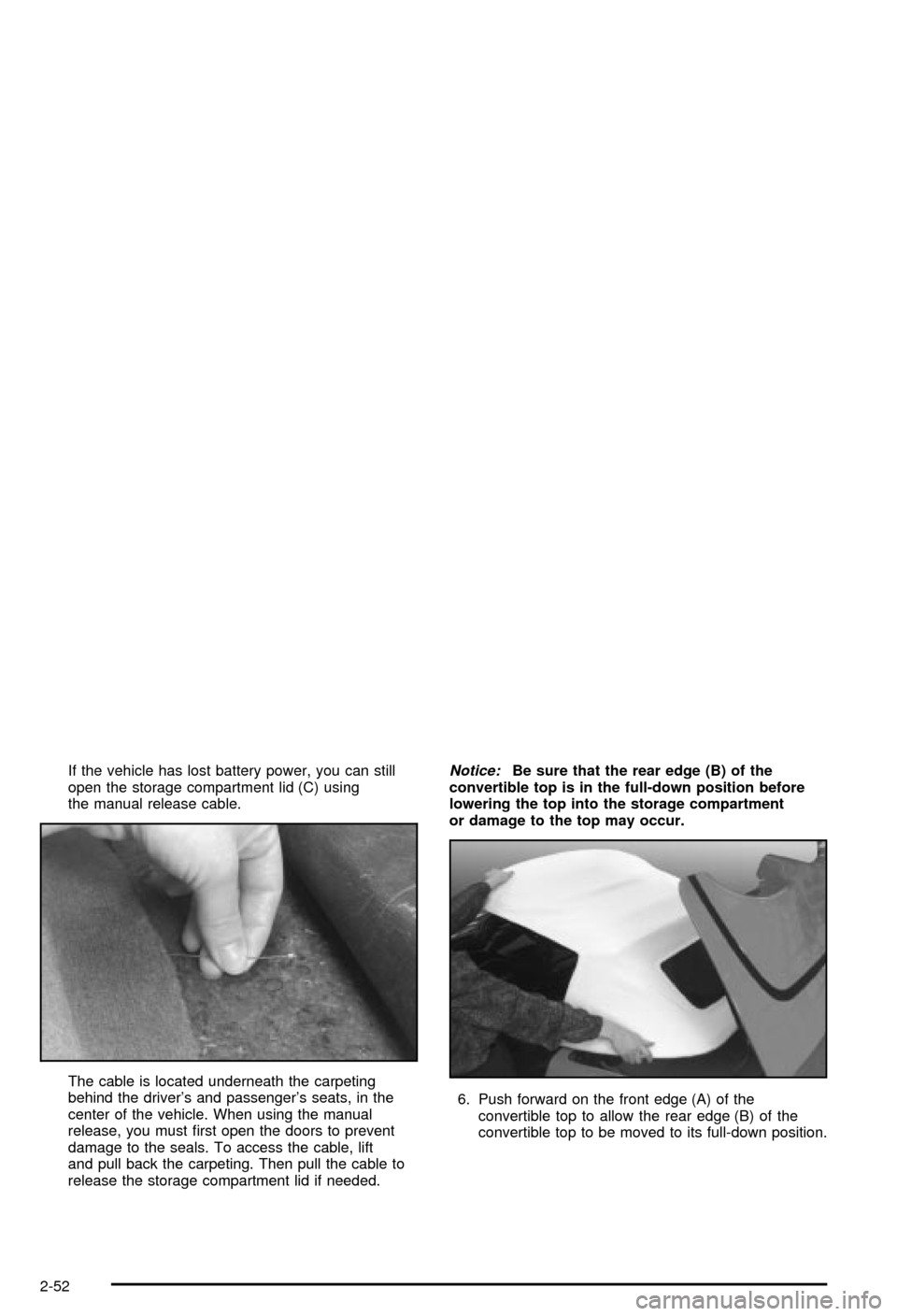
6. Push forward on the front edge (A) of the
convertible top to allow the rear edge (B) of the
convertible top to be moved to its full-down position.
2-52
Page 140 of 368

=REAR:Press this button to turn the rear window
defogger on. Be sure to clear as much snow from
the rear window as possible. An indicator light in the
button will come on to let you know that the rear window
defogger is activated.
The rear window defogger will automatically turn off
approximately 15 minutes after the button is pressed. If
turned on again, the defogger will only run for
approximately seven minutes before turning off. The
defogger can also be turned off by pressing the button
again or by turning off the engine.
Your vehicle has heated outside rearview mirrors. The
mirrors will heat to help clear fog or frost from the
surface of the mirrors when the rear window defog
button is pressed.
Notice:Don't use anything sharp on the inside of
the rear window. If you do, you could cut or damage
the warming grid, and the repairs wouldn't be
covered by your warranty. Do not attach a temporary
vehicle license, tape, a decal or anything similar
to the defogger grid.
Outlet Adjustment
Use the tab located on the air outlets to change the
direction of the air¯ow.
Operation Tips
·
Clear away any ice, snow or leaves from the air
inlets at the base of the windshield that may
block the ¯ow of air into your vehicle.
·Use of non-GM approved hood de¯ectors may
adversely affect the performance of the system.
·Keep the area around the base of the instrument
panel console and air path under the seats clear
of objects to help circulate the air inside of
your vehicle more effectively.
3-28
Page 156 of 368

Driver Information Center (DIC)
The Driver Information Center (DIC) will display
information about how your vehicle is functioning, as
well as warning messages if a system problem is
detected. The DIC display area is located in the
instrument panel cluster below the speedometer and
tachometer, directly above the steering column.
The following buttons are located on the DIC control
panel which is located to the right of the instrument
panel cluster.1 FUEL:Press this button to display fuel information
such as fuel economy and range.
2 GAGES:Press this button to display gage information
like oil pressure and temperature, coolant temperature,
automatic transmission ¯uid temperature, battery
voltage and front/rear tire pressures.
3 TRIP:Press this button to display your total and trip
miles, the elapsed time function, your average speed
and the engine oil life.
4 OPTIONS:This button allows you to choose personal
options that are available on your vehicle, depending
on the options your vehicle is equipped with, such
as security, door locks, easy entry seats and language.
5 E/M (English/Metric):Press this button to change
the display between English and metric units.
RESET:This button, used along with the other buttons,
will reset system functions and turn off or acknowledge
messages on the Driver Information Center (DIC).
At the top of the DIC control buttons is a light sensor.
Be sure not to block the sensor or your lighting functions
may be disrupted.
3-44
Page 227 of 368
{CAUTION:
Things you put inside your vehicle can strike
and injure people in a sudden stop or turn, or
in a crash.
·Put things in the rear area of your vehicle.
Try to spread the weight evenly.
·Never stack heavier things, like suitcases,
inside the vehicle so that some of them
are above the tops of the seats.
·Don't leave an unsecured child restraint in
your vehicle.
·When you carry something inside the
vehicle, secure it whenever you can.
Towing a Trailer
Your Corvette is neither designed nor intended to tow a
trailer.
4-35
Page 313 of 368

Notice:When using the accessory power plug:
·Do NOT splice wires directly into the vehicle
electrical wire harness. If done incorrectly,
spicing may cause damage to your electrical
system and would not be covered by the
vehicle's warranty.
·The maximum load of any electrical equipment
should not exceed 20 amps.
·Be sure to turn off any electrical equipment
when not in use. Leaving electrical equipment
on for extended periods of time can drain
your battery.
·DO NOT use this plug if the electrical equipment
requires frequent connecting and disconnecting.
This may cause excessive wear on the
accessory power plug and damage your
electrical system and the damage would not be
covered by your warranty.
Headlamp Wiring
The headlamp wiring is protected by a circuit breaker.
An electrical overload will cause the lamps to go on and
off, or in some cases to remain off. If this happens,
have your headlamp wiring checked right away.
Windshield Wiper Fuses
The windshield wiper motor is protected by a fuse and
an internal circuit breaker. If the motor overheats
due to heavy snow, etc., the wiper will stop until the
motor cools. If the overload is caused by some electrical
problem and not snow, etc., be sure to get it ®xed.
Power Windows and Other Power
Options
Circuit breakers protect the power seats and other
power accessories. When the current load is too heavy,
the circuit breaker opens and closes, protecting the
circuit until the problem is ®xed or goes away.
5-85
Page 363 of 368

Maintenance Schedule (cont.)
Tire and Wheel Inspection............................6-12
Using Your................................................... 6-4
Your Vehicle and the Environment................... 6-2
Malfunction Indicator Light................................3-38
Manual Seats................................................... 1-2
Manual Transmission Check............................... 6-9
Manual Transmission.......................................2-21
Fluid..........................................................5-20
Operation...................................................2-27
Matching Transmitter(s) to Your Vehicle............... 2-7
Memory.........................................................2-55
Message.......................................................3-53
DIC Warnings and Messages........................3-53
Mexico, Central America and Caribbean Islands/
Countries (Except Puerto Rico and U.S. Virgin
Islands) ± Customer Assistance....................... 7-5
Mirrors..........................................................2-37
Automatic Dimming Rearview........................2-37
Manual Rearview Mirror................................2-37
Outside Automatic Dimming Mirror.................2-38
Outside Convex Mirror.................................2-38
Outside Power Heated Mirrors.......................2-38
Model Reference................................................ vi
MyGMLink.com................................................ 7-3
N
New Vehicle Break-In......................................2-19
Normal Maintenance Replacement Parts............5-94
O
Odometer......................................................3-31
Off-Road Recovery..........................................4-15
Oil ................................................................3-41
Engine Oil Pressure Gage............................3-41
Engine.......................................................5-13
Older Children, Restraints................................1-21
One to Four Shift Light
(Manual Transmission)..................................2-29
Online Owner Center........................................ 7-3
Operating the Trunk-Mounted CD Changer
with the AM-FM Radio with Cassette..............3-73
Operating the Trunk-Mounted CD Changer with
the AM-FM Radio with CD............................3-74
Other Warning Devices...................................... 3-4
Outlet Adjustment............................................3-28
Outside.........................................................2-38
Automatic Dimming Mirror.............................2-38
Convex Mirror.............................................2-38
Power Heated Mirrors..................................2-38
Overheated Engine Protection
Operating Mode..........................................5-26
Overseas ± Customer Assistance........................ 7-5
Owners, Canadian............................................... ii
Owner's Information........................................7-11
9
Page 365 of 368

Rearview Mirror, Automatic Dimming..................2-37
Rearview Mirrors.............................................2-37
Reclining Seatbacks.......................................... 1-3
Recreational Vehicle Towing.............................4-33
Remote Keyless Entry System, Operation............ 2-5
Remote Keyless Entry System............................ 2-4
Removing the Roof Panel................................2-43
Replacement Bulbs.........................................5-51
Replacing Brake System Parts..........................5-40
Replacing Restraint System Parts
After a Crash..............................................1-48
Reporting Safety Defects.................................7-10
Canadian Government..................................7-10
General Motors...........................................7-10
United States Government.............................. 7-9
Restraint System Check.................................... 6-9
Checking Your Restraint Systems...................1-48
Replacing Restraint System Parts After a
Crash.....................................................1-48
Restraint Systems...........................................1-48
Checking....................................................1-48
Replacing Parts...........................................1-48
Retained Accessory Power (RAP)......................2-21
Roadside......................................................... 7-6
Assistance Program....................................... 7-6
Rocking Your Vehicle To Get It Out...................4-32
Roof Panel....................................................2-43
Installing the Roof Panel...............................2-47
Removing the Roof Panel.............................2-43Roof Panel (cont.)
Storing the Roof Panel.................................2-46
Running Your Engine While You Are Parked.......2-36
S
Safety Belt.....................................................3-31
Reminder Light............................................3-31
Safety Belts...................................................5-77
Care of......................................................5-77
Driver Position............................................1-13
How to Wear Safety Belts Properly................1-12
Passenger Position......................................1-20
Questions and Answers About Safety Belts.....1-11
Safety Belt Extender....................................1-20
Safety Belt Use During Pregnancy.................1-20
Safety Belts Are for Everyone......................... 1-7
Safety Warnings and Symbols.............................. iii
Scheduled Maintenance..................................... 6-4
Seatback Latches............................................. 1-5
Seats.............................................................. 1-2
Manual........................................................ 1-2
Power Seats................................................. 1-2
Reclining Seatbacks...................................... 1-3
Seatback Latches.......................................... 1-5
Sport Seat................................................... 1-6
11