Page 54 of 368

Restraint System Check
Checking Your Restraint Systems
Now and then, make sure the safety belt reminder light
and all your belts, buckles, latch plates, retractors
and anchorages are working properly. Look for any other
loose or damaged safety belt system parts. If you see
anything that might keep a safety belt system from doing
its job, have it repaired.
Torn or frayed safety belts may not protect you in a
crash. They can rip apart under impact forces. If a belt
is torn or frayed, get a new one right away.
Also look for any opened or broken air bag covers, and
have them repaired or replaced. (The air bag system
does not need regular maintenance.)
Replacing Restraint System Parts
After a Crash
{CAUTION:
A crash can damage the restraint systems in
your vehicle. A damaged restraint system may
not properly protect the person using it,
resulting in serious injury or even death in a
crash. To help make sure your restraint
systems are working properly after a crash,
have them inspected and any necessary
replacements made as soon as possible.
If you've had a crash, do you need new belts?
After a very minor collision, nothing may be necessary.
But if the belts were stretched, as they would be if
worn during a more severe crash, then you need
new parts.
1-48
Page 69 of 368
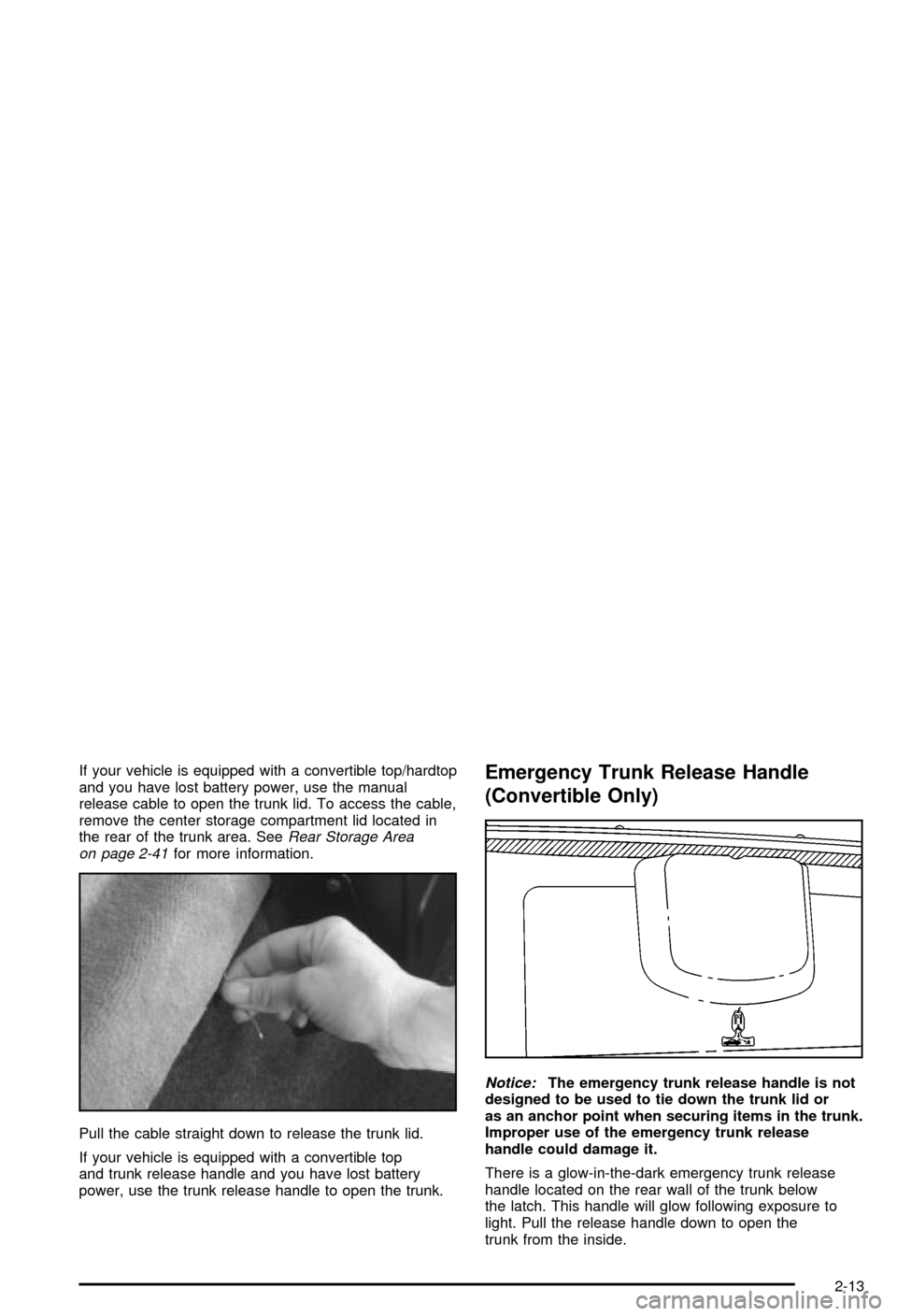
If your vehicle is equipped with a convertible top/hardtop
and you have lost battery power, use the manual
release cable to open the trunk lid. To access the cable,
remove the center storage compartment lid located in
the rear of the trunk area. See
Rear Storage Area
on page 2-41for more information.
Pull the cable straight down to release the trunk lid.
If your vehicle is equipped with a convertible top
and trunk release handle and you have lost battery
power, use the trunk release handle to open the trunk.
Emergency Trunk Release Handle
(Convertible Only)
Notice:The emergency trunk release handle is not
designed to be used to tie down the trunk lid or
as an anchor point when securing items in the trunk.
Improper use of the emergency trunk release
handle could damage it.
There is a glow-in-the-dark emergency trunk release
handle located on the rear wall of the trunk below
the latch. This handle will glow following exposure to
light. Pull the release handle down to open the
trunk from the inside.
2-13
Page 71 of 368
Power Windows
With power windows, switches on the door control each
window when the ignition is on or when RAP is
present. See ªRetained Accessory Power (RAP)º under
Ignition Positions on page 2-20.
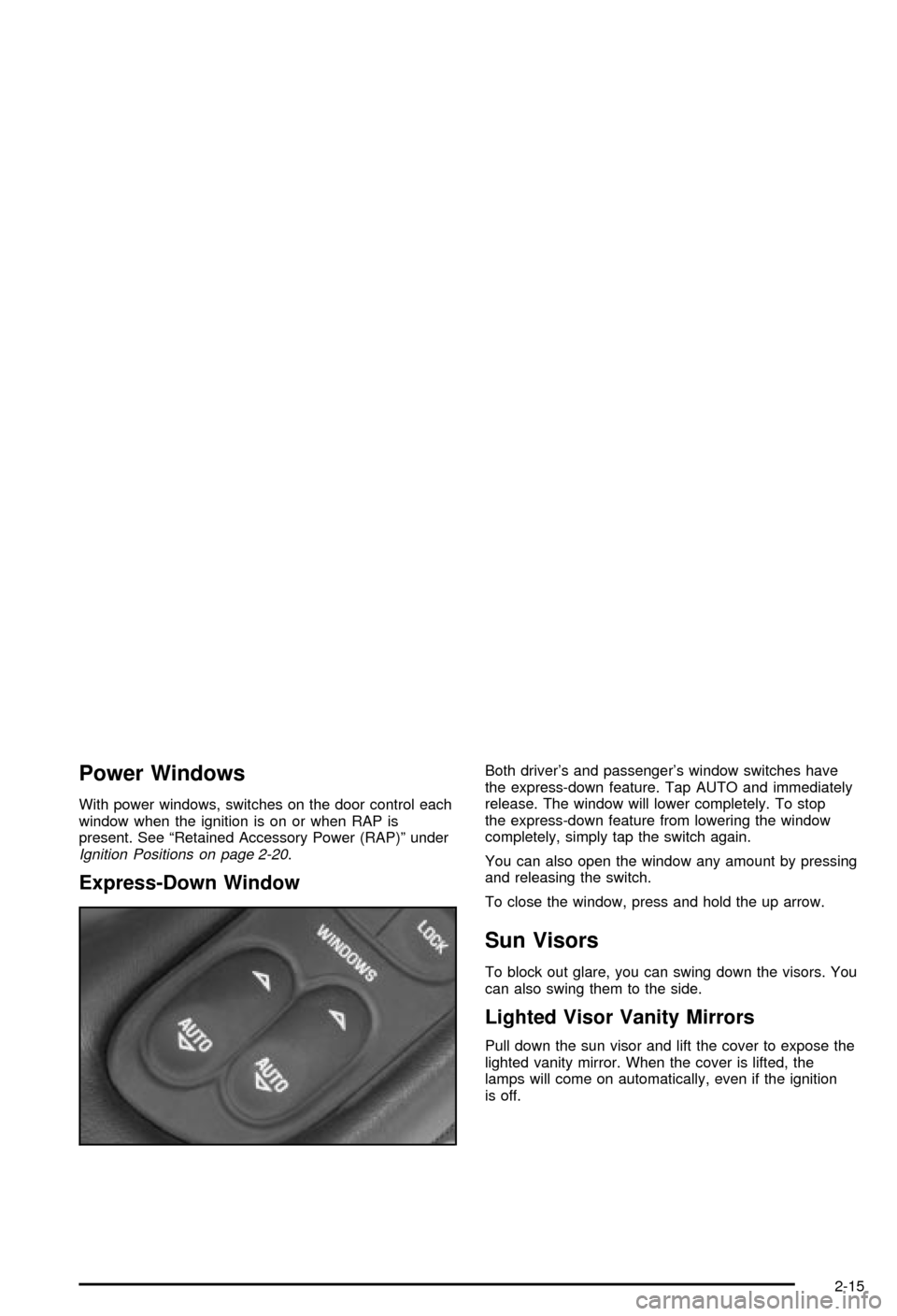
Express-Down Window
Both driver's and passenger's window switches have
the express-down feature. Tap AUTO and immediately
release. The window will lower completely. To stop
the express-down feature from lowering the window
completely, simply tap the switch again.
You can also open the window any amount by pressing
and releasing the switch.
To close the window, press and hold the up arrow.
Sun Visors
To block out glare, you can swing down the visors. You
can also swing them to the side.
Lighted Visor Vanity Mirrors
Pull down the sun visor and lift the cover to expose the
lighted vanity mirror. When the cover is lifted, the
lamps will come on automatically, even if the ignition
is off.
2-15
Page 72 of 368

Theft-Deterrent Systems
Vehicle theft is big business, expecially in some cities.
Although your vehicle has a number of theft-deterrent
features, we know that nothing we put on it can make it
impossible to steal. However, there are ways you
can help.
Theft-Deterrent System
Your vehicle is equipped with a theft-deterrent alarm
system.
With this system, the
SECURITY light will ¯ash
as you open the door
if your ignition is off. This
light reminds you to
arm the theft-deterent
system.
Arming the System
Use one of the two following items listed here to arm
the system:
·Press the lock button on the remote keyless entry
transmitter.
·Open the door. The SECURITY light should ¯ash.
Lock the door with the power door lock switch.
The SECURITY light will stop ¯ashing and stay on.
Close the door. The security light should go off.
Now, if a door or the hatch/trunk lid is opened without
the key or the remote keyless entry transmitter, the
alarm will go off. Your horn will sound for two minutes,
then it will go off to save battery power. And, your
vehicle won't start.
The theft-deterrent system won't arm if you lock the
driver's door with a key, the manual door lock, or if you
use the power door lock after the doors are closed.
If your passenger stays in the vehicle when you leave
with the keys, have the passenger lock the vehicle after
the doors are closed. This way the alarm won't arm,
and your passenger won't set it off.
2-16
Page 74 of 368

The key must be clean and dry before it's inserted in
the ignition or the engine may not start. If the SECURITY
light comes on, the key may be dirty or wet.
If this happens and the starter won't work, turn the
ignition off. Clean and dry the key, wait three minutes
and try again. If the starter still won't work, wait
three minutes and try the other ignition key. At this time,
you may also want to check the fuses. See
Fuses
and Circuit Breakers on page 5-86. If the starter won't
work with the other key, your vehicle needs service.
If your vehicle does start, the ®rst ignition key may be
faulty. See your dealer or a locksmith who can
service the PASS-Key
ž.If you accidentally use a key that has a damaged or
missing resistor pellet, you will see no SECURITY light.
You don't have to wait three minutes before trying
the proper key.
If the resistor pellet is damaged or missing, the starter
won't work. Use the other ignition key, and see your
dealer or a locksmith who can service the PASS-Key
žto
have a new key made.
If the SECURITY light comes on while driving, have
your vehicle serviced as soon as possible.
If you lose or damage a PASS-Key
žignition key, see
your dealer or a locksmith who can service PASS-Keyž.
In an emergency, call Chevrolet Roadside Assistance.
See
Roadside Assistance Program on page 7-6for more
information.
2-18
Page 85 of 368

If your engine speed drops below 900 rpm, or if the
engine is not running smoothly, you should downshift to
the next lower gear. You may have to downshift two
or more gears to keep the engine running smoothly or
for good engine performance.
Notice:When you are shifting gears, don't move
the gearshift lever around needlessly. This can
damage parts of the transmission and may require
costly repair. Shift directly into the next appropriate
gear.
One to Four Shift Light
(Manual Transmission)
When this light comes on,
you can only shift from
FIRST (1) to FOURTH (4)
instead of FIRST (1) to
SECOND (2).
You must complete the shift into FOURTH (4) to turn off
this feature. This helps you get the best possible fuel
economy.After shifting to FOURTH (4), you may downshift to a
lower gear if you prefer.
Notice:Do not try to force the shift lever into
SECOND (2) or THIRD (3) when the 1 TO 4 SHIFT light
comes on. Do not try to re-engage FIRST (1) after
starting to shift into FOURTH (4). You will damage
your transmission. Shift only from FIRST (1) to
FOURTH (4) when the light comes on.
This light will come on when:
·The engine coolant temperature is higher than
169ÉF (76ÉC),
·you are going 15 to 19 mph (24 to 31 km/h) and
·you are 21 percent throttle or less.
Downshifting (Manual Transmission)
If your vehicle is a coupe or convertible, do not downshift
into the gear shown below at a speed greater than
shown in the table:
FIRST (1) 50 mph (80 km/h)
SECOND (2) 74 mph (119 km/h)
THIRD (3) 101 mph (163 km/h)
FOURTH (4) 130 mph (209 km/h)
2-29
Page 86 of 368
If your vehicle is a Z06, do not downshift into a gear
shown below at a speed greater than shown in the table:
FIRST (1) 48 mph (77 km/h)
SECOND (2) 69 mph (111 km/h)
THIRD (3) 100 mph (161 km/h)
FOURTH (4) 143 mph (230 km/h)
Notice:If you skip more than one gear when you
downshift, or if you race the engine when you
release the clutch pedal while downshifting, you
could damage the engine, clutch, driveshaft or the
transmission.
The six-speed transmission has a spring that centers
the gearshift lever near THIRD (3) and FOURTH (4).
This spring helps you know which gear you are in when
you are shifting. Be careful when shifting from
FIRST (1) to SECOND (2) or downshifting from
SIXTH (6) to FIFTH (5). The spring will try to pull the
gearshift lever toward FOURTH (4) and THIRD (3).
Make sure you move the lever into SECOND (2)
or FIFTH (5). If you let the gearshift lever move in the
direction of the pulling, you may end up shifting
from FIRST (1) to FOURTH (4) or from SIXTH (6) to
THIRD (3).
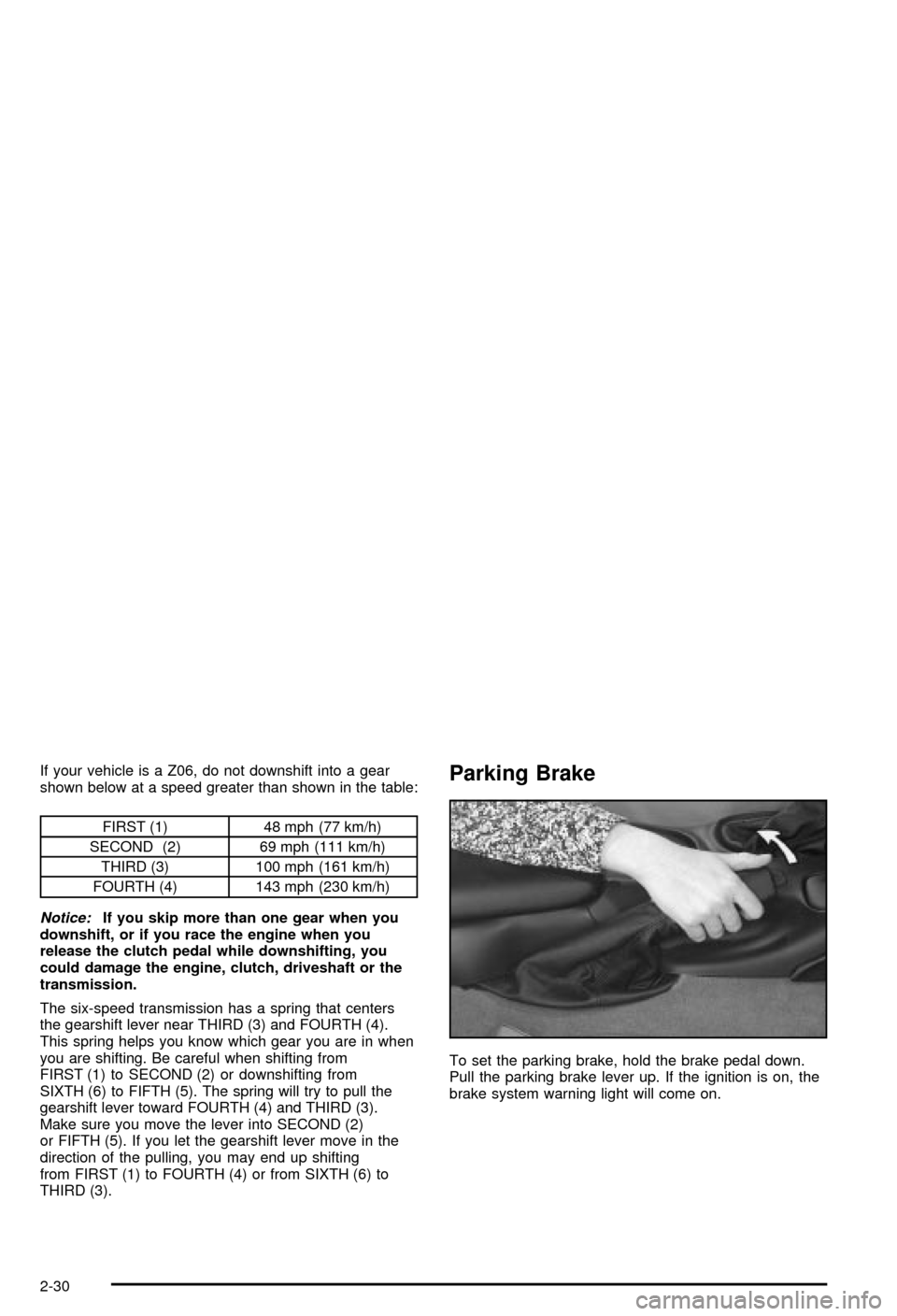
Parking Brake
To set the parking brake, hold the brake pedal down.
Pull the parking brake lever up. If the ignition is on, the
brake system warning light will come on.
2-30
Page 87 of 368
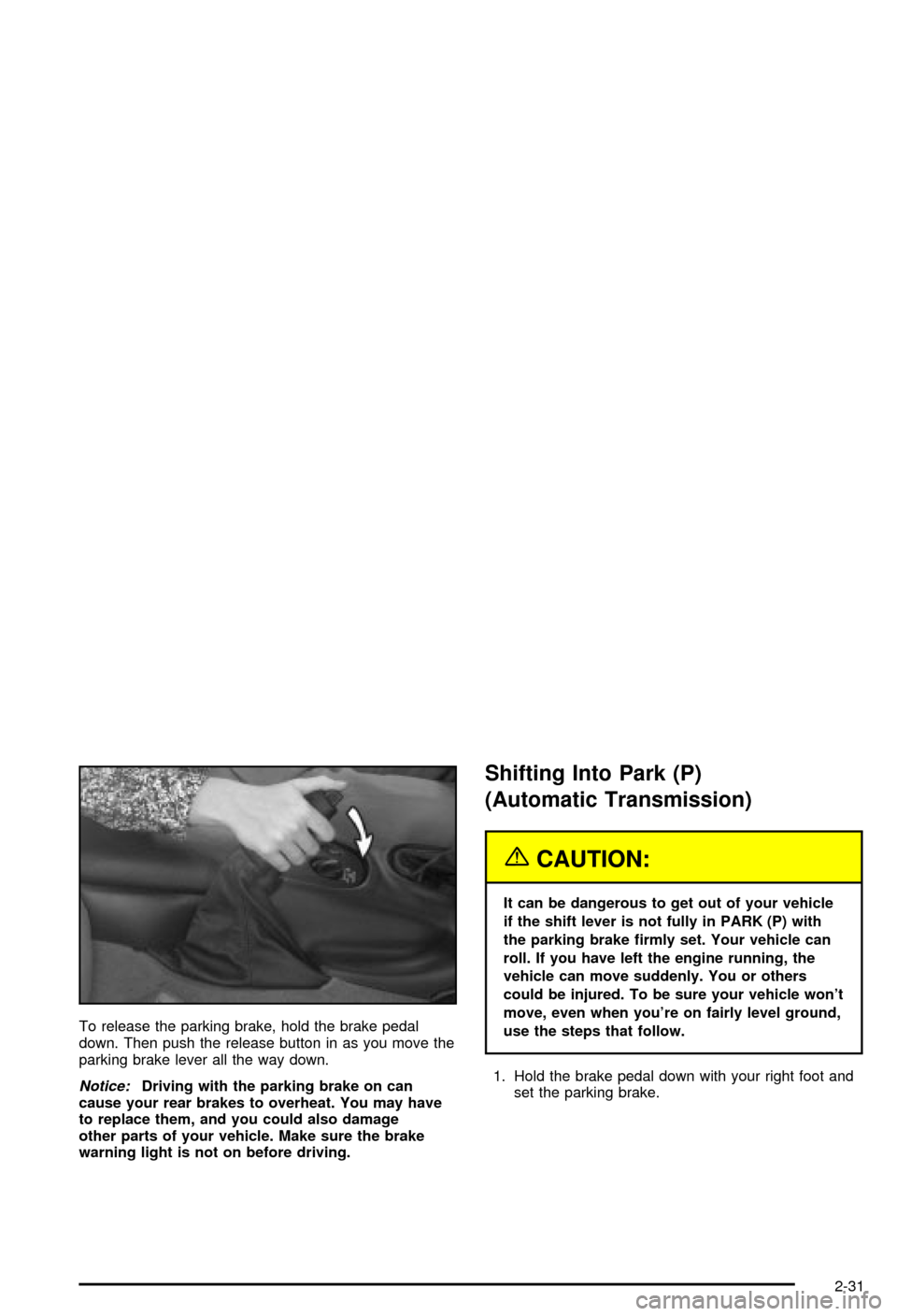
To release the parking brake, hold the brake pedal
down. Then push the release button in as you move the
parking brake lever all the way down.
Notice:Driving with the parking brake on can
cause your rear brakes to overheat. You may have
to replace them, and you could also damage
other parts of your vehicle. Make sure the brake
warning light is not on before driving.
Shifting Into Park (P)
(Automatic Transmission)
{CAUTION:
It can be dangerous to get out of your vehicle
if the shift lever is not fully in PARK (P) with
the parking brake ®rmly set. Your vehicle can
roll. If you have left the engine running, the
vehicle can move suddenly. You or others
could be injured. To be sure your vehicle won't
move, even when you're on fairly level ground,
use the steps that follow.
1. Hold the brake pedal down with your right foot and
set the parking brake.
2-31