Page 8 of 386
1-
1-1
Section 1 Seats and Restraint Systems
Here you'll find information about the seats in your vehicle and how to use your safety belts properly. You can also
learn about some things you should not do with air bags and safety belts.
1
-2 Seats and Seat Controls
1
-8 Safety Belts: They're for Everyone
1
-12 Here Are Questions Many People Ask About
Safety Belts
-- and the Answers
1
-13 How to Wear Safety Belts Properly
1
-13 Driver Position
1
-21 Safety Belt Use During Pregnancy
1
-22 Right Front Passenger Position
1
-22 Air Bag System1
-36 Center Passenger Position
1
-37 Rear Seat Passengers
1
-41 Children
1
-45 Restraint Systems for Children
1
-64 Older Children
1
-67 Safety Belt Extender
1
-67 Checking Your Restraint Systems
1
-68 Replacing Restraint System Parts
After a Crash
Page 15 of 386
1-8 Rear Seats (Crew Cab
�)
Folding the Rear Seat
The Crew Cab's rear bench seat can be folded down to
provide more cargo space.
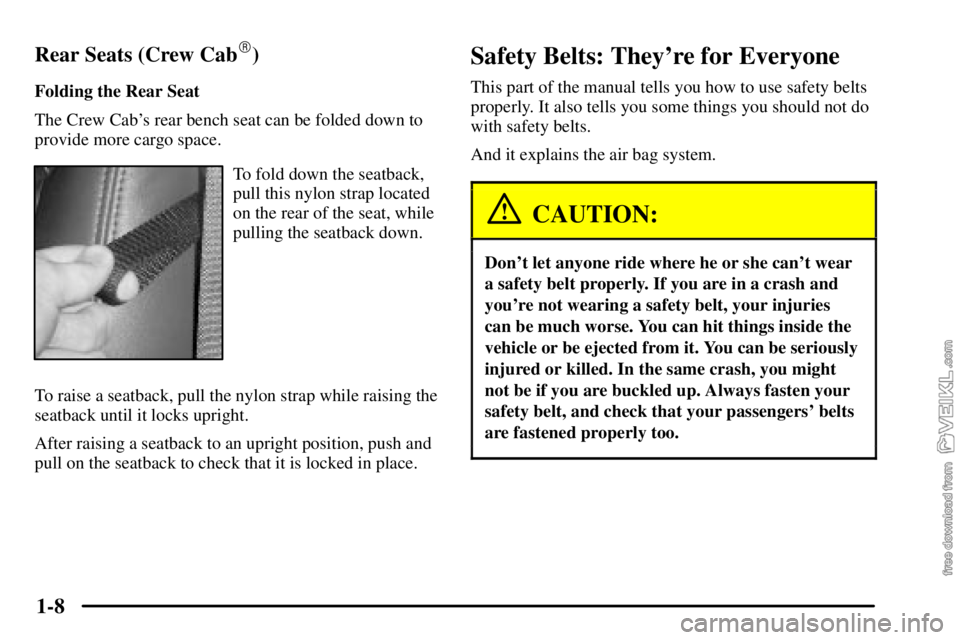
To fold down the seatback,
pull this nylon strap located
on the rear of the seat, while
pulling the seatback down.
To raise a seatback, pull the nylon strap while raising the
seatback until it locks upright.
After raising a seatback to an upright position, push and
pull on the seatback to check that it is locked in place.
Safety Belts: They're for Everyone
This part of the manual tells you how to use safety belts
properly. It also tells you some things you should not do
with safety belts.
And it explains the air bag system.
CAUTION:
Don't let anyone ride where he or she can't wear
a safety belt properly. If you are in a crash and
you're not wearing a safety belt, your injuries
can be much worse. You can hit things inside the
vehicle or be ejected from it. You can be seriously
injured or killed. In the same crash, you might
not be if you are buckled up. Always fasten your
safety belt, and check that your passengers' belts
are fastened properly too.
Page 32 of 386
1-25
If your vehicle has an air bag for the right front
passenger, please read this:
CAUTION:
Anyone who is up against, or very close to, any
air bag when it inflates can be seriously injured
or killed. Air bags plus lap
-shoulder belts offer
the best protection for adults, but not for young
children and infants. Neither the vehicle's safety
belt system nor its air bag system is designed for
them. Young children and infants need the
protection that a child restraint system can
provide. Always secure children properly in your
vehicle. To read how, see the part of this manual
called ªChildren.º
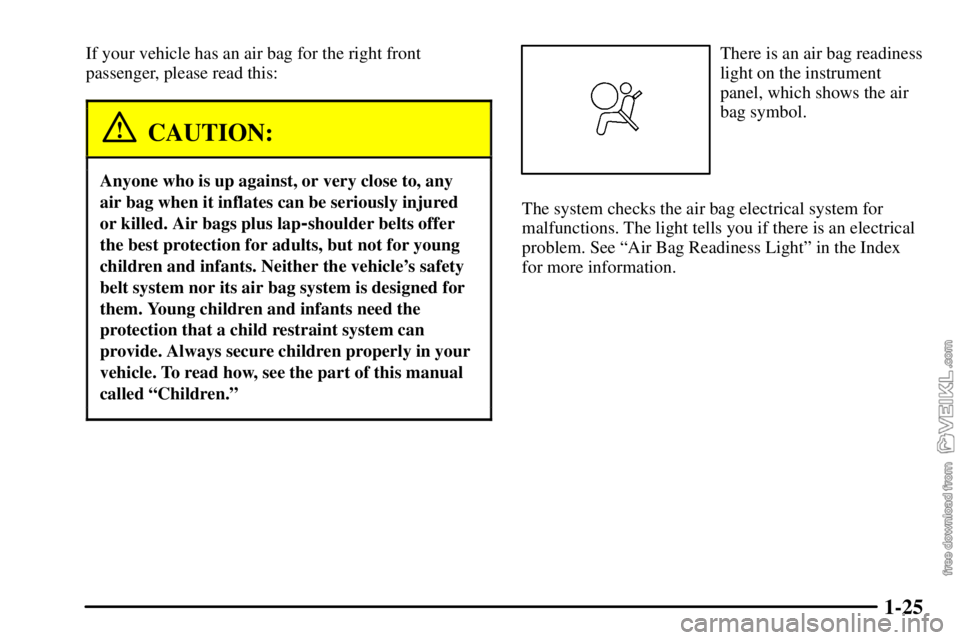
There is an air bag readiness
light on the instrument
panel, which shows the air
bag symbol.
The system checks the air bag electrical system for
malfunctions. The light tells you if there is an electrical
problem. See ªAir Bag Readiness Lightº in the Index
for more information.
Page 74 of 386

1-67
Safety Belt Extender
If the vehicle's safety belt will fasten around you, you
should use it.
But if a safety belt isn't long enough to fasten, your
dealer will order you an extender. It's free. When you go
in to order it, take the heaviest coat you will wear, so the
extender will be long enough for you. The extender will
be just for you, and just for the seat in your vehicle that
you choose. Don't let someone else use it, and use it
only for the seat it is made to fit. To wear it, just attach it
to the regular safety belt.
Checking Your Restraint Systems
Now and then, make sure the safety belt reminder light
and all your belts, buckles, latch plates, retractors and
anchorages are working properly. Look for any other
loose or damaged safety belt system parts. If you see
anything that might keep a safety belt system from
doing its job, have it repaired.
Torn or frayed safety belts may not protect you in a
crash. They can rip apart under impact forces. If a belt is
torn or frayed, get a new one right away.
Also look for any opened or broken air bag covers, and
have them repaired or replaced. (The air bag system
does not need regular maintenance.)
Page 76 of 386

2-
2-1
Section 2 Features and Controls
Here you can learn about the many standard and optional features on your vehicle, and information on starting,
shifting and braking. Also explained are the instrument panel and the warning systems that tell you if everything is
working properly
-- and what to do if you have a problem.
2
-2 Windows
2-5 Keys
2-7 Door Locks
2-8 Keyless Entry System (If Equipped)
2-12 Switchbanks
2-13 Theft
2-14 New Vehicle ªBreak-Inº
2-15 Ignition Positions
2-16 Starting Your Gasoline Engine
2-19 Starting the Diesel Engine
2-24 Starting Your DURAMAX� Diesel Engine
2-27 Engine Checks Before Operating
2-28 Engine Coolant Heater (If Equipped)
2-30 Diesel Engine Exhaust Brake (If Equipped)
2-31 Two-Speed Rear Axle Electric Shift Control
(If Equipped)
2
-34 Automatic Transmission Operation
2-36 Manual Transmission Operation
2-40 Parking
2-45 Parking Over Things That Burn
2-45 Engine Exhaust2
-46 Running Your Engine While You're Parked
(Automatic Transmission)
2
-47 Horn
2-48 Tilt Wheel (If Equipped)
2-48 Turn Signal/Multifunction Lever
2-55 Inter-Axle Differential Lock Control
(If Equipped)
2
-56 Rear Axle Differential Lock Control
(If Equipped)
2
-57 Exterior Lamps
2-60 Interior Lamps
2-61 Mirrors
2-63 Storage Compartments
2-65 Accessory Power Outlets
2-66 Trailer Connections (C4/C5 Models Only)
(If Equipped)
2
-67 Trailer Connections (C6/C7/C8 Models Only)
(If Equipped)
2
-68 The Instrument Panel-Your
Information System
2
-70 Instrument Panel Cluster
2-73 Warning Lights, Gages and Indicators
Page 84 of 386

2-9
Changes or modifications to this system by other than an
authorized service facility could void authorization to
use this equipment.
At times you may notice a decrease in range. This is
normal for any remote keyless entry system. If the
transmitter does not work or if you have to stand closer
to your vehicle for the transmitter to work, try this:
�Check the distance. You may be too far from your
vehicle. You may need to stand closer during rainy
or snowy weather.
�Check the location. Other vehicles or objects may be
blocking the signal. Take a few steps to the left or
right, hold the transmitter higher, and try again.
�Check to determine if battery replacement is
necessary. See the instructions that follow.
�If you're still having trouble, see your dealer or a
qualified technician for service.Operation
To unlock the driver's door, press the UNLOCK
button one time. If you press the button again within
five seconds, all of the doors will unlock. When the
UNLOCK button is pressed, the interior dome lamps
are turned on for about 40 seconds or until the ignition
switch is activated. Press the LOCK button to lock
all doors.
Page 86 of 386
2-11
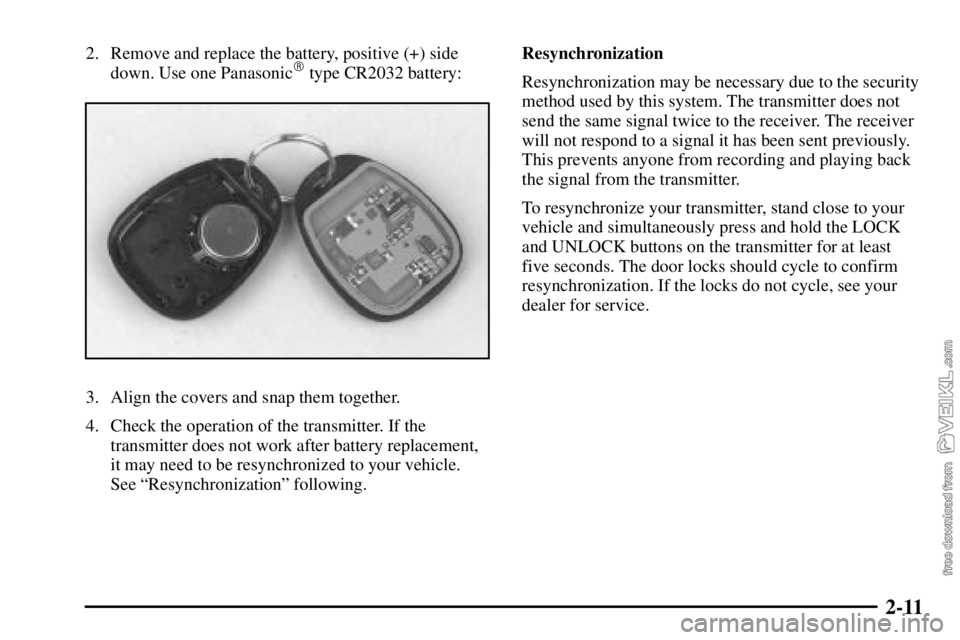
2. Remove and replace the battery, positive (+) side
down. Use one Panasonic� type CR2032 battery:
3. Align the covers and snap them together.
4. Check the operation of the transmitter. If the
transmitter does not work after battery replacement,
it may need to be resynchronized to your vehicle.
See ªResynchronizationº following.Resynchronization
Resynchronization may be necessary due to the security
method used by this system. The transmitter does not
send the same signal twice to the receiver. The receiver
will not respond to a signal it has been sent previously.
This prevents anyone from recording and playing back
the signal from the transmitter.
To resynchronize your transmitter, stand close to your
vehicle and simultaneously press and hold the LOCK
and UNLOCK buttons on the transmitter for at least
five seconds. The door locks should cycle to confirm
resynchronization. If the locks do not cycle, see your
dealer for service.
Page 89 of 386

2-14
New Vehicle ªBreak-Inº
NOTICE:
Your vehicle doesn't need an elaborate
ªbreak
-in.º But it will perform better in the long
run if you follow these guidelines:
�Let your engine warm up before you
operate your vehicle under load.
�Keep your speed at 55 mph (88 km/h) or
less for the first 500 miles (805 km).
�Don't drive at any one speed
-- fast or
slow
-- for the first 500 miles (805 km).
Don't make full
-throttle starts.
NOTICE: (Continued)
NOTICE: (Continued)
�Avoid making hard stops for the first
200 miles (322 km) or so. During this time
your new brake linings aren't yet broken
in. Hard stops with new linings can mean
premature wear and earlier replacement.
Follow this breaking
-in guideline every
time you get new brake linings.
�Use the lowest gear you can when you start
a loaded vehicle in motion and when going
up hills to avoid overloading the engine.
�Check and adjust engine and transmission
fluid levels often and be sure tires are
properly inflated for the load you're
carrying.
�If you have a Caterpillar
� diesel engine, see
the Caterpillar� Diesel Engine Operation
& Maintenance Manual.