Page 281 of 386
6-27
Engine Oil (Caterpillar�
Diesel Engines)
See your Caterpillar� Operation & Maintenance Manual
for information on oil quality and viscosities as well as
the temperature range chart.
Engine Oil (DURAMAX� Diesel)
Checking Engine Oil
It's a good idea to check your engine oil level every time
you get fuel.
The engine oil dipstick is
located in the engine
compartment on the driver's
side of the vehicle.
In order to get an accurate
reading, the oil must be
warm (at normal operating
temperature) and the vehicle
must be on level ground.Turn off the engine and give the oil at least five minutes
to drain back into the oil pan. With a cool engine, allow
30 minutes. If you don't, the oil dipstick might not show
the actual level.
Pull out the dipstick and clean it with a paper towel or a
cloth, then push it back in all the way. Remove it again,
keeping the tip down.
Page 286 of 386

6-32
Automatic Transmission Fluid
When to Check
A good time to have it checked is when the engine oil is
checked. See your Allison Automatic Transmission
Operator's Manual to find out when to change your
transmission fluid and filters.
How to Check and What to Use
The Allison Automatic Transmission Operator's Manual
that came with the vehicle shows how to check the
automatic transmission fluid and what fluid to use.
Automatic Transmission External Filter
Your automatic transmission filter requires periodic
replacement.
Consult the Allison Automatic Transmission
Operator's Manual that came with the vehicle for
proper change intervals.
Manual Transmission Fluid
Refer to the Maintenance Schedule to determine how
often to check the lubricant and when to change it. See
ªScheduled Maintenance Servicesº in the Index.
Refer to the Maintenance Schedule to determine what
kind of fluid to use. See ªRecommended Fluids and
Lubricantsº in the Index.
When to Check
A good time to have it checked is when the engine oil is
checked. See your Maintenance Schedule to find out
when to change your transmission fluid.
Page 287 of 386
6-33 How to Check and What to Use
Check the fluid level only when your engine is off, the
vehicle is parked on a level place and the transmission is
cool enough for you to rest your fingers on the
transmission case.
Then, follow these steps:
1. Remove the filler plug.
2. Check to be sure that the lubricant level is up
to the bottom of the fill opening. On heavy duty
transmissions (an inch of oil level equals about
one gallon of fluid.)
3. If the fluid level is good, install the plug and be sure
it is fully seated. If the fluid level is low, add more
fluid as described in the next steps.
How to Add Fluid
Here's how to add fluid. Refer to the Maintenance
Schedule to determine the proper fluid to use. See
ªRecommended Fluids and Lubricantsº in the Index.
1. Remove the filler plug.
2. Add fluid at the filler plug hole. Add only enough
fluid to bring the fluid level up to the bottom of the
fill opening.
3. Install the filler plug. Be sure the plug is fully seated.
Page 288 of 386
6-34
Rear Axle
When to Check and Change Lubricant
Refer to the Maintenance Schedule to determine how
often to check the lubricant and when to change it. See
ªScheduled Maintenance Servicesº in the Index.
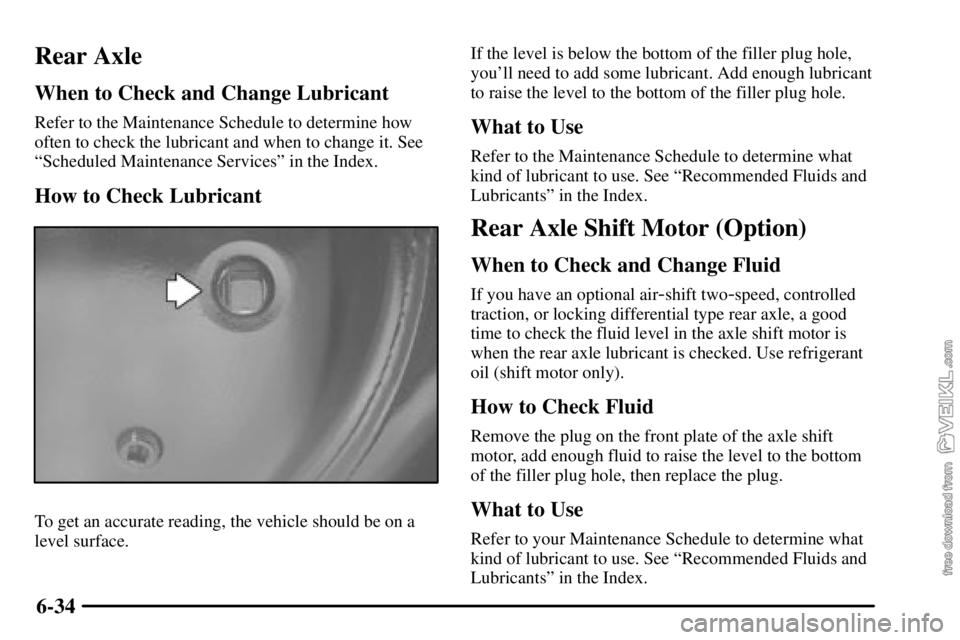
How to Check Lubricant
To get an accurate reading, the vehicle should be on a
level surface.If the level is below the bottom of the filler plug hole,
you'll need to add some lubricant. Add enough lubricant
to raise the level to the bottom of the filler plug hole.
What to Use
Refer to the Maintenance Schedule to determine what
kind of lubricant to use. See ªRecommended Fluids and
Lubricantsº in the Index.
Rear Axle Shift Motor (Option)
When to Check and Change Fluid
If you have an optional air-shift two-speed, controlled
traction, or locking differential type rear axle, a good
time to check the fluid level in the axle shift motor is
when the rear axle lubricant is checked. Use refrigerant
oil (shift motor only).
How to Check Fluid
Remove the plug on the front plate of the axle shift
motor, add enough fluid to raise the level to the bottom
of the filler plug hole, then replace the plug.
What to Use
Refer to your Maintenance Schedule to determine what
kind of lubricant to use. See ªRecommended Fluids and
Lubricantsº in the Index.
Page 290 of 386

6-36 What to Use
Use a mixture of one-half clean, drinkable water and
one
-half DEX-COOL� coolant which won't damage
aluminum parts. If you use this coolant mixture, you
don't need to add anything else.
CAUTION:
Adding only plain water to your cooling system
can be dangerous. Plain water, or some other
liquid such as alcohol, can boil before the proper
coolant mixture will. Your vehicle's coolant
warning system is set for the proper coolant
mixture. With plain water or the wrong mixture,
your engine could get too hot but you wouldn't
get the overheat warning. Your engine could
catch fire and you or others could be burned.
Use a 50/50 mixture of clean, drinkable water
and DEX
-COOL� coolant.
NOTICE:
If you use an improper coolant mixture, your
engine could overheat and be badly damaged.
The repair cost wouldn't be covered by your
warranty. Too much water in the mixture can
freeze and crack the engine, radiator, heater core
and other parts.
If you have to add coolant more than four times a year,
have your dealer check your cooling system.
NOTICE:
If you use the proper coolant, you don't have to
add extra inhibitors or additives which claim to
improve the system. These can be harmful.
Page 291 of 386
6-37 Checking Coolant
The coolant surge tank is located in the engine
compartment on the driver's side of the vehicle.
CAUTION:
Turning the surge tank pressure cap when the
engine and radiator are hot can allow steam and
scalding liquids to blow out and burn you badly.
Never turn the surge tank pressure cap
-- even a
little
-- when the engine and radiator are hot.
The vehicle must be on a level surface. When your
engine is cold, the coolant level should be at the COLD
FILL mark or higher.
If the low coolant light
comes on and stays on,
it means you're low on
engine coolant.
See ªLights, Low Coolant Warning Lightº in the Index
for further information.
Page 293 of 386

6-39
Power Steering Fluid
See your Maintenance Schedule for when to check your
power steering fluid.
How To Check Power Steering Fluid
Check your power steering fluid only when the engine is
warm. If the engine isn't warm, you probably won't get
an accurate reading.
If the fluid level is
between the MIN and
MAX marks, you have
enough. If you need
fluid, add only enough
of the proper fluid to
bring it into view in
the sight glass.If your power steering fluid level is low, this can cause
the BRAKE or service brake soon warning lights to
come on. If either light remains on after you have added
power steering fluid to the proper level, then shut off the
engine for 10 seconds. This should reset the brake
warning lights. If one or both lights stay on though, see
ªHydraulic Brake Warning Lightsº in the Index.
What to Use
To determine what kind of fluid to use, see
ªRecommended Fluids and Lubricantsº in the Index.
NOTICE:
When adding power steering fluid or making a
complete fluid change, always use the proper
fluid. Failure to use the proper fluid can cause
leaks and damage hoses and seals.
Page 295 of 386

6-41
NOTICE:
�When using concentrated washer fluid,
follow the manufacturer's instructions for
adding water.
�Don't mix water with ready
-to-use washer
fluid. Water can cause the solution to freeze
and damage your washer fluid tank and
other parts of the washer system. Also,
water doesn't clean as well as washer fluid.
�Fill your washer fluid tank only
three
-quarters full when it's very cold.
This allows for expansion if freezing occurs,
which could damage the tank if it is
completely full.
�Don't use engine coolant (antifreeze) in
your windshield washer. It can damage
your washer system and paint.
Brakes
Brake Fluid
If your vehicle has hydraulic brakes, there's a brake
master cylinder. Refer to the Maintenance Schedule to
determine when to check your brake fluid.
CAUTION:
Don't add brake fluid before you check the level.
If you do, you could get too much brake fluid.
Brake fluid could spill on the hot engine and it
can catch fire. You could be burned and your
vehicle could be damaged. See ªChecking Brake
Fluidº in this section.


