Page 154 of 386
2-79 Service Transmission Warning Light
(If Equipped)
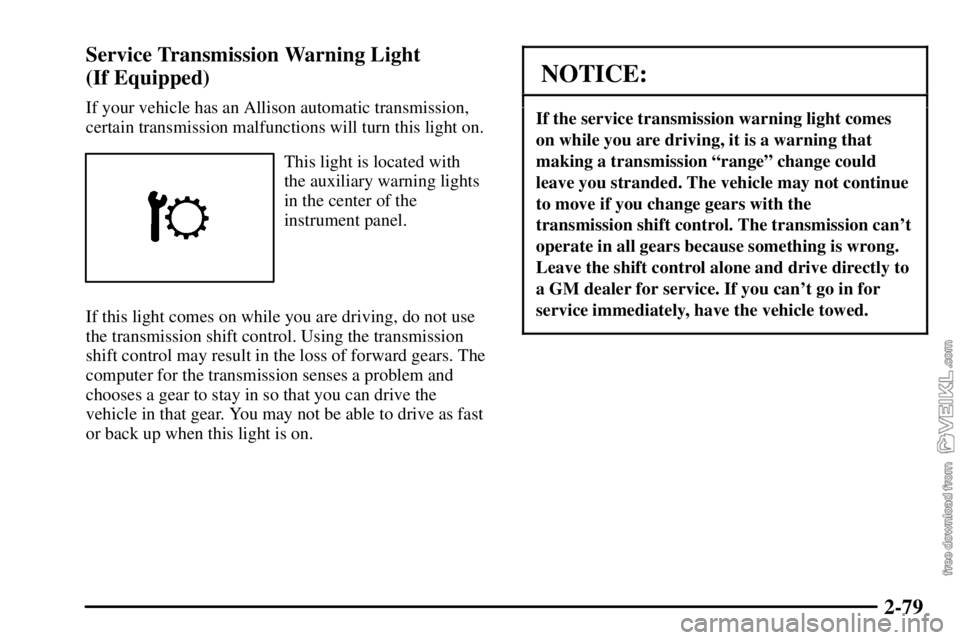
If your vehicle has an Allison automatic transmission,
certain transmission malfunctions will turn this light on.
This light is located with
the auxiliary warning lights
in the center of the
instrument panel.
If this light comes on while you are driving, do not use
the transmission shift control. Using the transmission
shift control may result in the loss of forward gears. The
computer for the transmission senses a problem and
chooses a gear to stay in so that you can drive the
vehicle in that gear. You may not be able to drive as fast
or back up when this light is on.
NOTICE:
If the service transmission warning light comes
on while you are driving, it is a warning that
making a transmission ªrangeº change could
leave you stranded. The vehicle may not continue
to move if you change gears with the
transmission shift control. The transmission can't
operate in all gears because something is wrong.
Leave the shift control alone and drive directly to
a GM dealer for service. If you can't go in for
service immediately, have the vehicle towed.
Page 155 of 386

2-80 Range Inhibited Warning Indicator
(If Equipped)
If your vehicle is equipped with an Allison
1000/2000/2400 series automatic transmission, a lighted
bar under the current gear selected will flash.
If your vehicle is equipped with an Allison MD
automatic transmission, the current gear selected on
the pushbutton display will flash.
The flashing bar or gear selection indicates that
transmission range shifts may not occur.
For detailed information on shift inhibit limitations, see
the Allison Automatic Transmission Operator's Manual
in your vehicle for further information.
Brake System Warning Light
Your vehicle has either hydraulic or air brakes.
Each system has different warning lights.
Hydraulic Brake System Warning Lights
Vehicles with hydraulic systems have two brake system
warning lights on the instrument panel.
If the BRAKE warning light
comes on, it means that the
fluid level in the master
cylinder reservoir is low or
there is another problem
with your hydraulic brakes.
When it comes on, you will also hear a warning tone.
The BRAKE warning light may come on, and the
warning tone may sound, when you're turning and
braking at the same time. This is normal. See ªHydraulic
Brake Systemsº in the Index.
Page 165 of 386
2-90 Engine Shutdown Warning Light
(If Equipped)
If your vehicle has the
engine shutdown feature,
this light will come on when
engine shutdown is active.
For more information, see ªEngine Alarm and
Automatic Shutdownº in the Index.
Transmission Temperature Gage
(If Equipped)
If you have an automatic
transmission, this gage is
located above the
switchbank in the center of
the instrument panel.
When your ignition is on, the gage shows the
temperature of the transmission oil. A reading in the
warning zone, the red area beginning at 300�F (150�C),
means you must stop driving and check into the cause.
One possible cause is a low oil level in the transmission.
NOTICE:
If you drive when the transmission temperature
gage is in the warning zone, you can badly
damage the transmission.
Page 203 of 386

4-10
Traction Control System (TCS)
(Option)
Your vehicle may have a traction control system that
limits wheel spin. This is especially useful in slippery
road conditions. The system operates only if it senses
that one or both of the rear wheels are spinning or
beginning to lose traction. When this happens, the
system applies the brake(s) at the affected wheel(s).
The bottom light on the TCS on/off button will come on
when the TCS is limiting wheel spin. You may feel or
hear the system working, but this is normal. The TCS
will function at speeds up to about 25 mph (42 km/h).
The TCS may operate on dry roads under some
conditions. When this happens, you may notice a
reduction in acceleration. This is normal and doesn't
mean there's a problem with your vehicle. Examples of
these conditions include a hard acceleration in a turn, an
abrupt upshift or downshift of the transmission or
driving on rough roads.
When the light in the top of the TCS button is on, the
TCS is off and will not limit wheel spin. Adjust your
driving accordingly.
The light in the top of the TCS button will come on if
the TCS is turned off by pressing the TCS on/off button.The light may also come on if a problem has been
detected in either the traction control system or the
anti
-lock brake system.
The traction control system automatically comes on
whenever you start your vehicle. To limit wheel spin,
especially in slippery road conditions, you should
always leave the system on. But you can turn the
traction control system off if you ever need to. You
should turn the system off if your vehicle ever gets stuck
in sand, mud or snow and rocking the vehicle is
required. See ªRocking Your Vehicleº in the Index.
To turn the system on
or off, press the traction
control button located in
the instrument panel
switchbank.
If you used the TCS button to turn the system off, the
light in the top of the button will come on and stay on.
You can turn the TCS back on at any time by pressing
the button again; the light should go off.
Page 217 of 386
4-24
Hill and Mountain Roads
Driving on steep hills or mountains is different from
driving in flat or rolling terrain.Here are some tips that can make your drive through
steep country safer:
�Keep the vehicle in good shape. Check all fluid
levels and also the brakes, tires, cooling system and
transmission. These parts can work hard on
mountain roads.
�Know how to go down hills. The most important
thing to know is this: let your engine do some of the
slowing down. Shift to a lower gear when you go
down a steep or long hill.
CAUTION:
If you don't shift down, your brakes could get
so hot that they wouldn't work well. You would
then have poor braking or even none going
down a hill. You could crash. Shift down to let
your engine assist your brakes on a steep
downhill slope.
Page 218 of 386
4-25
CAUTION:
Coasting downhill in NEUTRAL (N) or with the
ignition off is dangerous. Your brakes will have to
do all the work of slowing down. They could get
so hot that they wouldn't work well. You would
then have poor braking or even none going down
a hill. You could crash. Always have your engine
running and your vehicle in gear when you go
downhill.
�Know how to go uphill. Use lower gears. They help
cool your engine and transmission, and you can
climb the hill better.
�Stay in your own lane when driving on two
-lane
roads in hills or mountains. Don't swing wide or cut
across the center of the road. Drive at speeds that let
you stay in your own lane.
�As you go over the top of a hill, be alert. There
could be something in your lane, like a stalled car
or an accident.
�You may see highway signs on mountains that warn
of special problems. Examples are long grades,
passing or no
-passing zones, a falling rocks area,
winding roads and special truck lanes. Be alert to
these and take appropriate action.
Page 229 of 386

5-4
If you have a diesel engine vehicle with two batteries
(or more), you should know before you begin that,
especially in cold weather, you may not be able to
get enough power from a single battery in another
vehicle to start your diesel engine.
If your vehicle has more than one battery, use the
one closest to the starter
-- this will reduce electrical
resistance.
2. Get the vehicles close enough so the jumper cables
can reach, but be sure the vehicles aren't touching
each other. If they are, it could cause a ground
connection you don't want. You wouldn't be able to
start your vehicle, and the bad grounding could
damage the electrical systems.
To avoid the possibility of the vehicles rolling, set
the parking brake firmly on both vehicles involved in
the jump start procedure. Put an automatic
transmission in PARK (P) or a manual transmission
in neutral before setting the parking brake.
NOTICE:
If you leave your radio on, it could be badly
damaged. The repairs wouldn't be covered by
your warranty.
3. Turn off the ignition on both vehicles. Unplug
unnecessary accessories plugged into the cigarette
lighter or accessory power outlets. Turn off the radio
and all lamps that aren't needed. This will avoid
sparks and help save both batteries, and it could save
your radio!
Page 240 of 386

5-15 Towing Your Vehicle From the Front
(All Wheels On the Ground)
Your vehicle may be towed on all wheels provided the
steering is working. Remember that the power brakes
and power steering will not have power assist. Vehicles
with air brakes will not have brakes. There must be a
tow bar installed between the towing vehicle and the
disabled vehicle.
Before Towing
Block the wheels of the disabled vehicle. On vehicles
with air brakes, release the emergency brake system by
compressing the brake chamber springs as outlined in
this section. (This is to prevent the possibility of the
emergency brake being applied during towing.)
On vehicles with hydraulic brakes, release the parking
brake fully by moving the lever to the fully
-released
position.
Disconnect the propshaft at the rear axle (forward axle
on tandem axle models). Secure the propshaft to the
frame or crossmember.
If there is damage or suspected damage to the axle(s),
remove the axle shafts. Cover the hub openings to
prevent the loss of lubricant or entry of dirt or
foreign objects.After Towing
1. Block the rear wheels and install axle and propshafts.
2. Check for proper phasing of universal joints.
3. Apply the parking brake system before
disconnecting from the towing vehicle.
4. Check and fill with oil as required.
Towing Your Vehicle From the Rear
Before Towing
Secure the steering wheel to maintain a straight
-ahead
position. Make certain that the front axle is not loaded
above the front axle Gross Axle Weight Rating (GAWR)
as indicated on the vehicle's Gross Vehicle Weight
Rating (GVWR) label. See ªGross Vehicle Weight
Rating (GVWR)º in the index for more information.
After Towing
Block the rear wheels and release the steering. Apply the
parking brake system before disconnecting from the
towing vehicle.
Refer to the transmission shift label for additional
information.

