Page 112 of 386

2-37 Eaton Fuller Five and Six-Speed
Transmissions and TTC Spicer
Seven-Speed Transmissions
These transmissions have gears that automatically
synchronize when you shift up or down (except
FIRST (1) gear on the five
-speed and seven-speed
transmission which is unsynchronized). Choose the gear
that will maintain the road speed you want while
keeping the engine above two
-thirds of the governed
speed. When the engine speed drops below two
-thirds of
the governed speed, shift into the next lower gear before
your engine begins to lug. When you shift down, be sure
to double
-clutch if required.
ZF Six-Speed Transmission
Here's how to operate
your transmission.
This six
-speed pattern is unique to GM manual
transmissions. The transmission always repositions
the shift lever to neutral, which is located between
FOURTH (4) and FIFTH (5) gear.
To prevent unintentional gear selections, additional
force is required to move the shift lever into
REVERSE (R) or FIRST (1). Use FIRST (1) when
trailer towing, driving with payload in the pickup box or
launching on a grade. Otherwise, start in SECOND (2)
gear. Only shift into FIRST (1) when the vehicle has
stopped moving.
Page 114 of 386

2-39 Eaton Fuller Nine and Ten-Speed
Non-Synchronized Manual Transmissions
(If Equipped)
If your vehicle has one of these unsynchronized
transmissions, it's naturally somewhat complicated.
The label above the windshield will tell you the
operating basics you need to know.
The following are driving tips.
�Always choose an initial starting gear suitable for
the load and terrain.
�Always use double
-clutching procedures
when shifting.
�Never move the range shift lever to the LO speed
gear position after HI range preselection, or anytime
the transmission is in the HI range.
�Never move the range knob or lever with the shift
lever in NEUTRAL while the vehicle is moving.
�Never make a range shift while moving
in REVERSE (R).
Clutch Brake (Vehicles with
Non-Synchronized Transmission)
A clutch brake is used to stop transmission input shaft
rotation so that FIRST (1) or REVERSE (R) gear
selection can be initiated when the vehicle is at a
standstill and the engine is idling.
Press the clutch pedal all the way down to the
floorboard to apply the clutch brake.
When using the clutch brake, disengage the clutch pedal
and shift the transmission into either the initial starting
gear or REVERSE (R). If the tooth
-butting occurs
between the clutching teeth, re
-engage the clutch while
applying light pressure to the shift lever. This will
provide for a smooth shift into either FIRST (1) or
REVERSE (R) gear.
NOTICE:
After engaging FIRST (1) or REVERSE (R) gear,
do not use the clutch brake for upshifting and
downshifting. To do so will shorten the service life
of the clutch brake and gear selection shift efforts
may be increased.
Page 115 of 386
2-40
Parking
CAUTION:
If you don't park your vehicle properly, it can
roll. If you've left the engine running, it can move
very quickly. You or others could be injured. To
be sure your vehicle won't move, even when
you're on level ground, follow the steps below.
Two-Speed Rear Axle
1. With the engine running, shift the two-speed rear
axle into low. To be sure it's in low, you'll need to
move the vehicle in gear just a little.
2. Hold the regular brake pedal down with your
right foot.
3. Apply the parking brake.
4. Shift the transmission to NEUTRAL or PARK (P).
Hydraulic Brakes (If Equipped)
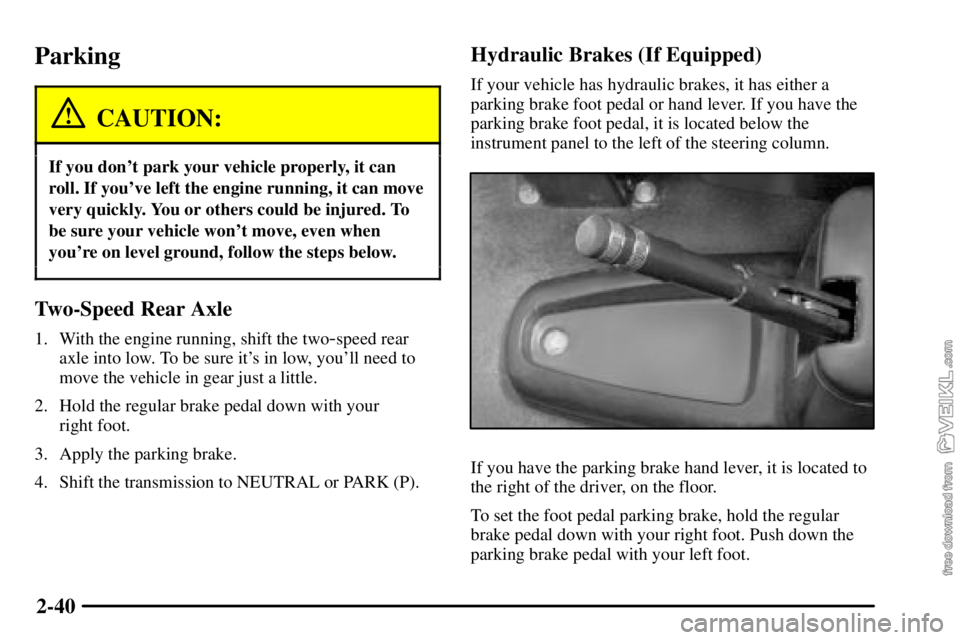
If your vehicle has hydraulic brakes, it has either a
parking brake foot pedal or hand lever. If you have the
parking brake foot pedal, it is located below the
instrument panel to the left of the steering column.
If you have the parking brake hand lever, it is located to
the right of the driver, on the floor.
To set the foot pedal parking brake, hold the regular
brake pedal down with your right foot. Push down the
parking brake pedal with your left foot.
Page 119 of 386

2-44
CAUTION:
If you apply any one of the air brake parking
controls while the vehicle is moving, your rig will
stop suddenly. If you are not ready for this, you
or others could be injured. Don't apply any one
of these controls while you're driving, unless you
have to make an emergency stop.
If the air pressure drops below 60 to 70 psi (413 to
482 kPa), the primary brake light and warning buzzer
will come on. If the air pressure drops to 35 to 45 psi
(241 to 310 kPa), the red trailer air supply knob will
automatically pop out and apply the spring brakes on
the trailer.If the air pressure drops to 35 to 45 psi (241 to 310 kPa),
the yellow park brake knob will automatically pop out
and apply the spring brakes on the truck or tractor.
If you ever have a complete loss of air so that your air
brakes automatically apply, there is a way that the tow
operator can release the parking brakes to tow the
vehicle. See ªTowing Your Vehicleº in the Index.
CAUTION:
If your vehicle is left in gear, the engine can start
if the vehicle starts to roll. This can easily happen
if you have the diesel engine. Shift the
transmission into NEUTRAL (N) before you
leave the vehicle.
Page 121 of 386
2-46
Running Your Engine While You're
Parked (Automatic Transmission)
It's better not to park with the engine running. But if you
ever have to, here are some things to know.
CAUTION:
Idling the engine with the climate control system
off could allow dangerous exhaust into your
vehicle. See the earlier Caution under ªEngine
Exhaust.º
Also, idling in a closed-in place can let deadly
carbon monoxide (CO) into your vehicle even
if the fan is at the highest setting. One place
this can happen is a garage. Exhaust
-- with
CO
-- can come in easily. NEVER park in a
garage with the engine running.
Another closed-in place can be a blizzard.
See ªBlizzardº in the Index.
CAUTION:
It can be dangerous to get out of your vehicle if
the shift lever is not fully in PARK (P) with the
parking brake firmly set. Your vehicle can roll.
Don't leave your vehicle when the engine is
running unless you have to. If you've left the
engine running, the vehicle can move suddenly.
You or others could be injured. To be sure your
vehicle won't move, even when you're on fairly
level ground, always set your parking brake and
move the shift lever to PARK (P).
Page 127 of 386
2-52
With cruise control, you can maintain a speed of about
30 mph (48 km/h) or more without keeping your foot on
the accelerator. Cruise control does not work at speeds
below about 30 mph (48 km/h).
If you have an automatic transmission and you apply
your brakes, the cruise control will shut off.
If you have a manual transmission and you apply your
brakes or push the clutch pedal, the cruise control will
shut off.
CAUTION:
�Cruise control can be dangerous where you
can't drive safely at a steady speed. So,
don't use your cruise control on winding
roads or in heavy traffic.
�Cruise control can be dangerous on
slippery roads. On such roads, fast changes
in tire traction can cause needless wheel
spinning, and you could lose control. Don't
use cruise control on slippery roads.
Setting Cruise Control
CAUTION:
If you leave your cruise control switch on when
you're not using cruise, you might hit a button
and go into cruise when you don't want to. You
could be startled and even lose control. Keep the
cruise control switch off until you want to use
cruise control.
1. Move the cruise control switch to on.
2. Get up to the speed you want.
3. Press in the set button at the end of the lever and
release it.
4. Take your foot off the accelerator pedal.
The accelerator pedal will not go down.
Page 129 of 386

2-54
Reducing Speed While Using Cruise Control
Press in the button at the end of the lever until you reach
the lower speed you want, then release it.
To slow down in very small amounts, tap the
button briefly. Each time you do this, you'll go
1 mph (1.6 km/h) slower.
Passing Another Vehicle While Using Cruise Control
Use the accelerator pedal to increase your speed. When
you take your foot off the pedal, your vehicle will slow
down to the cruise control speed you set earlier.
Using Cruise Control on Hills
How well your cruise control will work on hills depends
upon your speed, load and the steepness of the hills.
When going up steep hills, you may want to step on the
accelerator pedal to maintain your speed. When going
downhill, you may have to brake or shift to a lower gear
to keep your speed down. Of course, applying the brake
or clutch takes you out of cruise control. Many drivers
find this to be too much trouble and don't use cruise
control on steep hills.Ending Cruise Control
There are four different ways to turn off the cruise
control:
�Step lightly on the brake pedal (manual and
automatic transmissions).
�Press the clutch pedal to the floor (manual
transmissions).
�Move the cruise switch to off, or
�Shift the transmission to NEUTRAL (N).
Erasing Speed Memory
When you turn off the ignition, your cruise control set
speed memory is erased.
Page 135 of 386

2-60
Interior Lamps
Instrument Panel Brightness Control
This feature controls the brightness of the instrument
panel lights.
The thumbwheel for this feature is located to the right of
the exterior lamp control.
Turn the thumbwheel up to brighten the lights. When the
thumbwheel is moved to the first position, the radio
display and transmission selection display will go to full
intensity. The instrument panel cluster will also be dimly
lit. Moving the thumbwheel up to the next position will
activate the interior dome lamps.
Dome Lamps
The dome lamps will come on when you open a door.
You can also turn the dome lamps on by moving the
thumbwheel, located to the right of the exterior lamp
control, all the way up to the second position. In this
position, the dome lamps will remain on whether a door
is open or closed.
You can use the dome override button to set the dome
lamps to automatically come on when a door is open, or
to remain off.
The dome override button is located below the exterior
lamp control.
If the dome override button is pushed in, the dome
lamps will not come on. Use this feature when you want
to leave your door(s) open for an extended period of
time and do not want to run the battery down.
If the dome override button is in the out position, the
interior lamps will work as usual.