Page 122 of 386
2-47
CAUTION:
It can be dangerous to get out of your vehicle
without the parking brake firmly set. Your
vehicle can roll. If you've left the engine running,
the vehicle can move suddenly. You or others
could be injured. To be sure your vehicle won't
move, even when you're on fairly level ground,
always set your parking brake.
Follow the proper steps to be sure your vehicle
won't move.
Horn
Sound the horn by pushing the center of the steering
wheel. If you have the optional air horn, it is controlled
by a cord that you'll find up above and to the left of
the driver. The harder you pull on the cord, the louder
the air horn will sound. The air horn works only after
your air brake system pressure gets up to about
115 psi (790 kPa). The air horn will work properly
unless the the air brake system pressure drops
below 60 psi (415 kPa).
Page 127 of 386
2-52
With cruise control, you can maintain a speed of about
30 mph (48 km/h) or more without keeping your foot on
the accelerator. Cruise control does not work at speeds
below about 30 mph (48 km/h).
If you have an automatic transmission and you apply
your brakes, the cruise control will shut off.
If you have a manual transmission and you apply your
brakes or push the clutch pedal, the cruise control will
shut off.
CAUTION:
�Cruise control can be dangerous where you
can't drive safely at a steady speed. So,
don't use your cruise control on winding
roads or in heavy traffic.
�Cruise control can be dangerous on
slippery roads. On such roads, fast changes
in tire traction can cause needless wheel
spinning, and you could lose control. Don't
use cruise control on slippery roads.
Setting Cruise Control
CAUTION:
If you leave your cruise control switch on when
you're not using cruise, you might hit a button
and go into cruise when you don't want to. You
could be startled and even lose control. Keep the
cruise control switch off until you want to use
cruise control.
1. Move the cruise control switch to on.
2. Get up to the speed you want.
3. Press in the set button at the end of the lever and
release it.
4. Take your foot off the accelerator pedal.
The accelerator pedal will not go down.
Page 128 of 386

2-53
Resuming a Set Speed
Suppose you set your cruise control at a desired speed
and then you apply the brake. This, of course, shuts off
the cruise control. But you don't need to reset it.
Once you're going about 30 mph (48 km/h) or more,
you can move the cruise control switch briefly from on
to resume/accelerate.
The vehicle will return to your chosen speed and
stay there.
If you hold the switch at resume/accelerate, the vehicle
will keep going faster until you release the switch or
apply the brake. So unless you want to go faster, don't
hold the switch at resume/accelerate.Increasing Speed While Using Cruise Control
There are two ways to go to a higher speed:
�Use the accelerator pedal to get to the higher speed.
Press the button at the end of the lever, then release
the button and the accelerator pedal. You'll now
cruise at the higher speed.
�Move the cruise switch from on to
resume/accelerate. Hold it there until you get up
to the speed you want, and then release the switch.
To increase your speed in very small amounts,
move the switch briefly to resume/accelerate.
Each time you do this, your vehicle will go about
1 mph (1.6 km/h) faster.
Page 129 of 386

2-54
Reducing Speed While Using Cruise Control
Press in the button at the end of the lever until you reach
the lower speed you want, then release it.
To slow down in very small amounts, tap the
button briefly. Each time you do this, you'll go
1 mph (1.6 km/h) slower.
Passing Another Vehicle While Using Cruise Control
Use the accelerator pedal to increase your speed. When
you take your foot off the pedal, your vehicle will slow
down to the cruise control speed you set earlier.
Using Cruise Control on Hills
How well your cruise control will work on hills depends
upon your speed, load and the steepness of the hills.
When going up steep hills, you may want to step on the
accelerator pedal to maintain your speed. When going
downhill, you may have to brake or shift to a lower gear
to keep your speed down. Of course, applying the brake
or clutch takes you out of cruise control. Many drivers
find this to be too much trouble and don't use cruise
control on steep hills.Ending Cruise Control
There are four different ways to turn off the cruise
control:
�Step lightly on the brake pedal (manual and
automatic transmissions).
�Press the clutch pedal to the floor (manual
transmissions).
�Move the cruise switch to off, or
�Shift the transmission to NEUTRAL (N).
Erasing Speed Memory
When you turn off the ignition, your cruise control set
speed memory is erased.
Page 132 of 386
2-57
Trailer Brake Hand Control Valve
(Option)
If your vehicle has this feature, it is located near the
center console on the floor.
This feature lets you apply the trailer brakes without
applying the tractor brakes. You can apply the trailer
brakes a little, or apply them all the way, if needed.
Press the trailer brake hand control valve downward to
apply the trailer brakes. Pull the hand control valve
upward to release the trailer brakes.
Use this control only when you're driving. Don't use it
for parking or to hold the rig on a hill.
CAUTION:
Using the trailer brake hand control for parking or
for holding the vehicle on a hill may not keep the
vehicle from rolling. This can happen if someone
hits the valve by accident, or if air pressure bleeds
from the system. If the vehicle rolls, you or others
could be injured. To park the vehicle or hold it on
a hill, use the parking brake properly.
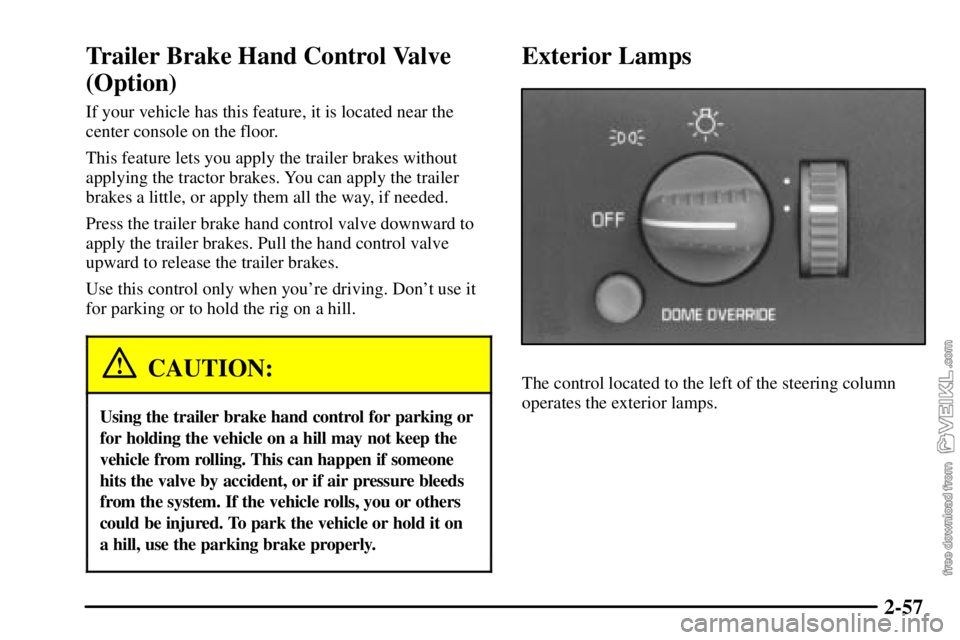
Exterior Lamps
The control located to the left of the steering column
operates the exterior lamps.
Page 133 of 386

2-58
The exterior lamp control has four positions:
OFF: Turning the control to this position turns off all
lamps except the Daytime Running Lamps (DRL).
(Parking Lamps): Turning the control to this
position turns on the parking lamps, together with the
following:
�Marker Lamps
�Taillamps
�License Plate Lamps
�Instrument Panel Lights
(Headlamps): Turning the control to this position
turns on the headlamps, together with the previously
listed lamps and lights.
You can switch your headlamps from low to high
beam by pulling the turn signal/multifunction lever
toward you. Pull the lever toward you again to return
to low beam.
A circuit breaker protects your headlamps. If you have
an electrical overload, your headlamps will flicker on
and off. Have your headlamp wiring checked right away
if this ever happens.
Headlamps On Reminder (If Equipped)
If you have this system, a tone will sound when your
headlamps and/or parking lamps are turned on and your
ignition is in LOCK or ACCESSORY.
Daytime Running Lamps
Daytime Running Lamps (DRL) can make it easier for
others to see the front of your vehicle during the day.
DRL can be helpful in many different driving
conditions, but they can be especially helpful in the
short periods after dawn and before sunset. Fully
functional daytime running lamps are required on all
vehicles first sold in Canada.
The DRL system will make your headlamps come
on at reduced brightness when the following conditions
are met:
�The ignition is on,
�the exterior lamp control is off, and
�the parking brake is released.
When the DRL are on, only your headlamps will be on.
The taillamps, sidemarker and other lamps won't be on.
Your instrument panel won't be lit up either.
Page 134 of 386
2-59
When it begins to get dark,
your DRL indicator light is
a reminder to turn the
headlamps on. The other
lamps that come on with
your headlamps, will also
come on.
When you turn the headlamps off, the regular lamps will
go off, and your low
-beam headlamps will change to the
reduced brightness of DRL.
To idle your vehicle with the DRL off, set the parking
brake. The DRL will stay off until you release the
parking brake.
As with any vehicle, you should turn on the regular
headlamp system when you need it.
Marker Lamp Defeat Switch
If your vehicle has this feature, you can manually blink
the marker and clearance lamps.
The marker lamp
defeat switch is located
in the instrument panel
switchbank.
Press and hold the bottom of the switch to turn off
the marker and clearance lamps. When you release
the switch, the marker and clearance lamps will come
back on.
Page 142 of 386

2-67
The eight-wire harness contains the following
trailer circuits:
�Yellow: Left Stop/Turn Signal
�Dark Green: Right Stop/Turn Signal
�Brown: Taillamps
�White: Ground
�Light Green: Back
-up Lamps
�Light Blue: CHMSL
�Red: Battery Feed
�Dark Blue: Trailer Brake
Trailer Connections (C6/C7/C8
Models Only) (If Equipped)
If your vehicle has these trailer connections, they are
located at the rear of the cab for a tractor and at the rear
of the chassis when towing a trailer. There will be an air
connection and an electrical connection.
Be sure that the couplings to the trailer are
made correctly.
Air Connections
If you are not connecting the trailer air line connections
to another piece of equipment, be sure to replace their
protective caps.
Electrical Connections
This system is a seven-wire cable that will connect to
the trailer, supplying power to the trailer's lighting
system. When not in use, it is stored in the trailer
air
-hose storage bracket.
NOTICE:
Starting in 1998, the center pin (also known as
the auxiliary circuit) of the seven
-pin trailer
electrical connector will be wired to provide
continuous power for the trailer anti
-lock brake
systems when the ignition key is in the on
position. Care should be taken to insure that
continuous power on this circuit will not cause
damage to the trailer electrical system.
Consult with the trailer manufacturer for the
proper operation and checking procedures for
the trailer anti
-lock brake systems.