Page 226 of 386
5-
5-1
Section 5 Problems on the Road
Here you'll find what to do about some problems that can occur on the road.
5
-2 Hazard Warning Flashers
5
-3 Other Warning Devices
5
-3 Jump Starting
5
-10 Towing Your Vehicle
5
-17 Engine Overheating5
-20 Cooling System
5
-26 Engine Fan Noise
5
-26 If a Tire Goes Flat
5
-27 Changing a Flat Tire
5
-28 If You're Stuck: In Sand, Mud, Ice or Snow
Page 242 of 386
5-17
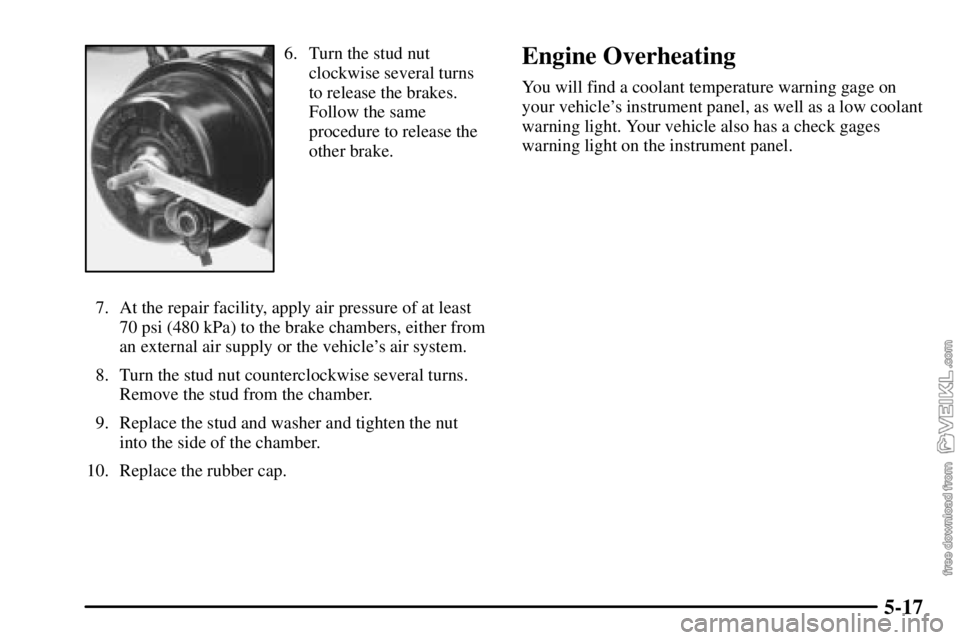
6. Turn the stud nut
clockwise several turns
to release the brakes.
Follow the same
procedure to release the
other brake.
7. At the repair facility, apply air pressure of at least
70 psi (480 kPa) to the brake chambers, either from
an external air supply or the vehicle's air system.
8. Turn the stud nut counterclockwise several turns.
Remove the stud from the chamber.
9. Replace the stud and washer and tighten the nut
into the side of the chamber.
10. Replace the rubber cap.Engine Overheating
You will find a coolant temperature warning gage on
your vehicle's instrument panel, as well as a low coolant
warning light. Your vehicle also has a check gages
warning light on the instrument panel.
Page 261 of 386

6-7
What Fuel to Use in Canada
Canadian fuels are blended for seasonal changes. Diesel
Type ªAº fuel is blended for better cold weather starting
(below 0�F or
-18�C); however, you may notice some
power and fuel economy loss. If Type ªAº fuel is used
in warmer temperatures, stalling and hard starting may
occur. Diesel Type ªBº fuel is blended for temperatures
above 0�F (
-18�C). The emission control system
requires the use of diesel fuel with low
-sulfur (.05% by
weight) content. Both low
- and higher-sulfur fuels will
be available in Canada. Only low
-sulfur diesel fuels are
available in the United States. It is important that
diesel
-powered trucks are refueled only with low-sulfur
fuel. Use of fuels with higher
-sulfur content will affect
the function of the emission components and may
cause reduced performance, excessive smoke and
unpleasant odor.
At a minimum, the diesel fuel you use should meet
specifications CAN/CGSB
-3.517-2000 (Low Sulfur
Diesel) in Canada. In addition, the Engine
Manufacturers Association (EMA) has identified
properties of an improved diesel fuel for better engine
performance and durability (FQP
-1A). Diesel fuels
corresponding to the EMA description could provide
better starting, less noise and better vehicle
performance. If there are questions about the fuel you
are using, contact your fuel supplier.
Very Cold Weather Operation
Follow the instructions listed previously under the
heading ªWhat Fuel to Use.º
NOTICE:
Never use home heating oil or gasoline in your
diesel engine. They can cause engine damage.
In cold weather, your fuel filter may become clogged
(waxed). To unclog it, move the vehicle to a warm
garage area and warm the filter to between 32�F and
50�F (0�C to 10�C). You won't need to replace it.
Additional information on the fuel filter follows.
Page 289 of 386

6-35
Engine Coolant
If your vehicle has a Caterpillar diesel engine, the
Caterpillar� Operation & Maintenance Manual provided
with your vehicle has information regarding the proper
coolant to use.
The cooling system in your vehicle is filled with
DEX
-COOL� engine coolant. This coolant is designed
to remain in your vehicle for 5 years or 150,000 miles
(240 000 km), whichever occurs first, if you add only
DEX
-COOL� extended life coolant.
The following explains your cooling system and how
to add coolant when it is low. If you have a problem
with engine overheating, see ªEngine Overheatingº in
the Index.A 50/50 mixture of clean, drinkable water and
DEX
-COOL� coolant will:
�Give freezing protection down to
-34�F (-37�C).
�Give boiling protection up to 252�F (122�C).
�Protect against rust and corrosion.
�Help keep the proper engine temperature.
�Let the warning lights and gages work as
they should.
NOTICE:
When adding coolant, it is important that you use
only DEX
-COOL� (silicate-free) coolant.
If coolant other than DEX-COOL is added to the
system, premature engine, heater core or
radiator corrosion may result. In addition, the
engine coolant will require change sooner
-- at
30,000 miles (50 000 km) or 24 months,
whichever occurs first. Damage caused by the use
of coolant other than DEX
-COOL� is not
covered by your new vehicle warranty.
Page 292 of 386

6-38
Adding Coolant
If you need more coolant, add the proper DEX
-COOL�
coolant mixture at the surge tank, but only when the
engine is cool.
CAUTION:
You can be burned if you spill coolant on hot
engine parts. Coolant contains ethylene glycol,
and it will burn if the engine parts are hot
enough. Don't spill coolant on a hot engine.
When replacing the pressure cap, make sure it is
hand
-tight.
Engine Coolant (Caterpillar�
Diesel Engine)
If your vehicle has a Caterpillar diesel engine, see the
Caterpillar� Diesel Engine Operation & Maintenance
Manual provided with your vehicle to find out what to
add, also when and how to service your cooling system.
Surge Tank Pressure Cap
The surge tank pressure cap
is located in the engine
compartment, on the
driver's side of the vehicle.
The surge tank pressure cap must be tightly installed.
NOTICE:
Your surge tank pressure cap is a 15 psi (103kPa)
pressure
-type cap for use with medium duty
cooling systems only. It must be tightly installed
to prevent coolant loss and possible engine
damage from overheating.
Page 312 of 386
6-58
Tires
Your new vehicle comes with high-quality tires made by
a leading tire manufacturer. If you ever have questions
about your tire warranty and where to obtain service, see
your General Motors Warranty booklet for details.
CAUTION:
Poorly maintained and improperly used tires are
dangerous.
�Overloading your tires can cause
overheating as a result of too much friction.
You could have an air
-out and a serious
accident. See ªLoading Your Vehicleº in
the Index.
CAUTION: (Continued)
CAUTION: (Continued)
�Underinflated tires pose the same danger as
overloaded tires. The resulting accident
could cause serious injury. Check all tires
frequently to maintain the recommended
pressure. Tire pressure should be checked
when your tires are cold.
�Overinflated tires are more likely to be
cut, punctured or broken by a sudden
impact
-- such as when you hit a pothole.
Keep tires at the recommended pressure.
�Worn, old tires can cause accidents. If your
tread is badly worn, or if your tires have
been damaged, replace them.