2003 CHEVROLET ASTRO steering
[x] Cancel search: steeringPage 257 of 386

Power Steering Fluid
When to Check Power Steering Fluid
It is not necessary to regularly check power steering fluid
unless you suspect there is a leak in the system or
you hear an unusual noise. A fluid loss in this system
could indicate a problem. Have the system inspected
and repaired. See
Engine Compartment Overview
on page
5-14 for reservoir location.
How to Check Power Steering Fluid
Turn the key off, let the engine compartment cool down,
wipe the cap and the top of the reservoir clean, then
unscrew the cap and wipe the dipstick with a clean rag.
Replace the cap and completely tighten
it. Then remove
the cap again and
look at the fluid level on the dipstick.
The level should be at the
FULL COLD mark. If
necessary, add only enough fluid to bring the level up to
the mark.
What to Use
To determine what kind of fluid to use, see Part D:
Recommended Fluids and Lubricants on page 6-32.
Always use the proper fluid. Failure to use the proper
fluid can cause leaks and damage hoses and seals.
5-40
Page 287 of 386
Used Replacement Wheels
Putting a uscu wheel on your vehicle is
dangerous. You can’t know how it’s been used or how far
it’s been driven. It could fail suddenly
and cause a crash. If you have to replace a
wheel, use a new
GM original equipment wheel.
Tire Chains
Notice: Use tire chains only where legal and only
when you must. Use only
SAE Class ”S” type chains
that are the proper size for your tires. Install them on the rear axle tires and tighten them as tightly
as possible with the ends securely fastened.
Drive slowly and follow the chain manufacturer’s
instructions.
If you can hear the chains contacting
your vehicle, stop and retighten them. If the contact
continues, slow down until
it stops. Driving too
fast or spinning
the wheels with chains on will
damage your vehicle.
If a Tire Goes Flat
It’s unusual for a tire to “blow out” while you’re driving,
especially
if you maintain your tires properly. If air
goes out of a tire, it’s much more likely to leak out
slowly. But
if you should ever have a “blowout”, here are
a few tips about what to expect and what to do:
If a front tire fails, the flat tire will create a drag that
pulls the vehicle toward that side. Take your foot off the
accelerator pedal and grip the steering wheel firmly.
Steer to maintain lane position, and then gently brake to
a stop well out of the traffic lane.
A rear blowout, particularly on a curve, acts much like a
skid and may require the same correction you’d use
in a skid. In any rear blowout, remove your foot from the
accelerator pedal. Get the vehicle under control by
steering the way you want the vehicle to go. It may be
very bumpy and noisy, but you can still steer. Gently
brake to a stop
- well off the road if possible.
If a tire goes flat, the next part shows how to use your
jacking equipment to change a flat tire safely.
5-70
Page 320 of 386

Section 6 Maintenance Schedule
Maintenance Schedule ............................... 6.2
Introduction
................................................... 6.2
Your Vehicle and the Environment
.................... 6-2
Maintenance Requirements
.............................. 6-2
How This Section
is Organized ......................... 6-3
Part
A: Scheduled Maintenance Services ........... 6.4
Using Your Maintenance Schedule
.................... 6.4
Selecting the Right Schedule
........................... 6-5
Short Trip/City Scheduled Maintenance
.............. 6.7
Long Trip/Highway Scheduled Maintenance
...... 6.18
Part B: Owner Checks and Services
................ 6.26
At Each Fuel Fill
.......................................... 6-26
At Least Once a Month
................................. 6.26
At Least Twice a Year
................................... 6.26 At
Least Once a Year
................................... 6-27
Part C: Periodic Maintenance inspections
......... 6.30
Steering. Suspension and Front Drive Axle
Boot and Seal Inspection
............................ 6.30
Exhaust System Inspection
............................ 6.30
Fuel System Inspection
.................................. 6.30
Engine Cooling System Inspection
................... 6.30
Throttle System Inspection
............................ -6-31
Transfer Case and Front Axle
(All-Wheel Drive) Inspection
....................... -6-31
Brake System Inspection
................................ 6.31
Part D: Recommended Fluids
and Lubricants
.......................................... 6.32
Part E: Maintenance Record
........................... 6.34
6-
1
Page 326 of 386

Short Trip/City Scheduled Maintenance
The services shown in this schedule up to 100,000 miles
(166 000 km) should be repeated after IQ0,OOQ miles
(166 000 km) at the same intervals for the life of
this vehicle. The services shown at
150,000 miles
(240
000 km) should be repeated at the same interval
after
150,000 miles (240 000 km) for the life of this
vehicle.
See
Part B: Owner Checks and Services on page 6-26
and Part C: Periodic Maintenance Inspections on
page 6-30.
Footnotes
t The U.S. Environmental Protection Agency or the
California Air Resources Board has determined that the
failure to perform this maintenance item will not nullify
the emission warranty or limit recall liability prior to
the completion of the vehicle’s useful life. We, however,
urge that all recommended maintenance services be
performed at the indicated intervals and the
maintenance be recorded.
# Lubricate the front suspension, ball joints and kingpin
bushings, steering linkage, parking brake cable
guides and brake pedal springs.
+ A good time to check your brakes is during tire
rotation. See Brake System Inspection
on page 6-3 1.
3,000 Miles (5 000 km)
0 Change engine oil and filter (or every 3 months,
0 Lubricate chassis components (or every 3 months,
0 Check readfront axle fluid level and add fluid as
whichever
occurs first).
An Emission Control Service.
whichever occurs first). (See footnote #.)
needed. Check constant velocity joints and axle seals
for leaking.
6,000 Miles (IO 000 km)
0
0
0
0
Change engine oil and filter (or every 3 months,
whichever occurs first).
An Emission Control Service.
Lubricate chassis components (or every 3 months,
whichever occurs first).
(See footnote #.)
Check readfront axle fluid level and add fluid as
needed. Check constant velocity joints and axle seals
for leaking.
Rotate tires. See
Tire Inspection and Rotation on
page 5-64
for proper rotation pattern and additional
information.
(See footnote +.)
9,000 Miles (15 000 km)
0 Change engine oil and filter (or every 3 months,
0 Lubricate chassis components (or every 3 months,
0 Check readfront axle fluid level and add fluid as
whichever
occurs first).
An Emission Control Service.
whichever occurs first). (See footnote #.)
needed. Check constant velocity joints and axle seals
for leaking.
6-7
Page 337 of 386

100,000 Miles (166 000 km)
0 Inspect spark plug wires. An Emission Control
Service.
0 Replace spark plugs. An Emission Control Service.
0 If you haven’t used your vehicle under severe service
conditions listed previously and, therefore, haven’t
changed your automatic transmission fluid, change
both the fluid and filter.
0 Change transfer case fluid.
Cl Inspect Positive Crankcase Ventilation (PCV) valve.
An Emission Control Service.
150,000 Miles (240 000 km)
0 Drain, flush and refill cooling system (or every
60 months since last service, whichever occurs first).
See
Engine Coolant on page 5-28 for what to use.
Inspect hoses. Clean radiator, condenser, pressure
cap and neck. Pressure test cooling system and
pressure cap.An
Emission Control Service.
An Emission Control Service.
Cl Inspect engine accessory drive belt.
Long Trip/Highway Scheduled
Maintenance
The services shown in this schedule up to 100,000 miles
(166 000 km) should be repeated after 100,000 miles
(166 000 km) at the same intervals for the life of
this vehicle. The services shown at
150,000 miles
(240 000 km) should be repeated at the same interval
after
150,000 miles (240 000 km) for the life of this
vehicle.
See
Part 5: Owner Checks and Services on page 6-26
and Part C: Periodic Maintenance Inspections on
page 6-30.
Footnotes
t The U.S. Environmental Protection Agency or the
California Air Resources Board has determined that the
failure to perform this maintenance item will not nullify the emission warranty or limit recall liability prior to
the completion of the vehicle’s useful life. We, however,
urge that all recommended maintenance services be
performed at the indicated intervals and the
maintenance be recorded.
# Lubricate the front suspension, ball joints and kingpin
bushings, steering linkage and transfer case shift linkage,
parking brake cable guides and brake pedal springs.
+ A good time to check your brakes is during tire
rotation. See Brake System Inspection
on page 6-31.
6-1 8
Page 349 of 386
Part C: Periodic Maintenance
Inspections
Listed in this part are inspections and services which
should be performed at least twice a year (for instance,
each spring and fall).
You should let your dealer’s
service department or other qualified service center
do these jobs. Make sure any necessary repairs
are completed at once.
Proper procedures to perform these services may be
found in a service manual. See
Service Publications
Ordering Information on page
7- 1 1.
Steering, Suspension and Front
Drive Axle Boot and Seal Inspection
Inspect the front and rear suspension and steering
system for damaged, loose or missing parts, signs of
wear or lack of lubrication. Inspect the power steering
lines and hoses for proper hook-up, binding, leaks,
cracks, chafing, etc. Clean and then inspect the drive
axle boot seals for damage, tears or leakage. Replace
seals
if necessary.
Exhaust System Inspection
Inspect the complete exhaust system. Inspect the body
near the exhaust system.
Look for broken, damaged,
missing or out-of-position parts as well as open seams,
holes, loose connections or other conditions which
could cause a heat build-up in the floor pan or could let
exhaust fumes into the vehicle. See
Engine Exhaust
on page
2-30.
Fuel System Inspection
Inspect the complete fuel system for damage or leaks.
Engine Cooling System Inspection
Inspect the hoses and have them replaced if they
are cracked, swollen or deteriorated. Inspect all pipes,
fittings and clamps; replace as needed. Clean the
outside of the radiator and air conditioning condenser.
To help ensure proper operation, a pressure test of
the cooling system and pressure cap is recommended
at least once a year.
6-30
Page 351 of 386
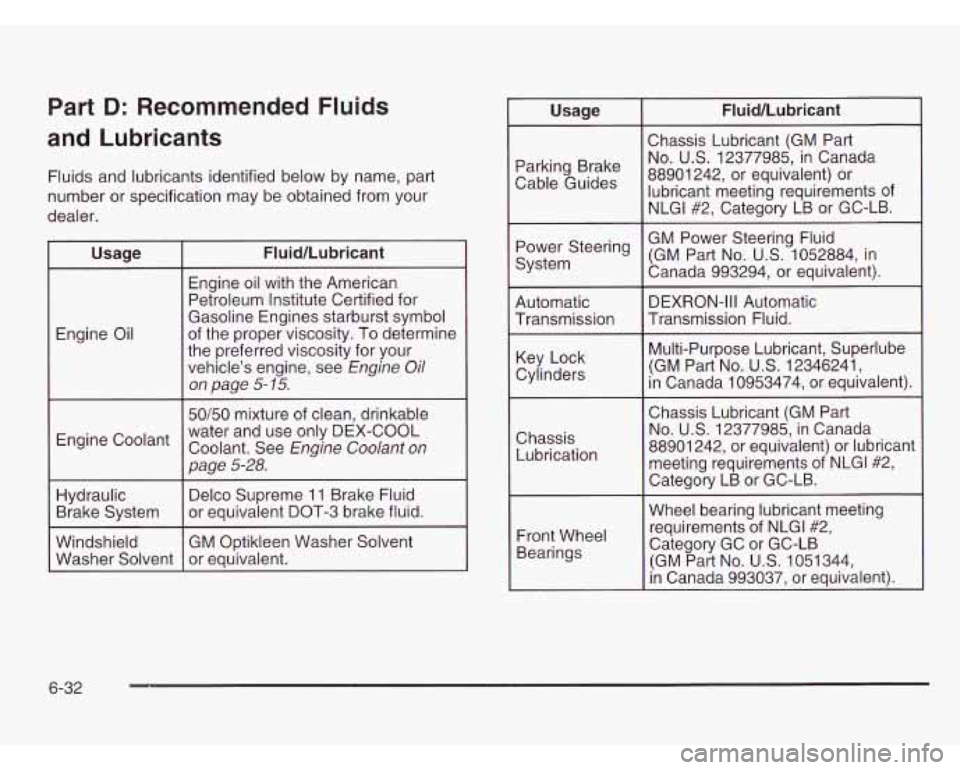
Part D: Recommended Fluids
and Lubricants
Fluids and lubricants identified below by name, part
number or specification may be obtained from your
dealer.
Engine Coolant
t
I
Hydraulic
Brake System
Windshield Washer Solvent
Fluid/Lubricant
Engine oil with the American
Petroleum Institute Certified for
Gasoline Engines starburst symbol
of the proper viscosity.
To determine
the preferred viscosity for your
vehicle’s engine, see
Engine Oil
on page 5- 15.
50/50 mixture of clean, drinkable
water and use only DEX-COOL
Coolant. See
Engine Coolant on
page
5-28.
Delco Supreme 11 Brake Fluid
or equivalent DOT-3 brake fluid.
GM Optikleen Washer Solvent
or equivalent.
Usage I Fluid/Lubricant
~~~~~
Chassis Lubricant (GM Part
No. U.S. 12377985, in Canada
88901242, or equivalent) or lubricant meeting requirements of
NLGl #2, Category LB or GC-LB. Parking Brake
Cable Guides
GM Power Steering Fluid
(GM Part
No. US. 1052884, in
Canada 993294, or equivalent).
System Power
Automatic
I DEXRON-Ill Automatic
Transmission
Transmission
Fluid.
Key Lock
Cylinders Multi-Purpose
Lubricant, Superlube
(GM Part No.
U.S. 12346241,
in Canada 10953474, or equivalent).
Chassis Lubrication Chassis Lubricant (GM Part
No. U.S. 12377985,
in Canada
88901 242, or equivalent) or lubricant
meeting requirements of NLGl#2,
Category LB or GC-LB.
Front Wheel
Bearings Wheel
bearing lubricant meeting
requirements of NLGl#2,
Category GC or GC-LB (GM Part
No. U.S. 1051344,
in Canada 993037, or equivalent).
6-32
Page 366 of 386
Reporting Safety Defects to the
Canadian Government
If you live in Canada, and you believe that your vehicle
has a safety defect, you should immediately notify
Transport Canada, in addition
to notifying General
Motors of Canada Limited. You may write to:
Transport Canada 330 Sparks Street
Tower C Ottawa, Ontario K1A ON5
Reporting Safety Defects to
General Motors
In addition to notifying NHTSA (or Transport Canada) in
a situation like this, we certainly hope you’ll notify us.
Please call us at 1-800-222-1020, or write:
Chevrolet Motor Division
Chevrolet Customer Assistance Center
P.O. Box 33170
Detroit, MI 48232-5170
In Canada, please call us at 1-800-263-3777 (English)
or 1-800-263-7854 (French). Or, write:
General Motors
of Canada Limited
Customer Communication Centre, 163-005
1908 Colonel Sam Drive
Oshawa, Ontario L1H 8P7
Service Publications Ordering
Information
Service Manuals
Service Manuals have the diagnosis and repair
information on engines, transmission, axle, suspension,
brakes, electrical, steering, body, etc.
RETAIL SELL PRICE: $120.00
Transmission, Transaxle, Transfer
Case Unit Repair Manual
This manual provides information on unit repair service
procedures, adjustments, and specifications for GM
transmissions, transaxles, and transfer cases.
RETAIL SELL PRICE: $50.00
7-1
1