2003 CHEVROLET ASTRO oil
[x] Cancel search: oilPage 236 of 386
Driving under these conditions causes engine oil to
break down sooner. If any one of these is true for your
vehicle, then you need to change your oil and filter
every
3,000 miles (5 000 km) or 3 months - whichever
occurs first.
If none of them is true, use the long trip/highway
maintenance schedule. Change the oil and filter every
7,500 miles (12 500 km) or 12 months - whichever
occurs first. Driving a vehicle with a fully warmed engine
under highway conditions will cause engine oil to
break down slower.
What to Do with Used Oil
Used engine oil contains certain elements that may be
unhealthy for your skin and could even cause cancer.
Don’t let used oil stay on your skin for very long. Clean
your skin and nails with soap and water, or a good
hand cleaner. Wash or properly dispose of clothing or
rags containing used engine oil. See the manufacturer’s
warnings about the use and disposal of oil products.
Used oil can be a threat to the environment.
If you
change your own oil, be sure to drain all the oil from
the filter before disposal. Never dispose of oil by putting
it in the trash, pouring it on the ground, into sewers,
or into streams or bodies of water. Instead, recycle
it
by taking it to a place that collects used oil. If you have
a problem properly disposing of your used oil, ask
your dealer, a service station or
a local recycling center
for help.
5-1 9
Page 242 of 386

Automatic Transmission Fluid
When to Check and Change
A good time to check your automatic transmission fluid
level is when the engine oil is changed.
Change both the fluid and filter every
15,000 miles
(25
000 km) if the vehicle is mainly driven under one or
more of these conditions:
In heavy city traffic where the outside temperature
In hilly or mountainous terrain.
When doing frequent trailer towing.
Uses such as found in taxi, police or delivery
If you do not use your vehicle under any of these
conditions, change the fluid and filter every
50,000 miles (83 000 km).
See
Part A: Scheduled Maintenance Services on
page
6-4.
regularly reaches 90°F (32°C) or higher.
service.
How to Check
Because this operation can be a little difficult, you may
choose to have this done at the dealership service
department.
If you do it yourself, be sure to follow all the instructions
here, or you could get a false reading on the dipstick.
Notices Too much or too little fluid can damage
your transmission.
Too much can mean that some
of the fluid could come out and fall on hot engine
part or exhaust system parts, starting a fire.
Too little fluid could cause the transmission to
overheat. Be sure to get an accurate reading if you
check your transmission fluid.
Wait at least 30 minutes before checking the
transmission fluid level
if you have been driving:
When outside temperatures are above 90°F (32°C).
0 At high speed for quite a while.
In heavy traffic
- especially in hot weather.
While pulling a trailer.
To get the right reading, the fluid should be at normal
operating temperature, which is 180°F to 200°F
(82°C to 93°C).
5-25
Page 245 of 386
Engine Coolant
The cooling system in your vehicle is filled with
DEX-COOL@ engine coolant. This coolant is designed
to remain in your vehicle for 5 years or 150,000 miles
(240
000 km), whichever occurs first, if you add
only DEX-COOL@ extended life coolant.
The following explains your cooling system and how to
add coolant when it
is low. If you have a problem
with engine overheating, see
Engine Overheating on
page
5-3 I.
A 50/50 mixture of clean, drinkable water and
DEX-COOL@ coolant will:
Give freezing protection down to -34°F (-37°C).
Give boiling protection up to 265°F (129°C).
Protect against rust and corrosion.
Help keep the proper engine temperature.
Let the warning lights and gages work as they
should.
Notice: When adding coolant, it is important that
you use only
DEX-COOL@ (silicate-free) coolant.
If coolant other than DEX-COOL@
is added to the
system, premature engine, heater core or radiator
corrosion may result.
In addition, the engine coolant
will require change sooner
- at 30,000 miles
(50,000 km) or 24 months, whichever occurs first. Damage
caused by the use
of coolant other than
DEX-COOL@
is not covered by your new vehicle
warranty.
What to Use
Use a mixture of one-half clean, drinkable water and
one-half DEX-COOL@ coolant which won’t damage
aluminum parts.
If you use this coolant mixture,
you don’t need to add anything else.
Adding only plain water to your cooling
system can be dangerous. Plain water, or
some other liquid such as alcohol, can boil
before the proper coolant mixture will. Your
vehicle’s coolant warning system is set for the
proper coolant mixture.
With plain water or the
wrong mixture, your engine could get too hot but you wouldn’t get the overheat warning.
Your engine could catch fire and you or others could be burned. Use a
50/50 mixture of clean,
drinkable water and the proper coolant.
5-28
Page 250 of 386
Cooling System
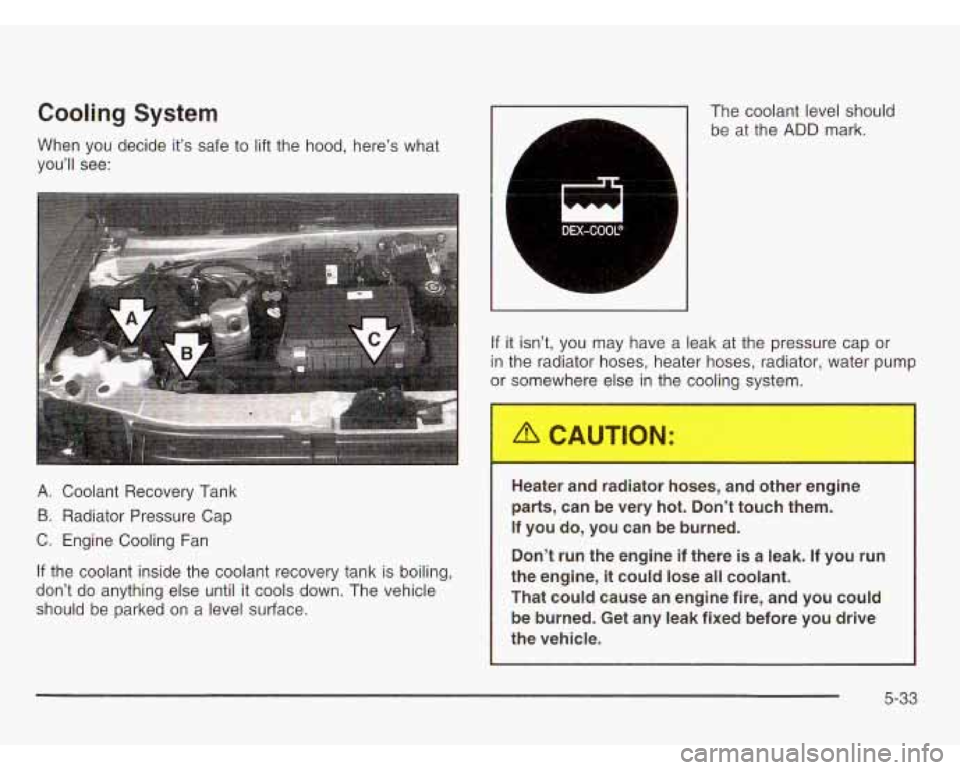
When you decide it’s safe to lift the hood, here’s what
you’ll see: The
coolant level should
be at the
ADD mark.
A. Coolant Recovery Tank
B. Radiator Pressure Cap
C. Engine Cooling Fan
If the coolant inside the coolant recovery tank is boiling,
don’t do anything else until it cools down. The vehicle
should be parked
on a level surface.
A
If it isn’t, you may have a leak at the pressure cap or
in the radiator hoses, heater hoses, radiator, water pump
or somewhere else
in the cooling system.
Heater and radiator hoses, and other engine
parts, can be very hot. Don’t touch them.
If you do, you can be burned.
Don’t run the engine if there
is a leak. If you run
the engine,
it could lose all coolant.
That could cause an engine fire, and you could be burned. Get any leak fixed before you drive
the vehicle.
5-33
Page 251 of 386
If there seems to be no leak, start the engine again. How to Add Coolant to the Coolant
The engine cooling fan speed should increase when idle
speed is doubled by pushing the accelerator pedal
Recovery Tank
down. If it doesn’t, your vehicle needs service. Turn off If you haven’t found a problem yet, but the coolant level
the engine. isn’t at the
ADD mark, add a 50/50 mixture of clean
Nofice: Engine damage from running your engine
without coolant isn’t covered by your warranty.
Notice: When adding coolant, it is important that
you use only
DEX-COOL@ (silicate-free) coolant.
If coolant other than DEX-COOL@’ is added to the
system, premature engine, heater core or radiator
corrosion may result.
In addition, the engine coolant
will require change sooner
- at 30,000 miles
(50 000 km) or 24 months, whichever occurs first.
Damage caused by the use of coolant other than
DEX-COOL@ is not covered by your new vehicle
warranty.
drinkable wafer, and DEX-COOL@ engine coolant at
the coolant recovery tank. See
Engine Coolant on
page 5-28 for more information.
Adding only p.,,n water to your coG...rg
system can be dangerous. Plain water, or
some other
liquid such as alcohol, can boil
before the proper coolant mixture will. Your
vehicle’s coolant warning system
is set for the
proper coolant mixture. With plain water or the
wrong mixture, your engine could get too hot but you wouldn’t get the overheat warning.
Your engine could catch fire and you or others
could be burned. Use a
50/50 mixture of clean,
drinkable water and DEX COOL@ coolant.
5-34
Page 261 of 386
Notice:
0 Using the wrong fluid can badly damage brake
system parts. For example, just a few drops
of
mineral-based oil, such as engine oil, in your
brake system can damage brake system
parts
so badly that they’ll have to be replaced.
Don’t let someone put in the wrong kind of fluid.
If you spill brake fluid on your vehicle’s painted
surfaces, the paint finish can be damaged.
Be careful not to spill brake fluid on your
vehicle. If you do, wash
it off immediately.
See “Appearance Care”
in the Index.
What to Add
When you do need brake fluid, use only DOT-3 brake
fluid. Use new brake fluid from a sealed container
only. See
Part D: Recommended Fluids and Lubricants
on page 6-32.
Always clean the brake fluid reservoir cap and the area
around the cap before removing it. This will help keep dirt
from enterinn the reservoir.
I
With the VI .-.. =I kir.- of flui, .n your b.,.re
system, your brakes may not work well, or they
may not even work at all. This could cause a
crash. Always use the proper brake fluid.
5-44
Page 296 of 386
9. Remove any rust or dirt from the wheel bolts,
mounting surfaces and spare wheel.
Rust or dirt on
the wheel, or on the parts to
which
it is fastened, can make the wheel nuts
become loose after
a time. The wheel could
come
off and cause an accident. When you
change a wheel, remove any rust or
dirt from
the places where the wheel attaches to the
vehicle. In an emergency, you can use a cloth
or a paper towel to do this; but be sure to use
a scraper or wire brush later, if you need to,
to get all the rust
or dirt off.
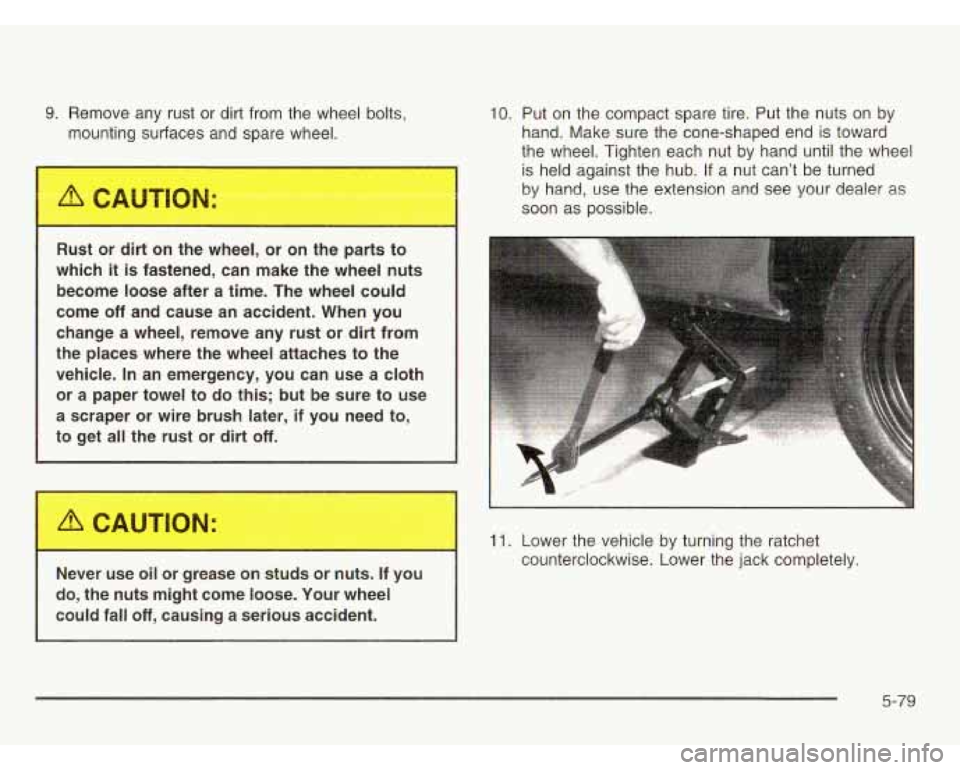
10. Put on the compact spare tire. Put the nuts on by
hand. Make sure the cone-shaped end is toward
the wheel. Tighten each nut by hand until the wheel
is held against the hub.
If a nut can’t be turned
by hand, use the extension and see your dealer as
soon as possible.
Never use oil or grease on studs or nuts. If you
do, the nuts might come
loose. Your wheel
could fall
off, causing a serious accident.
-
11. Lower the vehicle by turning the ratchet
counterclockwise. Lower the jack completely.
5-79
Page 301 of 386
Here are some cleaning tips:
Always read the instructions on the cleaner label.
Clean up stains as soon as you can - before
Carefully scrape off any excess stain.
they set.
Use
a clean cloth or sponge, and change to a clean
area often. A soft brush may be used
if stains are
stubborn.
If a ring forms on fabric after spot cleaning,
clean the entire area immediately or it will set.
Using Cleaner on Fabric
1. Vacuum and brush the area to remove any loose dirt.
2. Always clean a whole trim panel or section.
Mask surrounding trim along stitch or welt lines.
3. Follow the directions on the container label.
4. Apply cleaner with a clean sponge. Don’t saturate
5. As soon as you’ve cleaned the section, use a
the
material and don’t rub it roughly.
sponge to remove any excess cleaner.
6. Wipe cleaned area with a clean, water-dampened
towel or cloth.
Special Fabric Cleaning Problems
Stains caused by such things as catsup, coffee (black),
egg, fruit, fruit juice, milk,
soft drinks, vomit, urine
and blood can be removed as follows:
1. Carefully scrape off excess stain, then sponge the
2. If a stain remains, follow the cleaner instructions
soiled area with cool
water.
described earlier.
3. If an odor lingers after cleaning vomit or urine,
treat the area with a watedbaking soda solution:
1 teaspoon (5 ml) of baking soda to 1 cup (250 ml)
of lukewarm water.
4. Let dry.
Stains caused by candy, ice cream, mayonnaise, chili
sauce and unknown stains can be removed as follows:
1. Carefully scrape off excess stain.
2. Clean with cool water and allow to dry completely.
3. If a stain remains, follow the cleaner instructions
described earlier.
7. Wipe with a clean cloth and let dry.
5-84