Page 18 of 386
Bench Seat
Each bench seat can carry up to three passengers.
They can also be removed to increase storage space.
Only the rear bench seat can be adjusted forward
or rearward using the lever at the front of the seat.
Move the seat adjustment
lever located at the front
of the seat toward the
passenger’s side to
unlock it. Slide the seat
to where you want it.
Then release the lever
and try to move the seat
with your body, to make
sure the seat is locked
into place. The optional
bench seats come with moveable armrests,
individual reclining seatbacks, adjustable headrests
and a fold-down center armrest console.
The center bench seat has a pivoting right armrest. To
adjust your seatback, pull up on the lever located on
the outboard side of the seat cushion.
1-1 1
Page 19 of 386
If your vehicle has the
optional touring package,
your vehicle will have
a center console.
To raise
or lower the center
console, press the button
located between the
beverage holders. Sit in
the center seating position only when the console
is in an upright and
locked position.
For details about headrests, see
Head Restraints
on page 1-5.
Bucket Seats
Your vehicle may have rear bucket seats with an
adjustment release bar located under the front
of the
seats. These seats can be adjusted forward or rearward
with the release bar. Pull the release bar up to release
the seat bottom. Slide the seat where you want it
and then let go of the release bar. Then try to move the
seat with your body to make sure the seat is locked
into place.
1-12
Page 25 of 386
Q: If I’m a good driver, and I never drive far from
home, why should
I wear safety belts?
A: You may be an excellent driver, but if you’re in an
accident
- even one that isn’t your fault - you and
your passengers can be hurt. Being a good
driver doesn’t protect you from things beyond your
control, such as bad drivers.
Most accidents occur within
25 miles (40 km)
of home. And the greatest number of serious
injuries and deaths occur at speeds of less than
40 mph (65 km/h).
Safety belts are for everyone.
How to Wear Safety Belts Properly
This part is only for people of adult size.
Be aware that there are special things to know about
safety belts and children. And there are different
rules for smaller children and babies.
If a child will be
riding in your vehicle, see
Older Children on page 1-35
or lnfants and Young Children on page 1-38. Follow
those rules for everyone’s protection.
First, you’ll want to know which restraint systems your
vehicle has.
We’ll start with the driver position.
Driver Position
This part describes the driver’s restraint system.
Lap-Shoulder Belt
The driver has a lap-shoulder belt. Here’s how to
wear it properly.
1. Close and lock the door.
2. Adjust the seat so you can sit up straight.
To see how, see “Seats” in the Index.
1-18
Page 26 of 386
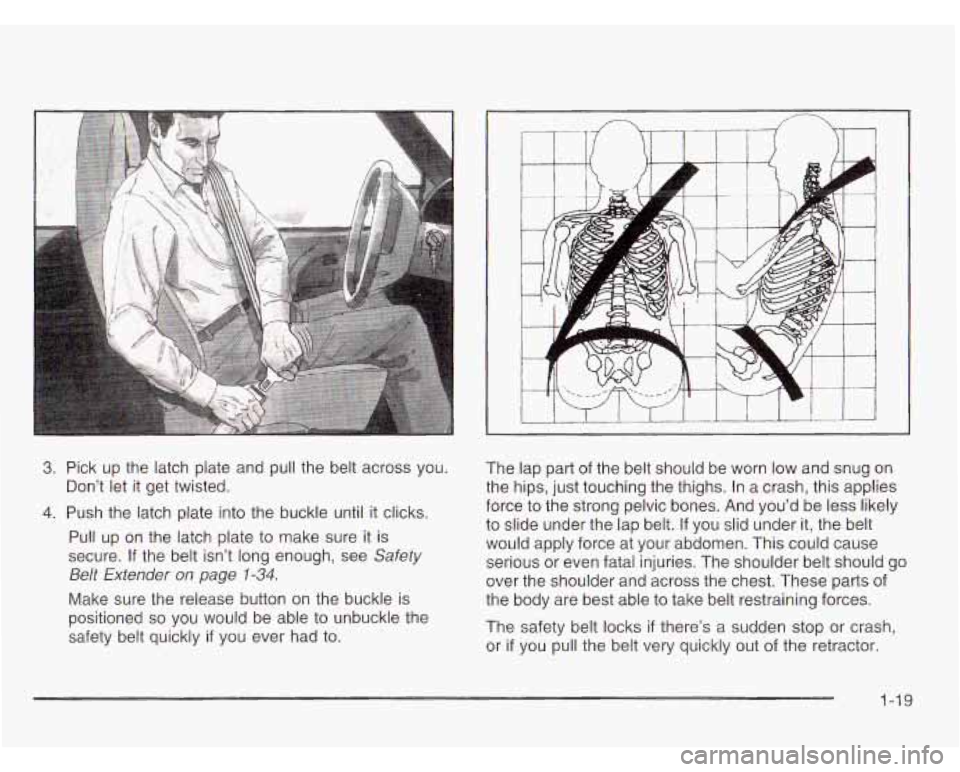
3. Pick up the latch plate and pull the belt across you.
4. Push the latch plate into the buckle until it clicks.
Pull up on the latch plate to make sure it is
secure. If the belt isn’t long enough, see
Safety
Belt Extender on page 1-34.
Make sure the release button on the buckle is
positioned so you would be able to unbuckle the
safety belt quickly
if you ever had to.
Don’t let it get twisted.
The lap part of the belt should
be worn
low and snug on
the hips, just touching the thighs. In a crash, this applies
force to the strong pelvic bones. And you’d be less likely
to slide under the lap belt. If you slid under it, the belt
would apply force at your abdomen. This could cause
serious or even fatal injuries. The shoulder belt should go
over the shoulder and across the chest. These parts of
the body are best able
to take belt restraining forces.
The safety belt locks
if there’s a sudden stop or crash,
or
if you pull the belt very quickly out of the retractor.
1-19
Page 34 of 386
The best way to protect the fetus is to protect the
mother. When a safety belt
is worn properly, it’s more
likely that the fetus won’t be hurt in a crash. For
pregnant women,
as for anyone, the key to making
safety belts effective is wearing them properly.
Right Front Passenger Position
To learn how to wear the right front passenger’s safety
belt properly, see
Driver Position on page 1-18.
The right front passenger’s safety belt works the same
way as the driver’s safety belt
- except for one thing.
If you ever pull the lap portion of the belt out all the
way, you
will engage the child restraint locking feature.
If this happens, just let the belt go back all the way and
start again.
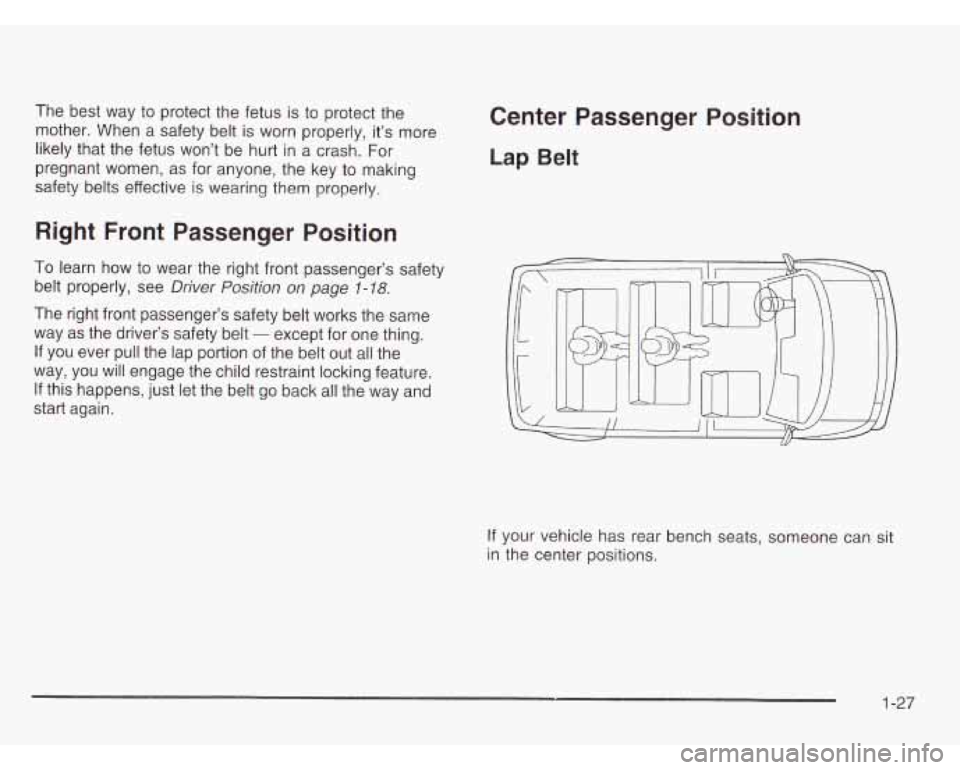
Center Passenger Position
Lap Belt
If your vehicle has rear bench seats, someone can sit
in the center positions.
1-27
Page 38 of 386
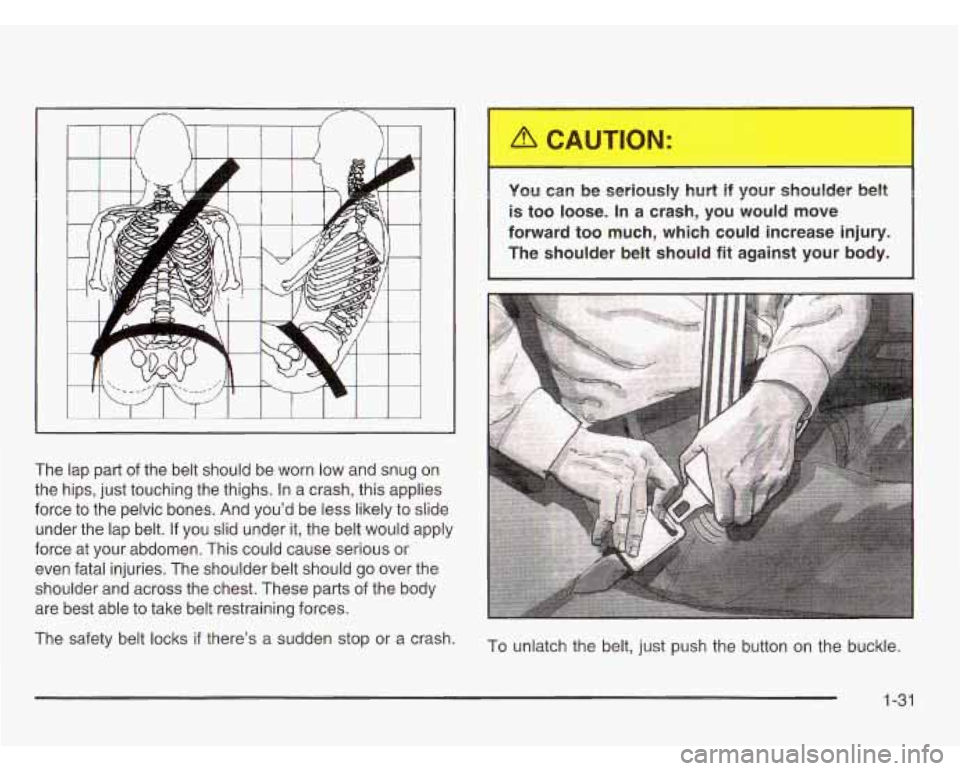
The lap part of the belt should be worn low and snug on
the hips, just touching the thighs. In a crash, this applies
force to the pelvic bones. And you’d be less likely to slide
under the lap belt.
If you slid under it, the belt would apply
force at your abdomen. Phis could cause serious or
even fatal injuries. The shoulder belt should go over the
shoulder and across the chest. These parts of the body
are best able to take belt restraining forces.
The safety belt locks
if there’s a sudden stop or a crash.
is too loose. In a crash, you would move
forward too much, which could increase injury.
The shoulder belt should fit against your body.
To unlatch the belt, just push the button on the buckle.
1-31
Page 80 of 386
Section 2 Features and controls
Keys ............................................................... 2.2
Remote Keyless Entry System
~ = ~ . = = = = = -2-4
Remote Keyless Entry System Operation
.......... -2-5
Doors and Locks ............................................. 2-7
Door Locks
.................................................... 2.7
Front Doors
................................................... 2.8
Power Door Locks
.......................................... 2-8
Programmable Automatic Door Locks
................ 2.9
Leaving Your Vehicle
................................... -2-10
Sliding Side Door
......................................... -2-1 0
Rear Doors ................................................. -2-1 3
Windows ........................................................ 2.16
Manual Windows
.......................................... 2.16
Power Windows
........................................... -2-1 7
Sun Visors ................................................... 2.17
Theft-Deterrent Systems .................................. 2.18
Passlock@
.................................................... 2.18
Starting and Operating Your Vehicle ................ 2.19
New Vehicle Break-In
.................................... 2.19
Ignition Positions
........ ................... 2.19 Starting
Your Engine
..................................... 2.21
Engine Coolant Heater
.................................. 2.22
Automatic Transmission Operation
................... 2.23
All-Wheel Drive
............................................ 2.26
Parking Brake
.............................................. 2.26
Shifting Into Park (P)
..................................... 2-27
Shifting Out
of Park (P) ................................. 2-29
Parking Over Things That Burn
....................... 2-30
Running Your Engine While You Are Parked
....... 2-31
Engine Exhaust
............................................ 2-30
Mirrors ........................................................... 2.32
Manual Rearview Mirror
................................ -2-32
Outside Manual Mirrors
.................................. 2.32
Outside Power Mirrors
................................... 2.32
Outside Convex Mirror
................................... 2.33
HomeLink@ Transmitter ................................... 2.34
Programming the HomeLink Transmitter
........... 2.35
Storage Areas ................................................ 2.38
Overhead Console
........................................ 2.39
Luggage Carrier
........................................... 2.44
Convenience Net
.......................................... 2.45
2-1
Page 82 of 386
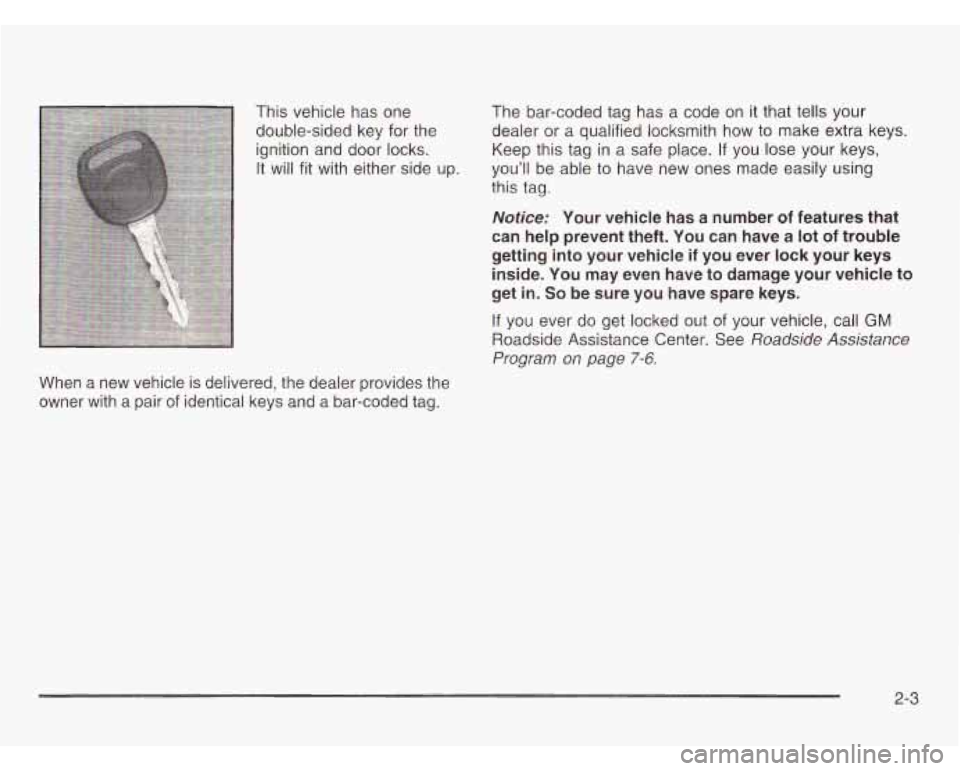
This vehicle has one The bar-coded tag has a code
on it that tells your
double-sided key for the dealer or a qualified locksmith how to make extra keys.
ignition and door locks.
Keep this tag in a safe place.
If you lose your keys,
It will fit with either side up. you’ll be able to have new ones made easily using
this tag.
Notice: Your vehicle has a number of features that
can help prevent theft. You can have a lot
of trouble
getting into your vehicle if you ever lock your keys
inside. You may even have to damage your vehicle to
get in. So be sure you have spare keys.
If you ever do get locked out of your vehicle, call GM
Roadside Assistance Center. See Roadside Assistance
Program on page 7-6.
When a new vehicle is delivered, the dealer provides the
owner with a pair of identical keys and a bar-coded tag.
2-3