2003 CHEVROLET ASTRO climate control
[x] Cancel search: climate controlPage 146 of 386
Be sure to keep the area under the front seats clear of
any objects
so that the air inside of your vehicle can
circulate effectively.
For information on how to use the main climate-control
system. For information
on ventilation, see “Outlet
Adjustment” listed later in this section.
Rear Climate Control System
Rear Window Defogger
Your vehicle may have a rear window defogger that
uses a warming grid
to remove fog or frost from the
rear window.
The rear window defogger will only work when the
ignition is in
RUN.
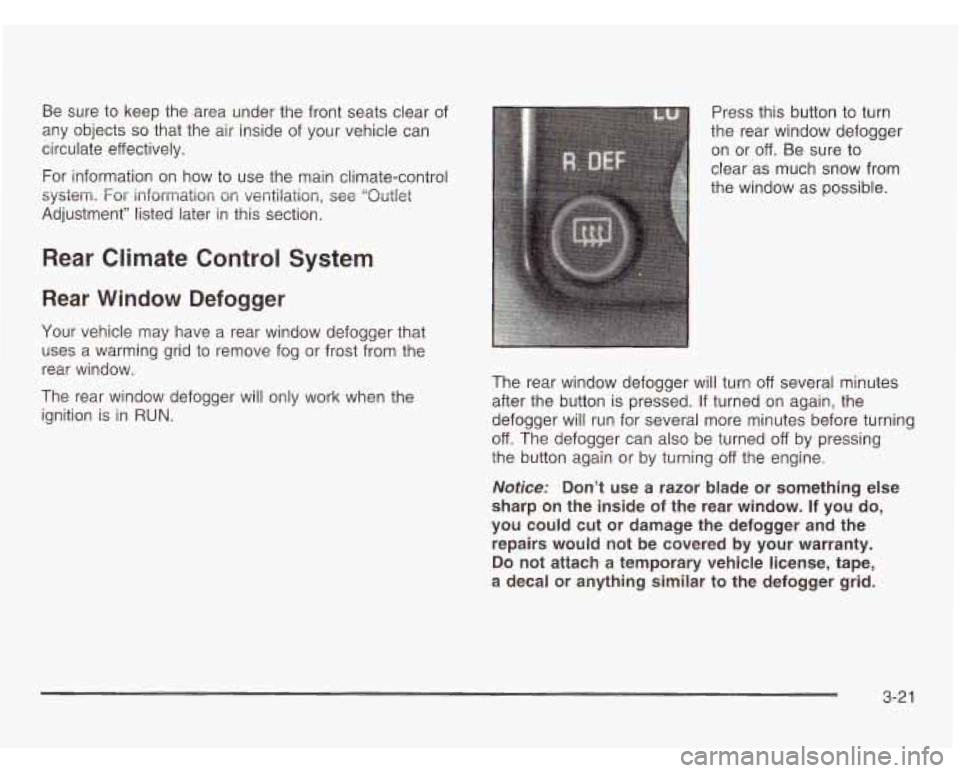
Press this button to turn
the rear window defogger
on or off. Be sure to
clear as much snow from
the window as possible.
The rear window defogger will turn
off several minutes
after the button is pressed. If turned on again, the
defogger will run for several more minutes before turning
off. The defogger can also be turned off by pressing
the button again or by turning off the engine.
Notice: Don’t use a razor blade or something else
sharp on the inside of the rear window. If you do,
you could cut or damage the defogger and the repairs would not be covered by your warranty.
Do not attach a temporary vehicle license, tape,
a decal or anything similar to the defogger grid.
3-2 1
Page 212 of 386

Driving with a Trailer
If you ~ ve a rear-most window open and
you pull a trailer with your vehicle, carbon monoxide (CO) could come into your vehicle.
You can’t see or smell
CO. It can cause
unconsciousness or death. See “Engine
Exhaust” in the Index.
To maximize your safety
when towing a trailer:
Have your exhaust system inspected for
leaks, and make necessary repairs before
starting on your trip.
Keep the rear-most windows closed.
If exhaust does come into your vehicle
through a window
in the rear or another
opening, drive with your front, main
heating or cooling system on and with the
fan on any speed. This will bring fresh,
outside air into your vehicle.
Do not use
the climate control setting for maximum air because
it only recirculates the air inside
your vehicle. See “Climate Controls” in
the Index. Towing
a trailer requires a certain amount of experience.
Before setting out for the open road, you’ll want to get
to know your rig. Acquaint yourself with the feel of
handling and braking with the added weight of the trailer.
And always keep in mind that the vehicle you are
driving is now a good deal longer and not nearly as
responsive as your vehicle is by itself.
Before you start, check the trailer hitch and platform
(and attachments), safety chains, electrical connector,
lamps, tires and mirror adjustment. If the trailer has
electric brakes, start your vehicle and trailer moving and
then apply the trailer brake controller by hand to be
sure the brakes are working. This lets you check your
electrical connection at the same time.
During your trip, check occasionally
to be sure that
the load
is secure, and that the lamps and any trailer
brakes are still working.
4-37
Page 285 of 386
Treadwear
The treadwear grade is a comparative rating based on
the wear rate of the tire when tested under controlled
conditions on a specified government test course.
For example, a tire graded
150 would wear one and
a half
(1.5) times as well on the government course as
a tire graded
100. The relative performance of tires
depends upon the actual conditions of their use,
however, and may depart significantly from the norm
due to variations in driving habits, service practices
and differences in road characteristics and climate.
Temperature - A, B, C
Traction - AA, A, B, C
The traction grades, from highest to lowest, are AA, A,
B, and C. Those grades represent the tire’s ability
to stop on wet pavement as measured under controlled
conditions on specified government test surfaces of
asphalt and concrete.
A tire marked C may have poor
traction performance. Warning: The traction grade
assigned to this tire is based on straight-ahead braking
traction tests, and does not include acceleration,
cornering, hydroplaning, or peak traction characteristics. The temperature
grades are
A (the highest), B, and C,
representing the tire’s resistance to the generation
of heat and its ability to dissipate heat when tested
under controlled conditions on a specified indoor
laboratory test wheel. Sustained high temperature
can cause the material of the tire to degenerate and
reduce tire life, and excessive temperature can lead to
sudden tire failure. The grade
C corresponds to a
level of performance which all passenger car tires must
meet under the Federal Motor Vehicle Safety Standard
No. 109. Grades B and A represent higher levels of
performance on the laboratory test wheel than the
minimum required by law.
Warning: The temperature grade for this tire is
established for a tire that is properly inflated and
not overloaded. Excessive speed, underinflation, or
excessive loading, either separately or in combination,
can cause heat buildup and possible tire failure.
5-68
Page 312 of 386

13
14
15
16
Fuse/Circuit Usage Breaker
10 Air Bag System
11 Not Used
12 L, MI, M2 Blower Motor, Rear Air
Conditioning Relay Coil, Front Cont.
Temp. Door Motor, HI Blower Relay.
Defogger Timer Coil
Cigarette Lighter, Door Lock
Switches, Dutch Door Release Module
Cluster Illum, Climate Controls,
Chime Module, Radio Illumination,
Rear Heat Switch Illumination, Rear
Wipermasher Switch Illumination,
Rear Liftgate Switch Illumination,
Remote Cassette Illumination,
Overhead Console, Truck Body
Control Illurnination
Truck Body Module, Headlamp Relay
Front Turn Signals, Rear Turn
Signals, Trailer Turn Signals,
Back-up Lamps, Brake Transmission
Shift Interlock Solenoid 21
22
23
24
A
19
20
FuseKircuit
Usage
Breaker
17 Front Wipers, Front Washer Pump
18 VCM-lgn
3, VCM-Brake, Cruise
Stepper Motor Signal, ATC Module
Instrument Panel Radio: ATC
(Main Feed),
2000 Series (Standby)
PRNDUOdometer, TCC Enable and
PWM Solenoid, Shift A and Shift B
Solenoids, 3-2 Downshift Solenoid, Instrument Panel Cluster, VCM
Module
Powr Adjust Mirrors
Not Used
Rear Wiper, Rear Washer Pump
Not Used
(Circuit Breaker) Power Door Lock
Relay, 6-Way Power Seats
(Circuit Breaker) Power Windows
B
5-95
Page 315 of 386

Fuse/Circuit Usage
Breaker
DIODE-I Air Conditioning
Blank Not Used
Blank
Not Used
Blank Not Used
LIGHTING Courtesy Fuse, Power Adjust
Mirrors Fuse, Truck Body Control
Battery Fuse
Power Accessory Circuit Breaker,
Stop/Hazard Fuse, Auxiliary Power
Fuse, Cigarette Lighter Fuse, Radio
Battery Fuse
BATT
Fuse/Circuit
Breaker
IGN A
IGN
B
ABS
Blank RAP
HTD MIRI
RR DEFOG
Usage
Starter Relay, Ignition Switch
Ignition Switch
Electronic Brake Control Module
Not Used Radio Accessory, Power Windows
Rear Window Defogger,
Climate Control Head
5-98
Page 370 of 386

Checking Brake Fluid .................................. 5-43
Checking Coolant ............................................ 5-29
Checking Engine Oil ........................................ 5-15
Checking Things Under the Hood ...................... 5-1 1
Checking Your Restraint Systems ...................... 1-71
Chemical Paint Spotting ................................... 5-89
Child Restraints
Child Restraint Systems
............................... 1-44
Infants and Young Children ........................... 1-38
Lower Anchorages and Top Tethers for
Children (LATCH System)
.......................... 1-52
Older Children ............................................. 1-35
Securing a Child Restraint Designed for
the LATCH System
................................ 1-54
Securing a Child Restraint in a Center
Seat Position
....................................... 1-57
Securing a Child Restraint in a Rear
Outside Seat Position
............................... 1-54
Securing a Child Restraint in the Right
Front Seat Position
................................... 1-59
Top Strap ................................................... 1-48
Top Strap Anchor Location ............................ 1-50
Where to Put the Restraint ........................... 1-47
Cigarette Lighter ............................................. 3-1 7
Cleaning
Inside of Your Vehicle
.................................. 5-83
Outside of Your Vehicle ................................ 5-86
Underbody Maintenance ............................... 5-89
Weatherstrips .............................................. 5-86
Cleaning Exterior Lamps/Lenses ....................... 5-86
Climate Control System ................................... 3-18
Rear .......................................................... 3-21
Rear Heating System ................................... 3-19
Compact Disc Messages .................................. 3-45
Compact Spare Tire ........................................ 5-82
Composite Headlamps ..................................... 5-56
Control of a Vehicle .......................................... 4-6
Convenience Net ............................................ 2-45
Coolant
Engine Temperature Gage
............................ 3-30
Heater, Engine ............................................ 2-22
Cooling System .............................................. 5-33
Cruise Control ................................................ 3-10
Current and Past Model Order Forms ................ 7-12
Customer Assistance Information
Customer Assistance for Text
Customer Assistance
Off ices ........................... 7-4
Customer Satisfaction Procedure ..................... 7-2
GM Mobility Program for Persons with
Disabilities
................................................ 7-5
Reporting Safety Defects to General Motors ....... 7-11
Reporting Safety Defects to the
Canadian Government
.............................. 7-11
Reporting Safety Defects to the United States Government
......................... 7-10
Roadside Assistance Program ......................... 7-6
Service Publications Ordering Information ........ 7-11
Rear Air Conditioning System ........................ 3-20
Courtesy Transportation ......... ...... 7-8
Telephone (TTY) Users ............................... 7-4
3
Page 377 of 386
Power Steering ................................................ 4-9
Programming the HomeLink Transmitter
............. 2-35
Programmable Automatic Door Locks
.................. 2-9
Q
Questions and Answers About
Safety Belts ......... 1-17
R
Radiator Pressure Cap ................. ............ 5-30
Radios
....................................... ............ 3-38
AM-FM
....................................... ........ 3-39
Care of Your CD Player
........................... 3-50
Care of Your CDs
.................................... 3-50
Radio with CD
............................................ 3-41
Rear Seat Audio
.......................................... 3-46
Setting the Time for Radios with HR and
MN Buttons
......................................... 3-38
Setting the Time for Radios with the
Set Buttons
............................. ........ 3-38
Theft-Deterrent
........................ ........ 3-47
Understanding Reception
.......................... 3-50
Reading Lamps
.............................................. 2-40
Rear Air Conditioning System
........................... 3-20
Rear Axle
...................................................... 5-53
Rear Climate Control System
............................ 3-21
Rear Doors
.................................................... 2-13
Rear Heating System
...................................... 3-19 Rear
Rear
Rear Rear
Rear
Rear Safety Belt
Comfort Guides
...................... 1-32
Seat Audio
............................................. 3-46
Seat Operation
......................................... 1-7
Seat Outside Passenger Positions
............. 1-29
Seat Passengers, Safety Belts
.................. 1-29
Window Defoqqer
.................................... 3-21
Rearview Mirrors 2-32 -- .............................................
Reclining Seatbacks .......................................... 1-4
Recreational Vehicle Towing
............................. 4-29
Reinstalling the Engine Cover
........................... 5-23
Remote Keyless Entry System
............................ 2-4
Remote Keyless Entry System, Operation
............ 2-5
Removing the Engine Cover
............................. 5-20
Removing the Flat Tire and Installing the
Spare Tire
.................................................. 5-76
Removing the Rear Seats
.................................. 1-7
Removing the Spare Tire and
Tools ................... 5-72
Removing the Wheel Covers
............................ 5-75
Replacement Bulbs
......................................... 5-61
Replacing Brake System Parts
.......................... 5-46
Replacing Restraint System Parts
After a Crash
.............................................. 1-71
Replacing the Rear Seats
.................................. 1-9
Reporting Safety Defects Canadian Government
.................................. 7-11
General Motors
........................................... 7-11
United States Government
............................ 7-10
Reprogramming a Single HomeLink@ Button
....... 2-37
Resetting Defaults
........................................... 2-37
10