2003 CHEVROLET ASTRO CARGO VAN manual transmission
[x] Cancel search: manual transmissionPage 79 of 382

Keys...............................................................2-2
Remote Keyless Entry System.........................2-4
Remote Keyless Entry System Operation...........2-5
Doors and Locks.............................................2-7
Door Locks....................................................2-7
Front Doors...................................................2-8
Power Door Locks..........................................2-8
Programmable Automatic Door Locks................2-9
Leaving Your Vehicle....................................2-10
Sliding Side Door..........................................2-10
Rear Doors..................................................2-13
Windows........................................................2-16
Manual Windows..........................................2-16
Power Windows............................................2-17
Sun Visors...................................................2-17
Theft-Deterrent Systems..................................2-18
Passlock
ž....................................................2-18
Starting and Operating Your Vehicle................2-19
New Vehicle Break-In....................................2-19
Ignition Positions..........................................2-19
Starting Your Engine.....................................2-21Engine Coolant Heater..................................2-22
Automatic Transmission Operation...................2-23
All-Wheel Drive............................................2-26
Parking Brake..............................................2-26
Shifting Into Park (P).....................................2-27
Shifting Out of Park (P).................................2-29
Parking Over Things That Burn.......................2-30
Engine Exhaust............................................2-30
Running Your Engine While You Are Parked. . . .2-31
Mirrors...........................................................2-32
Manual Rearview Mirror.................................2-32
Outside Manual Mirror...................................2-32
Outside Power Mirrors...................................2-32
Outside Convex Mirror...................................2-33
HomeLink
žTransmitter...................................2-34
Programming the HomeLinkžTransmitter.........2-35
Storage Areas................................................2-38
Overhead Console........................................2-39
Luggage Carrier...........................................2-44
Convenience Net..........................................2-45
Section 2 Features and Controls
2-1
Page 103 of 382
If you manually select SECOND (2), the transmission
will drive in second gear. You may use this feature
for reducing torque to the rear wheels when you
are trying to start your vehicle from a stop on slippery
road surfaces.
FIRST (1):This position gives you even more power
(but lower fuel economy) than SECOND (2). You
can use it on very steep hills, or in deep snow or mud.
If the shift selector lever is put in FIRST (1), the
transmission won't shift into ®rst gear until the vehicle is
going slow enough.
Notice:If your wheels won't turn, don't try to drive.
This might happen if you were stuck in very deep
sand or mud or were up against a solid object. You
could damage your transmission. Also, if you
stop when going uphill, don't hold your vehicle there
with only the accelerator pedal. This could overheat
and damage the transmission. Use your brakes
or shift into PARK (P) to hold your vehicle in
position on a hill.
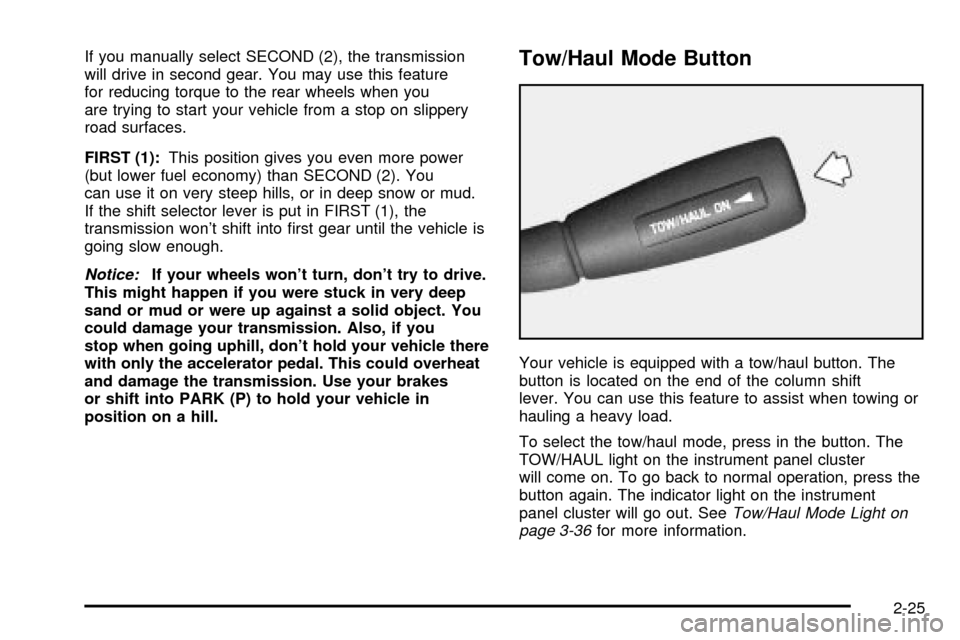
Tow/Haul Mode Button
Your vehicle is equipped with a tow/haul button. The
button is located on the end of the column shift
lever. You can use this feature to assist when towing or
hauling a heavy load.
To select the tow/haul mode, press in the button. The
TOW/HAUL light on the instrument panel cluster
will come on. To go back to normal operation, press the
button again. The indicator light on the instrument
panel cluster will go out. See
Tow/Haul Mode Light on
page 3-36for more information.
2-25
Page 138 of 382

To idle your vehicle with the automatic headlamp
system off, set the parking brake while the ignition is off.
Then start your vehicle. The automatic headlamp
system will stay off until you release the parking brake.
You may be able to turn off your automatic headlamp
system. See ªDaytime Running Lamps (DRL)º later
in this section for more information.
As with any vehicle, you should turn on the regular
headlamps when you need them.
Lamps On Reminder
A reminder tone will sound when your headlamps or
parking lamps are manually turned on and your ignition
is in OFF, LOCK or ACCESSORY. To disable the
tone, turn the instrument panel brightness thumbwheel
all the way down. In the automatic mode, the
headlamps turn off once the ignition key is in OFF.
Daytime Running Lamps (DRL)
Daytime Running Lamps (DRL) can make it easier for
others to see the front of your vehicle during the
day. DRL can be helpful in many different driving
conditions, but they can be especially helpful in the short
periods after dawn and before sunset. Fully functional
daytime running lamps are required on all vehicles
®rst sold in Canada.
The DRL system will make your headlamps come on at
a reduced brightness when the following conditions
are met:
·The ignition is on,
·the exterior lamp control is off.
·the automatic transmission is not in PARK (P),
·the light sensor determines it is daytime and
·the parking brake is released.
When the DRL are on, only your DRL lamps will be on.
The taillamps, sidemarker and other lamps won't be
on. Your instrument panel won't be lit up either.
3-14
Page 214 of 382

When You Are Ready to Leave After
Parking on a Hill
1. Apply your regular brakes and hold the pedal down
while you:
·start your engine,
·shift into a gear, and
·release the parking brake.
2. Let up on the brake pedal.
3. Drive slowly until the trailer is clear of the chocks.
4. Stop and have someone pick up and store the
chocks.
Maintenance When Trailer Towing
Your vehicle will need service more often when you're
pulling a trailer. See the Maintenance Schedule for more
on this. Things that are especially important in trailer
operation are automatic transmission ¯uid (don't over®ll),
engine oil, axle lubricant, belt, cooling system and
brake system. Each of these is covered in this manual,
and the Index will help you ®nd them quickly. If
you're trailering, it's a good idea to review these sections
before you start your trip.
Check periodically to see that all hitch nuts and bolts
are tight.
4-40
Page 264 of 382
1. Check the other vehicle. It must have a 12±-volt
battery with a negative ground system.
Notice:If the other system isn't a 12-volt system
with a negative ground, both vehicles can be
damaged.
2. Get the vehicles close enough so the jumper cables
can reach, but be sure the vehicles aren't touching
each other. If they are, it could cause a ground
connection you don't want. You wouldn't be able to
start your vehicle, and the bad grounding could
damage the electrical systems.
To avoid the possibility of the vehicles rolling, set
the parking brake ®rmly on both vehicles involved in
the jump start procedure. Put an automatic
transmission in PARK (P) and a manual
transmission in NEUTRAL.
3. Turn off the ignition on both vehicles. Unplug
unnecessary accessories plugged into the cigarette
lighter or accessory power outlets. Turn off all
lamps that aren't needed as well as radios.
This will avoid sparks and help save both batteries.
In addition, it could save your radio!
Notice:If you leave your radio on, it could be badly
damaged. The repairs wouldn't be covered by
your warranty.4. Open the hoods and locate the batteries. Find the
positive (+) and negative (-) terminals on each
battery.
{CAUTION:
Using a match near a battery can cause battery
gas to explode. People have been hurt doing
this, and some have been blinded. Use a
¯ashlight if you need more light.
Be sure the battery has enough water. You
don't need to add water to the ACDelco
ž
battery installed in your new vehicle. But if a
battery has ®ller caps, be sure the right
amount of ¯uid is there. If it is low, add water
to take care of that ®rst. If you don't, explosive
gas could be present.
Battery ¯uid contains acid that can burn you.
Don't get it on you. If you accidentally get it in
your eyes or on your skin, ¯ush the place with
water and get medical help immediately.
5-48
Page 365 of 382

Reporting Safety Defects to the
Canadian Government
If you live in Canada, and you believe that your vehicle
has a safety defect, you should immediately notify
Transport Canada, in addition to notifying General
Motors of Canada Limited. You may write to:
Transport Canada
330 Sparks Street
Tower C
Ottawa, Ontario K1A 0N5
Reporting Safety Defects to
General Motors
In addition to notifying NHTSA (or Transport Canada) in
a situation like this, we certainly hope you'll notify us.
Please call us at 1-800-222-1020, or write:
Chevrolet Motor Division
Chevrolet Customer Assistance Center
P.O. Box 33170
Detroit, MI 48232-5170
In Canada, please call us at 1-800-263-3777 (English)
or 1-800-263-7854 (French). Or, write:
General Motors of Canada Limited
Customer Communication Centre, 163-005
1908 Colonel Sam Drive
Oshawa, Ontario L1H 8P7
Service Publications Ordering
Information
Service Manuals
Service Manuals have the diagnosis and repair
information on engines, transmission, axle, suspension,
brakes, electrical, steering, body, etc.
RETAIL SELL PRICE: $120.00
Transmission, Transaxle, Transfer
Case Unit Repair Manual
This manual provides information on unit repair service
procedures, adjustments, and speci®cations for GM
transmissions, transaxles, and transfer cases.
RETAIL SELL PRICE: $50.00
7-11
Page 373 of 382

How to Add Coolant to the Coolant
Recovery Tank............................................5-34
How to Add Coolant to the Radiator..................5-37
How to Add Fluid............................................5-27
How to Check Lubricant...................................5-53
How to Check Power Steering Fluid..................5-40
How to Check........................................5-25, 5-64
How to Inspect the Engine Air Cleaner/Filter.......5-24
How to Use This Manual...................................... ii
How to Wear Safety Belts Properly...................1-18
Hydroplaning..................................................4-18
I
If No Steam Is Coming From Your Engine..........5-32
If Steam Is Coming From Your Engine...............5-31
If the Light Is Flashing.....................................3-32
If the Light Is On Steady.................................3-32
If You Are Stuck in Sand, Mud, Ice or Snow.......4-28
If You Do Decide To Pull A Trailer.....................4-32
If You're Caught in a Blizzard...........................4-26
Ignition Positions.............................................2-19
Ignition Transmission Lock Check......................6-29
Infants and Young Children, Restraints...............1-38
In¯ation Ð Tire Pressure.................................5-64
Inspection......................................................6-31
Brake System.............................................6-31
Engine Cooling System................................6-30Inspection (cont.)
Exhaust System..........................................6-30
Fuel System...............................................6-30
Part C - Periodic Maintenance.......................6-30
Steering, Suspension and Front Drive Axle
Boot and Seal.........................................6-30
Throttle System...........................................6-31
Transfer Case and Front Axle
(All-Wheel Drive)......................................6-31
Installing a Garage Door Opener.......................2-40
Instrument Panel Brightness Control..................3-15
Instrument Panel Fuse Block............................5-93
Instrument Panel.............................................3-24
Cluster.......................................................3-24
Overview..................................................... 3-2
Interior Lamps................................................3-15
J
Jump Starting.................................................5-47
K
Key Lock Cylinders Service..............................6-27
Keyless Entry System....................................... 2-4
Keys............................................................... 2-2
7
Page 376 of 382

Operation Tips................................................3-22
Other Warning Devices...................................... 3-5
Outlet Adjustment............................................3-22
Outside.........................................................2-33
Convex Mirror.............................................2-33
Manual Mirror.............................................2-32
Power Mirrors.............................................2-32
Overhead Console..........................................2-39
Overseas ± Customer Assistance........................ 7-5
Owners, Canadian............................................... ii
Owner's Information........................................7-12
P
Park (P)........................................................2-29
Shifting Out of............................................2-29
Parking Brake and Automatic Transmission Park
(P)
Mechanism Check.......................................6-29
Parking on Hills..............................................4-39
Parking.........................................................2-26
Brake........................................................2-26
Over Things That Burn.................................2-30
Park(P).........................................................2-27
Shifting Into................................................2-27
Part A - Scheduled Maintenance Services............ 6-4
Part B - Owner Checks and Services................6-26Part C - Periodic MaintenanceInspections..........6-30
Part D - Recommended Fluids and Lubricants....6-32
Part E - Maintenance Record...........................6-34
Passing.................................................4-12, 4-38
Passlock
ž......................................................2-18
Payload.........................................................4-31 .
Plan Ahead When Possible................................ 7-8
Playing a Compact Disc...................................3-43
Playing the Radio...................................3-39, 3-41
Power Steering................................................ 4-9
Power...........................................................3-16
Accessory Outlets........................................3-16
Door Locks.................................................. 2-8
Electrical System.........................................5-92
Seat............................................................ 1-3
Steering Fluid.............................................5-40
Windows....................................................2-17
Programmable Automatic Door Locks.................. 2-9
Programming the HomeLink Transmitter.............2-35
Q
Questions and Answers About Safety Belts.........1-17
10