2003 CADILLAC ESCALADE warning light
[x] Cancel search: warning lightPage 265 of 486

Supplemental Brake Assist System
If your vehicle has vacuum assist power brakes, it is also
equipped with a supplemental brake assist system
that supplies additional vacuum to the vacuum brake
booster if engine vacuum is reduced. Under certain
conditions, the supplemental brake assist system may
run brie¯y after starting your vehicle or when you
apply and release the brake pedal and it may continue
to run even after you have removed your foot from
the brake pedal. When the supplemental brake assist
system is operating, you may hear a motor running
or feel a slight vibration in the steering wheel or brake
pedal. This indicates that the supplemental brake
assist system is working to supply additional vacuum for
your vacuum assist power brakes. This is a normal
operation of your brake system and does not require that
the brake system be serviced.
Each time you start your vehicle and accelerate to 10
mph, the supplemental brake assist system will perform
a self-diagnostic check of the system and you may
hear or feel the supplemental brake assist motor run
brie¯y. While you are driving your vehicle, the
supplemental brake assist system monitors itself to
ensure that it is operating properly. If there is a problem
with the supplemental brake assist system, the
SERVICE BRAKE BOOSTER message will be displayed
on the Driver Information Center. See
DIC Warnings
and Messages on page 3-62.If your supplemental brake assist system runs every
time you apply and release the brake pedal or you notice
that the brake pedal has suddenly become much
harder to push and the vehicle takes longer to stop, you
should have your vehicle serviced as soon as possible.
Road Sensing Suspension
The Road Sensing Suspension (RSS) feature provides
superior vehicle ride and handling under a variety of
passenger and loading conditions.
The system is fully automatic and uses a computer
controller to continuously monitor vehicle speed, wheel
to body position, lift/dive and steering position of the
vehicle. The controller then sends signals to each shock
absorber to independently adjust the damping level to
provide the optimum vehicle ride.
RSS also interacts with the tow/haul mode that, when
engaged, will provide additional control of the shock
absorbers. This additional control results in better ride
and handling characteristics when the vehicle is
loaded or towing a trailer. See ªTow/Haul Modeº under
Towing a Trailer on page 4-54.
4-9
Page 292 of 486
Hydroplaning
Hydroplaning is dangerous. So much water can build up
under your tires that they can actually ride on the
water. This can happen if the road is wet enough and
you're going fast enough. When your vehicle is
hydroplaning, it has little or no contact with the road.
Hydroplaning doesn't happen often. But it can if
your tires do not have much tread or if the pressure in
one or more is low. It can happen if a lot of water is
standing on the road. If you can see re¯ections
from trees, telephone poles or other vehicles, and
raindrops ªdimpleº the water's surface, there could be
hydroplaning.
Hydroplaning usually happens at higher speeds. There
just isn't a hard and fast rule about hydroplaning.
The best advice is to slow down when it is raining.
Driving Through Deep Standing Water
Notice:If you drive too quickly through deep
puddles or standing water, water can come in
through your engine's air intake and badly damage
your engine. Never drive through water that is
slightly lower than the underbody of your vehicle. If
you can't avoid deep puddles or standing water,
drive through them very slowly.
Driving Through Flowing Water
{CAUTION:
Flowing or rushing water creates strong forces.
If you try to drive through ¯owing water, as you
might at a low water crossing, your vehicle can
be carried away. As little as six inches of
¯owing water can carry away a smaller vehicle.
If this happens, you and other vehicle
occupants could drown. Don't ignore police
warning signs, and otherwise be very cautious
about trying to drive through ¯owing water.
4-36
Page 294 of 486
Here are ways to increase your safety in city driving:
·Know the best way to get to where you are
going. Get a city map and plan your trip into
an unknown part of the city just as you would for a
cross-country trip.
·Try to use the freeways that rim and crisscross
most large cities. You'll save time and energy.
See
Freeway Driving on page 4-38.
·Treat a green light as a warning signal. A traffic
light is there because the corner is busy enough
to need it. When a light turns green, and just before
you start to move, check both ways for vehicles
that have not cleared the intersection or may
be running the red light.
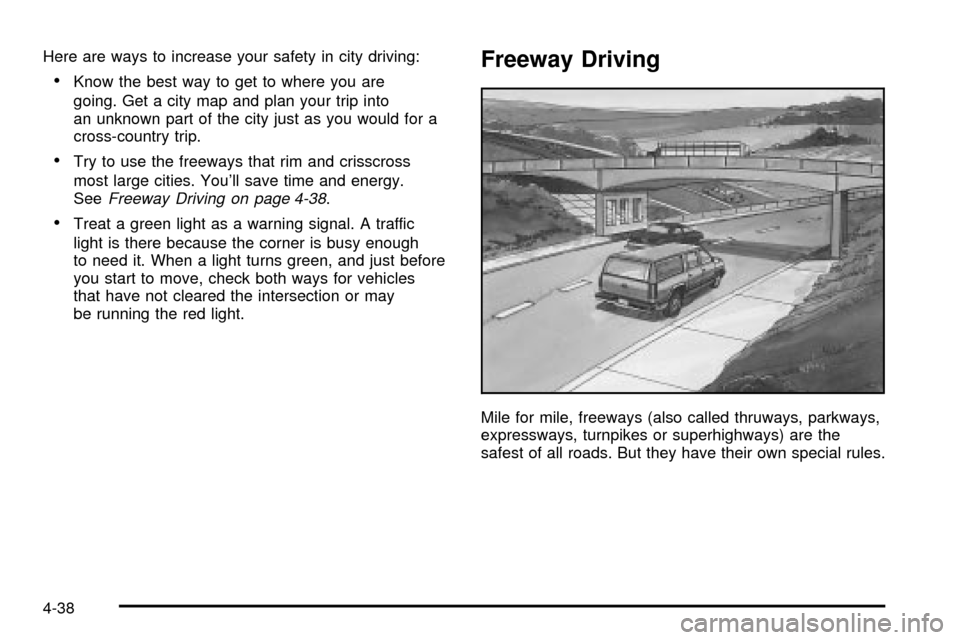
Freeway Driving
Mile for mile, freeways (also called thruways, parkways,
expressways, turnpikes or superhighways) are the
safest of all roads. But they have their own special rules.
4-38
Page 300 of 486

Include an ice scraper, a small brush or broom, a
supply of windshield washer ¯uid, a rag, some winter
outer clothing, a small shovel, a ¯ashlight, a red
cloth and a couple of re¯ective warning triangles. And, if
you will be driving under severe conditions, include a
small bag of sand, a piece of old carpet or a couple of
burlap bags to help provide traction. Be sure you
properly secure these items in your vehicle.
Driving on Snow or Ice
Most of the time, those places where your tires meet
the road probably have good traction.
However, if there is snow or ice between your tires and
the road, you can have a very slippery situation.
You'll have a lot less traction or ªgripº and will need to
very careful.
What's the worst time for this? ªWet ice.º Very cold
snow or ice can be slick and hard to drive on. But wet
ice can be even more trouble because it may offer
the least traction of all. You can get wet ice when it's
about freezing (32ÉF; 0ÉC) and freezing rain begins
to fall. Try to avoid driving on wet ice until salt and sand
crews can get there.
Whatever the condition ± smooth ice, packed, blowing
or loose snow ± drive with caution.
4-44
Page 344 of 486

Engine Coolant
The cooling system in your vehicle is ®lled with
DEX-COOLžengine coolant. This coolant is designed
to remain in your vehicle for 5 years or 150,000 miles
(240 000 km), whichever occurs ®rst, if you add
only DEX-COOL
žextended life coolant.
The following explains your cooling system and how to
add coolant when it is low. If you have a problem
with engine overheating, see
Engine Overheating on
page 5-28.
A 50/50 mixture of clean, drinkable water and
DEX-COOL
žcoolant will:
·Give freezing protection down to-34ÉF (-37ÉC).
·Give boiling protection up to 265ÉF (129ÉC).
·Protect against rust and corrosion.
·Help keep the proper engine temperature.
·Let the warning lights and gages work as they
should.
Notice:When adding coolant, it is important that
you use only DEX-COOLž(silicate-free) coolant.
If coolant other than DEX-COOLžis added to
the system, premature engine, heater core or
radiator corrosion may result. In addition, the engine
coolant will require change sooner -- at 30,000 miles
(50,000 km) or 24 months, whichever occurs ®rst.
Damage caused by the use of coolant other
than DEX-COOL
žis not covered by your new vehicle
warranty.
5-24
Page 361 of 486

Notice:
·Using the wrong ¯uid can badly damage brake
system parts. For example, just a few drops of
mineral-based oil, such as engine oil, in your
brake system can damage brake system
parts so badly that they'll have to be replaced.
Don't let someone put in the wrong kind of ¯uid.
·If you spill brake ¯uid on your vehicle's painted
surfaces, the paint ®nish can be damaged. Be
careful not to spill brake ¯uid on your vehicle. If
you do, wash it off immediately. See
ªAppearance Careº in the Index.
Brake Wear
Your vehicle has four-wheel disc brakes.
Disc brake pads have built-in wear indicators that make
a high-pitched warning sound when the brake pads
are worn and new pads are needed. The sound
may come and go or be heard all the time your vehicle
is moving (except when you are pushing on the
brake pedal ®rmly).
{CAUTION:
The brake wear warning sound means that
soon your brakes won't work well. That could
lead to an accident. When you hear the brake
wear warning sound, have your vehicle
serviced.
Notice:Continuing to drive with worn-out brake
pads could result in costly brake repair.
Some driving conditions or climates may cause a brake
squeal when the brakes are ®rst applied or lightly
applied. This does not mean something is wrong with
your brakes.
Properly torqued wheel nuts are necessary to help
prevent brake pulsation. When tires are rotated, inspect
brake pads for wear and evenly tighten wheel nuts in
the proper sequence to GM torque speci®cations.
Brake linings should always be replaced as complete
axle sets.
See
Brake System Inspection on page 6-17.
5-41
Page 469 of 486

A
Accessory Power Outlets.................................3-23
Adding Washer Fluid.......................................5-38
Additional Program Information........................... 7-9
Additives, Fuel................................................. 5-6
Add-On Equipment..........................................4-52
Adjustable Throttle and Brake Pedal..................2-22
Adjusting the Speakers (Balance/Fade)..............3-75
After Off-Road Driving.....................................4-32
Air Bag System, Supplemental Restraint
System (SRS).............................................1-76
Air Bag .........................................................3-38
Passenger Status Indicator...........................3-38
Readiness Light..........................................3-37
Air Cleaner/Filter, Engine.................................5-19
Air Conditioning..............................................3-29
All-Wheel Drive...............................................5-50
AM .............................................................3-103
Analog Clock..................................................3-24
Antenna, Diversity Antenna System..................3-105
Antenna, XMŸ Satellite Radio Antenna
System.....................................................3-105
Anti-Lock Brake, System Warning Light..............3-42
Anti-lock Brake System..................................... 4-7
Appearance Care............................................5-94
Care of Safety Belts....................................5-96
Chemical Paint Spotting..............................5-100
Cleaning the Inside of Your Vehicle................5-94Appearance Care (cont.)
Cleaning the Outside of Your Vehicle..............5-97
Finish Damage..........................................5-100
Sheet Metal Damage...................................5-99
Underbody Maintenance.............................5-100
Vehicle Care/Appearance Materials...............5-100
Weatherstrips..............................................5-96
Approaching a Hill..........................................4-24
Ashtrays........................................................3-23
Audio Output..................................................3-92
Audio System(s).............................................3-70
Audio Steering Wheel Controls....................3-102
Care of Your Cassette Tape Player...............3-103
Care of Your CD and DVD Player................3-104
Care of Your CD Changer...........................3-104
Care of Your CDs and DVDs.......................3-104
CD Changer...............................................3-99
Diversity Antenna System............................3-105
Navigation/Radio System..............................3-96
Radio with Cassette and CD.........................3-71
Rear Seat Audio (RSA)................................3-97
Setting the Time..........................................3-70
Theft-Deterrent Feature...............................3-101
Understanding Radio Reception...................3-103
XMŸ Satellite Radio Antenna System...........3-105
Automatic Climate Control System.....................3-24
Automatic Headlamp System............................3-16
Automatic Level Control...................................4-53
Automatic Transmission Check..........................6-12
1
Page 470 of 486

Automatic Transmission Shift Lock Control
System Check.............................................6-14
Automatic Transmission...................................5-21
Fluid..........................................................5-21
Operation...................................................2-24
B
Backing Up....................................................4-61
BATTERY NOT CHARGING.............................3-63
Battery Replacement......................................... 2-7
Battery Run-Down Protection............................3-19
Battery..........................................................5-43
Before Leaving on a Long Trip.........................4-40
Before You Drive............................................3-85
Before You Go Off-Roading..............................4-19
Bench Seat Split (50/50)..................................1-13
Bench Seat, Split (60/40).................................1-10
Bench Seat....................................................1-19
Body Lubrication Service..................................6-13
Brake Adjustment............................................5-42
Brake Fluid....................................................5-39
Brake Pedal, Throttle.......................................2-22
Brake Pedal Travel.........................................5-42
Brake Wear...................................................5-41
Brake............................................................2-27
Parking......................................................2-27
System Inspection.......................................6-17
System Warning Light..................................3-40Brake (cont.)
Brakes..........................................................5-39
Braking in Emergencies..................................... 4-8
Braking........................................................... 4-6
Break-In, New Vehicle.....................................2-20
Bucket Seats, Rear.........................................1-25
Bulb Replacement...........................................5-57
Center High-Mounted Stoplamp (CHMSL)........5-63
Front Turn Signal, Sidemarker and Daytime
Running Lamps........................................5-62
Halogen Bulbs............................................5-57
Headlamp Aiming........................................5-53
Headlamps.................................................5-58
High Intensity Discharge (HID) Lighting...........5-57
Replacement Bulbs......................................5-64
Taillamps....................................................5-63
Buying New Tires...........................................5-70
C
Cadillac Owner PrivilegesŸ............................... 7-6
California Fuel.................................................. 5-5
Canada ± Customer Assistance.......................... 7-4
Canadian Owners................................................ ii
Capacities and Speci®cations..........................5-112
Carbon Monoxide...................4-43, 4-54, 2-15, 2-31
Care of.........................................................5-96
Safety Belts................................................5-96
Your Cassette Tape Player..........................3-103
2