2003 BUICK CENTURY ignition lock
[x] Cancel search: ignition lockPage 86 of 344
Power Windows
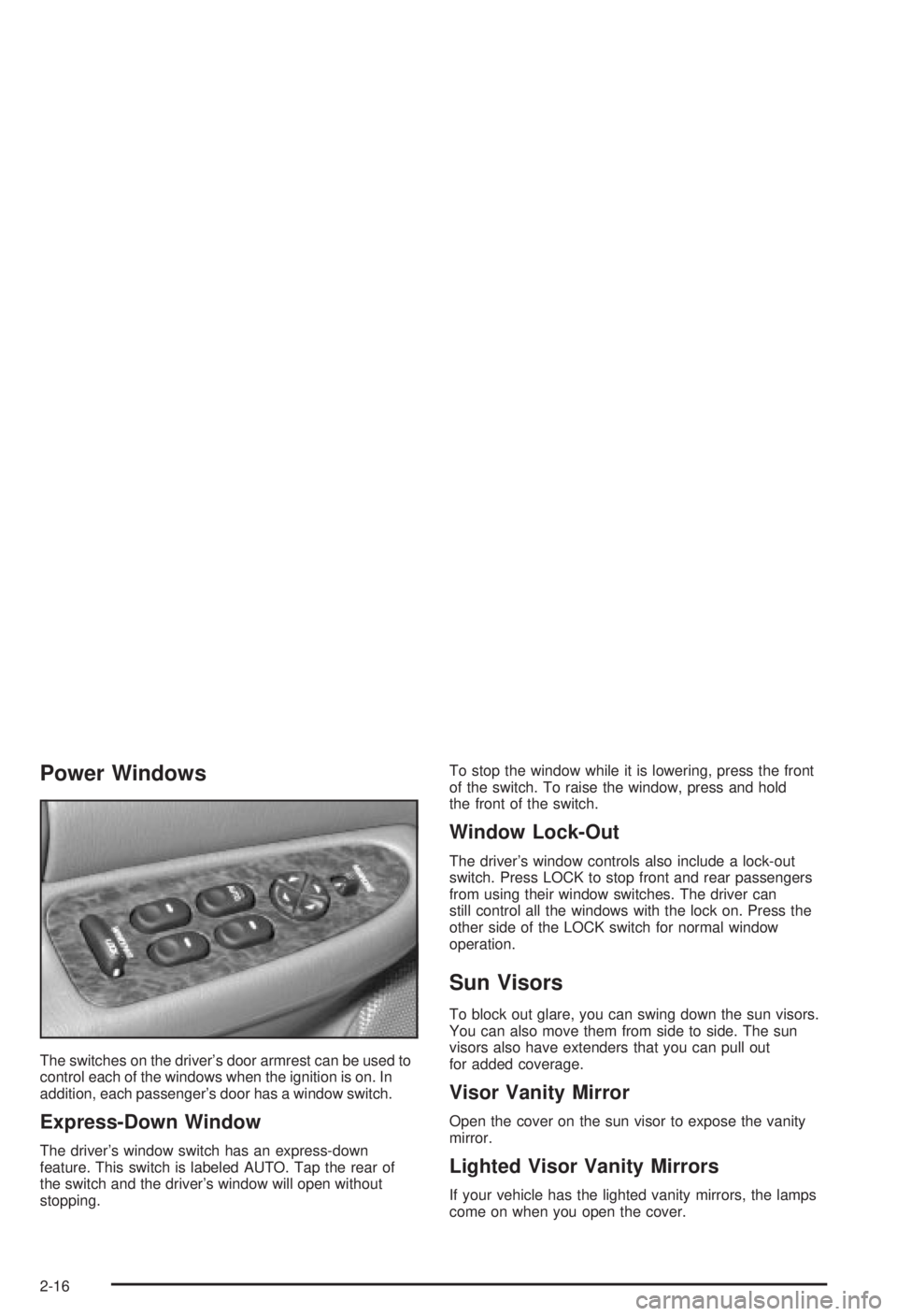
The switches on the driver's door armrest can be used to
control each of the windows when the ignition is on. In
addition, each passenger's door has a window switch.
Express-Down Window
The driver's window switch has an express-down
feature. This switch is labeled AUTO. Tap the rear of
the switch and the driver's window will open without
stopping.To stop the window while it is lowering, press the front
of the switch. To raise the window, press and hold
the front of the switch.
Window Lock-Out
The driver's window controls also include a lock-out
switch. Press LOCK to stop front and rear passengers
from using their window switches. The driver can
still control all the windows with the lock on. Press the
other side of the LOCK switch for normal window
operation.
Sun Visors
To block out glare, you can swing down the sun visors.
You can also move them from side to side. The sun
visors also have extenders that you can pull out
for added coverage.
Visor Vanity Mirror
Open the cover on the sun visor to expose the vanity
mirror.
Lighted Visor Vanity Mirrors
If your vehicle has the lighted vanity mirrors, the lamps
come on when you open the cover.
2-16
Page 88 of 344

Clean and dry the key. Wait about three minutes and try
again. If the starter still won't work, and the key
appears to be clean and dry, wait about three minutes
and try another ignition key. At this time, you may
also want to check the fuse. See
Fuses and Circuit
Breakers on page 5-89. If the starter won't work with the
other key, your vehicle needs service. If your vehicle
does start, the ®rst ignition key may be faulty. See your
dealer or a locksmith who can service the PASS-Key
žII.
If you accidentally use a key that has a damaged or
missing resistor pellet, the starter won't work. The
SECURITY warning light on the instrument panel will
then come on. But you don't have to wait three minutes
before trying another ignition key.
See your dealer or a locksmith who can service the
PASS-Key
žII to have a new key made.If you're ever driving and the SECURITY warning light
comes on, you will be able to restart your engine if
you turn it off. Your PASS-Key
žII system, however, is
not working properly and must be serviced by your
dealer. Your vehicle is not protected by the
PASS-Key
žII system.
If you lose or damage a PASS-Key
žII ignition key, see
your dealer or a locksmith who can service
PASS-Key
žII to have a new key made. Also, seeRoadside Assistance Program on page 7-6for more
information.
2-18
Page 89 of 344

Starting and Operating Your
Vehicle
New Vehicle Break-In
Notice:Your vehicle doesn't need an elaborate
ªbreak-in.º But it will perform better in the long run
if you follow these guidelines:
·Don't drive at any one speed Ð fast or
slow Ð for the ®rst 500 miles (805 km). Don't
make full-throttle starts.
·Avoid making hard stops for the ®rst 200 miles
(322 km) or so. During this time your new
brake linings aren't yet broken in. Hard stops
with new linings can mean premature wear and
earlier replacement. Follow this breaking-in
guideline every time you get new brake linings.
·Don't tow a trailer during break-in. See ªTowing
a Trailerº in the Index for more information.
Ignition Positions
With the ignition key in the ignition, you can turn the key
to ®ve different positions:
A (ACCESSORY):This position lets you use the radio
and windshield wipers when the engine is off. To
use ACCESSORY, push in the key and turn it toward
you. Your steering wheel will stay locked.
B (LOCK):This is the only position in which you can
insert or remove the key. This position locks the ignition,
steering wheel and transaxle. It's a theft-deterrent
feature.
2-19
Page 90 of 344

Notice:If your key seems stuck in LOCK and you
can't turn it, be sure you are using the correct key;
if so, is it all the way in? If it is, then turn the
steering wheel left and right while you turn the key
hard. Turn the key only with your hand. Using a
tool to force it could break the key or the ignition
switch. If none of these works, then your vehicle
needs service.
C (OFF):This position lets you turn off the engine but
still turn the steering wheel. It doesn't lock the steering
wheel. Use OFF if you must have your vehicle pushed or
towed.
D (RUN):This position is where the key returns to after
you start your vehicle. With the engine off, you can
use RUN to display some of your warning and
indicator lights.
E (START):This position starts your engine.
A warning chime will sound if you open the driver's door
when the ignition is in OFF, LOCK or ACCESSORY
and the key is in the ignition.Retained Accessory Power (RAP)
With Retained Accessory Power (RAP), your power
windows and audio system will continue to work for up
to 10 minutes after the ignition key is turned to OFF
and before any of the doors are opened.
Starting Your Engine
Move your shift lever to PARK (P) or NEUTRAL (N).
Your engine won't start in any other position ± that's a
safety feature. To restart when you're already moving,
use NEUTRAL (N) only.
Notice:Don't try to shift to PARK (P) if your
vehicle is moving. If you do, you could damage
the transaxle. Shift to PARK (P) only when your
vehicle is stopped.
1. With your foot off the accelerator pedal, turn your
ignition key to START. When the engine starts, let
go of the key. The idle speed will go down as
your engine gets warm.
2-20
Page 94 of 344

Make sure the shift lever is fully in PARK (P) before
starting the engine. Your vehicle has an automatic
transaxle shift lock control system. You must fully apply
your regular brakes before you can shift from PARK (P)
when the ignition is in RUN. If you cannot shift out
of PARK (P), increase pressure on the shift lever by
pushing is all the way in to PARK (P) while keeping the
brake pedal pushed down. Then move the shift lever
out of PARK (P). See
Shifting Out of Park (P) on
page 2-29
Notice:
Shifting to REVERSE (R) while your vehicle
is moving forward could damage your transaxle.
Shift to REVERSE (R) only after your vehicle is
stopped.
REVERSE (R):Use this gear to back up.
To rock your vehicle back and forth to get out of snow,
ice or sand without damaging your transaxle, see If
You Are Stuck: In Sand, Mud, Ice or Snow on
page 4-31.
NEUTRAL (N):In this position, your engine doesn't
connect with the wheels. To restart when you're already
moving, use NEUTRAL (N) only. Also, use
NEUTRAL (N) when your vehicle is being towed.
{CAUTION:
Shifting into a drive gear while your engine is
ªracingº (running at high speed) is dangerous.
Unless your foot is ®rmly on the brake pedal,
your vehicle could move very rapidly. You
could lose control and hit people or objects.
Don't shift into a drive gear while your engine
is racing.
Notice:Damage to your transaxle caused by
shifting into a drive gear with the engine racing isn't
covered by your warranty.
Notice:If your vehicle seems to start up rather
slowly, or if it seems not to shift gears as you go
faster, something may be wrong with a transaxle
system sensor. If you drive very far that way, your
vehicle can be damaged. So, if this happens,
have your vehicle serviced right away. Until then,
you can use SECOND (2) when you are driving less
than 35 mph (55 km/h) and AUTOMATIC OVERDRIVE
(
X)for higher speeds.
2-24
Page 99 of 344
Shifting Out of Park (P)
Your vehicle has an automatic transaxle shiftlock control
system which locks the shift lever in PARK (P) when
the ignition is in the OFF position. In addition, you have
to fully apply the regular brakes before you can shift
from PARK (P) when the ignition is in RUN. See
Automatic Transaxle Operation on page 2-23.
If you cannot shift out of PARK (P), ease pressure on
the shift lever and push the shift lever all the way up into
PARK (P) as you maintain brake application. Then
move the shift lever into the gear you want.
If you ever hold the brake pedal down but still can't shift
out of PARK (P), try this:
1. Turn the ignition key to ACCESSORY. There is no
shift interlock in this key position.
2. Apply and hold the brake until the end of Step 4.
3. Shift the transaxle to NEUTRAL (N).
4. Start the vehicle and then shift to the drive gear
you want.
5. Have the system ®xed as soon as you can.
Parking Over Things That Burn
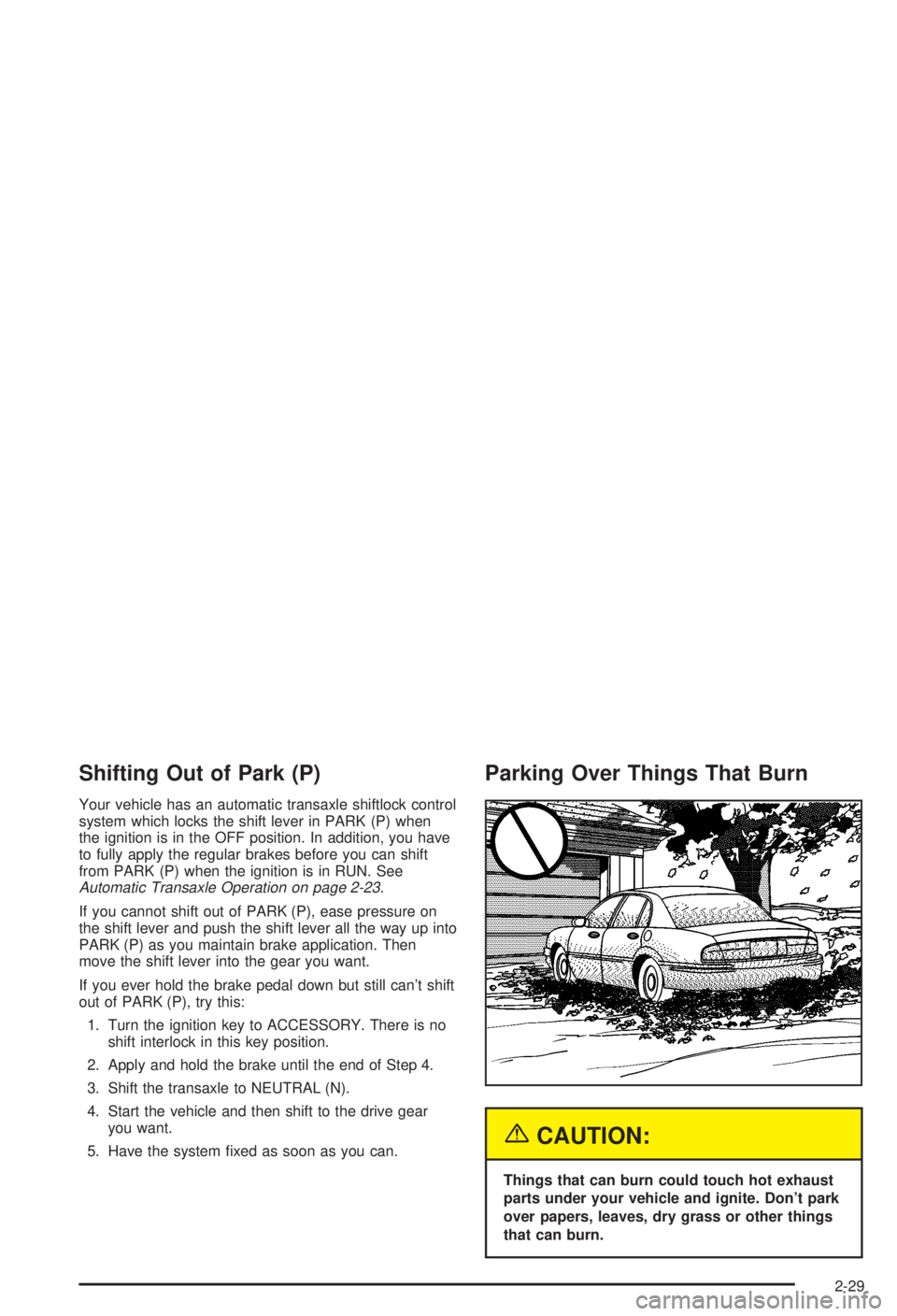
{CAUTION:
Things that can burn could touch hot exhaust
parts under your vehicle and ignite. Don't park
over papers, leaves, dry grass or other things
that can burn.
2-29
Page 117 of 344

Ending Cruise Control
There are two ways to turn off the cruise control:
·Step lightly on the brake pedal, or
·move the cruise switch to OFF.
Ending Speed Memory
When you turn off the cruise control or the ignition, or
shift into PARK (P) or NEUTRAL (N), your cruise control
set speed memory is erased.
Exterior Lamps
This control, located to the
left of the instrument
panel, operates the
exterior lamps.The exterior lamps control has three positions:
Off:Push the control all the way in to turn off all lamps
and lights.
Parking Lamps:Pull the control out, to the ®rst
position, to turn on the parking lamps together with the
following:
·Taillamps
·License Plate Lamps
·Sidemarker Lamps
·Instrument Panel Lights
Headlamps:Pull the control out all the way, to the
second position, to turn on the headlamps together with
the previously listed lamps and lights.
A warning chime will sound if you open the driver's door
when you turn the ignition switch to OFF, LOCK or
ACCESSORY with the lamps on.
3-11
Page 118 of 344

Daytime Running Lamps/Automatic
Headlamp System
Daytime Running Lamps (DRL) can make it easier for
others to see the front of your vehicle during the
day. DRL can be helpful in many different driving
conditions, but they can be especially helpful in the short
periods after dawn and before sunset. Fully functional
daytime running lamps are required on all vehicles
®rst sold in Canada.
A light sensor on top of the instrument panel makes the
DRL work, so be sure it isn't covered.
The DRL system will make your front turn signal lamps
come on when the following conditions are met:
·The ignition is on,
·the exterior lamps control is off and
·the parking brake is released.
While the DRL are on, only your front turn signal lamps
will be on. The headlamps, taillamps, sidemarker
and other lamps won't be on. Your instrument panel
won't be lit up either.When it's dark enough outside, your front turn signal
lamps will turn off and your vehicle's headlamps
and parking lamps will turn on. The other lamps that
come on with your headlamps will also come on.
When it's bright enough outside, your headlamps will
go off and your front turn signal lamps will come on.
To idle your vehicle with the DRL and automatic
headlamp control off, set the parking brake while the
ignition is in OFF or LOCK. Then start your vehicle. The
DRL, headlamps and parking lamps will stay off until
you release the parking brake.
To turn off the automatic headlamp feature when it's
dark outside, move the exterior lamps control to
the parking lamp position. Your parking lamps will
remain illuminated and your headlamps will turn off.
As with any vehicle, you should turn on the regular
headlamp system when you need it.
3-12