2003 BMW 540I SEDAN warning light
[x] Cancel search: warning lightPage 125 of 187
125n
OverviewControlsMaintenanceRepairsDataIndex
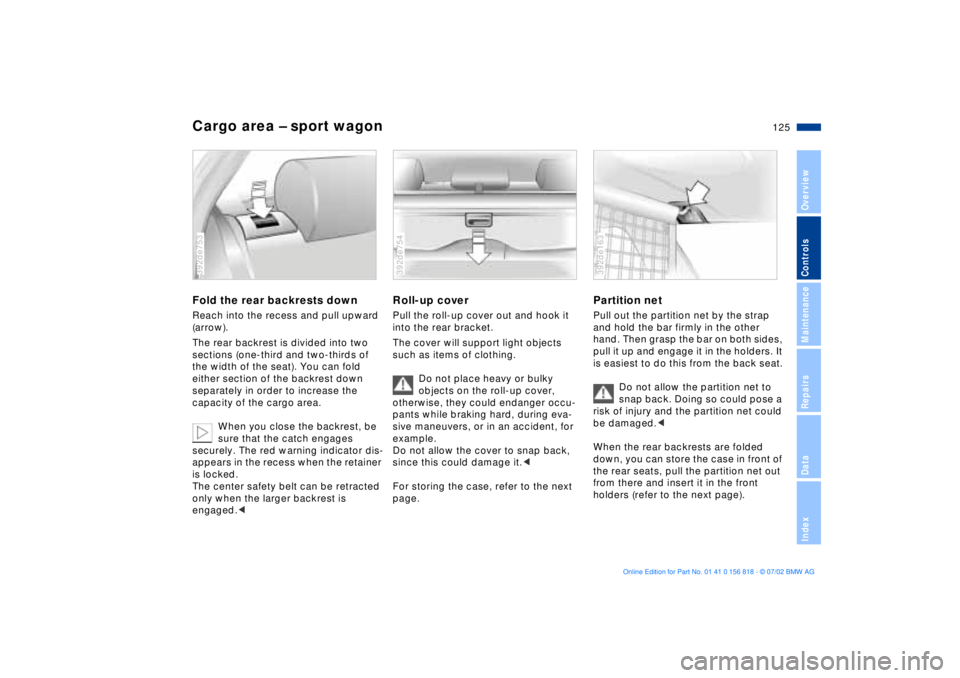
Cargo area Ð sport wagonFold the rear backrests downReach into the recess and pull upward
(arrow).
The rear backrest is divided into two
sections (one-third and two-thirds of
the width of the seat). You can fold
either section of the backrest down
separately in order to increase the
capacity of the cargo area.
When you close the backrest, be
sure that the catch engages
securely. The red warning indicator dis-
appears in the recess when the retainer
is locked.
The center safety belt can be retracted
only when the larger backrest is
engaged.<392de753
Roll-up coverPull the roll-up cover out and hook it
into the rear bracket.
The cover will support light objects
such as items of clothing.
Do not place heavy or bulky
objects on the roll-up cover,
otherwise, they could endanger occu-
pants while braking hard, during eva-
sive maneuvers, or in an accident, for
example.
Do not allow the cover to snap back,
since this could damage it.<
For storing the case, refer to the next
page.392de754
Partition netPull out the partition net by the strap
and hold the bar firmly in the other
hand. Then grasp the bar on both sides,
pull it up and engage it in the holders. It
is easiest to do this from the back seat.
Do not allow the partition net to
snap back. Doing so could pose a
risk of injury and the partition net could
be damaged.<
When the rear backrests are folded
down, you can store the case in front of
the rear seats, pull the partition net out
from there and insert it in the front
holders (refer to the next page).392de163
Page 147 of 187
147n
OverviewControlsMaintenanceRepairsDataIndex
Light-emitting diodes (LEDs)Light-emitting diodes installed behind
translucent lenses serve as the light
source for many of the controls and dis-
plays in your vehicle. The concept
behind their operation is related to that
employed for lasers, and they are offi-
cially designated as Class 1 light-emit-
ting diodes.
Do not remove the protective lens
and avoid staring directly at the
unfiltered beam for extended periods
(several hours), as inflammation of the
iris could result.<
California laws require us to state the
following warning:
Engine exhaust, some of its con-
stituents, and certain vehicle com-
ponents contain or emit chemicals
known to the State of California to
cause cancer and birth defects and
reproductive harm. In addition, certain
fluids contained in vehicles and certain
products of component wear contain or
emit chemicals known to the State of
California to cause cancer and birth
defects or other reproductive harm.
Battery posts, terminals and related
accessories contain lead and lead
compounds. Wash your hands after
handling.
Used engine oil contains chemicals that
have caused cancer in laboratory ani-
mals. Always protect your skin by
washing thoroughly with soap and
water.<
Technical modifications California Proposition 65 Warning
Page 148 of 187
148n
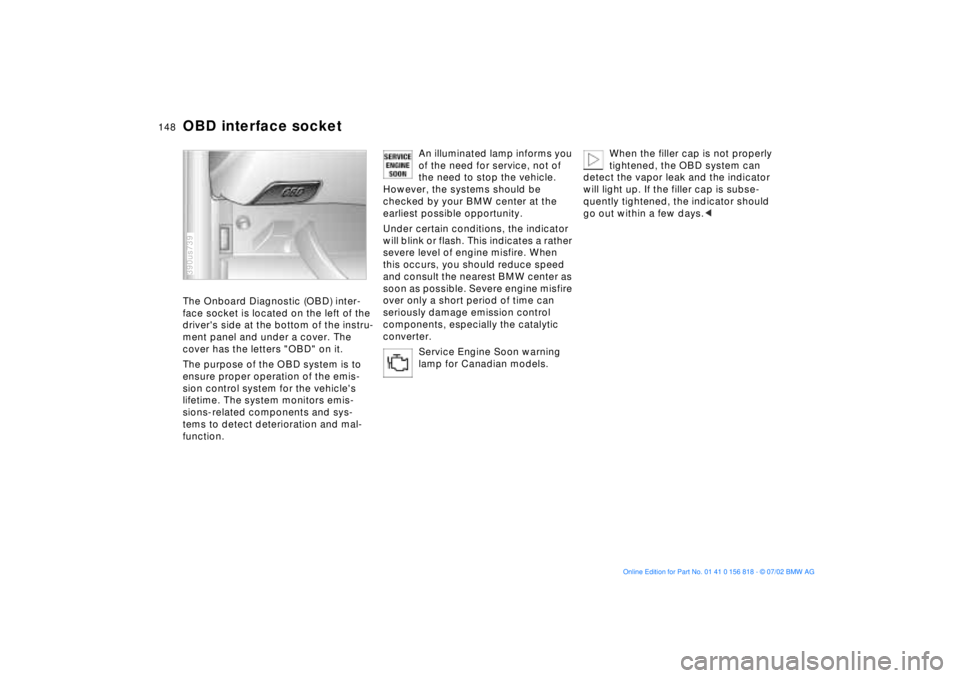
OBD interface socketThe Onboard Diagnostic (OBD) inter-
face socket is located on the left of the
driver's side at the bottom of the instru-
ment panel and under a cover. The
cover has the letters "OBD" on it.
The purpose of the OBD system is to
ensure proper operation of the emis-
sion control system for the vehicle's
lifetime. The system monitors emis-
sions-related components and sys-
tems to detect deterioration and mal-
function.390us739
An illuminated lamp informs you
of the need for service, not of
the need to stop the vehicle.
However, the systems should be
checked by your BMW center at the
earliest possible opportunity.
Under certain conditions, the indicator
will blink or flash. This indicates a rather
severe level of engine misfire. When
this occurs, you should reduce speed
and consult the nearest BMW center as
soon as possible. Severe engine misfire
over only a short period of time can
seriously damage emission control
components, especially the catalytic
converter.
Service Engine Soon warning
lamp for Canadian models.
When the filler cap is not properly
tightened, the OBD system can
detect the vapor leak and the indicator
will light up. If the filler cap is subse-
quently tightened, the indicator should
go out within a few days.<
Page 166 of 187
166n
Towing the vehicle
The towed vehicle should always
be the lighter of the two vehicles.
If this is not the case, it is no longer
possible to control vehicle response.<
Tow-startingIt is not possible to start the engine of
vehicles equipped with an automatic
transmission by towing or pushing.
For instructions on jump-starting: refer
to page 164.
Never attempt to use your vehicle to
push another vehicle, since damage to
the energy-absorbing bumpers could
result.
Towing a vehicle with automatic
transmission1. Place the selector lever in position N
2. Towing speed:
Max. 45 mph (70 km/h)
3. Towing distance:
Max. 95 miles (150 km)
4. Leave the ignition key in position 1 to
ensure that the brake lamps, turn
signal indicators, horn and wind-
shield wipers remain operative, and
to prevent the steering lock from
engaging
5. Switch on the hazard warning
flashers (observe official regulations).
Find some means of identifying the
vehicle in tow, for instance, place a sign
or warning triangle in the rear window.
Make sure that the ignition key
remains in position 1 even when
the electrical system has failed to pre-
vent the steering lock from engaging.
The steering and brakes are without
power-assist when the engine is off.
This means that increased effort is
required for steering and braking.<
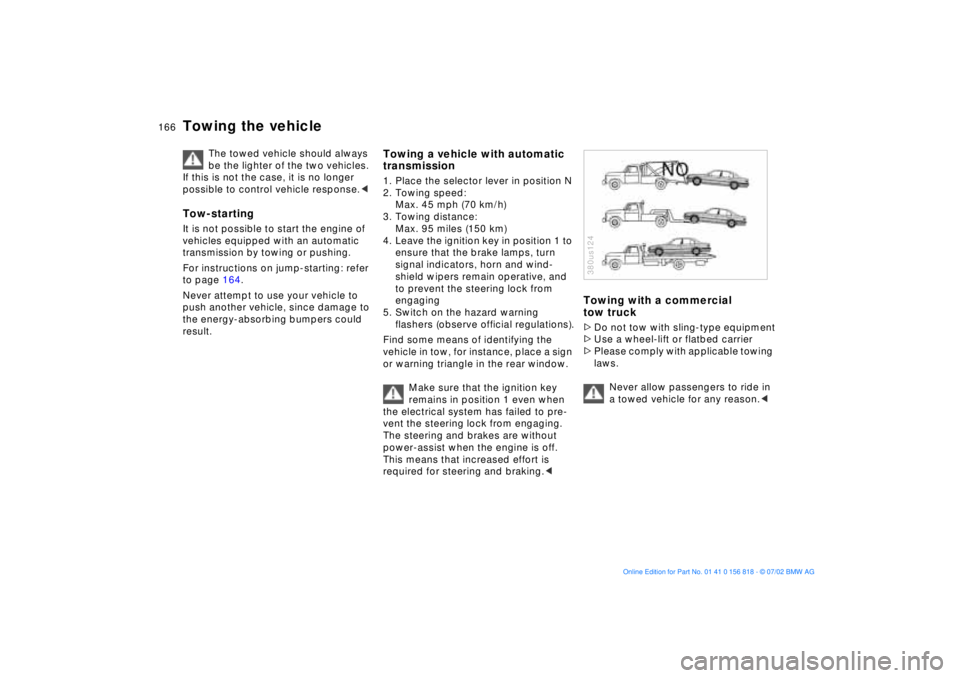
Towing with a commercial
tow truck>Do not tow with sling-type equipment
>Use a wheel-lift or flatbed carrier
>Please comply with applicable towing
laws.
Never allow passengers to ride in
a towed vehicle for any reason.< 380us124
Page 179 of 187
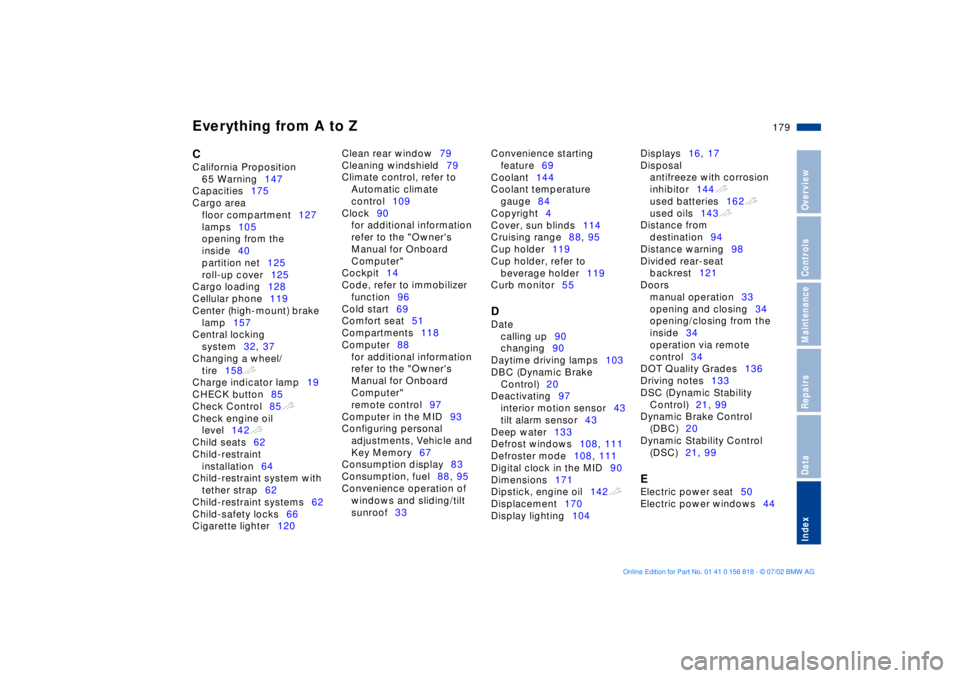
Everything from A to Z
179n
OverviewControlsMaintenanceRepairsDataIndex
C
California Proposition
65 Warning147
Capacities175
Cargo area
floor compartment127
lamps105
opening from the
inside40
partition net125
roll-up cover125
Cargo loading128
Cellular phone119
Center (high-mount) brake
lamp157
Central locking
system32, 37
Changing a wheel/
tire158t
Charge indicator lamp19
CHECK button85
Check Control85t
Check engine oil
level142t
Child seats62
Child-restraint
installation64
Child-restraint system with
tether strap62
Child-restraint systems62
Child-safety locks66
Cigarette lighter120 Clean rear window79
Cleaning windshield79
Climate control, refer to
Automatic climate
control109
Clock90
for additional information
refer to the "Owner's
Manual for Onboard
Computer"
Cockpit14
Code, refer to immobilizer
function96
Cold start69
Comfort seat51
Compartments118
Computer88
for additional information
refer to the "Owner's
Manual for Onboard
Computer"
remote control97
Computer in the MID93
Configuring personal
adjustments, Vehicle and
Key Memory67
Consumption display83
Consumption, fuel88, 95
Convenience operation of
windows and sliding/tilt
sunroof33 Convenience starting
feature69
Coolant144
Coolant temperature
gauge84
Copyright4
Cover, sun blinds114
Cruising range88, 95
Cup holder119
Cup holder, refer to
beverage holder119
Curb monitor55
D
Date
calling up90
changing90
Daytime driving lamps103
DBC (Dynamic Brake
Control)20
Deactivating97
interior motion sensor43
tilt alarm sensor43
Deep water133
Defrost windows108, 111
Defroster mode108, 111
Digital clock in the MID90
Dimensions171
Dipstick, engine oil142t
Displacement170
Display lighting104 Displays16, 17
Disposal
antifreeze with corrosion
inhibitor144t
used batteries162t
used oils143t
Distance from
destination94
Distance warning98
Divided rear-seat
backrest121
Doors
manual operation33
opening and closing34
opening/closing from the
inside34
operation via remote
control34
DOT Quality Grades136
Driving notes133
DSC (Dynamic Stability
Control)21, 99
Dynamic Brake Control
(DBC)20
Dynamic Stability Control
(DSC)21, 99
E
Electric power seat50
Electric power windows44
Page 180 of 187
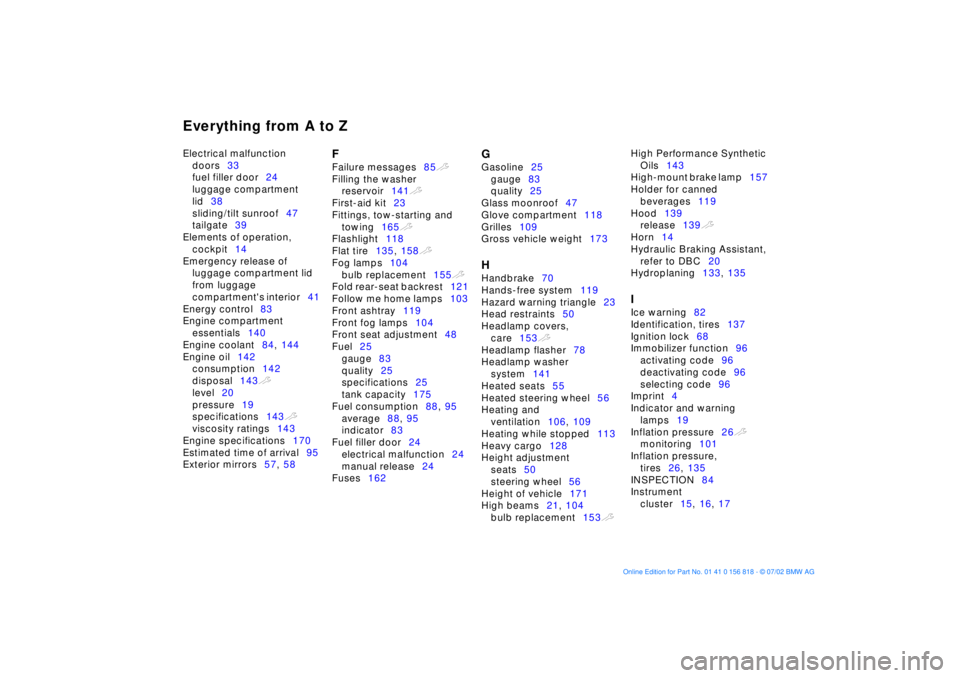
Everything from A to ZElectrical malfunction
doors33
fuel filler door24
luggage compartment
lid38
sliding/tilt sunroof47
tailgate39
Elements of operation,
cockpit14
Emergency release of
luggage compartment lid
from luggage
compartment's interior41
Energy control83
Engine compartment
essentials140
Engine coolant84, 144
Engine oil142
consumption142
disposal143t
level20
pressure19
specifications143t
viscosity ratings143
Engine specifications170
Estimated time of arrival95
Exterior mirrors57, 58
F
Failure messages85t
Filling the washer
reservoir141t
First-aid kit23
Fittings, tow-starting and
towing165t
Flashlight118
Flat tire135, 158t
Fog lamps104
bulb replacement155t
Fold rear-seat backrest121
Follow me home lamps103
Front ashtray119
Front fog lamps104
Front seat adjustment48
Fuel25
gauge83
quality25
specifications25
tank capacity175
Fuel consumption88, 95
average88, 95
indicator83
Fuel filler door24
electrical malfunction24
manual release24
Fuses162
G
Gasoline25
gauge83
quality25
Glass moonroof47
Glove compartment118
Grilles109
Gross vehicle weight173 H
Handbrake70
Hands-free system119
Hazard warning triangle23
Head restraints50
Headlamp covers,
care153t
Headlamp flasher78
Headlamp washer
system141
Heated seats55
Heated steering wheel56
Heating and
ventilation106, 109
Heating while stopped113
Heavy cargo128
Height adjustment
seats50
steering wheel56
Height of vehicle171
High beams21, 104
bulb replacement153t High Performance Synthetic
Oils143
High-mount brake lamp157
Holder for canned
beverages119
Hood139
release139t
Horn14
Hydraulic Braking Assistant,
refer to DBC20
Hydroplaning133, 135
I
Ice warning82
Identification, tires137
Ignition lock68
Immobilizer function96
activating code96
deactivating code96
selecting code96
Imprint4
Indicator and warning
lamps19
Inflation pressure26t
monitoring101
Inflation pressure,
tires26, 135
INSPECTION84
Instrument
cluster15, 16, 17
Page 181 of 187
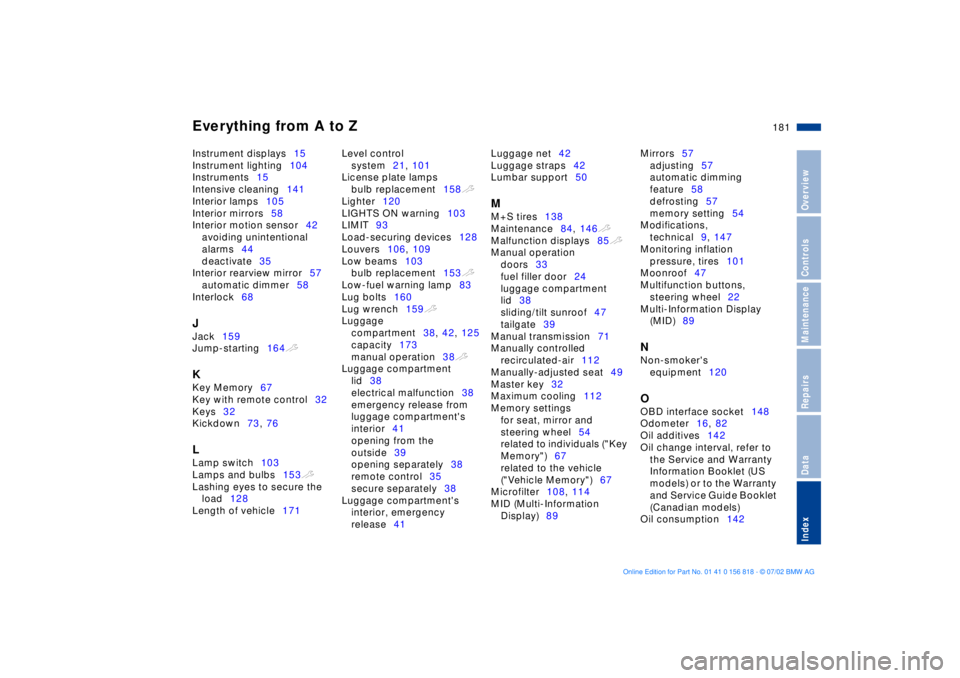
Everything from A to Z
181n
OverviewControlsMaintenanceRepairsDataIndex
Instrument displays15
Instrument lighting104
Instruments15
Intensive cleaning141
Interior lamps105
Interior mirrors58
Interior motion sensor42
avoiding unintentional
alarms44
deactivate35
Interior rearview mirror57
automatic dimmer58
Interlock68 J
Jack159
Jump-starting164t K
Key Memory67
Key with remote control32
Keys32
Kickdown73, 76 L
Lamp switch103
Lamps and bulbs153t
Lashing eyes to secure the
load128
Length of vehicle171 Level control
system21, 101
License plate lamps
bulb replacement158t
Lighter120
LIGHTS ON warning103
LIMIT93
Load-securing devices128
Louvers106, 109
Low beams103
bulb replacement153t
Low-fuel warning lamp83
Lug bolts160
Lug wrench159t
Luggage
compartment38, 42, 125
capacity173
manual operation38t
Luggage compartment
lid38
electrical malfunction38
emergency release from
luggage compartment's
interior41
opening from the
outside39
opening separately38
remote control35
secure separately38
Luggage compartment's
interior, emergency
release41 Luggage net42
Luggage straps42
Lumbar support50
M
M+S tires138
Maintenance84, 146t
Malfunction displays85t
Manual operation
doors33
fuel filler door24
luggage compartment
lid38
sliding/tilt sunroof47
tailgate39
Manual transmission71
Manually controlled
recirculated-air112
Manually-adjusted seat49
Master key32
Maximum cooling112
Memory settings
for seat, mirror and
steering wheel54
related to individuals ("Key
Memory")67
related to the vehicle
("Vehicle Memory")67
Microfilter108, 114
MID (Multi-Information
Display)89 Mirrors57
adjusting57
automatic dimming
feature58
defrosting57
memory setting54
Modifications,
technical9, 147
Monitoring inflation
pressure, tires101
Moonroof47
Multifunction buttons,
steering wheel22
Multi-Information Display
(MID)89
N
Non-smoker's
equipment120 O
OBD interface socket148
Odometer16, 82
Oil additives142
Oil change interval, refer to
the Service and Warranty
Information Booklet (US
models) or to the Warranty
and Service Guide Booklet
(Canadian models)
Oil consumption142