Page 25 of 102
INSTRUMENT AND CONTROL FUNCTIONS
3-10
3
‘EAU00186
CAUTION:@ �
Immediately wipe off spilled fuel
with a clean, dry, soft cloth,
since fuel may deteriorate paint-
ed surfaces or plastic parts.
�
For Germany only: Whenever
replacement is necessary, use a
fuel tank cap of the same spe-
cial design as the original.
@
EAU04284ECA00104
CAUTION:_ Use only unleaded gasoline. The
use of leaded gasoline will cause se-
vere damage to internal engine
parts, such as the valves and piston
rings, as well as to the exhaust sys-
tem. _Your Yamaha engine has been de-
signed to use regular unleaded gaso-
line with a research octane number of
91 or higher. If knocking (or pinging)
occurs, use a gasoline of a different
brand or premium unleaded fuel. Use
of unleaded fuel will extend spark plug
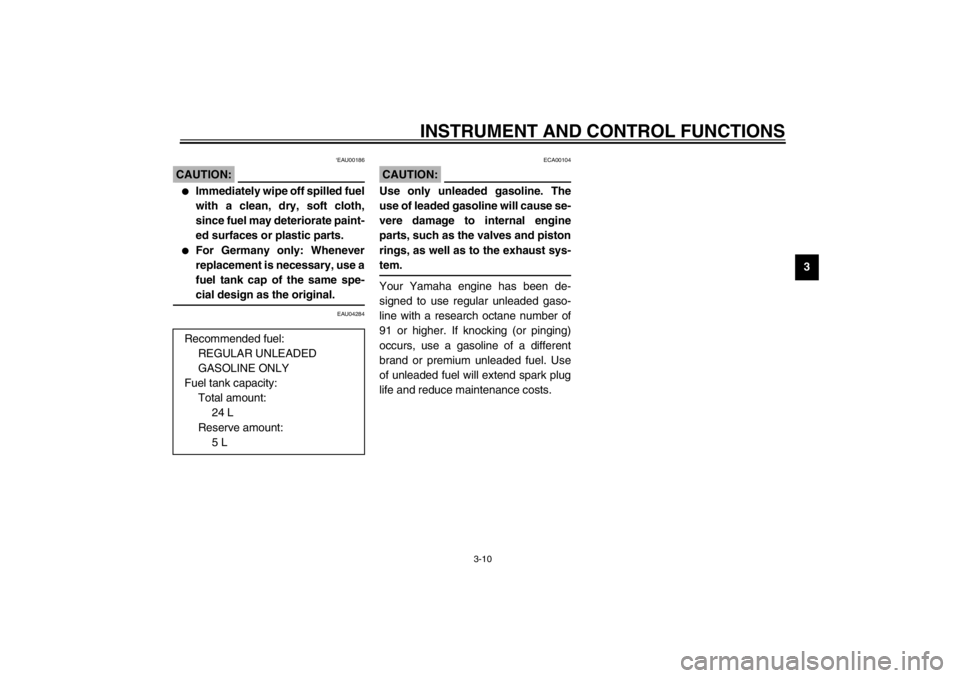
life and reduce maintenance costs. Recommended fuel:
REGULAR UNLEADED
GASOLINE ONLY
Fuel tank capacity:
Total amount:
24 L
Reserve amount:
5 L
E_4km.book Page 10 Tuesday, August 28, 2001 9:51 AM
Page 26 of 102
INSTRUMENT AND CONTROL FUNCTIONS
3-11
3
EAU00196
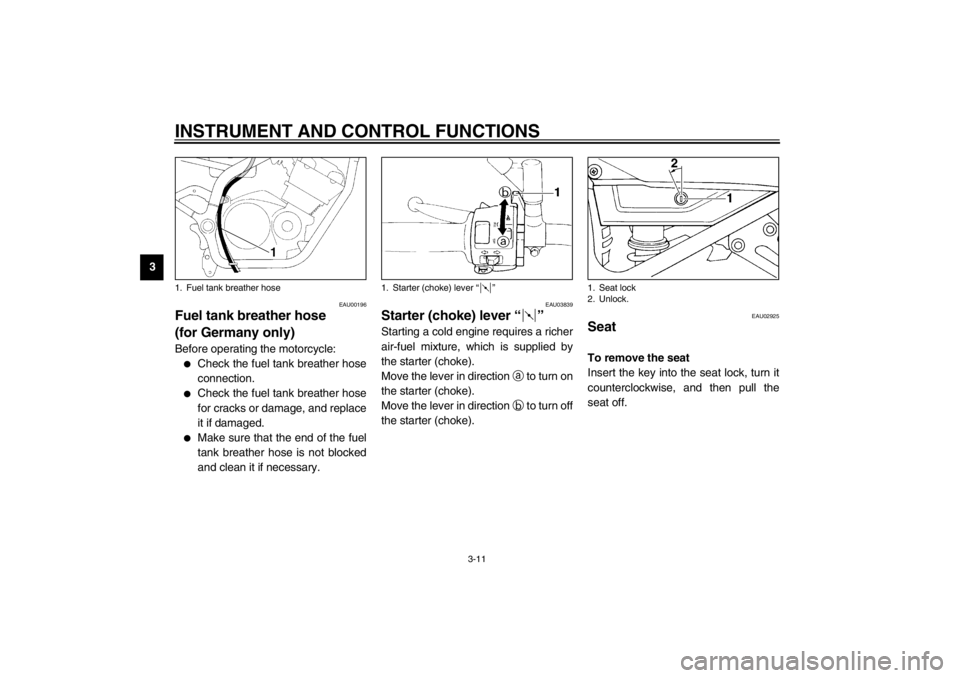
Fuel tank breather hose
(for Germany only) Before operating the motorcycle:�
Check the fuel tank breather hose
connection.
�
Check the fuel tank breather hose
for cracks or damage, and replace
it if damaged.
�
Make sure that the end of the fuel
tank breather hose is not blocked
and clean it if necessary.
EAU03839
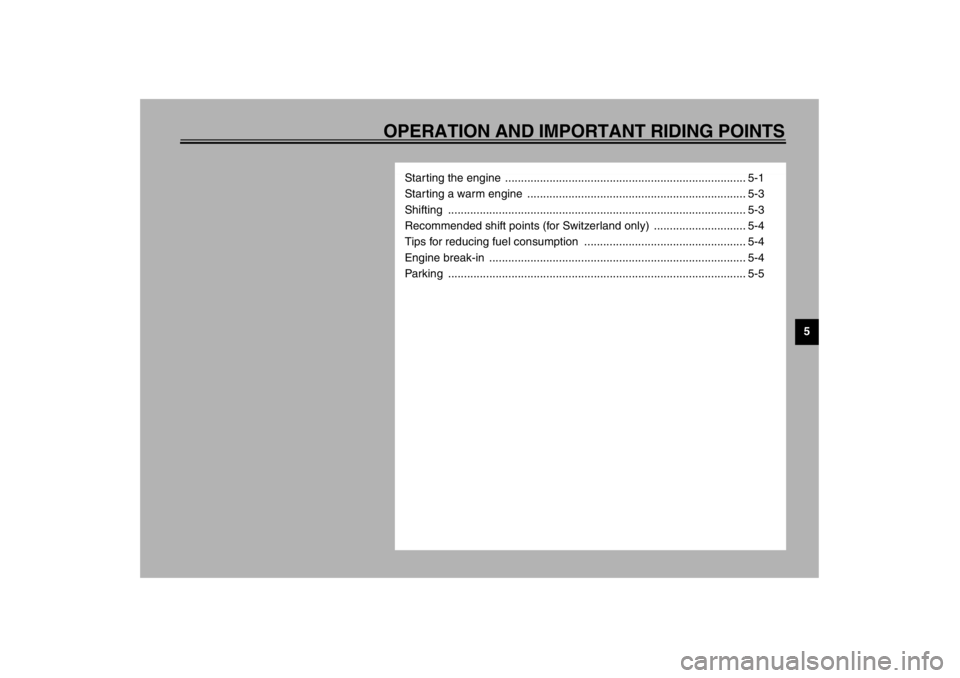
Starter (choke) lever “” Starting a cold engine requires a richer
air-fuel mixture, which is supplied by
the starter (choke).
Move the lever in direction
a to turn on
the starter (choke).
Move the lever in direction
b to turn off
the starter (choke).
EAU02925
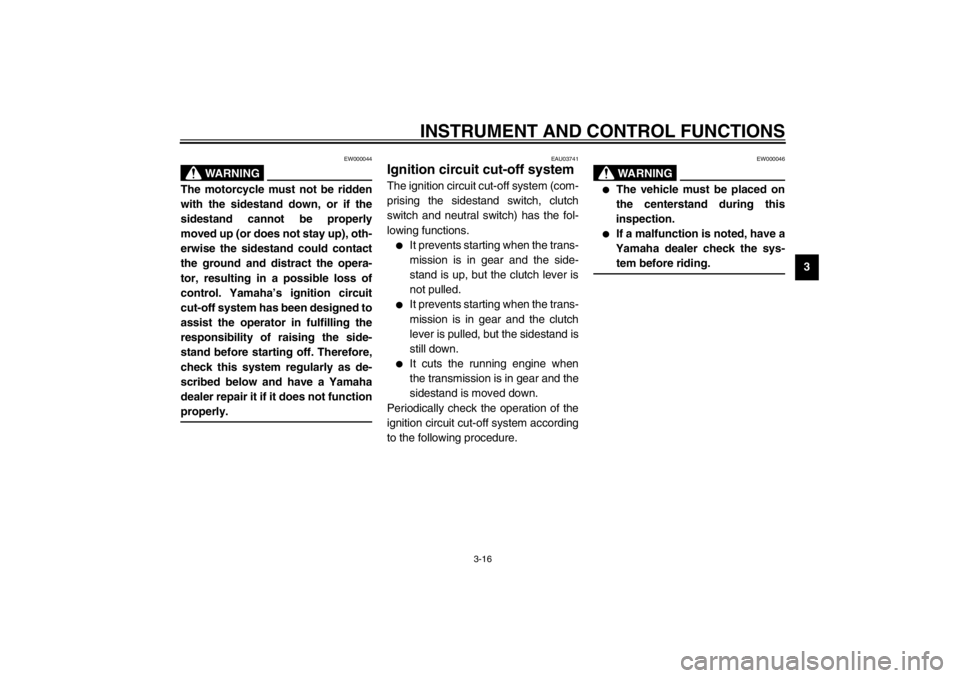
Seat To remove the seat
Insert the key into the seat lock, turn it
counterclockwise, and then pull the
seat off.
1. Fuel tank breather hose
1. Starter (choke) lever “”
1. Seat lock
2. Unlock.
E_4km.book Page 11 Tuesday, August 28, 2001 9:51 AM
Page 31 of 102
INSTRUMENT AND CONTROL FUNCTIONS
3-16
3
EW000044
WARNING
@ The motorcycle must not be ridden
with the sidestand down, or if the
sidestand cannot be properly
moved up (or does not stay up), oth-
erwise the sidestand could contact
the ground and distract the opera-
tor, resulting in a possible loss of
control. Yamaha’s ignition circuit
cut-off system has been designed to
assist the operator in fulfilling the
responsibility of raising the side-
stand before starting off. Therefore,
check this system regularly as de-
scribed below and have a Yamaha
dealer repair it if it does not function
properly. @
EAU03741
Ignition circuit cut-off system The ignition circuit cut-off system (com-
prising the sidestand switch, clutch
switch and neutral switch) has the fol-
lowing functions.�
It prevents starting when the trans-
mission is in gear and the side-
stand is up, but the clutch lever is
not pulled.
�
It prevents starting when the trans-
mission is in gear and the clutch
lever is pulled, but the sidestand is
still down.
�
It cuts the running engine when
the transmission is in gear and the
sidestand is moved down.
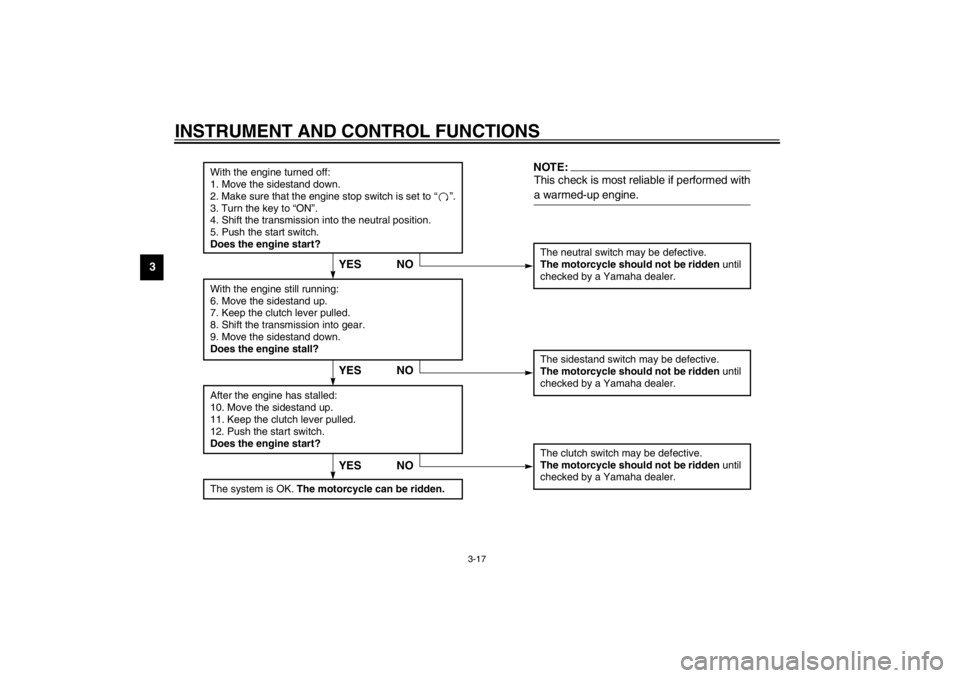
Periodically check the operation of the
ignition circuit cut-off system according
to the following procedure.
EW000046
WARNING
@ �
The vehicle must be placed on
the centerstand during this
inspection.
�
If a malfunction is noted, have a
Yamaha dealer check the sys-
tem before riding.
@
E_4km.book Page 16 Tuesday, August 28, 2001 9:51 AM
Page 32 of 102
INSTRUMENT AND CONTROL FUNCTIONS
3-17
3
CD-01E
With the engine turned off:
1. Move the sidestand down.
2. Make sure that the engine stop switch is set to “”.
3. Turn the key to “ON”.
4. Shift the transmission into the neutral position.
5. Push the start switch.
Does the engine start?
The neutral switch may be defective.
The motorcycle should not be ridden until
checked by a Yamaha dealer.
With the engine still running:
6. Move the sidestand up.
7. Keep the clutch lever pulled.
8. Shift the transmission into gear.
9. Move the sidestand down.
Does the engine stall?After the engine has stalled:
10. Move the sidestand up.
11. Keep the clutch lever pulled.
12. Push the start switch.
Does the engine start?
The sidestand switch may be defective.
The motorcycle should not be ridden until
checked by a Yamaha dealer.The clutch switch may be defective.
The motorcycle should not be ridden until
checked by a Yamaha dealer.
NO
NOTE:This check is most reliable if performed with
a warmed-up engine.
YESYES NO
The system is OK.
The motorcycle can be ridden.
YES NO
E_4km.book Page 17 Tuesday, August 28, 2001 9:51 AM
Page 34 of 102

4-1
4
EAU01114
4-PRE-OPERATION CHECKSThe condition of a vehicle is the owner’s responsibility. Vital components can start to deteriorate quickly and unexpectedly,
even if the vehicle remains unused (for example, as a result of exposure to the elements). Any damage, fluid leakage or loss
of tire air pressure could have serious consequences. Therefore, it is very important, in addition to a thorough visual inspec-
tion, to check the following points before each ride.
EAU03439
Pre-operation check list
ITEM CHECKS PAGE
FuelCheck fuel level in fuel tank.
Refuel if necessary.
Check fuel line for leakage.3-9–3-10
Engine oilCheck oil level in engine.
If necessary, add recommended oil to specified level.
Check vehicle for oil leakage.6-8
Final gear oilCheck vehicle for oil leakage. 6-11–6-12
Front brakeCheck operation.
If soft or spongy, have Yamaha dealer bleed hydraulic system.
Check fluid level in reservoir.
If necessary, add recommended brake fluid to specified level.
Check hydraulic system for leakage.6-22–6-23
Rear brakeCheck operation.
If soft or spongy, have Yamaha dealer bleed hydraulic system.
Check fluid level in reservoir.
If necessary, add recommended brake fluid to specified level.
Check hydraulic system for leakage.6-21–6-23
ClutchCheck operation.
Lubricate cable if necessary.
Check lever free play.
Adjust if necessary.6-20
Throttle gripMake sure that operation is smooth.
Check free play.
If necessary, have Yamaha dealer make adjustment or lubricate.6-16
Control cablesMake sure that operation is smooth.
Lubricate if necessary.6-24
E_4km.book Page 1 Tuesday, August 28, 2001 9:51 AM
Page 37 of 102
OPERATION AND IMPORTANT RIDING POINTS
5
Starting the engine ............................................................................ 5-1
Starting a warm engine ..................................................................... 5-3
Shifting .............................................................................................. 5-3
Recommended shift points (for Switzerland only) ............................. 5-4
Tips for reducing fuel consumption ................................................... 5-4
Engine break-in ................................................................................. 5-4
Parking .............................................................................................. 5-5
E_4km.book Page 1 Tuesday, August 28, 2001 9:51 AM
Page 38 of 102
5-1
5
EAU00372
5-OPERATION AND IMPORTANT RIDING POINTS
EAU00373
WARNING
@ �
Become thoroughly familiar
with all operating controls and
their functions before riding.
Consult a Yamaha dealer re-
garding any control or function
that you do not thoroughly
understand.
�
Never start the engine or oper-
ate it in a closed area for any
length of time. Exhaust fumes
are poisonous, and inhaling
them can cause loss of con-
sciousness and death within a
short time. Always make sure
that there is adequate
ventilation.
�
Before starting out, make sure
that the sidestand is up. If the
sidestand is not raised com-
pletely, it could contact the
ground and distract the opera-
tor, resulting in a possible loss
of control.
@
EAU03818*
Starting the engine In order for the ignition circuit cut-off
system to enable starting, one of the
following conditions must be met:�
The transmission is in the neutral
position.
�
The transmission is in gear with
the clutch lever pulled and the
sidestand up.
EW000054
WARNING
_ �
Before starting the engine,
check the function of the igni-
tion circuit cut-off system ac-
cording to the procedure
described on page 3-17.
�
Never ride with the sidestand
down.
_1. Turn the key to “ON” and make
sure that the engine stop switch is
set to “”.
EC000035
CAUTION:_ If the fuel level warning light comes
on, check the fuel level, and, if nec-
essary, refuel as soon as possible. _2. Shift the transmission into the neu-
tral position.NOTE:_ When the transmission is in the neutral
position, the neutral indicator light
should be on, otherwise have a
Yamaha dealer check the electrical cir-
cuit. _3. Turn the starter (choke) on and
completely close the throttle. (See
page 3-11 for starter (choke) oper-
ation.)
4. Start the engine by pushing the
start switch.
E_4km.book Page 1 Tuesday, August 28, 2001 9:51 AM
Page 39 of 102
OPERATION AND IMPORTANT RIDING POINTS
5-2
5
NOTE:_ If the engine fails to start, release the
start switch, wait a few seconds, and
then try again. Each starting attempt
should be as short as possible to pre-
serve the battery. Do not crank the en-
gine more than 10 seconds on any one
attempt. _
EC000038
CAUTION:_ �
The oil level warning light and
fuel level warning light should
come on when the start switch
is pushed, and they should go
off when the start switch is re-
leased.
�
If the oil level warning light flick-
ers or remains on after starting,
immediately stop the engine,
and then check the engine oil
level and the vehicle for oil leak-
age. If necessary, add engine
oil, and then check the warning
light again. If the warning light
does not come on when push-
ing the start switch, or if it doesnot go off after starting with suf-
ficient engine oil, have a
Yamaha dealer check the elec-
trical circuit.
�
If the fuel level warning light re-
mains on after starting, stop the
engine, and then check the fuel
level. If necessary, refuel as
soon as possible, and then
check the warning light again. If
the warning light does not come
on when pushing the start
switch, or if it does not go off af-
ter starting with sufficient fuel,
have a Yamaha dealer check the
electrical circuit.
_5. After starting the engine, move the
starter (choke) lever back halfway.
ECA00045
CAUTION:_ For maximum engine life, never ac-
celerate hard when the engine is
cold! _6. When the engine is warm, turn the
starter (choke) off.
NOTE:_ The engine is warm when it responds
normally to the throttle with the starter
(choke) turned off. _
E_4km.book Page 2 Tuesday, August 28, 2001 9:51 AM