DESCRIPTION
2-2
2
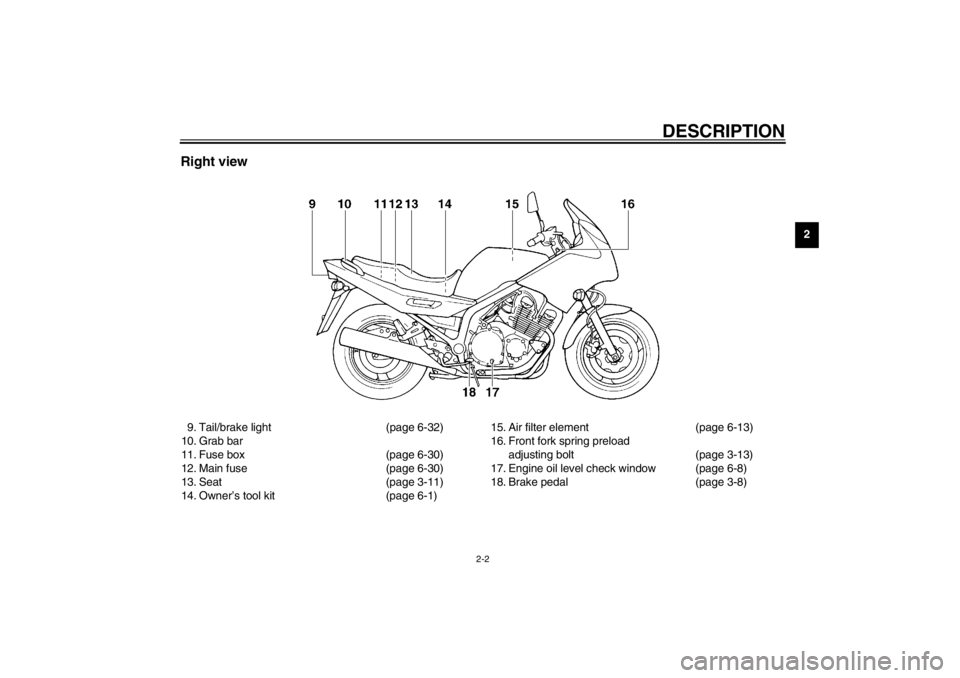
Right view9. Tail/brake light (page 6-32)
10. Grab bar
11. Fuse box (page 6-30)
12. Main fuse (page 6-30)
13. Seat (page 3-11)
14. Owner’s tool kit (page 6-1)15. Air filter element (page 6-13)
16. Front fork spring preload
adjusting bolt (page 3-13)
17. Engine oil level check window (page 6-8)
18. Brake pedal (page 3-8)
E_4km.book Page 2 Tuesday, August 28, 2001 9:51 AM
PERIODIC MAINTENANCE AND MINOR REPAIR
6-30
6
EC000102
CAUTION:@ �
Always keep the battery
charged. Storing a discharged
battery can cause permanent
battery damage.
�
To charge a sealed-type (MF)
battery, a special (constant-
voltage) battery charger is re-
quired. Using a conventional
battery charger will damage the
battery. If you do not have ac-
cess to a sealed-type (MF) bat-
tery charger, have a Yamaha
dealer charge your battery.
@
EAU04359*
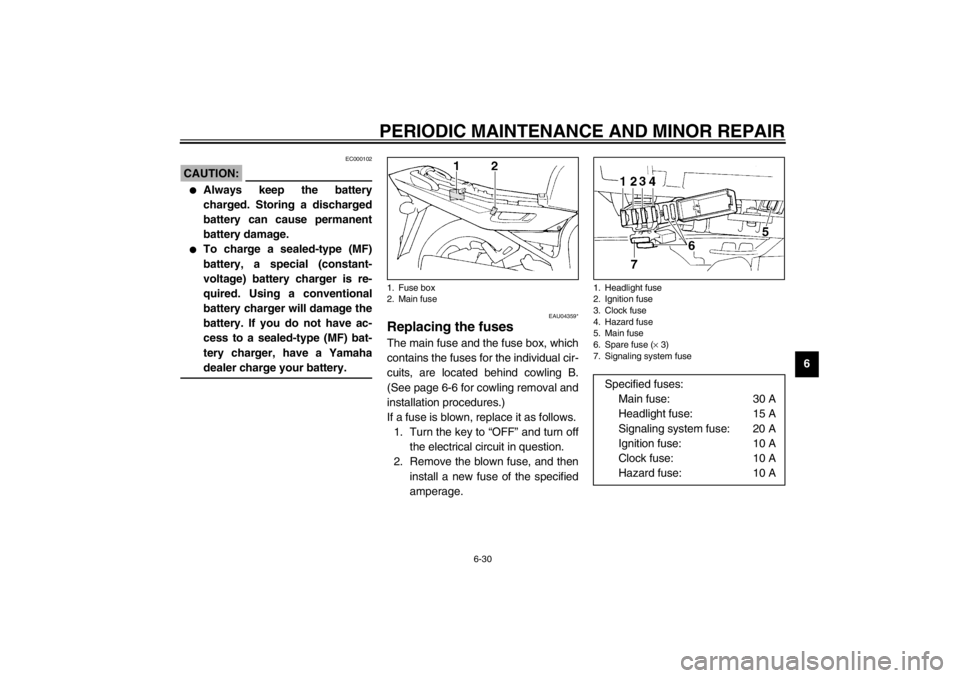
Replacing the fuses The main fuse and the fuse box, which
contains the fuses for the individual cir-
cuits, are located behind cowling B.
(See page 6-6 for cowling removal and
installation procedures.)
If a fuse is blown, replace it as follows.
1. Turn the key to “OFF” and turn off
the electrical circuit in question.
2. Remove the blown fuse, and then
install a new fuse of the specified
amperage.1. Fuse box
2. Main fuse
1. Headlight fuse
2. Ignition fuse
3. Clock fuse
4. Hazard fuse
5. Main fuse
6. Spare fuse (× 3)
7. Signaling system fuseSpecified fuses:
Main fuse: 30 A
Headlight fuse: 15 A
Signaling system fuse: 20 A
Ignition fuse: 10 A
Clock fuse: 10 A
Hazard fuse: 10 A
E_4km.book Page 30 Tuesday, August 28, 2001 9:51 AM