Page 65 of 106
3-30
E
EJU01081
Beaching the watercraft
1. Make sure no obstructions, boats or
swimmers are near the beach. Release
the throttle lever about 90 m (300 ft)
before you reach the intended beaching
area.
2. Approach the beach slowly and stop the
engine before reaching land.
Remember: you need throttle to steer.
3. Get off the watercraft and pull it up on
the beach.
CAUTION:@ Small pebbles, sand, seaweed, and other
debris can be pulled into the jet intake
and impair or damage the impeller.
Always stop the engine and get off
before beaching the watercraft.
@
EJU01295
Rough water operation
The force of landing after jumping can
cause a strong impact on both the watercraft
and the operator. It is possible for the opera-
tor to hit his or her chest or jaw on the water-
craft body or handlebars and be injured. Do
not operate the watercraft with your chin
right above the handlebars or with your feet
outside the watercraft. Operating in rough
water or jumping waves can also crack the
watercraft body or damage internal parts.
Avoid operating in rough water or bad
weather conditions.
E_F1N-70.book Page 30 Wednesday, July 18, 2001 3:28 PM
Page 66 of 106

3-31
E
EJU01296
Post-operation checks
Always perform the following post-opera-
tion checks after operating the watercraft.
1. Remove the watercraft from the water.
2. Wash down the hull, steering pole, han-
dlebars, and jet unit with fresh water.
3. Remove the hood and check the engine
compartment for water. To drain excess
water, turn the watercraft on its port (left)
side. If necessary, turn the watercraft
upside down to drain water completely.
CAUTION:@ �Place a suitable clean cloth or carpet-
ing underneath the watercraft to pro-
tect it from abrasions and scratches.
�Always turn the watercraft over onto
its port (left) side.
�When turning the watercraft onto its
side or inverting it, support the bow
and secure the steering pole, other-
wise the steering pole and handlebars
could be bent or damaged.
@
NOTE:@ This watercraft is equipped with an auto-
matic bilge-draining system that removes
water from the engine compartment while
you are underway. However, some residual
water will remain.
@
4. Put the watercraft in a horizontal posi-
tion.
5. Flush the cooling system to prevent it
from clogging with salt, sand, or dirt.
(See pages 4-1 to 4-2 for flushing the
cooling system procedures.)
6. Drain residual water from the exhaust
system by alternately squeezing and
releasing the throttle lever for 10 to
15 seconds while the engine is running.
E_F1N-70.book Page 31 Wednesday, July 18, 2001 3:28 PM
Page 68 of 106
3-33
E
EJU01297
Transporting
WARNING@ Always place the fuel cock knob in the
“OFF” position when transporting the
watercraft, otherwise fuel could leak out
into the engine or engine compartment,
which would create a fire hazard.
@
Transport this watercraft using the special
trailer that incorporates a hole into which the
pin 1 can be inserted and locked after
passing it through the rope hole 2.
After securing the bow with the pin,
secure the stern with ropes or tie downs 2
over the gunwale. Use a rubber shock
cord1 to hold the steering pole.
CAUTION:@ �Do not route ropes or tie downs over
the steering pole, as they may damage
it. Also, wrap the ropes or tie downs
with towels or rags where they touch
the body of the watercraft to avoid
scratching or damage.
�Do not transport the watercraft with
steering pole up, or the steering pole
may be damaged during transporta-
tion.
@
E_F1N-70.book Page 33 Wednesday, July 18, 2001 3:28 PM
Page 72 of 106
4-3
E
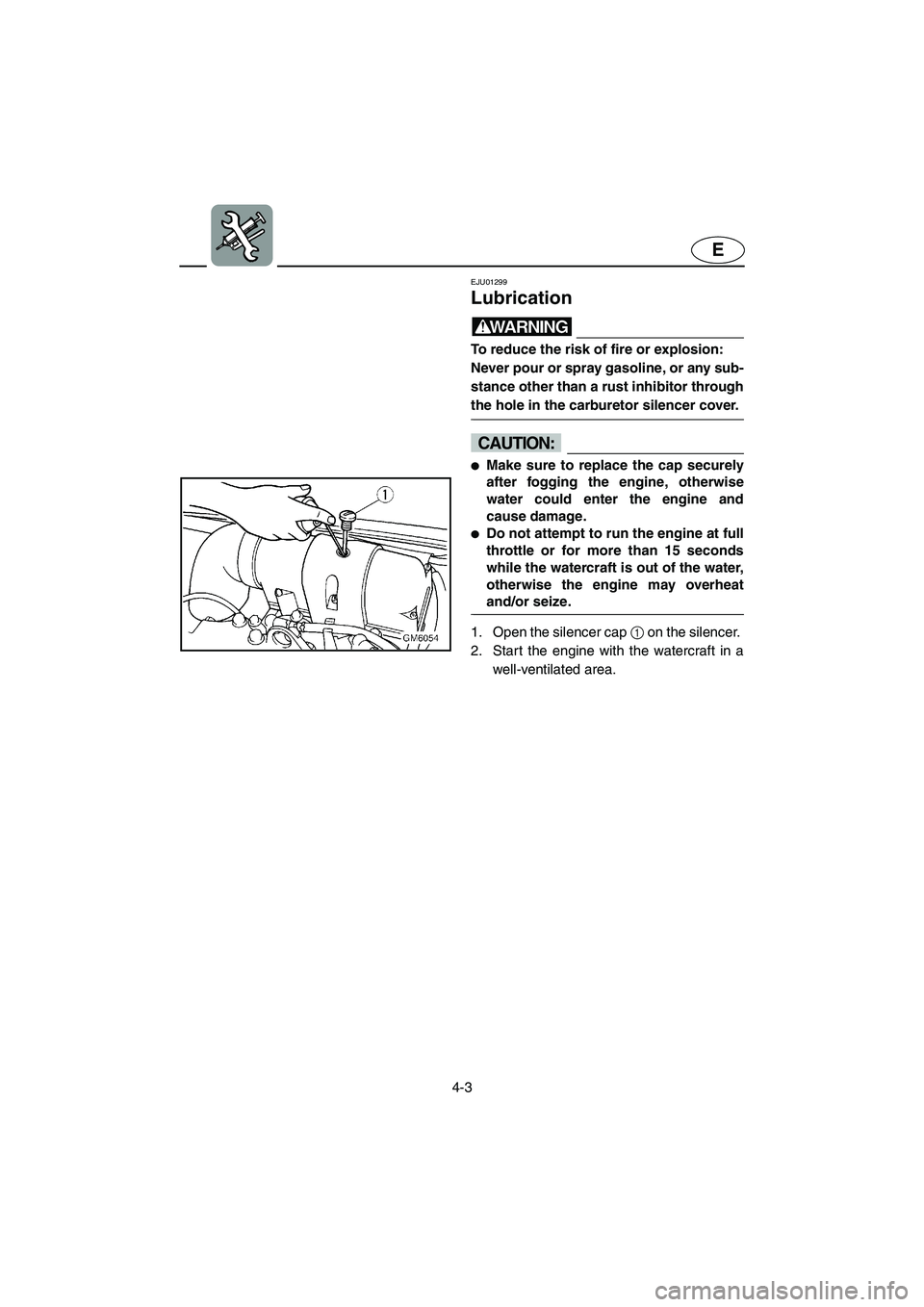
EJU01299
Lubrication
WARNING@ To reduce the risk of fire or explosion:
Never pour or spray gasoline, or any sub-
stance other than a rust inhibitor through
the hole in the carburetor silencer cover.
@
CAUTION:@ �Make sure to replace the cap securely
after fogging the engine, otherwise
water could enter the engine and
cause damage.
�Do not attempt to run the engine at full
throttle or for more than 15 seconds
while the watercraft is out of the water,
otherwise the engine may overheat
and/or seize.
@
1. Open the silencer cap 1 on the silencer.
2. Start the engine with the watercraft in a
well-ventilated area.
E_F1N-70.book Page 3 Wednesday, July 18, 2001 3:28 PM
Page 78 of 106

4-9
E
EJU01355
Periodic maintenance chart
The following chart gives general guidelines for periodic maintenance. However, depend-
ing on your operating conditions maintenance may need to be performed more frequently.
*1: Grease capacity: 20.0–22.0 cm3 (0.68–0.74 oz)
*2: Grease capacity: 3.0–5.0 cm3 (0.10–0.17 oz)
(�) This mark indicates maintenance that you may do yourself.
(
❍) This mark indicates work to be done by a Yamaha dealer.
MAINTENANCE INTERVAL INITIALTHEREAF-
TER EVERYPA G E
10
hours50
hours100
hours 100
hours 200
hours
ITEM
3
months6
months6
months12
months
Spark plug Inspect, clean, adjust ����
4-13
Lubrication points Lubricate��
4-14
Intermediate housing Lubricate❍
*1�
*2�
*2 4-16
Fuel system Inspect❍❍
4-10
Fuel filter Check, replace❍❍
4-11
Fuel tank Clean❍
4-11
Carburetor setting Inspect, adjust❍❍❍
4-19
Trolling speed Adjust��
4-19
Carburetor throttle shaft Inspect❍❍
—
Cooling water passages Flush�
(after
ever y
use) 4-1
Bilge strainer Clean���
—
Impeller Inspect���
—
Steering cable Inspect��
4-12
Steering pivot Inspect❍❍❍
—
Steering friction Inspect���
4-20
Throttle cable Inspect, adjust��
4-12
Choke cable Inspect, adjust ��
4-16
Battery Inspect�
(Inspect
fluid level
before
ever y
use)4-17
Rubber coupling Inspect❍
—
Nuts and bolts Tighten❍❍❍
—
E_F1N-70.book Page 9 Wednesday, July 18, 2001 3:28 PM
Page 80 of 106
4-11
E
EJU01098
Fuel filter
This watercraft is equipped with a one-
piece, disposable fuel filter 1. The fuel filter
should be replaced once a year or after
every 200 hours of operation, or if water is
found in the filter. Have a Yamaha dealer
replace the fuel filter if necessary.
WARNING@ Do not try to replace the fuel filter your-
self. An incorrectly installed filter can
leak gasoline, which could lead to fire or
explosion. If necessary, have a Yamaha
dealer replace the fuel filter.
@
EJU01099
Fuel tank
Check the fuel tank 1 for leakage or
water in the tank. If water is found in the fuel
system or if the fuel tank needs to be
cleaned have a Yamaha dealer service the
watercraft.
E_F1N-70.book Page 11 Wednesday, July 18, 2001 3:28 PM
Page 88 of 106
4-19
E
EJU01109
Adjusting the carburetor
The carburetor is a vital part of the engine
and requires very sophisticated adjustment.
Most adjusting should be left to a Yamaha
dealer who has the professional knowledge
and experience to perform it. However, the
operator may adjust the trolling speed as
part of the usual maintenance routine.
CAUTION:@ The carburetor was set at the Yamaha
factory after many tests. If the settings
are disturbed by someone who does not
have the necessary technical knowledge,
poor engine performance and damage
may result.
@
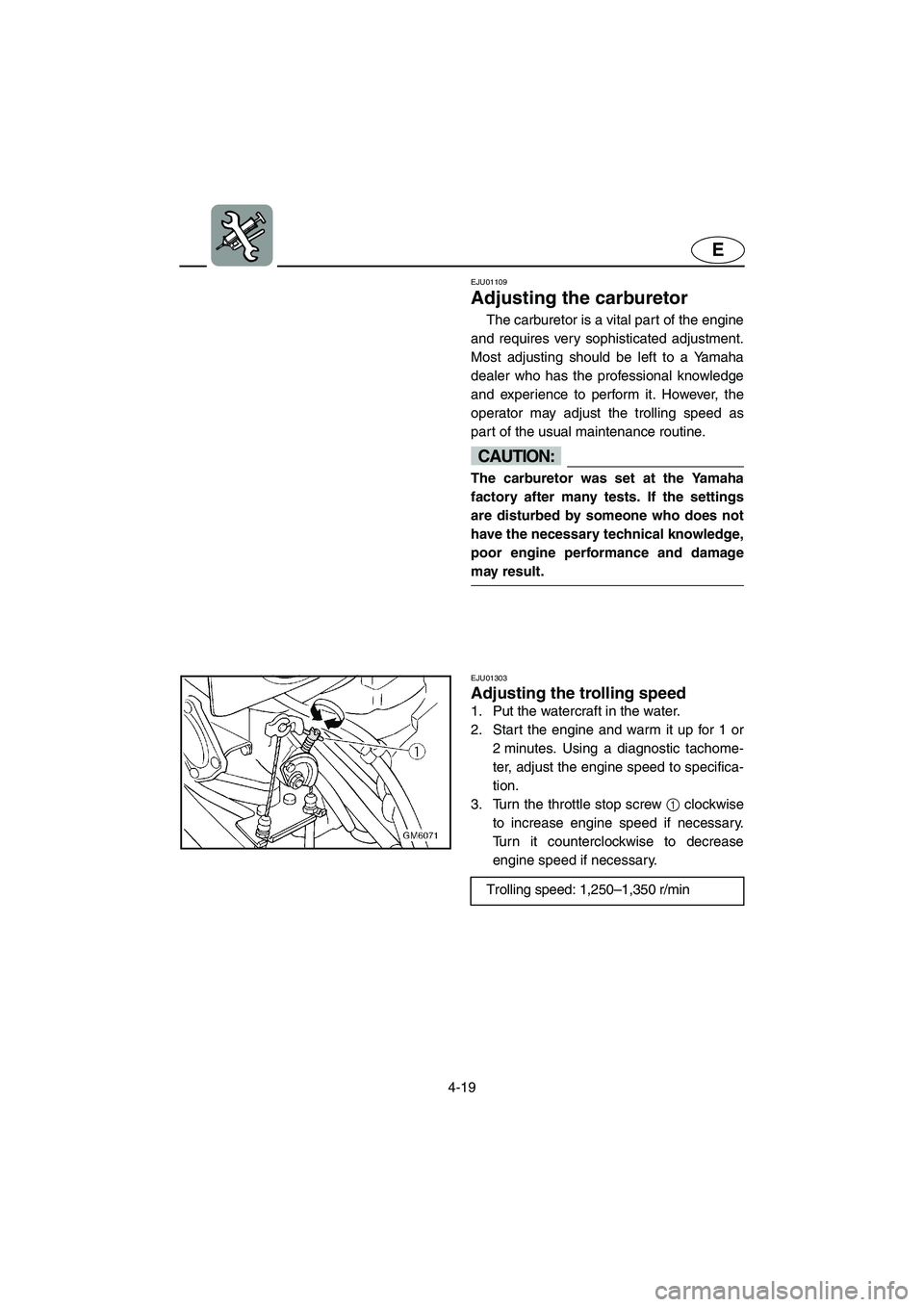
EJU01303
Adjusting the trolling speed
1. Put the watercraft in the water.
2. Start the engine and warm it up for 1 or
2 minutes. Using a diagnostic tachome-
ter, adjust the engine speed to specifica-
tion.
3. Turn the throttle stop screw 1 clockwise
to increase engine speed if necessary.
Turn it counterclockwise to decrease
engine speed if necessary.
Trolling speed: 1,250–1,350 r/min
E_F1N-70.book Page 19 Wednesday, July 18, 2001 3:28 PM
Page:
< prev 1-8 9-16 17-24