Page 42 of 106
3-7
E
EJU01052
Water separator
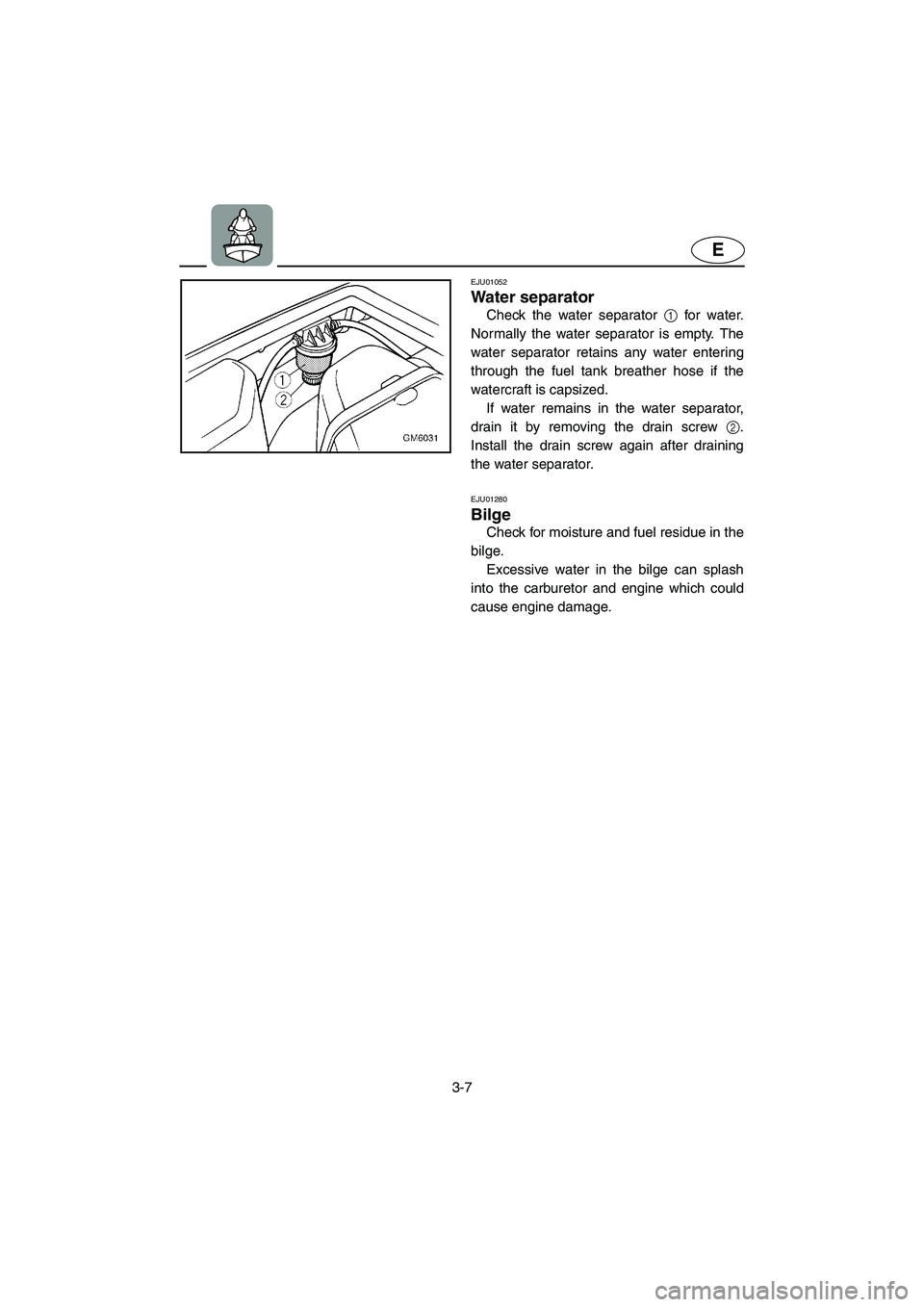
Check the water separator 1 for water.
Normally the water separator is empty. The
water separator retains any water entering
through the fuel tank breather hose if the
watercraft is capsized.
If water remains in the water separator,
drain it by removing the drain screw 2.
Install the drain screw again after draining
the water separator.
EJU01280
Bilge
Check for moisture and fuel residue in the
bilge.
Excessive water in the bilge can splash
into the carburetor and engine which could
cause engine damage.
E_F1N-70.book Page 7 Wednesday, July 18, 2001 3:28 PM
Page 44 of 106
3-9
E
EJU01282
Fire extinguisher
Check that there is a full fire extinguisher
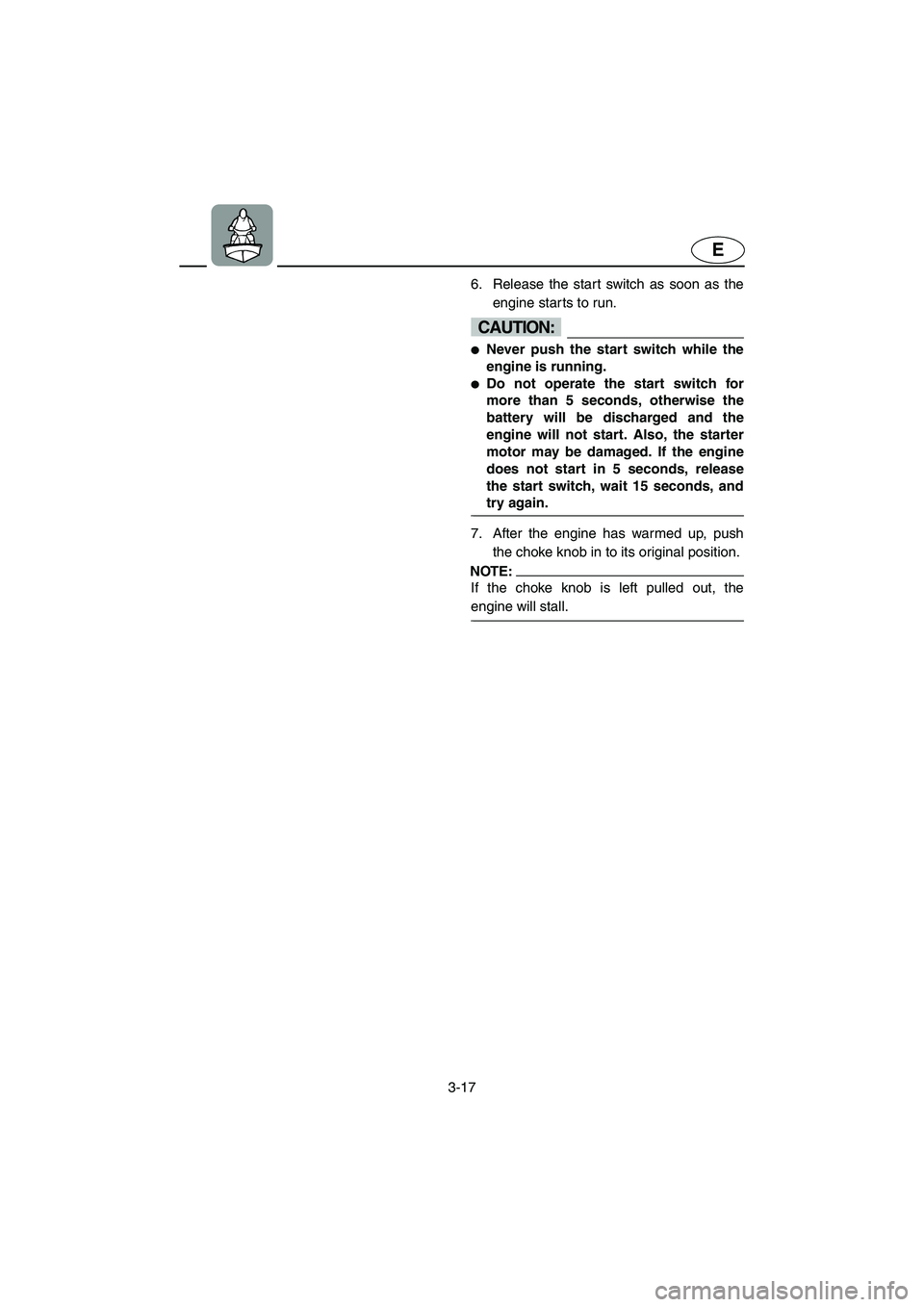
on board. The fire extinguisher container 1
is on the hood under the steering pole.
To open the fire extinguisher container:
1. Grasp the tab 2, pull the band to the
rear, and then pull up.
2. Lift the container about 30 degrees from
the stored position.
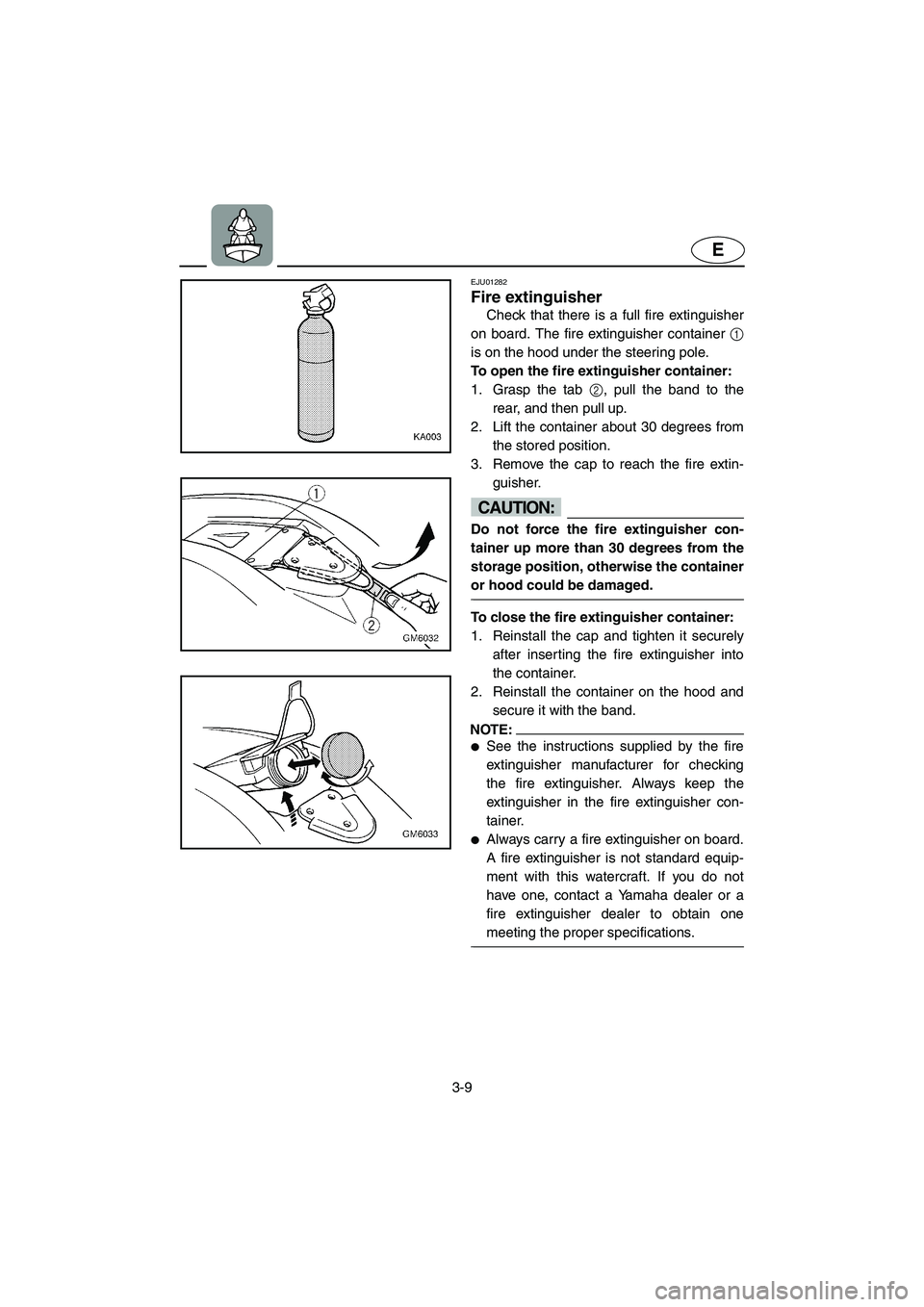
3. Remove the cap to reach the fire extin-
guisher.
CAUTION:@ Do not force the fire extinguisher con-
tainer up more than 30 degrees from the
storage position, otherwise the container
or hood could be damaged.
@
To close the fire extinguisher container:
1. Reinstall the cap and tighten it securely
after inserting the fire extinguisher into
the container.
2. Reinstall the container on the hood and
secure it with the band.
NOTE:@ �See the instructions supplied by the fire
extinguisher manufacturer for checking
the fire extinguisher. Always keep the
extinguisher in the fire extinguisher con-
tainer.
�Always carry a fire extinguisher on board.
A fire extinguisher is not standard equip-
ment with this watercraft. If you do not
have one, contact a Yamaha dealer or a
fire extinguisher dealer to obtain one
meeting the proper specifications.
@
E_F1N-70.book Page 9 Wednesday, July 18, 2001 3:28 PM
Page 48 of 106
3-13
E
EJU01283
Operation
WARNING@ Before operating your watercraft,
become familiar with all controls. Con-
sult your Yamaha dealer about any con-
trols or functions you do not fully
understand. Failure to understand how
controls work could cause an accident or
prevent you from avoiding an accident.
@
EJU01284
Engine break-in
The engine break-in period is essential to
allow the various components of the engine
to wear and polish themselves to the correct
operating clearances. This ensures proper
performance and promotes longer compo-
nent life.
CAUTION:@ �For the first 5 hours or 2 tankfuls of
operation, premix fuel and oil in a 25:1
ratio.
�After break-in, premix fuel and oil in a
50:1 ratio for normal operation.
@
1. Launch the watercraft and start the
engine, and then board the watercraft.
2. Run the engine at the lowest possible
speed for 5 minutes.
E_F1N-70.book Page 13 Wednesday, July 18, 2001 3:28 PM
Page 50 of 106
3-15
E
EJU01137
Starting the engine
WARNING@ Never start the engine or let it run for any
length of time in an enclosed area.
Exhaust fumes contain carbon monox-
ide, a colorless, odorless gas that may
cause loss of consciousness and death
within a short time. Always operate the
watercraft in an open area.
@
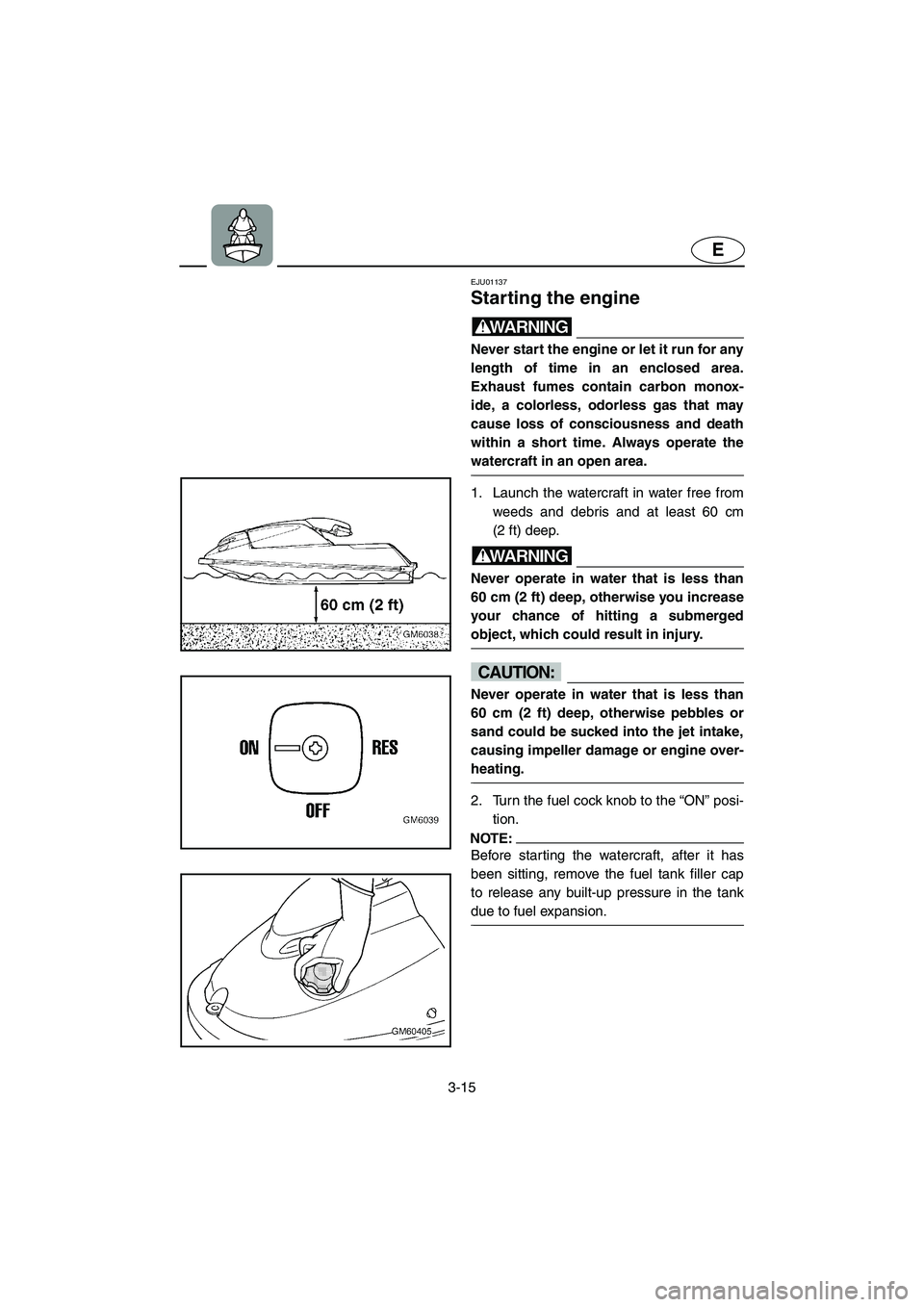
1. Launch the watercraft in water free from
weeds and debris and at least 60 cm
(2 ft) deep.
WARNING@ Never operate in water that is less than
60 cm (2 ft) deep, otherwise you increase
your chance of hitting a submerged
object, which could result in injury.
@
CAUTION:@ Never operate in water that is less than
60 cm (2 ft) deep, otherwise pebbles or
sand could be sucked into the jet intake,
causing impeller damage or engine over-
heating.
@
2. Turn the fuel cock knob to the “ON” posi-
tion.
NOTE:@ Before starting the watercraft, after it has
been sitting, remove the fuel tank filler cap
to release any built-up pressure in the tank
due to fuel expansion.
@
E_F1N-70.book Page 15 Wednesday, July 18, 2001 3:28 PM
Page 52 of 106
3-17
E
6. Release the start switch as soon as the
engine starts to run.
CAUTION:@ �Never push the start switch while the
engine is running.
�Do not operate the start switch for
more than 5 seconds, otherwise the
battery will be discharged and the
engine will not start. Also, the starter
motor may be damaged. If the engine
does not start in 5 seconds, release
the start switch, wait 15 seconds, and
try again.
@
7. After the engine has warmed up, push
the choke knob in to its original position.
NOTE:@ If the choke knob is left pulled out, the
engine will stall.
@
E_F1N-70.book Page 17 Wednesday, July 18, 2001 3:28 PM
Page 60 of 106

3-25
E
EJU01290
Operating positions
After you are underway, you may choose
to kneel or stand, depending upon water-
craft speed, your skill level, and your prefer-
ence. Here are some guidelines.
EJU01291
Kneeling
It is easier to maintain your balance when
kneeling than when standing. This position
is suggested when traveling at sub-planing
speeds. (At sub-planing speeds, there is a
wake, but the watercraft is moving through
the water rather than skimming on top of it.)
NOTE:@ At very slow speeds, it may be necessary to
support your upper-body weight with your
elbows resting on the gunwales, trailing your
legs in the water.
@
EJU01292
Standing
After you are comfortable handling the
watercraft from a kneeling position, try
standing as the watercraft gains speed. Sta-
bility increases when you are traveling at
planing speed. When you are moving slowly,
or preparing to stop, you will probably need
to return to the kneeling position to maintain
your balance.
E_F1N-70.book Page 25 Wednesday, July 18, 2001 3:28 PM
Page 62 of 106
3-27
E
A
B
C
D
EJU01294
Turning the watercraft
Steering control depends on the combi-
nation of handlebar position and the amount
of throttle.
Water sucked in through the intake grate
is pressurized by the impeller in the jet
pump. As the pressurized water is expelled
from the pump through the jet thrust nozzle,
it creates thrust to move and steer the
watercraft. The higher the engine speed, the
more thrust is produced.
The amount of jet thrust, in addition to the
position of the handlebars, determines how
sharply you turn.
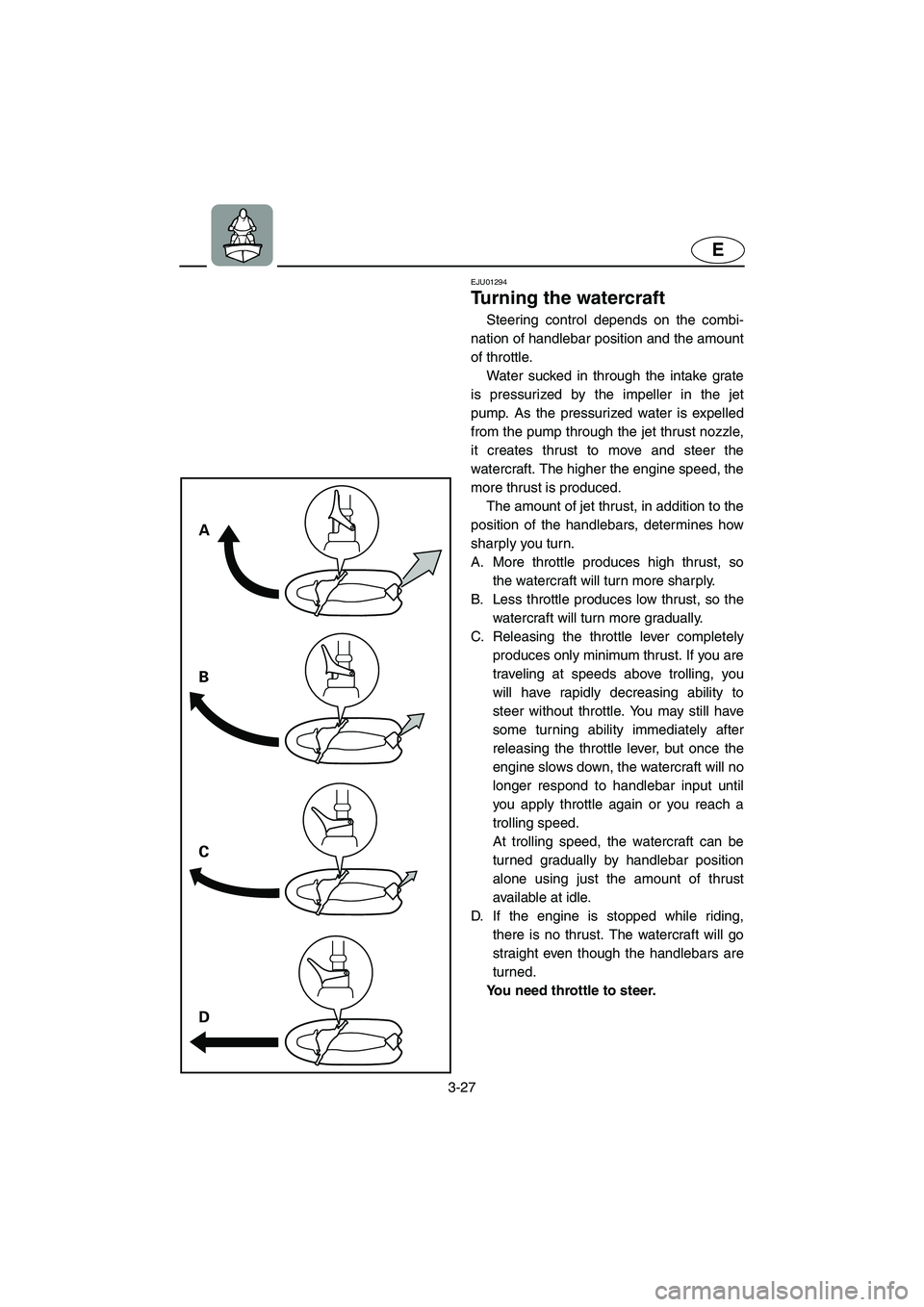
A. More throttle produces high thrust, so
the watercraft will turn more sharply.
B. Less throttle produces low thrust, so the
watercraft will turn more gradually.
C. Releasing the throttle lever completely
produces only minimum thrust. If you are
traveling at speeds above trolling, you
will have rapidly decreasing ability to
steer without throttle. You may still have
some turning ability immediately after
releasing the throttle lever, but once the
engine slows down, the watercraft will no
longer respond to handlebar input until
you apply throttle again or you reach a
trolling speed.
At trolling speed, the watercraft can be
turned gradually by handlebar position
alone using just the amount of thrust
available at idle.
D. If the engine is stopped while riding,
there is no thrust. The watercraft will go
straight even though the handlebars are
turned.
You need throttle to steer.
E_F1N-70.book Page 27 Wednesday, July 18, 2001 3:28 PM
Page 64 of 106

3-29
E
EJU01080
Stopping the watercraft
The watercraft is not equipped with a sep-
arate braking system. It is stopped by water
resistance when the throttle lever is
released. From full speed, the watercraft
comes to a complete stop in approximately
90 m (300 ft) after the throttle is released
and the engine is stopped, although this dis-
tance will vary depending on many factors,
including gross weight, water surface condi-
tions, and wind direction. The watercraft
slows down as soon as the throttle lever is
released, but will coast for a distance before
fully stopping. If you are not sure you can
stop in time before hitting an obstacle, apply
throttle and turn in another direction.
WARNING@ �Allow adequate stopping distance.
�Take early action to avoid collisions.
Remember, watercraft and other boats
do not have brakes.
�Operate defensively at safe speeds
and keep a safe distance away from
people, objects, and other watercraft
to give you time to stop.
�Do not shut the engine off when slow-
ing down in case you need engine
power to steer away from a boat or
other obstacle that comes into your
path.
@
E_F1N-70.book Page 29 Wednesday, July 18, 2001 3:28 PM