2002 VOLVO S60 fuel
[x] Cancel search: fuelPage 84 of 106

Operation in hot climates
When temperatures exceed 86° F (30° C) in your area, Volvo recommends, for the protection of your engine, that you
use a heavier weight oil, such as SAE 10W/30. See the viscosity chart below.
Oil viscosity (stable ambient temperatures)
Operation in temperate climates
Incorrect viscosity oil can shorten engine life. Under normal use when temperatures do not exceed 86° F (30° C), SAE
5W/30 will provide good fuel economy and engine protection. See the viscosity chart at right.
Extreme engine operation
Synthetic oils meeting SAE 10W/30 and complying with oil quality requirements are recommended for driving in
areas of sustained temperature extremes (hot or cold), when towing a trailer over long distances, and for prolonged
driving in mountainous areas.
Changing oil and oil filter
Oil and oil filter changes should be made at 7,500 mile (12,000 km) intervals.
Volvo does not recommend the use of oil additives.
Synthetic oil is not used when the oil is changed at the normal maintenance service intervals.
The API Service Symbol "donut" is divided into three parts:
The top half describes the oil's performance level.
The center identifies the oil's viscosity.
The bottom half tells whether the oil has demonstrated energy-conserving properties in a standard test in
comparison to a reference oil.
pg. 174 Oils and fluids
Checking the oil level
The oil level should be checked every time the car is refueled. This is especially important during the period up to the
first service.
CAUTION:
Not checking the oil level regularly can result in serious engine damage if the oil level becomes too low.
Park the car on a level surface and wait for at least 5 minutes after the engine has been switched off. Be sure the oil
ProCarManuals.com
Page 88 of 106
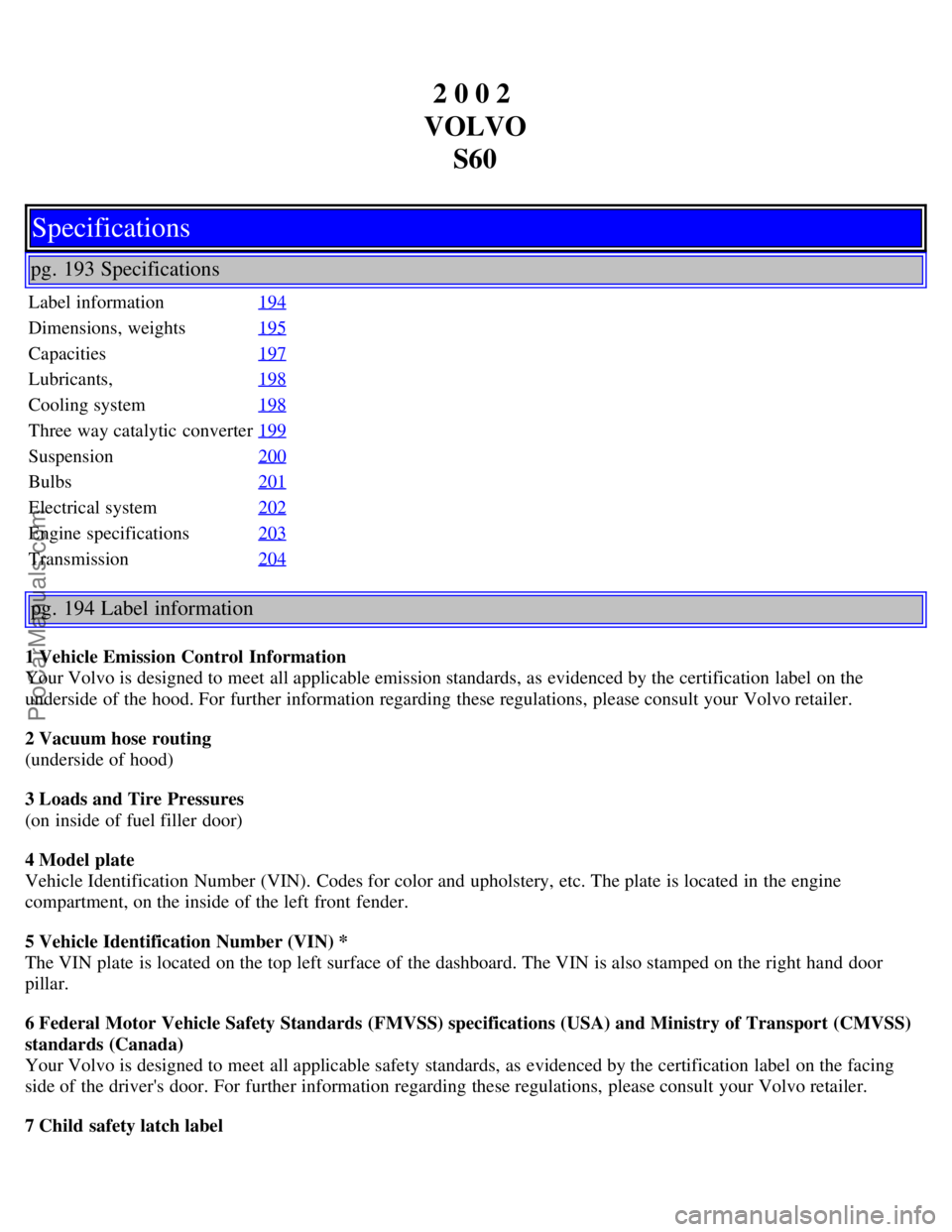
2 0 0 2
VOLVO S60
Specifications
pg. 193 Specifications
Label information 194
Dimensions, weights195
Capacities197
Lubricants,198
Cooling system198
Three way catalytic converter199
Suspension200
Bulbs201
Electrical system202
Engine specifications203
Transmission204
pg. 194 Label information
1 Vehicle Emission Control Information
Your Volvo is designed to meet all applicable emission standards, as evidenced by the certification label on the
underside of the hood. For further information regarding these regulations, please consult your Volvo retailer.
2 Vacuum hose routing
(underside of hood)
3 Loads and Tire Pressures
(on inside of fuel filler door)
4 Model plate
Vehicle Identification Number (VIN). Codes for color and upholstery, etc. The plate is located in the engine
compartment, on the inside of the left front fender.
5 Vehicle Identification Number (VIN) *
The VIN plate is located on the top left surface of the dashboard. The VIN is also stamped on the right hand door
pillar.
6 Federal Motor Vehicle Safety Standards (FMVSS) specifications (USA) and Ministry of Transport (CMVSS)
standards (Canada)
Your Volvo is designed to meet all applicable safety standards, as evidenced by the certification label on the facing
side of the driver's door. For further information regarding these regulations, please consult your Volvo retailer.
7 Child safety latch label
ProCarManuals.com
Page 91 of 106
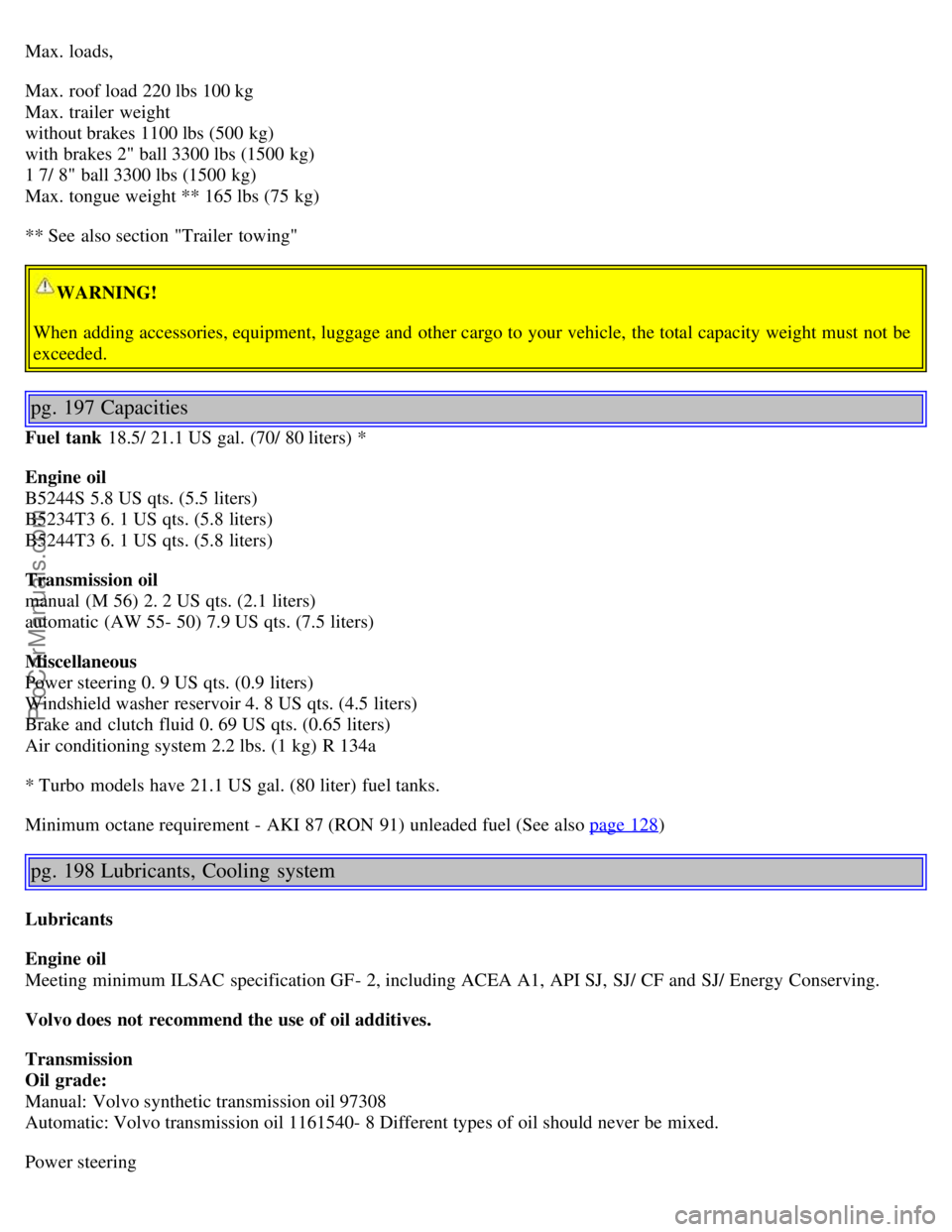
Max. loads,
Max. roof load 220 lbs 100 kg
Max. trailer weight
without brakes 1100 lbs (500 kg)
with brakes 2" ball 3300 lbs (1500 kg)
1 7/ 8" ball 3300 lbs (1500 kg)
Max. tongue weight ** 165 lbs (75 kg)
** See also section "Trailer towing"
WARNING!
When adding accessories, equipment, luggage and other cargo to your vehicle, the total capacity weight must not be
exceeded.
pg. 197 Capacities
Fuel tank 18.5/ 21.1 US gal. (70/ 80 liters) *
Engine oil
B5244S 5.8 US qts. (5.5 liters)
B5234T3 6. 1 US qts. (5.8 liters)
B5244T3 6. 1 US qts. (5.8 liters)
Transmission oil
manual (M 56) 2. 2 US qts. (2.1 liters)
automatic (AW 55- 50) 7.9 US qts. (7.5 liters)
Miscellaneous
Power steering 0. 9 US qts. (0.9 liters)
Windshield washer reservoir 4. 8 US qts. (4.5 liters)
Brake and clutch fluid 0. 69 US qts. (0.65 liters)
Air conditioning system 2.2 lbs. (1 kg) R 134a
* Turbo models have 21.1 US gal. (80 liter) fuel tanks.
Minimum octane requirement - AKI 87 (RON 91) unleaded fuel (See also page 128
)
pg. 198 Lubricants, Cooling system
Lubricants
Engine oil
Meeting minimum ILSAC specification GF- 2, including ACEA A1, API SJ, SJ/ CF and SJ/ Energy Conserving.
Volvo does not recommend the use of oil additives.
Transmission
Oil grade:
Manual: Volvo synthetic transmission oil 97308
Automatic: Volvo transmission oil 1161540- 8 Different types of oil should never be mixed.
Power steering
ProCarManuals.com
Page 92 of 106
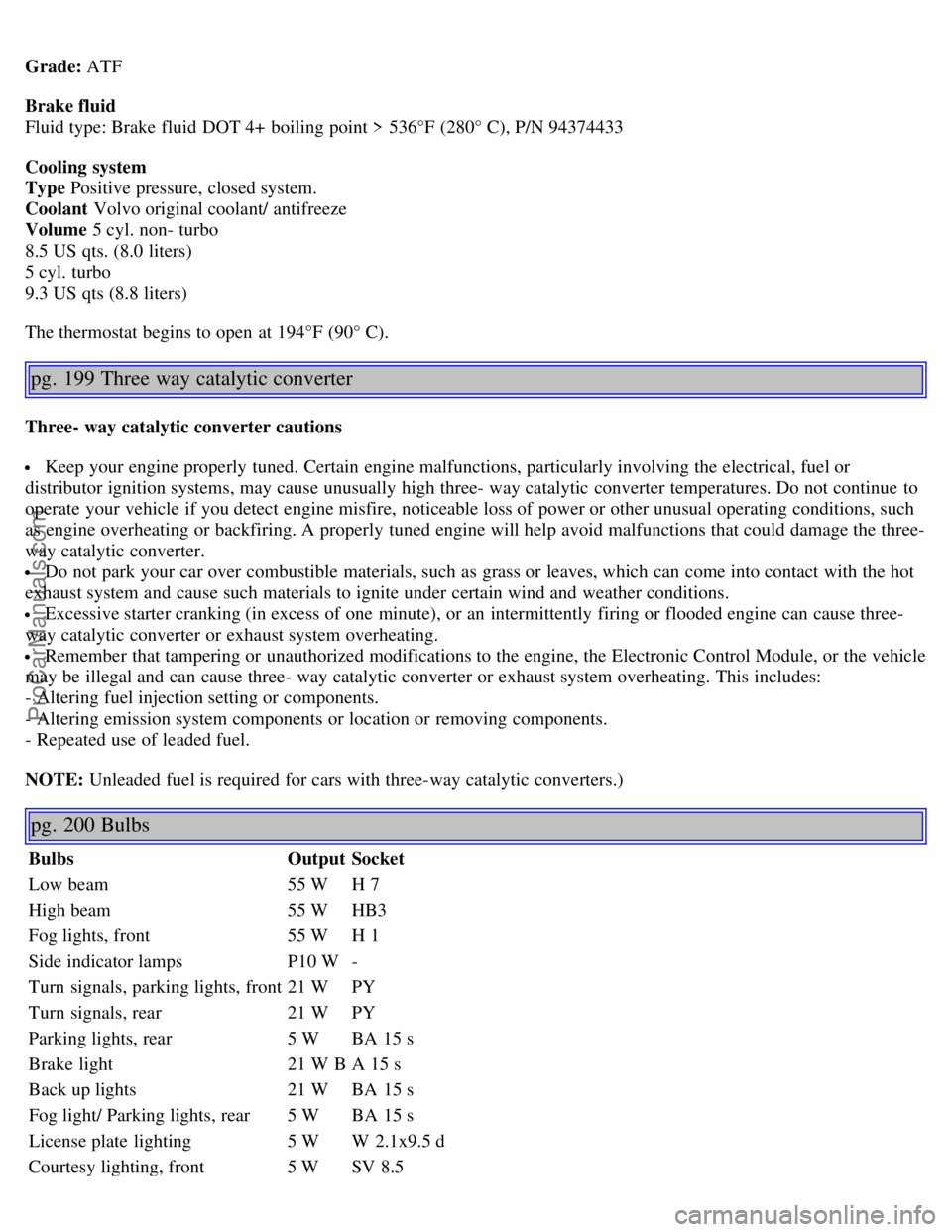
Grade: ATF
Brake fluid
Fluid type: Brake fluid DOT 4+ boiling point > 536°F (280° C), P/N 94374433
Cooling system
Type Positive pressure, closed system.
Coolant Volvo original coolant/ antifreeze
Volume 5 cyl. non- turbo
8.5 US qts. (8.0 liters)
5 cyl. turbo
9.3 US qts (8.8 liters)
The thermostat begins to open at 194°F (90° C).
pg. 199 Three way catalytic converter
Three- way catalytic converter cautions
Keep your engine properly tuned. Certain engine malfunctions, particularly involving the electrical, fuel or
distributor ignition systems, may cause unusually high three- way catalytic converter temperatures. Do not continue to
operate your vehicle if you detect engine misfire, noticeable loss of power or other unusual operating conditions, such
as engine overheating or backfiring. A properly tuned engine will help avoid malfunctions that could damage the three-
way catalytic converter.
Do not park your car over combustible materials, such as grass or leaves, which can come into contact with the hot
exhaust system and cause such materials to ignite under certain wind and weather conditions.
Excessive starter cranking (in excess of one minute), or an intermittently firing or flooded engine can cause three-
way catalytic converter or exhaust system overheating.
Remember that tampering or unauthorized modifications to the engine, the Electronic Control Module, or the vehicle
may be illegal and can cause three- way catalytic converter or exhaust system overheating. This includes:
- Altering fuel injection setting or components.
- Altering emission system components or location or removing components.
- Repeated use of leaded fuel.
NOTE: Unleaded fuel is required for cars with three-way catalytic converters.)
pg. 200 Bulbs
Bulbs OutputSocket
Low beam 55 WH 7
High beam 55 WHB3
Fog lights, front 55 WH 1
Side indicator lamps P10 W-
Turn signals, parking lights, front 21 WPY
Turn signals, rear 21 WPY
Parking lights, rear 5 WBA 15 s
Brake light 21 W BA 15 s
Back up lights 21 WBA 15 s
Fog light/ Parking lights, rear 5 WBA 15 s
License plate lighting 5 WW 2.1x9.5 d
Courtesy lighting, front 5 WSV 8.5
ProCarManuals.com
Page 94 of 106
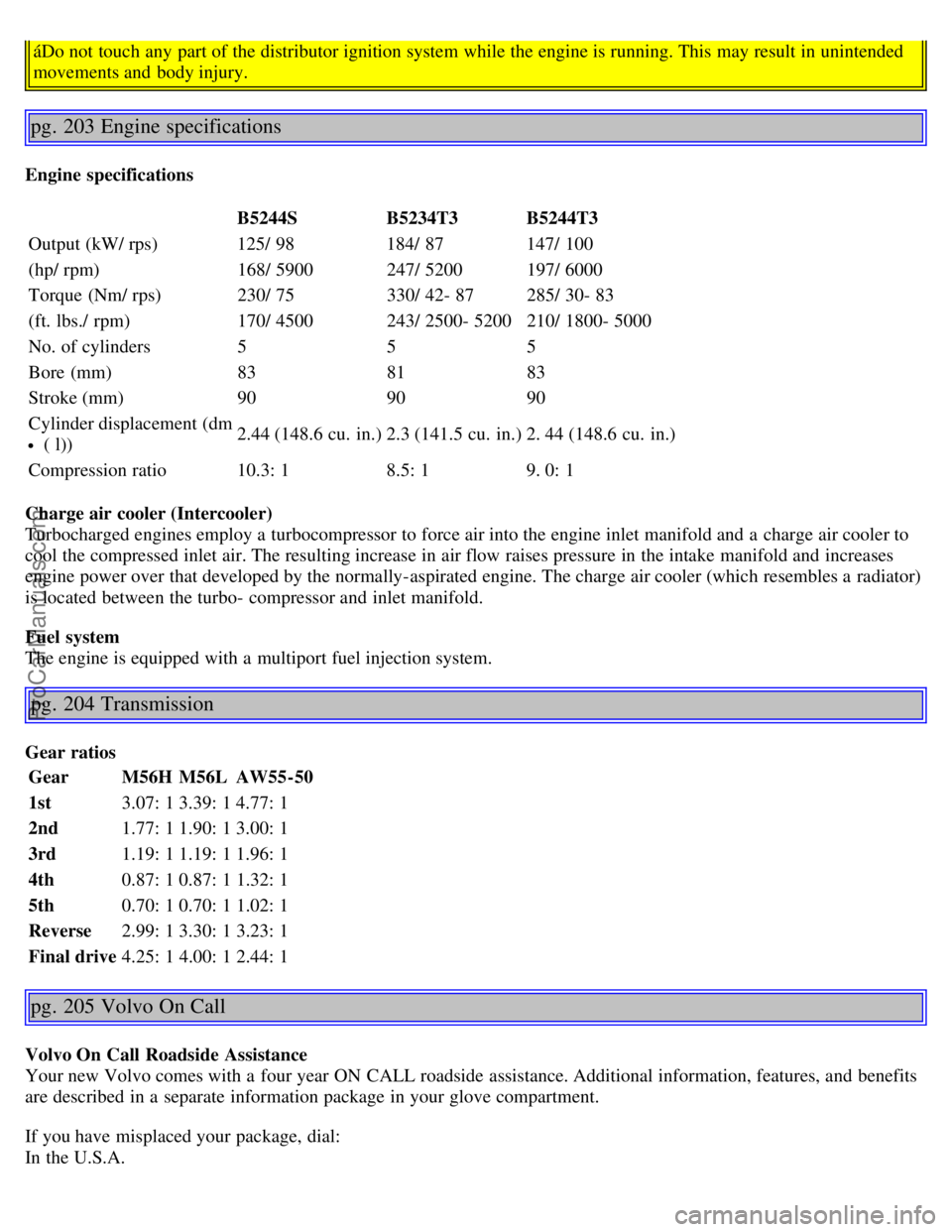
áDo not touch any part of the distributor ignition system while the engine is running. This may result in unintended
movements and body injury.
pg. 203 Engine specifications
Engine specificationsB5244SB5234T3B5244T3
Output (kW/ rps) 125/ 98184/ 87147/ 100
(hp/ rpm) 168/ 5900247/ 5200197/ 6000
Torque (Nm/ rps) 230/ 75330/ 42- 87285/ 30- 83
(ft. lbs./ rpm) 170/ 4500243/ 2500- 5200210/ 1800- 5000
No. of cylinders 555
Bore (mm) 838183
Stroke (mm) 909090
Cylinder displacement (dm
( l)) 2.44 (148.6 cu. in.)
2.3 (141.5 cu. in.)2. 44 (148.6 cu. in.)
Compression ratio 10.3: 18.5: 19. 0: 1
Charge air cooler (Intercooler)
Turbocharged engines employ a turbocompressor to force air into the engine inlet manifold and a charge air cooler to
cool the compressed inlet air. The resulting increase in air flow raises pressure in the intake manifold and increases
engine power over that developed by the normally-aspirated engine. The charge air cooler (which resembles a radiator)
is located between the turbo- compressor and inlet manifold.
Fuel system
The engine is equipped with a multiport fuel injection system.
pg. 204 Transmission
Gear ratios Gear M56HM56LAW55-50
1st 3.07: 13.39: 14.77: 1
2nd 1.77: 11.90: 13.00: 1
3rd 1.19: 11.19: 11.96: 1
4th 0.87: 10.87: 11.32: 1
5th 0.70: 10.70: 11.02: 1
Reverse 2.99: 13.30: 13.23: 1
Final drive 4.25: 14.00: 12.44: 1
pg. 205 Volvo On Call
Volvo On Call Roadside Assistance
Your new Volvo comes with a four year ON CALL roadside assistance. Additional information, features, and benefits
are described in a separate information package in your glove compartment.
If you have misplaced your package, dial:
In the U.S.A.
ProCarManuals.com
Page 98 of 106

Cup holder110 , 111
Current fuel consumption44
D
Defroster57
Dimension designation (tires)156
Direction indicator, rear - bulb185
Direction indicators41
Dolby Surround Pro Logic79
Door mirror defroster43
Door mirrors37
Driving economically133
DSTC35 , 38
Dual - threshold airbags13
E
ECC56
Economical driving133
Electric socket38 , 46
Electrical system202
Electrically operated windows47
Engine - starting131
Engine compartment172
Engine oil173
Engine oil, capacity197
Engine specifications203
Engine oil - checking174
Environment3
F
Federal Clean Air Act168
FIX NEXT SERVICE36
Floor mats108
Fog lamp33 , 185
Front seat - backrest103
Front seats102
Front seats - heated43
Front seats - manual adjustment102
Front seats - power104
Front seats - power(programming the memory)106
Front suspension201
Fuel2 , 128
Fuel filler cap2 , 130
Fuel filler door - unlocking40
Fuel filler door2 , 130
Fuel gauge30
Fuel tank, capacity197
ProCarManuals.com
Page 101 of 106

PROPOSITION 65 WARNING147
R
Radiator172
Radio67
Reading lamps107
Rear fog lights40
Rear seat113
Rear suspension201
Rear window defroster43 , 61
Rearview mirror/ door mirrors49
Recirculation58 , 62
REDUCE SPEED36
Refrigerant (A/ C system)54
Refueling128 , 130
Remote control - central locking system119
Replacing the battery179
Reporting safety defects28
Reverse gear inhibitor135
Roadholding134
Roof racks (load carriers)152
S
Safety9
Safety defects - reporting28
Seat belt10
Seat belt maintenance28
Seat belt reminder49
Seat belts (keeping child seats in place)27
Service168
Service key118
Service reminder34
SERVICE REQUIRED36
SERVICE URGENT36
Shiftlock2 , 131
Side airbags18
Side marker lamp185
SIPS airbags18
Ski hatch114
Snow chains157
Snow tires157
Spare tires158
Spare wheel115
Spark plugs202
Specifications193
Speedometer30
ProCarManuals.com
Page 105 of 106

the vehicle and others sharing the roadway. Avoiding distractions is part of that responsibility.
The following should be checked regularly: *
1 Washer fluid reservoir should be filled with water and solvent (wintertime: windshield washer anti-freeze). See page
175.
2 Power steering- When cold, the level must not be above the COLD mark and when hot it must not be above the
HOT mark. Top up if the level drops to the ADD mark with ATF fluid. See page 176.
3 Coolant level should be between the expansion tank marks. Mixture: 50% anti-freeze and 50% water. See page 171.
4 Engine oil level should be between the dipstick marks. The distance between the marks represents approx.
1.6 US qts (1.5 liters). See page 174.
5 Brake fluid - check, without removing the cap, that the level is above the MIN mark. Use brake fluid DOT 4+. See
page 176.
Fuel octane rating, see page 128.
Tire pressure, see label located on the inside of the fuel tank cover.
* Engine oil should be check each time the car is refueled.
BulbsPower Socket US no.
ProCarManuals.com