2002 SAAB 9-3 lock
[x] Cancel search: lockPage 172 of 256

172 Starting and driving Check the anti-freeze in the engine cool-
ant, see page 192.
The car´s trip computer will warn you when
there is a risk of slippery conditions. For fur-
ther information on this function, see page
69.
The car is equipped with tires designed to
provide optimum grip on both wet and dry
roads, although this has been achieved at
the expense of somewhat reduced grip on
snow and ice. For regular driving on snow
and ice, we therefore recommend that
winter (snow) tires be fitted.
Winter (snow) tires, particularly studded
tires (where use is legally permitted), gener-
ally make driving safer on snow and ice. Acquaint yourself with the legal provi-
sions governing the use of different
types of winter tires and snow chains.
Studded tires are not allowed in some
countries.
If winter tires are installed, the same type
must be installed on all wheels. Your Saab
dealer will be pleased to advise you on the
best tires for your car.
Remember that tires age. It may therefore
be necessary to change them before they
reach the legal wear limit, as they gradually
lose their friction properties. Date code, see
page 214.
The best response if the car gets into a
front-wheel skid is to freewheel (manual
gearbox only), i.e. disengage the clutch (so
that the wheels are neither driven nor
braked by the engine) and carefully steer
the wheels in the direction you want to go.
If the car has an automatic transmission you
should lift off the accelerator somewhat and
carefully steer the wheels in the direction
you want to go.
In a rear-wheel skid, steer into the skid, i.e.
in the same direction as that in which the
back is sliding.
Tire chainsIf you want to fit tire chains (where legally
permitted) they should only be installed to
the tires recommended under ”Technical
data” (see page 242).
Consult your Saab dealer for details about
approved tire chains.
WARNING
Do not exceed 30 mph (50 km/h)
when tire chains are fitted.
Tire chains can reduce the directional
stability of the car.
Tire chains must not be used on the
rear wheels.NOTE Check the links frequently for wear.
Check that the chains do not contact
the wheel-arch liner at full lock.
See section "Technical data", page
242, for information on allowable
wheel dimensions for the fitting of tire
chains.
ProCarManuals.com
Page 177 of 256

177 Starting and driving
Installing the roof carriers (acces-
sory) The carrier feet are marked with a top view
of the car and an arrow indicating their
positions.
1 Slip the plastic cover onto the adjustable
foot of the carrier (the foot with a knob for
tightening) to protect the paintwork
during assembly.
2 Open all the doors.
Fold back the rubber strip and locate the
fixing holes. On Coupés, the cover
plates for the rearmost points of attach-
ment must be removed.
3 Position the carrier gently across the
roof, with the rigid foot towards you. Hold
the foot clear of the roof to avoid damag-
ing the paintwork.
4 Fold back the rubber strip and insert the
pins of the foot into the fixing holes. In fit-
ting the rear carrier on Coupés, press
the foot down over the pins in the mount-
ing and slide it forward.
5 Carefully close the doors on this side, so
as to hold the feet in place.
6 Move to the other side of the car and
remove the plastic cover from the
adjustable foot. Fold back the rubber
strip and insert the pins of the foot into
the fixing holes.
7 When fitting the rear carrier on Coupés,
press the foot down over the pins in the
mounting and slide it forward.
8 Make the carrier hand-tight by turning
the knob clockwise.
IB882
IB883
Mounting holes for load carrier, front on
Coupés and front/rear on five-door mod-
els Carrier mounting, rear, on Coupés
ProCarManuals.com
Page 186 of 256

186 Car careHood release handleThe handle of the hood lock is located on the
left under the instrument panel. Open the
hood in the following way:
1 Pull the release handle.
2 The hood moves to the half-locked posi-
tion and is stopped by a safety catch at
the front edge.
3 Press the lever of the catch upwards and
raise the hood.
When you close the hood you should drop it
from a height of about 8 inches (20 cm),
without slamming it.
WARNING
Never hold your fingers between the hood
and safety catch if lowering but not clos-
ing the hood.
IB1514
Hood release pressure plate
IB887
Hood release handle
ProCarManuals.com
Page 201 of 256

201 Car care
Front turn signal bulb To change the bulb, the complete lamp unit has to be removed.
1 Loosen the screw (1). There is no need to remove it completely.
2 Carefully remove the complete lamp unit.
3 Grasp the two plastic tabs and turn the bulb holder counterclock-
wise.
4 Pull the bulb holder out of the lamp unit and change the bulb.
5 Check that the new bulb is firmly in place and has good contact.
6 When mounting the lamp unit, see that the two guide lugs on the
rear edge of the unit come inside the edge of the body panel.
7 Insert the lamp unit in towards the headlight and see that the
front bracket comes under the screw. Tighten the screw (1).
Side-mounted turn signal1 Slide the lens forward so that its rear part can be pulled out.
2 Change the bulb.
3 When refitting, make sure that the groove in the spring engages
the edge of the body panel and that the rubber gasket is correctly
positioned.
IB904
1 Retaining screw
2 Turn signal bulb
IB906
ProCarManuals.com
Page 202 of 256
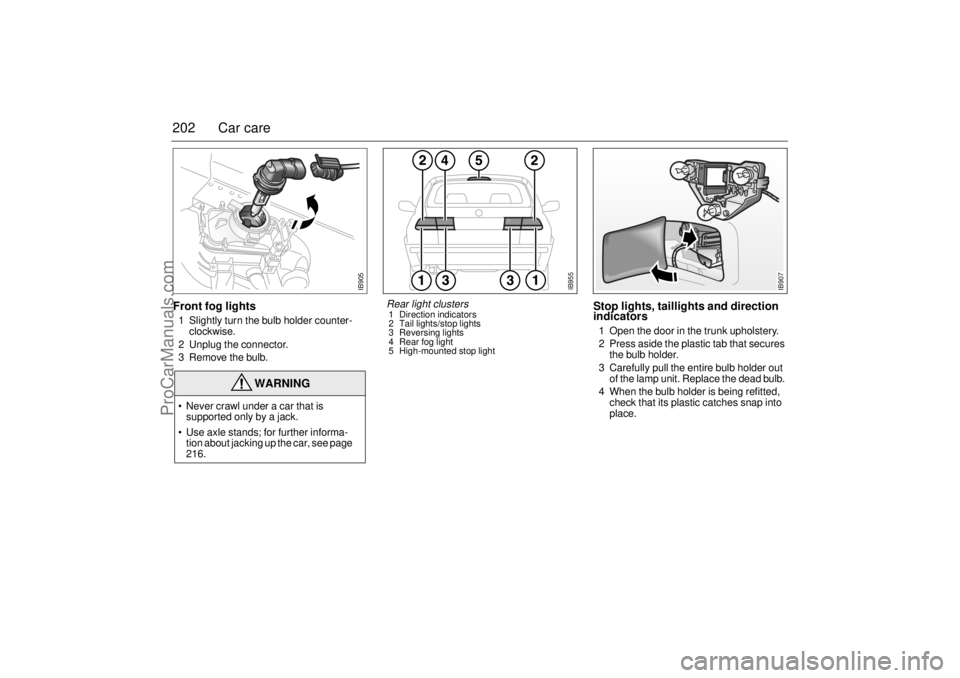
202 Car careFront fog lights1 Slightly turn the bulb holder counter-
clockwise.
2 Unplug the connector.
3 Remove the bulb.
Stop lights, taillights and direction
indicators 1 Open the door in the trunk upholstery.
2 Press aside the plastic tab that secures
the bulb holder.
3 Carefully pull the entire bulb holder out
of the lamp unit. Replace the dead bulb.
4 When the bulb holder is being refitted,
check that its plastic catches snap into
place.
WARNING
Never crawl under a car that is
supported only by a jack.
Use axle stands; for further informa-
tion about jacking up the car, see page
216.
IB905
IB955
Rear light clusters 1 Direction indicators
2 Tail lights/stop lights
3 Reversing lights
4 Rear fog light
5 High-mounted stop light
IB907
ProCarManuals.com
Page 207 of 256

207 Car care
MAXI fusesThe MAXI fuses are housed in the fuse box
under the hood. These fuses can be
checked in the same way as the other fuses.
The MAXI fuses are designed to protect the
car’s electrical system from being dam-
aged. Each MAXI fuse protects a number of
electrical circuits and functions and there-
fore has a higher rating (amperage) than the
standard fuses. No spare MAXI fuses are
supplied with the car.
DICE / TWICEDICE = Dashboard Integrated Central Elec-
tronics
TWICE = Theft-Warning Central Electronics
DICE and TWICE are electronic control
modules.
DICE controls, among other things:
Front lights and interior lighting.
Instrument illumination.
Intermittent wiper operation.
Electric heating of rear window and door
mirrors.
TWICE controls, among other things:
Central locking.
Car alarm (Anti-theft system).
Engine immobilizer.
Auto checking of lights.
Electric heating of rear seat.
Safety belt reminder.
Electrically adjustable passenger seat.The DICE and TWICE control modules are
linked to a data bus, which is basically an
information carrier that allows information to
be exchanged between all the control mod-
ules and components connected to the bus.
If a fault occurs in any of these components,
diagnostic faults codes are set in the rele-
vant control module, which enhances fault
diagnosis at the Saab dealer.
The scan tool connector for fault diagnosis
is located under the instrument panel on the
driver’s side.
NOTEIf a MAXI fuse blows, it means that there
is a major fault in the electrical system.
Have the car checked without delay by an
authorized Saab dealer.
IB920
MAXI fuse for soft-top system
(Convertible)
ProCarManuals.com
Page 209 of 256

209 Car care
Relay holderUnder the instrument panel next to the steering wheel No. Amp Function
21 10 Switch, manual A/C; soft top (Convertible)
22 15 Direction indicators; Cruise Control
23 20 Soft top (Convertible); telephone
24 7.5 Radio
25 30 Central locking; amplifier
26 30 Control module, engine management system
27 15 High beam flash; ACC
28 10 Control module, engine management system
29 10 Right parking light; license plate lighting
30 10 Left parking light
31 20 Reversing light; windshield wipers; headlight
beam-length adjustment
32 15 Fuel pump
33 15 Electric heating of rear seat
34 10 SID; control module; automatic transmission
35 15 DICE/TWICE; main instrument panel; interior light-
ing
36 10 Relay, starter
37 15 Limp-home
38 25 Oxygen sensor (lambda probe)
39 – –
S–SpareItem Function
A Electric heating of rear seat
B Reversing light, cars with automatic transmission
C1 –
C2 Lock motor, trunk lid
D1 Rear wiper
D2 Rear-window washing
E Ignition switch
F–
G1 Horn
G2 Windshield wipers (intermittent)
H Rear-window heating
IFuel pump
J–
KStart relay
L Main relay (injection system)
ProCarManuals.com
Page 216 of 256

216 Car careWhen it is time to raise the car, apply the
jack to one of the four jacking points (front or
rear) located beneath the sills.
If a floor jack is used it can be applied to the
standard jacking points used by the dealer
or centrally under the front of the engine
subframe. If the car is equipped with a trailer
hitch, the jack can also be placed under the
hitch. 1 Put the car in 1st gear (automatic trans-
mission: move selector to the P position)
and apply the parking brake.
Saab 9-3 Viggen: The front and rear
jacking points are located behind covers
that must be removed. See page 217.
2 Wind the jack up to a suitable height
before placing it under the recess in the
sill.
3 Make sure that the jack fully engages
the recess in the sill and that the base of
the jack is steady and flat on the ground.
4 Turn the jack handle clockwise until it
just begins to lift the car. 5 Remove the wheel cover (where appli-
cable). Loosen the wheel bolts by half a
turn.
6 Turn the jack handle to raise the wheel
clear of the ground. Remove the wheel
bolts and lift off the wheel.
7 Clean the contact surfaces between the
rim and hub.
8 Fit the wheel and screw in the bolts in the
sequence shown (opposite pairs).
Tighten the studs enough for the studs
and wheel to be seated correctly.
See page 218 for sequence.
9 Lower the car and tighten the wheel
bolts to the correct torque in the
sequence shown (opposite pairs).
Tightening torque:
Light-alloy wheels: 80 ft.lbs (110 Nm).
Steel wheels: 80 ft.lbs (110 Nm)NOTE Do not position the jack under the rear
axle or under the rear floor.
Only use the points specified on
page 217.
IB924
Pos i ti o n for j ack
IB1538
Positioning the jack
ProCarManuals.com