2002 NISSAN SENTRA tire type
[x] Cancel search: tire typePage 131 of 235
locking up, the actuator (under the hood)
rapidly applies and releases hydraulic pres-
sure (like pumping the brakes very quickly).
While the actuator is working, you may feel
a pulsation in the brake pedal and hear a
noise or vibration from the actuator under
the hood. This is normal and indicates that
the anti-lock system is working properly.
However, the pulsation may indicate that
road conditions are hazardous and extra
care is required while driving.
Self-test feature
The anti-lock brake system is a sophisti-
cated device with electronic sensors, elec-
tric pumps, and hydraulic solenoids con-
trolled by a computer. The computer has a
built-in diagnostic feature that tests the sys-
tem each time you start the engine and
move the vehicle at a low speed in forward
or reverse. When the self-test occurs, you
may hear a ``clunk'' noise and/or feel a
pulsation in the brake pedal. This is normal
and is not an indication of any malfunction.
If the computer senses any malfunction, it
switches the anti-lock brake system OFF
and turns on the ABS brake warning light in
the dashboard. The brake system then op-erates normally, but without anti-lock assis-
tance.
If the light comes on during the self-test or
while driving, take the vehicle to an autho-
rized NISSAN dealer for repair.
WARNING
c
The anti-lock brake system is a so-
phisticated device, but it cannot pre-
vent accidents resulting from care-
less or dangerous driving tech-
niques. It can help maintain vehicle
control during braking on slippery
surfaces, but remember that the stop-
ping distance on slippery surfaces
will be longer than on normal sur-
faces, even with the anti-lock brake
system. Stopping distances may also
be longer on rough, gravel or snow
covered roads, or if you are using tire
chains. Always maintain a safe dis-
tance from the vehicle in front of you.
Ultimately, the responsibility for
safety of self and others rests in the
hands of the driver.
Tire type and condition of tires may
also affect braking effectiveness.cWhen replacing tires, install the
specified tire size on all four wheels.
c
When installing a spare tire, make
sure it is the proper size and type as
specified on the tire placard. For tire
placard location information, refer to
``Tire placard'' in the ``Technical and
consumer information'' section of
this manual.
cFor additional information, refer to
``Wheels and tires'' in the ``Mainte-
nance and do-it-yourself'' section of
this manual.
5-20Starting and driving
ZX
Page 132 of 235

FREEING A FROZEN DOOR
LOCK
To prevent a door lock from freezing, apply
de-icer or glycerin through the key hole. If
the lock becomes frozen, heat the key be-
fore inserting it in the key hole.
ANTI-FREEZE
In the winter when it is anticipated that the
temperature will drop below 32ÉF (0ÉC),
check the anti-freeze (ethylene glycol base)
to assure proper winter protection. For de-
tails, see ``Engine cooling system'' in the
``Maintenance and do-it-yourself'' section of
this manual.
BATTERY
If the battery is not fully charged during
extremely cold weather conditions, the bat-
tery fluid may freeze and damage the bat-
tery. To maintain maximum efficiency, the
battery should be checked regularly. For
details, see ``Battery'' in the ``Maintenance
and do-it-yourself'' section of this manual.
DRAINING OF COOLANT
If the vehicle is to be left outside without
anti-freeze, drain the cooling system byopening the drain valves located under the
radiator and on the engine block. Refill
before operating the vehicle. See ``Chang-
ing engine coolant'' in the ``Maintenance
and do-it-yourself'' section of this manual.
TIRE EQUIPMENT
1.SUMMER tires are of a tread design to
provide superior performance on dry
pavement. However, the performance of
these tires will be substantially reduced in
snowy and icy conditions. If you operate
your vehicle on snowy or icy roads, NIS-
SAN recommends the use of MUD &
SNOW or ALL SEASON TIRES on all four
wheels. Please consult an authorized
NISSAN dealer for the tire type, size,
speed rating and availability information.
2. For additional traction on icy roads, stud-
ded tires may be used. However, most
U.S. states and Canadian provinces pro-
hibit their use. Check local, state and
provincial laws before installing studded
tires.
Skid and traction capabilities of studded
snow tires on wet or dry surfaces may be
poorer than that of non-studded snow
tires.3. Tire chains may be used. Make sure they
are of proper size for the tires on your
vehicle and are installed according to the
chain manufacturer's suggestions.
Use of tire chains may be prohibited
according to location. Check the local
laws before installing tire chains. When
installing tire chains, make sure they are
of proper size for the tires on your vehicle
and are installed according to the chain
manufacturer's suggestions.Use only
SAE Class ªSº chains.Other types may
damage your vehicle. Use chain tension-
ers when recommended by the tire chain
manufacturer to ensure a tight fit. Loose
end links of the tire chain must be se-
cured or removed to prevent the possi-
bility of whipping action damage to the
fenders or underbody. If possible, avoid
fully loading your vehicle when using tire
chains. In addition, drive at a reduced
speed. Otherwise, your vehicle may be
damaged and/or vehicle handling and
performance may be adversely affected.
Never install tire chains on TEMPO-
RARY USE ONLY spare tires. Do not
use tire chains on dry roads.
COLD WEATHER DRIVING
Starting and driving5-21
ZX
Page 156 of 235

Headlights ........................................................8-36
Fog lights (if so equipped)...............................8-39
Exterior and interior lights ...............................8-40
Wheels and tires ..................................................8-43Tire pressure ...................................................8-43
Types of tires ...................................................8-44
Tire chains .......................................................8-45
Changing wheels and tires ..............................8-45
ZX
Page 199 of 235
checked when tires are COLD. Tires are
considered COLD after the vehicle has
been parked for three or more hours, or
driven less than 1 mile (1.6 km) at moderate
speeds. COLD tire pressures are shown on
the tire placard affixed to the driver's side
rear door pillar.
WARNING
cImproperly inflated tires can fail sud-
denly and cause an accident.
c
The vehicle weight capacity is indi-
cated on the tire placard. Do not load
your vehicle beyond this capacity.
Overloading your vehicle may result
in reduced tire life, unsafe operating
conditions due to premature tire fail-
ure, or unfavorable handling charac-
teristics and could also lead to a
serious accident. Loading beyond the
specified capacity may also result in
failure of other vehicle components.
cBefore taking a long trip, or when-
ever you heavily load your vehicle,
use a tire pressure gauge to ensure
that the tire pressures are at the
specified level.cDo not drive your vehicle over 85
MPH (140 km/h) unless it is equipped
with high speed rated tires. Driving
faster than 85 MPH (140 km/h) may
result in tire failure, loss of control
and possible injury.
cFor additional information regarding
tires, refer to ``Important Tire Safety
Information'' in the Warranty Infor-
mation Booklet (US) or ``Tire Safety
Information'' in the Warranty and
Roadside Assistance Information
booklet (Canada).
TYPES OF TIRES
WARNING
cWhen changing or replacing tires, be
sure all four tires are of the same
type (i.e., summer, all season or
snow) and construction. An autho-
rized NISSAN dealer may be able to
help you with information about tire
type, size, speed rating and availabil-
ity. Replacement tires may have a
lower speed rating than the factory
equipped tires, and may not matchthe potential maximum vehicle speed.
Never exceed the maximum speed rat-
ing of the tire.
cFor additional information regarding
tires, refer to ``Important Tire Safety
Information'' in the Warranty Informa-
tion Booklet (US) or ``Tire Safety In-
formation'' in the Warranty and Road-
side Assistance Information booklet
(Canada).
All Season tires
NISSAN specifies All Season tires on some
models to provide good performance all
year round, including snowy and icy road
conditions. All Season tires are identified by
``ALL SEASON'' and/or ``M&S'' on the tire
sidewall. Snow tires have better snow trac-
tion than All Season tires and may be more
appropriate in some areas.
Summer tires
NISSAN specifies summer tires on some
models to provide superior performance on
dry roads. Summer tire performance is sub-
stantially reduced in snow and ice. Summer
tires do not have the tire traction rating
``M&S'' on the tire sidewall.
8-44Maintenance and do-it-yourself
ZX
Page 200 of 235

If you plan to operate your vehicle in snowy
or icy conditions, NISSAN recommends the
use of ``SNOW'' tires or ``ALL SEASON''
tires on all four wheels.
Snow tires
If snow tires are needed, it is necessary to
select tires equivalent in size and load rating
to the original equipment tires. If you do not,
it can adversely affect the safety and han-
dling of your vehicle.
Generally, snow tires have lower speed
ratings than factory equipped tires and may
not match the potential maximum vehicle
speed. Never exceed the maximum speed
rating of the tire.
If you plan to operate your vehicle in snowy
or icy conditions, NISSAN recommends the
use of ``SNOW'' tires or ``ALL SEASON''
tires on all four wheels.
For additional traction on icy roads, studded
tires may be used. However, some U.S.
states and Canadian provinces prohibit their
use. Check local, state and provincial laws
before installing studded tires. Skid and
traction capabilities of studded snow tires
on wet or dry surfaces may be poorer than
that of non-studded snow tires.
TIRE CHAINS
Use of tire chains may be prohibited accord-
ing to location. Check the local laws before
installing tire chains. When installing tire
chains, make sure they are of proper size
for the tires on your vehicle and are installed
according to the chain manufacturer's sug-
gestions.Use only SAE class ªSº chains.
Other types may damage your vehicle. Use
chain tensioners when recommended by
the tire chain manufacturer to ensure a tight
fit. Loose end links of the tire chain must be
secured or removed to prevent the possibil-
ity of whipping action damage to the fenders
or underbody. If possible, avoid fully loading
your vehicle when using tire chains. In ad-
dition, drive at a reduced speed. Otherwise,
your vehicle may be damaged and/or ve-
hicle handling and performance may be
adversely affected.
Never install tire chains on a TEMPORARY
USE ONLY spare tire. Do not use tire
chains on dry roads.
Tire chains must be installed only on the
front wheels and not on the rear wheels.
CHANGING WHEELS AND TIRES
Tire rotation
Tire should be rotated every 7,500 miles
(12,000 km).
See ``Flat tire'' in the ``In case of emergency''
section for tire replacing procedures.
As soon as possible, tighten the wheel
nuts to the specified torque with a torque
wrench.
Wheel nut tightening torque:
80 ft-lb (108 Nzm)
ADI1115
Maintenance and do-it-yourself8-45
ZX
Page 201 of 235
The wheel nuts must be kept tightened to
specifications at all times. It is recom-
mended that wheel nuts be tightened to
specification at each tire rotation interval.
WARNING
cAfter rotating the tires, check and
adjust the tire pressure.
cRetighten the wheel nuts when the
vehicle has been driven for 600 miles
(1,000 km) (also in cases of a flat tire,
etc.).
cDo not include the spare tire in the
tire rotation.
cFor additional information regarding
tires, refer to ``Important Tire Safety
Information'' in the Warranty Infor-
mation Booklet (US) or ``Tire Safety
Information'' in the Warranty and
Roadside Assistance Information
booklet (Canada).
Tire wear and damage
WARNING
c
Tires should be periodically inspected
for wear, cracking, bulging, or objects
caught in the tread. If excessive wear,
cracks, bulging, or deep cuts are
found, the tire(s) should be replaced.
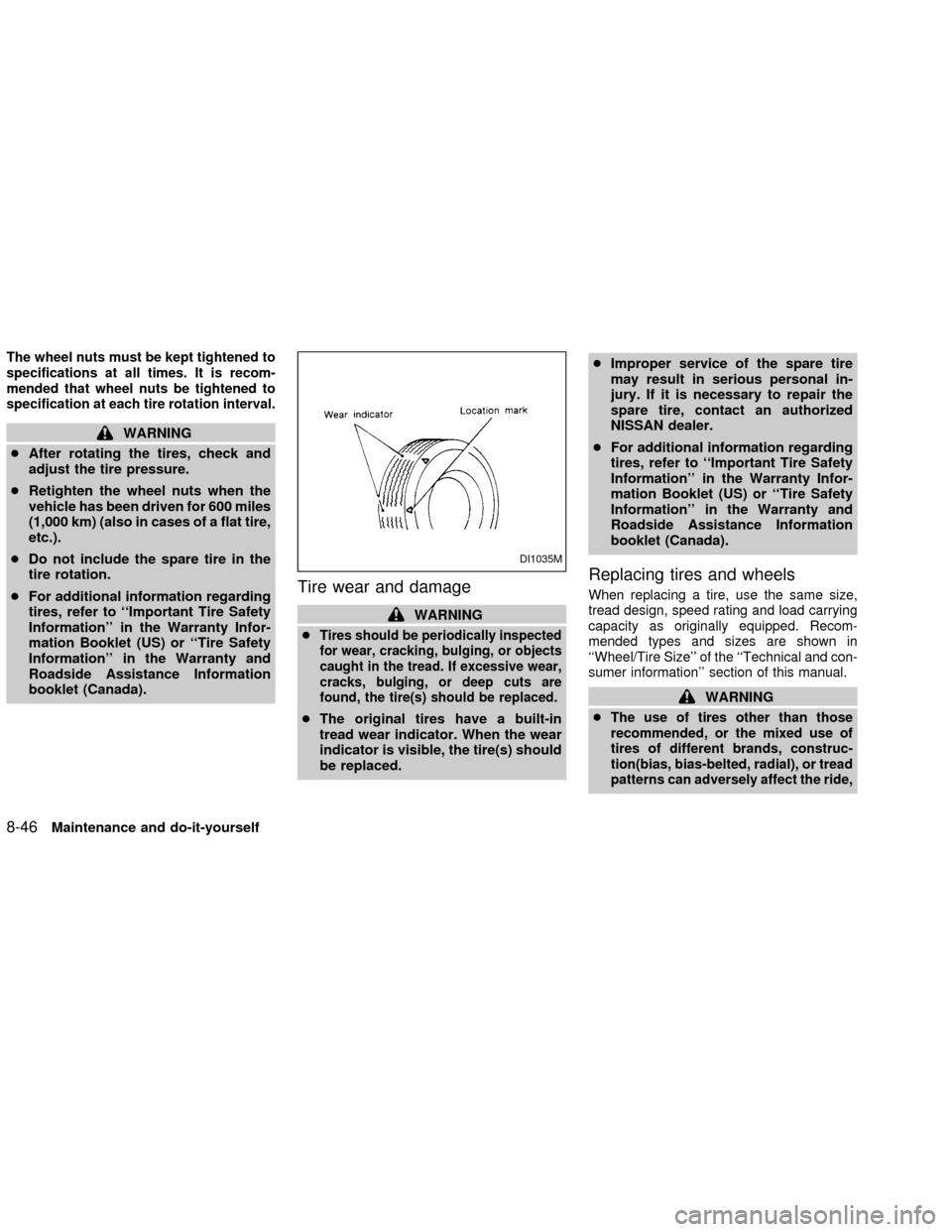
cThe original tires have a built-in
tread wear indicator. When the wear
indicator is visible, the tire(s) should
be replaced.cImproper service of the spare tire
may result in serious personal in-
jury. If it is necessary to repair the
spare tire, contact an authorized
NISSAN dealer.
cFor additional information regarding
tires, refer to ``Important Tire Safety
Information'' in the Warranty Infor-
mation Booklet (US) or ``Tire Safety
Information'' in the Warranty and
Roadside Assistance Information
booklet (Canada).
Replacing tires and wheels
When replacing a tire, use the same size,
tread design, speed rating and load carrying
capacity as originally equipped. Recom-
mended types and sizes are shown in
``Wheel/Tire Size'' of the ``Technical and con-
sumer information'' section of this manual.
WARNING
c
The use of tires other than those
recommended, or the mixed use of
tires of different brands, construc-
tion(bias, bias-belted, radial), or tread
patterns can adversely affect the ride,
DI1035M
8-46Maintenance and do-it-yourself
ZX
Page 232 of 235

Service manual order form ........................ 9-22
Servicing air conditioner .............................. 4-9
Shift lock release ....................................... 5-10
Shifting
Automatic transmission .......................... 5-8
Manual transmission............................. 5-12
Shoulder belt height adjustment ................ 1-23
Spark plug replacement............................. 8-23
Speedometer ............................................... 2-3
Spotlights (See map light) ......................... 2-27
SRS warning label ..................................... 1-16
Starting
Before starting the engine ...................... 5-6
Jump starting .......................................... 6-8
Precautions when starting and driving ... 5-2
Push starting......................................... 6-10
Starting the engine ................................. 5-7
Steering
Power steering fluid .............................. 8-17
Power steering system ......................... 5-18
Tilting steering wheel............................ 3-15
Stop light .................................................... 8-40
Storage ...................................................... 2-21
Sunglasses case........................................ 2-21
Sunroof ...................................................... 2-26
Supplemental restraint system
(Supplemental air bag system).................... 1-6
Switch
Automatic power window switch .......... 2-25
Front fog light switch ............................ 2-18
Hazard warning flasher switch ............. 2-18
Headlight and turn signal switch .......... 2-16Ignition switch ......................................... 5-4
Overdrive switch ................................... 5-11
Rear window defogger switch .............. 2-16
Turn signal switch................................. 2-17
Windshield wiper and washer switch ... 2-15
T
Tachometer .................................................. 2-4
Three-way catalyst....................................... 5-2
Tilting steering wheel ................................. 3-15
Tire
Flat tire.................................................... 6-2
Spare tire....................................... 6-3, 8-47
Tire chains ............................................ 8-45
Tire placard........................................... 9-12
Tire pressure ........................................ 8-43
Tire rotation .......................................... 8-45
Types of tires ........................................ 8-44
Uniform tire quality grading .................. 9-19
Wheels and tires................................... 8-43
Wheel/tire size ........................................ 9-9
Towing
Tow truck towing .................................. 6-11
Towing load/specification chart ............ 9-16
Trailer towing ........................................ 9-15
Transmission
Automatic transmission fluid (ATF) ...... 8-15
Driving with automatic transmission ....... 5-7
Driving with manual transmission ......... 5-11
Selector lever lock release ................... 5-10
Travel (See registering your vehicle inanother country)......................................... 9-10
Trip odometer .............................................. 2-4
Trunk access through the rear seat ............ 1-4
Trunk lid lock opener lever ........................ 3-10
Trunk light .................................................. 2-28
Turn signal switch ...................................... 2-17
U
Uniform tire quality grading ....................... 9-19
V
Vanity mirror .............................................. 3-15
Vehicle dimensions and weights ................. 9-9
Vehicle identification number (VIN)
(chassis number) ....................................... 9-10
Vehicle identification number (VIN) plate .. 9-10
Vehicle loading information ....................... 9-14
Vehicle recovery ........................................ 6-13
Vehicle security system ............................. 2-11
Ventilators .................................................... 4-2
W
Warning
Air bag warning light ..................... 1-16, 2-9
Hazard warning flasher switch ............. 2-18
Vehicle security system ........................ 2-11
Warning labels (for SRS) ..................... 1-16
10-5
ZX