2002 NISSAN ALTIMA key battery
[x] Cancel search: key batteryPage 164 of 249
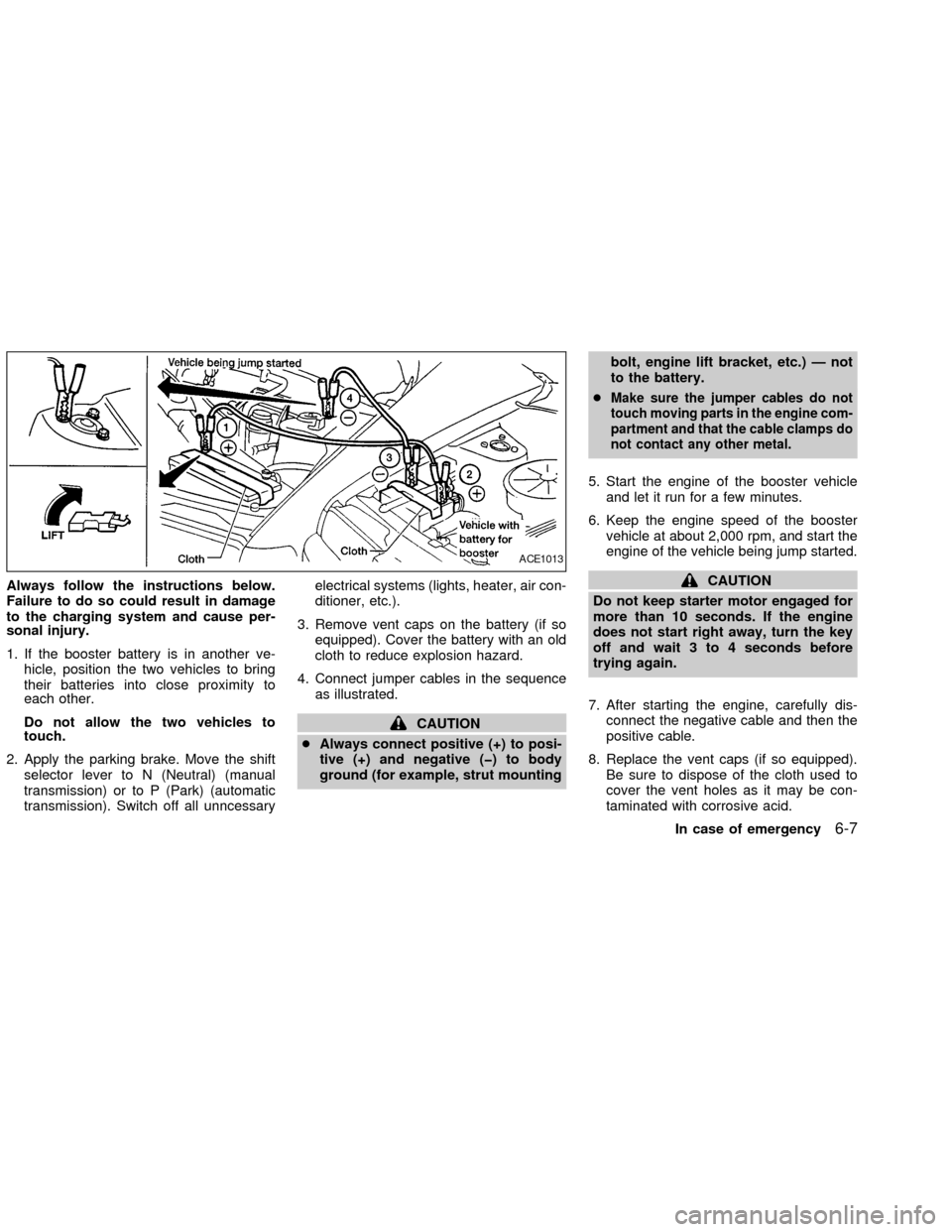
Always follow the instructions below.
Failure to do so could result in damage
to the charging system and cause per-
sonal injury.
1. If the booster battery is in another ve-
hicle, position the two vehicles to bring
their batteries into close proximity to
each other.
Do not allow the two vehicles to
touch.
2. Apply the parking brake. Move the shift
selector lever to N (Neutral) (manual
transmission) or to P (Park) (automatic
transmission). Switch off all unncessaryelectrical systems (lights, heater, air con-
ditioner, etc.).
3. Remove vent caps on the battery (if so
equipped). Cover the battery with an old
cloth to reduce explosion hazard.
4. Connect jumper cables in the sequence
as illustrated.
CAUTION
cAlways connect positive (+) to posi-
tive (+) and negative (þ) to body
ground (for example, strut mountingbolt, engine lift bracket, etc.) Ð not
to the battery.
c
Make sure the jumper cables do not
touch moving parts in the engine com-
partment and that the cable clamps do
not contact any other metal.
5. Start the engine of the booster vehicle
and let it run for a few minutes.
6. Keep the engine speed of the booster
vehicle at about 2,000 rpm, and start the
engine of the vehicle being jump started.
CAUTION
Do not keep starter motor engaged for
more than 10 seconds. If the engine
does not start right away, turn the key
off and wait 3 to 4 seconds before
trying again.
7. After starting the engine, carefully dis-
connect the negative cable and then the
positive cable.
8. Replace the vent caps (if so equipped).
Be sure to dispose of the cloth used to
cover the vent holes as it may be con-
taminated with corrosive acid.
ACE1013
In case of emergency6-7
ZX
Page 177 of 249

8 Maintenance and do-it-yourself
Maintenance requirements .....................................8-2
General maintenance .............................................8-3
Explanation of general maintenance
items ..................................................................8-3
Maintenance precautions .......................................8-5
Engine compartment check locations QR
engine .....................................................................8-7
Engine compartment check locations VQ
engine .....................................................................8-8
Engine cooling system ...........................................8-9
Checking engine coolant level ..........................8-9
Changing engine coolant ................................8-10
Engine oil .............................................................8-10
Checking engine oil level ................................8-10
Changing engine oil ........................................8-11
Changing engine oil filter.................................8-13
Automatic transmission fluid ................................8-14
Temperature conditions for checking ..............8-14
Power steering fluid..............................................8-15
Brake and clutch fluid...........................................8-16
Brake fluid........................................................8-16
Clutch fluid .......................................................8-16Window washer fluid ............................................8-17
Battery ..................................................................8-17
Jump starting ...................................................8-18
Drive belts ............................................................8-19
Spark plugs ..........................................................8-20
Replacing spark plugs (QR25DE) ...................8-20
Replacing spark plugs (VQ35DE) ...................8-20
Air cleaner ............................................................8-21
Cabin air filter (if so equipped) ........................8-21
Windshield wiper blades ......................................8-24
Cleaning ..........................................................8-24
Replacing .........................................................8-24
Parking brake and brake pedal ............................8-25
Checking parking brake...................................8-25
Checking brake pedal .....................................8-25
Brake booster ..................................................8-26
Clutch pedal .........................................................8-26
Checking clutch pedal .....................................8-26
Fuses ....................................................................8-27
Engine compartment .......................................8-27
Passenger compartment .................................8-28
Keyfob battery replacement .................................8-29
ZX
Page 182 of 249
checks of the battery fluid level.
Exhaust systemMake sure there are no
loose supports, cracks or holes. If the sound
of the exhaust seems unusual or there is a
smell of exhaust fumes, immediately have
the exhaust system inspected by an autho-
rized NISSAN dealer. See the carbon mon-
oxide warning in the ``Starting and driving''
section of this manual.
UnderbodyThe underbody is frequently
exposed to corrosive substances such as
those used on icy roads or to control dust. It
is very important to remove these sub-
stances from the underbody, otherwise rust
may form on the floor pan, frame, fuel lines
and exhaust system. At the end of winter,
the underbody should be thoroughly flushed
with plain water, in those areas where mud
and dirt may have accumulated. See the
``Appearance and care'' section of this
manual.
Fluid leaksCheck under the vehicle for
fuel, oil, water or other fluid leaks after the
vehicle has been parked for a while. Water
dripping from the air conditioner after use is
normal. If you should notice any leaks or if
gasoline fumes are evident, check for the
cause and have it corrected immediately.When performing any inspection or mainte-
nance work on your vehicle, always take
care to prevent serious accidental injury to
yourself or damage to the vehicle. The
following are general precautions which
should be closely observed.
WARNING
cPark the vehicle on a level surface,
apply the parking brake securely and
block the wheels to prevent the ve-
hicle from moving. For manual trans-
mission models, move the shift lever
to (N) Neutral. For an automatic
transmission models, move the shift
selector lever to P (Park).
cBe sure the ignition key is in the OFF
or LOCK position when performing
any parts replacement or repairs.
cYour vehicle is equipped with an
automatic engine cooling fan. It may
come on at any time without warn-
ing, even if the ignition key is in the
OFF position and the engine is not
running. To avoid injury, always dis-
connect the negative battery cable
before working near the fan.c
If you must work with the engine run-
ning, keep your hands, clothing, hair
and tools away from moving fans,
belts and any other moving parts.
cIt is advisable to secure or remove
any loose clothing and remove any
jewelry, such as rings, watches, etc.
before working on your vehicle.
cAlways wear eye protection when-
ever you work on your vehicle.
cIf you must run the engine in an
enclosed space such as a garage, be
sure there is proper ventilation for
exhaust gases to escape.
cNever get under the vehicle while it
is supported only by a jack. If it is
necessary to work under the vehicle,
support it with safety stands.
c
Keep smoking materials, flame and
sparks away from the fuel tank and
battery.
cOn gasoline engine models with the
multiport fuel injection (MFI) system,
the fuel filter or fuel lines should be
serviced by an authorized NISSAN
MAINTENANCE
PRECAUTIONS
Maintenance and do-it-yourself8-5
ZX
Page 206 of 249

Replace the battery in the keyfob as follows:
1. Open the lid using a coin.
2. Replace the battery with a new one.
Recommended battery: Sanyo CR2025
or equivalent.3. Close the lid securely.
4. Press the
button, then thebutton
two or three times to check the keyfob
operation.
Each time the
button is pressed, thehazard lights flash once.
If the battery is removed for any reason
other than replacement, perform step 4.
cAn improperly disposed battery can
hurt the environment. Always confirm
local regulations for battery disposal.
cThe keyfob is water-resistant; how-
ever, if it does get wet, immediately
wipe completely dry.
cThe operational range of the keyfob
extends to approximately 33 ft (10 m)
from the vehicle. This range may vary
with conditions.
FCC Notice:
Changes or modifications not expressly
approved by the manufacturer for com-
pliance could void the user's authority to
operate the equipment.
This device complies with part 15 of the
FCC Rules and RSS-210 of Industry
Canada.
LPD0081
KEYFOB BATTERY
REPLACEMENT
Maintenance and do-it-yourself8-29
ZX
Page 242 of 249

10 Index
A
Air bag (See supplemental restraint
system) ........................................................ 1-8
Air bag warning light ................. 1-14, 1-19, 2-9
Air cleaner housing filter ............................ 8-21
Air conditioner
Air conditioner operation ........................ 4-5
Air conditioner service .......................... 4-11
Air conditioner specification label ......... 9-12
Air conditioner system refrigerant and
lubrication recommendations.................. 9-7
Heater and air conditioner controls ........ 4-3
Servicing air conditioner ....................... 4-11
Air flow charts .............................................. 4-6
Alarm system (See vehicle security
system) ...................................................... 2-13
Anchor point locations ............................... 1-37
Antenna...................................................... 4-29
Anti-lock brake system (ABS).................... 5-19
Anti-lock brake warning light ..................... 2-10
Armrests....................................................... 1-7
Audio system
FM-AM radio with compact disc (CD)
changer ....................................... 4-16, 4-21
Autolamp switch......................................... 2-20
Automatic
Automatic power window switch .......... 2-32Automatic transmission fluid (ATF) ...... 8-14
Driving with automatic transmission ....... 5-4
B
Battery........................................................ 8-17
Battery
Charge warning light .............................. 2-9
Battery replacement (See remote keyless
entry system) ............................................... 3-8
Before starting the engine ........................... 5-6
Belts (See drive belts) ........................ 8-19, 9-8
Brake
Anti-lock brake system (ABS) .............. 5-19
Brake booster ....................................... 8-26
Brake fluid............................................. 8-16
Brake pedal .......................................... 8-25
Brake system .............................. 2-12, 5-18
Brake warning light ............................... 2-10
Brake wear indicators ................. 2-12, 8-26
Parking brake check ............................. 8-25
Parking brake operation ....................... 5-13
Self-adjusting brakes ............................ 8-26
Break-in schedule ...................................... 5-15
Bulb check/instrument panel ....................... 2-8
Bulb replacement ....................................... 8-32C
Capacities and recommended fuel/
lubricants...................................................... 9-2
Car phone or CB radio .............................. 4-29
Cargo (See vehicle loading information) ... 9-13
Check engine indicator light
(See malfunction indicator light) ................ 2-11
Child restraint with top tether strap ........... 1-37
Child restraints ........................ 1-23, 1-28, 1-35
Child safety rear door lock .......................... 3-4
Cleaning exterior and interior ...................... 7-2
Clutch
Clutch fluid ............................................ 8-16
Clutch pedal.......................................... 8-26
Cold weather driving .................................. 5-21
Controls
Heater and air conditioner controls ........ 4-3
Coolant
Capacities and recommended fuel/
lubricants ................................................ 9-2
Changing engine coolant...................... 8-10
Checking engine coolant level ............... 8-9
Engine coolant temperature gauge ........ 2-6
Corrosion protection .................................... 7-5
Cruise control............................................. 5-14
Cup holders ............................................... 2-27
ZX
Page 244 of 249

Headlight and turn signal switch ............... 2-18
Heated seats.............................................. 2-24
Heater
Heater and air conditioner controls ........ 4-3
Heater operation ..................................... 4-4
Homelink Transceiver
Integrated HomeLinkTUniversal
Transceiver (If so equipped) ................ 2-35
Hood release ............................................... 3-9
Horn ........................................................... 2-23
I
Ignition switch .............................................. 5-4
Immobilizer system ..................... 2-14, 3-2, 5-6
Important vehicle information label............ 9-11
Increasing fuel economy............................ 5-16
Indicator lights and audible reminders
(See warning/indicator lights and audible
reminders) .................................................... 2-8
Inside mirror ............................................... 3-15
Instrument brightness control .................... 2-20
Integrated HomeLinkTUniversal Transceiver
(If so equipped).......................................... 2-35
Interior light ................................................ 2-34
Interior trunk lid release ............................. 3-11
J
Jump starting ...................................... 6-6, 8-18K
Key ............................................................... 3-2
Keyless entry system (See remote keyless
entry system) ............................................... 3-5
L
Labels
Air conditioner specification label ......... 9-12
Emission control information label........ 9-12
Engine serial number ........................... 9-11
F.M.V.S.S. certification label ................ 9-11
Vehicle identification number (VIN)
plate ...................................................... 9-10
Warning labels (for SRS) ..................... 1-19
License plate
Installing the license plate .................... 9-13
Light
Air bag warning light ............ 1-14, 1-19, 2-9
Bulb check/instrument panel .................. 2-8
Bulb replacement.................................. 8-32
Charge warning light .............................. 2-9
Front fog light switch ............................ 2-21
Headlight and turn signal switch .......... 2-18
Interior light ........................................... 2-34
Low washer fluid warning light ............. 2-10
Spotlights (See map light) .................... 2-34
Trunk light ............................................. 2-35
Warning/indicator lights and audible
reminders ................................................ 2-8Lock
Child safety rear door lock ..................... 3-4
Door locks............................................... 3-2
Fuel filler lid lock opener lever ............. 3-12
Glove box lock ...................................... 2-28
Power door locks .................................... 3-3
Trunk lid lock opener lever ................... 3-10
M
Maintenance
General maintenance ............................. 8-3
Maintenance precautions ................ 8-2, 8-5
Outside the vehicle ................................. 8-3
Seat belt maintenance.......................... 1-28
Under the hood and vehicle ................... 8-4
Malfunction indicator lamp (MIL) ............... 2-11
Map lights .................................................. 2-34
Meters and gauges .............................. 2-2, 2-3
Mirror
Inside mirror.......................................... 3-15
Outside mirror control ........................... 3-16
Vanity mirror ......................................... 3-14
Multi-remote control system (See remote
keyless entry system) .................................. 3-5
Multi-remote controller battery
replacement ............................................... 8-29
N
Nissan vehicle immobilizer system
(NVIS) ......................................... 2-13, 3-2, 5-6
10-3
ZX