2002 MERCEDES-BENZ CLK-CLASS lock
[x] Cancel search: lockPage 59 of 341
56 Restraint systems
Te ch n i c a l
data Instruments
and controlsOperationDrivingInstrument
cluster displayPractical hints Car care Index
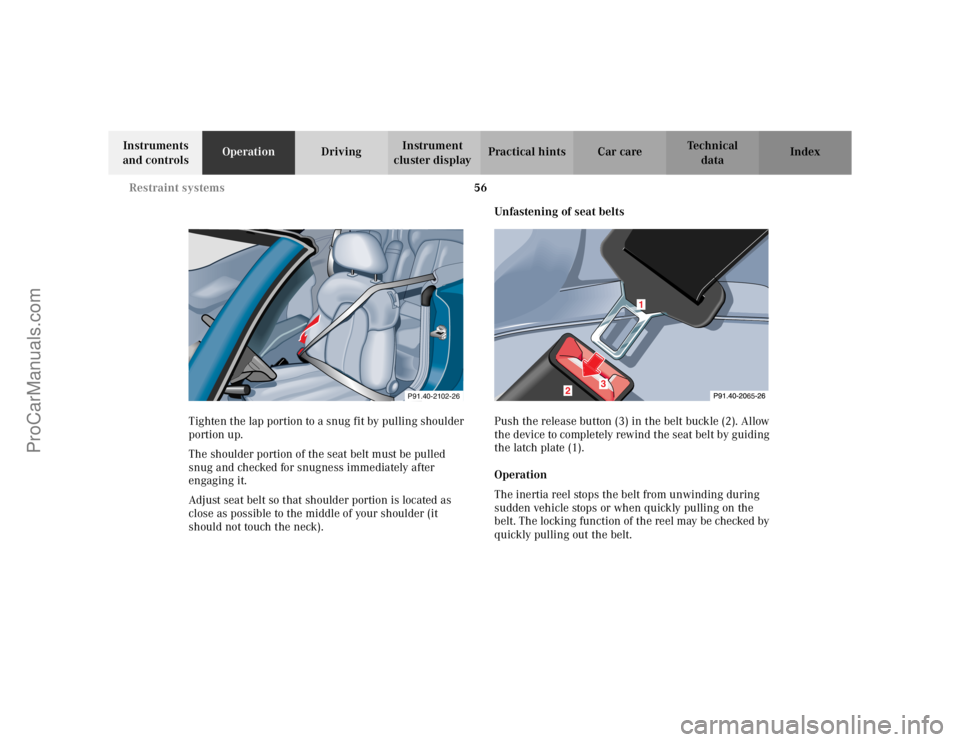
Tighten the lap portion to a snug fit by pulling shoulder
portion up.
The shoulder portion of the seat belt must be pulled
snug and checked for snugness immediately after
engaging it.
Adjust seat belt so that shoulder portion is located as
close as possible to the middle of your shoulder (it
should not touch the neck).Unfastening of seat belts
Push the release button (3) in the belt buckle (2). Allow
the device to completely rewind the seat belt by guiding
the latch plate (1).
Operation
The inertia reel stops the belt from unwinding during
sudden vehicle stops or when quickly pulling on the
belt. The locking function of the reel may be checked by
quickly pulling out the belt.
P91.40-2102-26
1
2
3
ProCarManuals.com
Page 62 of 341
59 Restraint systems
Te ch n i c a l
data Instruments
and controlsOperationDrivingInstrument
cluster displayPractical hints Car care Index BabySmart
TM airbag deactivation system
Special BabySmart
TM compatible child seats, designed
for use with the Mercedes-Benz system and available at
any authorized Mercedes-Benz Center are required for
use with the BabySmart
TM airbag deactivation system.
With the special child seat properly installed, the
passenger front airbag will not deploy. The 7
indicator lamp located on the center console will be
illuminated, except with electronic key removed or in
steering lock position 0. The system does not deactivate
the door mounted side impact airbag.
BabySmart
TM is a trademark of Siemens Automotive Corp.
Self-test BabySmart
TM
without special child seat installed
After turning electronic key in steering lock to
position 1 or 2, the 7 indicator lamp located on the
center console comes on for approx. 6 seconds and then
extinguishes.
If the indicator lamp should not come on or is
continuously lit, the system is not functioning. You must
see an authorized Mercedes-Benz Center before seating
any child on the front passenger seat.
Wa r n i n g !
The BabySmart
TM airbag deactivation system will
ONLY work with a special child seat designed to
operate with it. It will not work with child seats
which are not BabySmart
TM compatible.
Never place anything between seat cushion and
child seat (e.g. pillow), since it reduces the
effectiveness of the deactivation system. The
bottom of the child seat must make full contact
with the passenger seat cushion. An incorrectly
mounted child seat could cause injuries to the
child in case of an accident instead of protecting
the child.
Follow the manufacturer’s instructions for
installation of special child seats.When using a BabySmart
TM compatible child seat
on the front passenger seat, the front passenger
airbag will not deploy only if the 7 indicator
lamp remains illuminated.
Please be sure to check the indicator every time
you use the special system child seat.Should the light go out while the restraint is
installed, please check installation. If the light
remains out, do not use the BabySmart
TM restraint
to transport children on the front passenger seat
until the system has been repaired.
ProCarManuals.com
Page 63 of 341
60 Restraint systems
Te ch n i c a l
data Instruments
and controlsOperationDrivingInstrument
cluster displayPractical hints Car care Index
Supplemental restraint system (SRS)
Airbags are intended as a supplement to seat belts.
Airbags alone cannot protect as well as airbags plus
seat belts in impacts for which the airbags were
designed to operate, and do not afford any protection
whatsoever in crashes for which the airbags are not
designed to deploy.
The SRS uses two crash severity levels (thresholds) to
activate either the Emergency tensioning device or front
airbag or both. Activation depends on the direction and
severity of the impact exceeding the preset thresholds
and whether the seat belt is fastened.
Seat belt fastened
•first threshold exceeded: ETD activates
•second threshold exceeded: airbag also activates
Seat belt not fastened
•first threshold exceeded:
airbag activates, but not ETD
Driver and front passenger systems operate
independently of each other.Emergency tensioning device (ETD)
The seat belts for the front seats are equipped with
Emergency tensioning devices. These tensioning
devices are located in each belt’s inertia reel and
become operationally ready with the electronic key in
steering lock position 1 or 2.
The Emergency tensioning devices are designed to
activate only when the seat belts are fastened during
frontal impacts exceeding the first threshold of the SRS
and in rear impacts exceeding a preset severity level.
They remove slack from the belts in such a way that the
seat belts fit more snugly against the body restricting its
forward Emergency tensioning device movement as
much as possible.
In cases of other frontal impacts, angled impacts,
roll-overs, certain side impacts, or other accidents
without sufficient frontal or rear impact forces, the
Emergency tensioning device will not be activated. The
driver and passengers will then be protected by the
fastened seat belts and inertia reel in the usual manner.
For seat belt and Emergency tensioning device safety
guidelines see page 67.
ProCarManuals.com
Page 65 of 341
62 Restraint systems
Te ch n i c a l
data Instruments
and controlsOperationDrivingInstrument
cluster displayPractical hints Car care Index
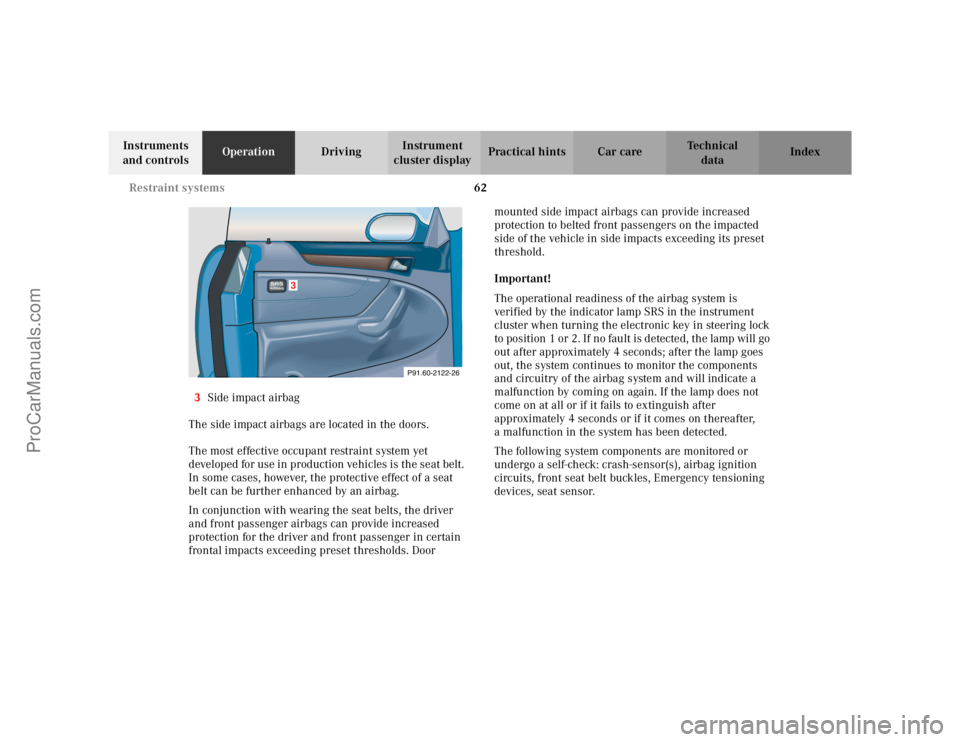
3Side impact airbag
The side impact airbags are located in the doors.
The most effective occupant restraint system yet
developed for use in production vehicles is the seat belt.
In some cases, however, the protective effect of a seat
belt can be further enhanced by an airbag.
In conjunction with wearing the seat belts, the driver
and front passenger airbags can provide increased
protection for the driver and front passenger in certain
frontal impacts exceeding preset thresholds. Door mounted side impact airbags can provide increased
protection to belted front passengers on the impacted
side of the vehicle in side impacts exceeding its preset
threshold.
Important!
The operational readiness of the airbag system is
verified by the indicator lamp SRS in the instrument
cluster when turning the electronic key in steering lock
to position 1 or 2. If no fault is detected, the lamp will go
out after approximately 4 seconds; after the lamp goes
out, the system continues to monitor the components
and circuitry of the airbag system and will indicate a
malfunction by coming on again. If the lamp does not
come on at all or if it fails to extinguish after
approximately 4 seconds or if it comes on thereafter,
a malfunction in the system has been detected.
The following system components are monitored or
undergo a self-check: crash-sensor(s), airbag ignition
circuits, front seat belt buckles, Emergency tensioning
devices, seat sensor.
3
P91.60-2122-26
ProCarManuals.com
Page 66 of 341
63 Restraint systems
Te ch n i c a l
data Instruments
and controlsOperationDrivingInstrument
cluster displayPractical hints Car care Index Initially, when the electronic key is turned from steering
lock position 0 to positions 1 or 2, malfunctions in the
crash-sensor are detected and indicated (the SRS
indicator lamp stays on longer than 4 seconds or does
not come on).
Have the system checked at your authorized
Mercedes-Benz Center immediately.
In the operational mode, after the indicator lamp has
gone out following the initial check, interruptions or
short circuits in the airbag ignition circuit and in the
driver and front passenger seat belt buckle harnesses,
and low voltage in the entire system are detected and
indicated.Front airbags
The driver and front passenger front airbags are
designed to activate only in certain frontal impacts
exceeding a preset threshold.
The front passenger airbag deploys only if the front
passenger seat is occupied and the indicator lamp on
the center console is not illuminated.
Note:
Objects heavier than 20 lbs (9 kg) on the front
passenger seat can appear to the SRS to indicate the
presence of an occupant in that seat which causes the
passenger front airbag to deploy in a crash exceeding
the appropriate threshold.
Wa r n i n g !
In the event a malfunction of the SRS is indicated
as outlined above, the SRS may not be operational.
For your safety, we strongly recommend that you
visit an authorized Mercedes-Benz Center
immediately to have the system checked; otherwise
the SRS may not be activated when needed in an
accident, which could result in serious or fatal
injury, or it might deploy unexpectedly and
unnecessarily which could also result in injury.
ProCarManuals.com
Page 72 of 341

69 Restraint systems
Te ch n i c a l
data Instruments
and controlsOperationDrivingInstrument
cluster displayPractical hints Car care Index Infant and child restraint systems
We recommend all infants and children be properly re-
strained at all times while the vehicle is in motion. All
lap-shoulder belts except the driver’s seat belt have
special seat belt devices for secure fastening of child
restraints.
To activate, pull shoulder belt out completely and let it
retract. During the seat belt retraction a ratcheting
sound can be heard to indicate that the special seat belt
device is activated. The belt is now locked.
To deactivate, release seat belt buckle and let seat belt
retract completely. The seat belt can again be used in
the usual manner.Important!
The use of infant or child restraints is required by law in
all 50 states, the District of Columbia, the U.S. territories
and all Canadian provinces.
Infants and small children should be seated in an
appropriate infant or child restraint system properly
secured by a lap-shoulder belt or, if so equipped, a child
restraint lower anchorage system that complies with
U.S. Federal Motor Vehicle Safety Standards 213 and
225 and Canadian Motor Vehicle Safety Standards 213
and 210.2.
When using any infant or child restraint system, be sure
to carefully read and follow all manufacturer’s
instructions for installation and use.
Please read and observe warning labels affixed to inside
of vehicle and to infant or child restraints.
Wa r n i n g !
Never release the seat belt buckle while vehicle is
in motion, since the special seat belt device will be
deactivated.
ProCarManuals.com
Page 76 of 341
73 Adjusting telescoping steering column
Te ch n i c a l
data Instruments
and controlsOperationDrivingInstrument
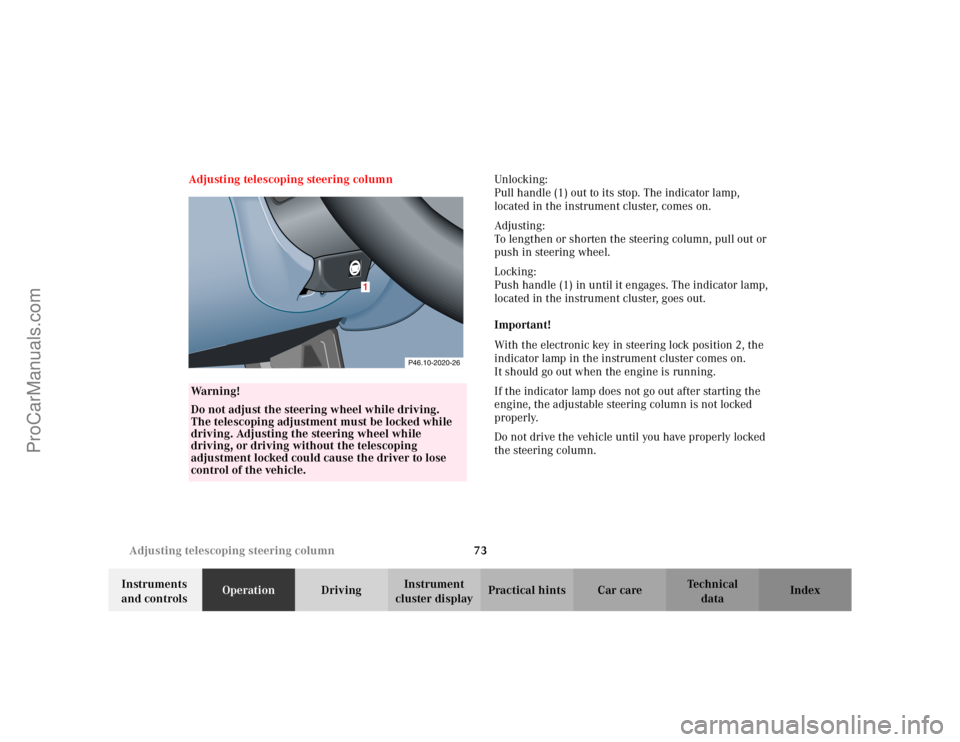
cluster displayPractical hints Car care Index Adjusting telescoping steering columnUnlocking:
Pull handle (1) out to its stop. The indicator lamp,
located in the instrument cluster, comes on.
Adjusting:
To lengthen or shorten the steering column, pull out or
push in steering wheel.
Locking:
Push handle (1) in until it engages. The indicator lamp,
located in the instrument cluster, goes out.
Important!
With the electronic key in steering lock position 2, the
indicator lamp in the instrument cluster comes on.
It should go out when the engine is running.
If the indicator lamp does not go out after starting the
engine, the adjustable steering column is not locked
properly.
Do not drive the vehicle until you have properly locked
the steering column.
Wa r n i n g !
Do not adjust the steering wheel while driving.
The telescoping adjustment must be locked while
driving. Adjusting the steering wheel while
driving, or driving without the telescoping
adjustment locked could cause the driver to lose
control of the vehicle.
1
P46.10-2020-26
ProCarManuals.com
Page 77 of 341

74 Rear view mirrors
Te ch n i c a l
data Instruments
and controlsOperationDrivingInstrument
cluster displayPractical hints Car care Index
Inside rear view mirror
Manually adjust the inside mirror.
Use your inside mirror to determine the size and
distance of objects seen in the passenger side convex
mirror.
Antiglare night position
With the electronic key in steering lock position 2, the
mirror reflection brightness responds to changes in
light sensitivity.
With gear selector lever in position “R”, or with the
interior lamp switched on, the mirror brightness does
not respond to changes in light sensitivity.Note:
The automatic antiglare function does not react, if
incoming light is not aimed directly at sensors in the
inside rear view mirror.
The automatic antiglare function will not react for
example, if the wind screen is installed.
Wa r n i n g !
In the case of an accident liquid electrolyte may
escape the mirror housing when the mirror glass
breaks.Electrolyte has an irritating effect. Do not allow the
liquid to come into contact with eyes, skin,
clothing, or respiratory system. In cases it does,
immediately flush affected area with water, and
seek medical help if necessary.
ProCarManuals.com