Page 185 of 250
8-9
Maintenance and Care
Owner Maintenance
Form No. 8Q50-EA-01G
Engine Compartment Overview
2.0-liter engineAutomatic transaxle fluid-level
dipstick (only for automatic
transaxle)
Brake/Clutch fluid reservoir
Battery Fuse block
Engine coolant
reservoirAir filter
Cooling system cap Engine oil-filler cap
Power steering fluid
reservoir
Windshield washer
fluid reservoir Engine oil dipstick
2.5-liter engine
Air filter
Cooling system cap
Engine coolant reservoir
Power steering fluid
reservoir
Battery
Fuse block
Automatic transaxle fluid-level
dipstick (only for automatic
transaxle)
Brake/Clutch fluid reservoir
Engine oil-filler cap
Windshield washer
fluid reservoir Engine oil dipstick
J94S.book Page 9 Saturday, June 23, 2001 1:04 PM
Page 186 of 250

8-10
Maintenance and Care
Owner Maintenance
Form No. 8Q50-EA-01G
�
�� � Recommended Oil
Oil container labels provide important
information.
The quality designation SG, SH, SJ, SL,
or ILSAC must be on the label.
Engine oil viscosity, or thickness, has an
effect on fuel economy and cold-weather
operation (starting and oil flow).
Low-viscosity engine oils can provide
improved fuel economy and cold-weather
performance.
But high-temperature weather conditions
require higher-viscosity engine oils for
satisfactory lubrication. When choosing an oil, consider the
temperature range your vehicle will
operate in before the next oil change.
Then select the recommended viscosity
from this chart.
Energy conserving oils are recommended.
A chief contribution they make to fuel
economy is reducing the amount of fuel
necessary to overcome engine friction.
Engine Oil
SAEFORGASOLINEENGINES10W-30
(ILSAC)
–30 –20 –100 1020304050
–20 0 20 40 60 80 100 120
5W-30
10W-30
Using oils of viscosity besides those
recommended for specific temperature
ranges could result in engine damage.
CAUTION
J94S.book Page 10 Saturday, June 23, 2001 1:04 PM
Page 187 of 250
8-11
Maintenance and Care
Owner Maintenance
Form No. 8Q50-EA-01G
�
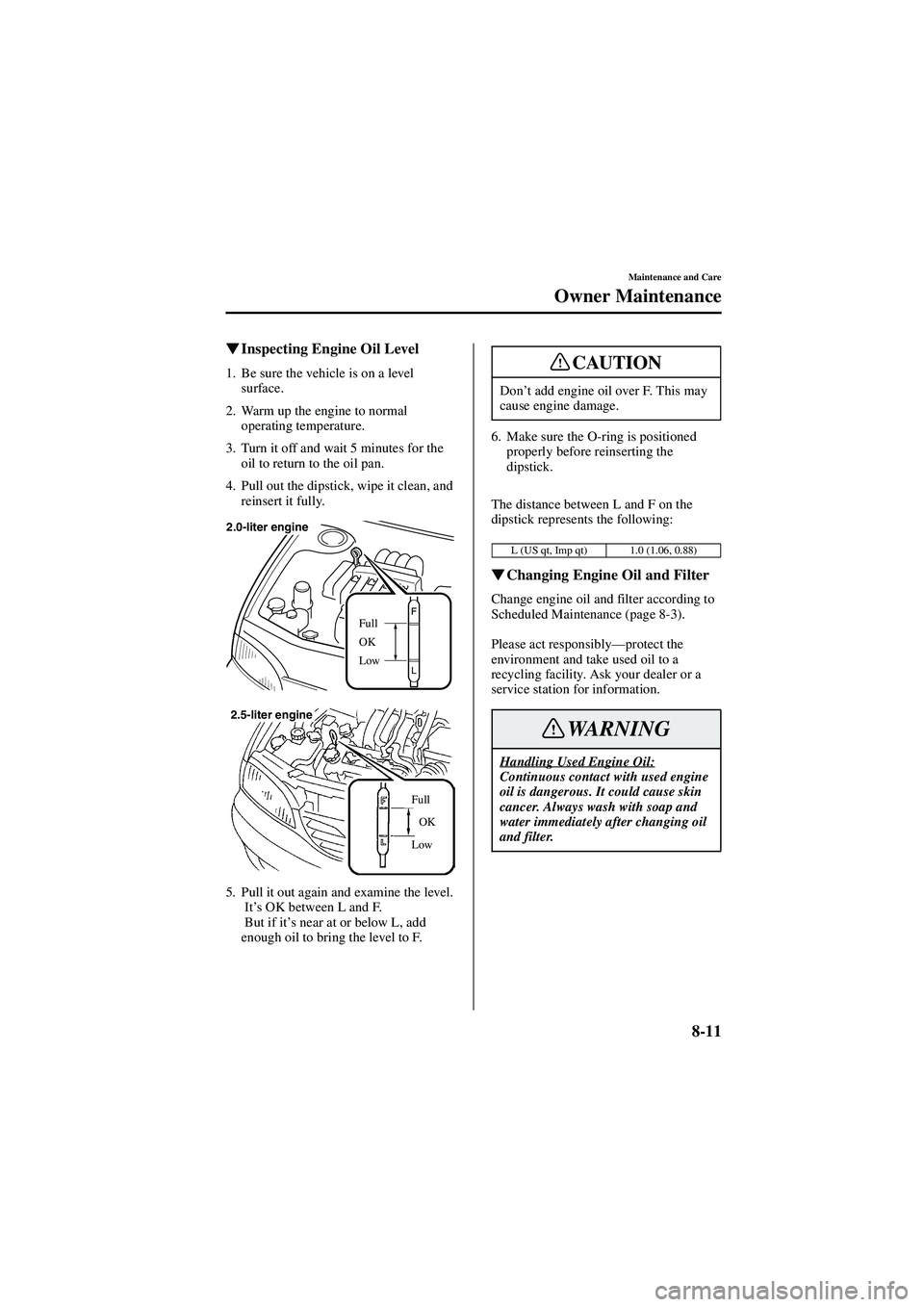
�� � Inspecting Engine Oil Level
1. Be sure the vehicle is on a level
surface.
2. Warm up the engine to normal operating temperature.
3. Turn it off and wait 5 minutes for the oil to return to the oil pan.
4. Pull out the dipstick, wipe it clean, and reinsert it fully.
5. Pull it out again and examine the level. It’s OK between L and F.
But if it’ s near at or below L, add
enough oil to bring the level to F. 6. Make sure the O-ring is positioned
properly before reinserting the
dipstick.
The distance between L and F on the
dipstick represents the following:
�
�� � Changing Engine Oil and Filter
Change engine oil and filter according to
Scheduled Maintenance (page 8-3).
Please act responsibly —protect the
environment and take used oil to a
recycling facility. Ask your dealer or a
service station for information.
Full
Low OK
2.0-liter engine
2.5-liter engine
Full
LowOK
Don
’t add engine oil over F. This may
cause engine damage.
L (US qt, Imp qt) 1.0 (1.06, 0.88)
Handling Used Engine Oil:Continuous contact with used engine
oil is dangerous. It could cause skin
cancer. Always wash with soap and
water immediately after changing oil
and filter.
CAUTION
WARNING
J94S.book Page 11 Saturday, June 23, 2001 1:04 PM
Page 188 of 250

8-12
Maintenance and Care
Owner Maintenance
Form No. 8Q50-EA-01G
Changing engine oil
1. Warm up the engine for a few minutes and turn it off. Remove the oil-filler
cap.
2. Remove the drain plug and drain the oil into a suitable container. 3. Replace the plug tightly after the oil
has thoroughly drained.
4. Fill the engine with new oil to the F mark on the dipstick.
5. Securely replace the oil-filler cap.
6. Start the engine and inspect around the drain plug for leaks.
7. Turn it off and wait 5 minutes for the oil to return to the oil pan.
Check the oil level and fill to the F mark if
necessary.
Oil capacity (General reference only,
refer to Specifications section for
capacities.)
Changing oil filter
Because you need a special tool to
retighten the filter, an Authorized Mazda
Dealer should do the work.
Checking or Changing Engine Oil:Hot engine oil is dangerous. If the
engine has been running, the engine
oil becomes very hot. You could be
seriously burned. Don ’t check or
change the engine oil when the
engine is hot.
WARNING
2.0-liter engine
Loosen Tighten
Oil-filler cap
Drain plug
Oil-filler cap
Loosen Tighten
Drain plug
2.5-liter engine
NOTE
•
The indicated engine oil capacities
are for general reference purposes
only. When adding or changing oil,
verify the engine oil level with the
oil dipstick.
• Use only specified engine oil (page
10-4).
J94S.book Page 12 Saturday, June 23, 2001 1:04 PM
Page 193 of 250

8-17
Maintenance and Care
Owner Maintenance
Form No. 8Q50-EA-01G
�
�� � Inspecting Power Steering Fluid
Level
Inspect the fluid level at each engine oil
change. Add fluid if necessary; it does not
require periodic changing.
The level must be kept between the HIGH
and LOW marks.
Visually examine the lines and hoses for
leaks and damage.
1. Park on a level surface, well off the
right-of-way, and set the parking brake
firmly.
2. Turn off the engine and allow it to cool. 3. Remove the filler cap and attached
dipstick.
4. Wipe them clean and put them back.
5. Remove again and inspect the level.
6. It must be between HIGH and LOW. Add fluid if necessary.
Don ’t overfill.
If new fluid is required frequently, consult
an Authorized Mazda Dealer.
Power Steering Fluid
To avoid damage to the power steering
pump, don’ t operate the vehicle for
long periods when the power steering
fluid level is low.
NOTE
Use specified power steering fluid
(page 10-4).
CAUTION
High
Low OK
J94S.book Page 17 Saturday, June 23, 2001 1:04 PM
Page 197 of 250
8-21
Maintenance and Care
Owner Maintenance
Form No. 8Q50-EA-01G
All moving points of the body, such as
door and hood hinges and locks, should
be lubricated each time the engine oil is
changed. Use a nonfreezing lubricant on
locks during cold weather.
Make sure the engine hood’s secondary
latch keeps the hood from opening when
the primary latch is released. A viscous paper air filter fits inside the air
cleaner housing, as shown. It
’s been
specially treated and should not be
cleaned and reused. Replace it when
necessary.
�
�� � Replacing the Air Filter
1. Unfasten the clamps.
Body LubricationAir Filter
Don ’t drive without an air filter. This
could result in excessive engine wear.
NOTE
If the vehicle is operated in very dusty
or sandy areas, replace the filter more
often than recommended intervals.
CAUTION
Clamp
J94S.book Page 21 Saturday, June 23, 2001 1:04 PM
Page 206 of 250

8-30
Maintenance and Care
Owner Maintenance
Form No. 8Q50-EA-01G
Yo u r M a z d a’s headlights have replaceable
halogen bulbs.�
�� � Replacing a Headlight Bulb
1. Make sure the headlight switch is off.
2. Lift the hood and find the bulb in the
rear of the headlight body.
3. 2.5-liter engine Remove the bolts and the coolant
reservoir.
4. Detach the electrical connector from the bulb by squeezing the tabs and
pulling it to the rear.
Handling Halogen Bulbs:When a halogen bulb breaks, it is
dangerous. These bulbs contain
pressurized gas. If one is broken, it
will explode and serious injuries
could be caused by the flying glass.
If the glass portion is touched with
bare hands, body oil could cause the
bulb to overheat and explode when lit.
Never touch the glass portion of the
bulb with your bare hands and always
wear eye protection when handling or
working around halogen bulbs.
Children and Halogen Bulbs:
Playing with a halogen bulb is
dangerous. Serious injuries could be
caused by dropping a halogen bulb or
breaking it some other way.
Always keep halogen bulbs out of the
reach of children.
WARNING
Do not touch the glass surface
Bolts
J94S.book Page 30 Saturday, June 23, 2001 1:04 PM
Page 219 of 250

8-43
Maintenance and Care
Appearance Care
Form No. 8Q50-EA-01G
Insects, tar, tree sap, bird droppings,
industrial fallout, and similar deposits can
damage the finish if not removed
immediately. When prompt washing with
plain water is ineffective, use a mild soap
made for use on vehicles.
Thoroughly rinse off all soap with
lukewarm or cold water. Don’t allow soap
to dry on the finish.
After washing the vehicle, dry it with a
clean chamois to prevent water spots from
forming.
Waxing
Your vehicle needs to be waxed when
water no longer beads on the finish.
Always wash and dry the vehicle before
waxing it. In addition to the vehicle body,
wax the metal trim to maintain its luster.
1. Use wax which contains no abrasives. Waxes containing abrasive will remove
paint and could damage bright metal
parts.
2. Use a good grade of natural wax for metallic, mica, and solid colors. 3. When waxing, coat evenly with the
sponge supplied or a soft cloth.
4. Wipe off the wax with a soft cloth.
�
�� � Repairing Damage to the Finish
Deep scratches or chips on the finish
should be repaired promptly. Exposed
metal quickly rusts and can lead to major
repairs.
�
�� � Bright-Metal Maintenance
• Use tar remover to remove road tar and
insects. Never do this with a knife or
similar tool.
• To prevent corrosion on bright-metal
surfaces, apply wax or chrome
preservative and rub it to a high luster.
• During cold weather or in coastal
areas, cover bright-metal parts with a
coating of wax or preservative heavier
than usual. It would also help to coat
them with noncorrosive petroleum jelly
or some other protective compound.
Driving with Wet Brakes:Driving with wet brakes is dangerous.
Increased stopping distance or the
vehicle pulling to one side when
braking could result in a serious
accident. Light braking will indicate
whether the brakes have been
affected. Dry the brakes by driving
very slowly and applying the brakes
lightly until brake performance is
normal.
WARNING
NOTE
A spot remover to remove oil, tar, and
similar materials will usually also take
off the wax. Rewax these areas even if
the rest of the vehicle doesn ’t need it.
If your Mazda is damaged and needs
metal parts repaired or replaced, make
sure the body shop applies anti-
corrosion materials to all parts, both
repaired and new. This will prevent
them from rusting.
CAUTION
J94S.book Page 43 Saturday, June 23, 2001 1:04 PM

