2002 LAND ROVER DISCOVERY oil
[x] Cancel search: oilPage 959 of 1672

FRONT SUSPENSION
60-20 DESCRIPTION AND OPERATION
ACE Electronic control unit (ECU)
1Body Control Unit (Ref. only)
2Bracket
3ACE Electronic control unit
4Attachment nuts 3 off
The ACE ECU is mounted on a bracket behind the passenger glove box and is identified from the other ECU's by its
single electrical harness connector. The single 36 pin connector is located on the lower face of the ECU and mates
with a connector from the main harness. The connector supplies power, ground, signal and sensor information to/from
the ECU for control of the ACE system.
The ACE ECU receives a battery power supply from fuse 15 in the engine compartment fusebox via the ACE relay,
also located in the engine compartment fusebox. The ECU provides an earth path for the relay coil, energising the
coil and supplying power to the ECU.
An ignition on signal is supplied from the ignition switch via fuse 29 in the passenger compartment fusebox. The
ignition on signal provides an input to the ECU which tells the ECU that ignition has been selected on and initiates a
250 ms start time. The start time is used to prevent functions operating when software routines are being initialised.
The ignition on signal, when removed, tells the ECU that the ignition is off. The ECU will remain powered for thirty
seconds after the ignition is turned off. The thirty second period allows the ECU to store values and fault flags in the
memory. These values are read by the ECU when the next ignition on signal is received.
An engine speed signal is transmitted to the ECU from the Engine Control Module (ECM) as a pulsed digital signal.
The engine speed signal is used by the ACE ECU to detect that the engine is running and hydraulic pressure for ACE
system operation is available.
Page 972 of 1672

FRONT SUSPENSION
REPAIRS 60-33
5.Remove 2 nuts securing ball joints to steering
knuckle.
6.Break taper joints using LRT-54-027 and
remove steering knuckle.
7.Remove tension collet from steering knuckle.
8.Remove drive shaft oil seal from axle casing.Refit
1.Clean taper bores in steering knuckle and
tension collet.
2.Fit tension collet into steering knuckle and
tighten to 5 Nm (3.7 lbf.ft).
3.Clean ball joint tapers and taper seats.
4.Position steering knuckle to axle yoke. Fit
upper ball joint nut and tighten to 110 Nm (81
lbf.ft). Fit lower ball joint nut and tighten to 135
Nm (100 lbf.ft).
5.Clean track rod and (if applicable) drag link
tapers and taper seats.
6.Connect track rod and drag link to steering
knuckle. Fit track rod and drag link nuts and
tighten to 80 Nm (59 lbf.ft).
7.Clean mudshield and steering knuckle mating
faces. Position mudshield, fit bolts and tighten
to 10 Nm (7 lbf.ft).
8.Fit wheel hub.
+ FRONT SUSPENSION, REPAIRS,
Wheel hub.
Page 973 of 1672

FRONT SUSPENSION
60-34 REPAIRS
Road spring - front
$% 60.20.11
Remove
1.Raise front of vehicle.
WARNING: Do not work on or under a
vehicle supported only by a jack. Always
support the vehicle on safety stands.
2.Support vehicle under chassis.
3.Remove front road wheels.
4.Support weight of front axle.
5.Remove 2 nuts securing anti-roll bar links to
front axle and disconnect links from axle.
6.Remove 2 bolts securing each damper to front
axle.
WARNING: Make sure the axle cannot move
when the damper is disconnected. The
damper limits the downward movement of
the axle. If the axle is not restrained,
disconnecting the damper will allow
unrestricted movement which may cause
personal injury or damage to equipment.
7.Lower front axle.
CAUTION: Ensure brake hoses and ABS
sensor harnesses are not damaged when
lowering front axle.
8.Release and remove front spring from damper.Refit
1.Clean front spring seats.
2.Position front spring, with close coil uppermost,
over damper and locate in cut out in lower
spring seat.
3.Ensure both front springs are correctly located
in spring seats and raise front axle. Fit bolts
securing both dampers to front axle and tighten
to 45 Nm (33 lbf.ft).
4.Ensure washer is in place on lower ball joint of
each anti-roll bar link, then connect lower ball
joints to axle. Tighten nuts to 100 Nm (74 lbf.ft).
5.Fit front road wheels and tighten nuts to 140
Nm (103 lbf.ft).
6.Remove stands and lower vehicle.
Page 975 of 1672

FRONT SUSPENSION
60-36 REPAIRS
9.Remove 4 bolts securing wheel hub to steering
knuckle.
10.Release wheel hub from steering knuckle, then
remove wheel hub and drive shaft assembly
from axle.
CAUTION: Do NOT remove the ABS sensor
from the hub. The hub and the sensor are
supplied as an assembly.
11.Position the wheel hub and drive shaft on a
press, place supports beneath the wheel studs
and press the drive shaft from the wheel hub.
12.Remove drive shaft oil seal from axle casing. Refit
1.Clean drive shaft oil seal recess, drive shaft
splines, oil seal running surface, wheel hub
and steering knuckle mating faces, ABS
sensor and sensor recess.
2.Lubricate lip of new drive shaft oil seal and
running surface on drive shaft with clean
differential oil.
+ CAPACITIES, FLUIDS AND
LUBRICANTS, Lubrication.
3.Use tool LRT-51-012 to fit new drive shaft oil
seal to axle casing.
4.Fit drive shaft to axle casing.
5.Apply anti-seize compound to wheel hub and
steering knuckle mating face.
M51 0057
Page 1008 of 1672
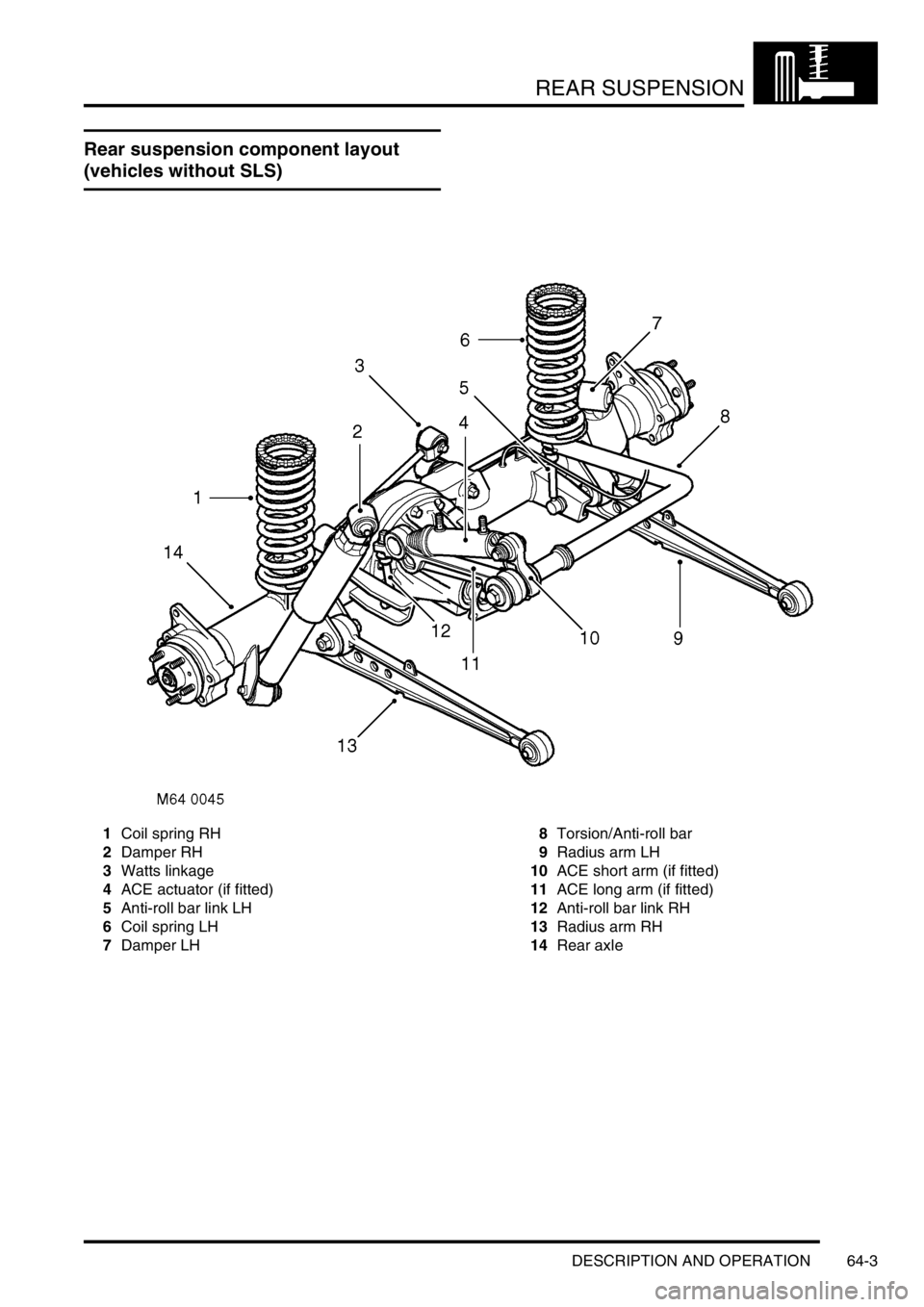
REAR SUSPENSION
DESCRIPTION AND OPERATION 64-3
Rear suspension component layout
(vehicles without SLS)
1Coil spring RH
2Damper RH
3Watts linkage
4ACE actuator (if fitted)
5Anti-roll bar link LH
6Coil spring LH
7Damper LH8Torsion/Anti-roll bar
9Radius arm LH
10ACE short arm (if fitted)
11ACE long arm (if fitted)
12Anti-roll bar link RH
13Radius arm RH
14Rear axle
Page 1010 of 1672

REAR SUSPENSION
DESCRIPTION AND OPERATION 64-5
1Rear axle
2Bolt
3Bush
4Locknut
5Transverse link
6Locknut
7Bolt
8Locknut
9Bush
10Bush
11Bolt
12Bolt
13Transverse link
14Bolt
15Bush
16Pivot housing
17Locknut
18Bush
19Lower spring seat 2 off (vehicles without SLS
only)
20Bolt 4 off (vehicles without SLS only)
21Coil spring 2 off (vehicles without SLS only)
22Spring seat isolator 2 off (vehicles without SLS
only)
23Clip 4 off (vehicles with SLS only)
24Air spring 2 off (vehicles with SLS only)
25Locknut
26Bush 2 off27Locknut 2 off
28Radius arm LH
29Locknut
30Torsion/Anti-roll bar link LH
31Washer
32Locknut
33Anti-roll bar assembly
34Mounting rubber 2 off
35Clamp plate 2 off
36Bolt 2 off
37Locknut
38Washer
39Anti-roll bar link RH
40Locknut
41Radius arm RH
42Bush 2 off
43Locknut 2 off
44Locknut 2 off
45Bush 2 off
46Bolt 2 off
47Bolt 2 off
48Bolt 2 off
49Damper 2 off
Page 1011 of 1672

REAR SUSPENSION
64-6 DESCRIPTION AND OPERATION
Description
General
The rear suspension comprises two dampers, two radius arms, a Watts linkage and an anti-roll bar assembly. On
vehicles without Self Levelling Suspension (SLS) coil springs are used. On vehicles with SLS air springs are used.
The anti-roll bar is an essential part of the rear suspension. On vehicles without ACE, a conventional 'passive' anti-
roll bar is fitted. On vehicles fitted with the ACE system, a thicker diameter anti-roll bar, known as a torsion bar, is used
with an actuator at one end.
+ FRONT SUSPENSION, DESCRIPTION AND OPERATION, Description - ACE.
The hydraulic dampers and springs provide springing for each rear wheel. The long travel dampers, springs and
radius arms provide maximum axle articulation and wheel travel for off-road driving. The rear axle is controlled
longitudinally by two forged steel radius arms and transversely by a Watts linkage.
Radius arms
Each radius arm is manufactured from forged steel. Two bushes are pressed into the rear of the radius arm. The rear
of the radius arm is located between a fabricated bracket on the axle and secured through the bushes with two bolts
and nuts. A bush is pressed into the forward end of the radius arm which is located in a fabricated bracket on each
chassis longitudinal and secured through the bush with a bolt and nut. Each radius arm is similar in its construction
to the front radius arms. The rear radius arms are shorter than the front and have a lug for attachment of the SLS
height sensor (when fitted).
The radius arms prevent longitudinal movement of the rear axle and because of their length allow maximum axle
articulation. The stiffness of the bushes in each radius arm also contributes to the vehicle roll stiffness.
Each radius arm has a notch on its lower edge which provides location for the vehicle jack.
Dampers
Two conventional telescopic dampers are used to control body/axle movement. The upper damper mounting is fitted
with a bush which locates in a bracket on the chassis longitudinal. The damper is secured with a bolt which screws
into a captive nut on the bracket. The lower damper mounting is also fitted with a bush and locates in a fabricated
bracket attached to the rear axle. The lower mounting is secured with a bolt which screws into a captive nut on the
bracket. The upper and lower bushes are replaceable items.
Air springs (vehicles with SLS)
On vehicles with SLS fitted, air springs are fitted between the rear axle and the chassis. Each spring is located at its
base on a fabricated platform on the rear axle. The top of the spring locates in a fabricated bracket attached to the
outside of each chassis longitudinal.
The plastic base of the air spring has two lugs which locate in a slotted hole in the rear axle platform. The spring is
secured by rotating the spring through 90
°, locating the lug in the platform. The plastic top of the air spring has two
grooved pins which locate in holes in the bracket on the chassis. Two spring clips locate on the grooved pins and
retain the top of the spring in position.
Each air spring comprises a top plate assembly, an air bag and a base piston. The air bag is attached to the top plate
and the piston with a crimped ring. The air bag is made from a flexible rubber material which allows the bag to expand
with air pressure and deform under load. The top plate assembly comprises the plastic top plate with two bonded
grooved pins on its top face. In the centre of the top face is a female connector which allows for the attachment of the
air hose from the SLS compressor. The piston is made from plastic and is shaped to allow the air bag to roll over its
outer diameter. The base of the piston is recessed with a boss moulded in the centre. The boss has two lugs which
provide attachment to the axle platform.
Page 1012 of 1672

REAR SUSPENSION
DESCRIPTION AND OPERATION 64-7
Coil springs (vehicles without SLS)
On vehicles without SLS fitted, coil springs are fitted between the rear axle and the chassis in place of the SLS air
springs. Each spring is located at its base by the lower spring seat which is secured to a fabricated platform on the
rear axle with two bolts. The top of each spring is located in the upper spring seat. The upper spring seat comprises
a pressed metal plate with an outer coating of natural rubber bonded to the plate. The upper spring seat is retained
in position by the compression of the spring.
Coil Spring Specifications – Models up to 03 Model Year
The rear coil springs are of the variable rate type and are manufactured from silicon manganese 16.5 mm (0.65 in.)
diameter bar. Each spring has 9 coils and a free length of 385 mm (15.1 in.). The variable rate of the spring is achieved
by the active coils at one end being closer together. The rear coil spring is identified by a purple stripe painted on a
number of coils.
Coil Spring Specifications – Models From 03 Model Year
The introduction of the 03MY vehicle introduced a range of additional rear coil spring fitments. These were introduced
as a package to optimise vehicle trim heights.
The coil springs are manufactured from silicon manganese 16.35 mm (0.64 in.) diameter bar for springs on five seater
models and 16.57 mm (0.65 in.) diameter bar on seven seater models. The following spring data table shows the
colour codes, number of coils and spring free length.
Spring Data
The following table shows spring fitment applicability.
Spring Fitment Applicability
Watts linkage
A Watts linkage is used to ensure that the rear axle remains centrally located. The Watts linkage comprises two
transverse links and a pivot housing. The transverse links and pivot housing allow the rear axle to move vertically
without any transverse movement.
The transverse links are made from fabricated and welded steel. Each transverse link has a bush press fitted into a
housing at one end. The opposite end has a forked bracket with two cross holes.
The pivot housing is made from cast iron. Three bushes are press fitted in the housing, one in the centre and one at
each end.
Colour Code Total No. of Coils Free Length Model
Brown/Orange 8.73 384.7 mm (15.14 in) 5 Seat
Grey/Orange 8.73 392 mm (15.43 in) 5 Seat
Yellow/Grey 8.73 376.6 mm (14.82 in) 5 Seat
Pink/Grey 8.73 400.3 mm (15.75 in) 5 Seat
Blue/Grey 9.10 387.8 mm (15.26 in) 7 Seat
Green/Grey 9.10 395.2 mm (15.55 in) 7 Seat
White/Grey 9.10 380.6 mm (14.98 in) 7 Seat
Left Hand Drive Right Hand Drive
Both Sides RH Side LH Side
Brown/Orange Grey/Orange Yellow/Grey
Grey Orange Pink/Grey Brown/Orange
Blue/Grey Green/Grey White/Grey