Page 1617 of 1672

NAVIGATION SYSTEM
87-2 DESCRIPTION AND OPERATION
Description
General
The navigation system provides audio and visual route guidance to help the driver reach a selected destination. The
system is an optional fit consisting of a Traffic Pro navigation computer and antenna, manufactured by Harman/
Becker Automotive Systems, which are fitted in place of the In Car Entertainment (ICE) head unit and antenna.
Compact Disc (CD) and radio functions are incorporated into the navigation computer.
The navigation system allows the driver to choose between the shortest and fastest routes between the vehicle's
current position and a selected destination, and to select a stopover point in the journey and a route that avoids
motorways, ferries and toll roads. Directions to Points Of Interest (POI) e.g. airports, hospitals, petrol stations etc,
either local, national or in another country, can also be selected. A traffic jam function enables the driver to request
diversion instructions, around an obstructed part of the selected route, during the journey. A Traffic Management
Control (TMC) function, currently only available in some European countries, monitors traffic broadcasts and
automatically selects an alternative route during the journey if the original route is effected by a traffic jam, accident
or road works etc.
The position of the vehicle is determined by the navigation computer using a combination of vehicle sensor inputs and
radio signals from the 24 Global Positioning System (GPS) satellites orbiting the earth. The position of the vehicle is
then plotted on a digitised map, loaded into the navigation computer from a CD-ROM, to determine the journey route
and provide the route guidance.
The GPS satellite signals are used for initial determination of the vehicle's position and periodic position updates. The
vehicle sensor inputs are used to monitor the vehicle's direction of travel and distance travelled between position
updates from the GPS satellite signals. The vehicle sensor inputs consist of:
lA vehicle speed signal from the ABS ECU, to monitor the distance travelled and for automatic volume control.
lA reverse gear signal from the selector and inhibitor switch of the automatic gearbox, or reverse gear switch of
the manual gearbox, to enable the navigation computer to differentiate between forward and rearward movement
of the vehicle.
lA gyro in the navigation computer, to monitor changes of direction, i.e. steering inputs.
The signal from each GPS satellite contains information about satellite position, almanac data and time (almanac data
is the current status of the satellite). Signals from between five and 11 of the GPS satellites can be received at a given
point on the earth's surface at any one time. The number and quality of separate GPS satellite signals received also
varies with vehicle location. In hilly or tree lined areas, built up areas with tall buildings, multi-storey car parks,
garages, tunnels, bridges and during heavy rain/thunderstorms, signal reception of some or all of the GPS satellites
will be poor or non existent.
A minimum of three separate GPS satellite signals are required for the navigation computer to calculate a three
dimensional (3D) positional fix. When only two signals are being received, the navigation computer will calculate a
less accurate two dimensional (2D) positional fix. The more widely dispersed that the GPS satellites are, the more
accurate the positional fix. The navigation computer can store information from a maximum of 12 GPS satellites at
any one time. When more than three signals are stored, the navigation computer selects the three most widely
dispersed signals for the position calculation.
GPS Antenna and diplexer unit
The GPS antenna is installed at the rear of the roof on the centreline. A diplexer unit on the underside of the GPS
antenna amplifies the radio signals received from the GPS satellites and transmits them through separate dedicated
co-axial cable to the navigation computer for processing.
Page 1634 of 1672
INSTRUMENTS
DESCRIPTION AND OPERATION 88-7
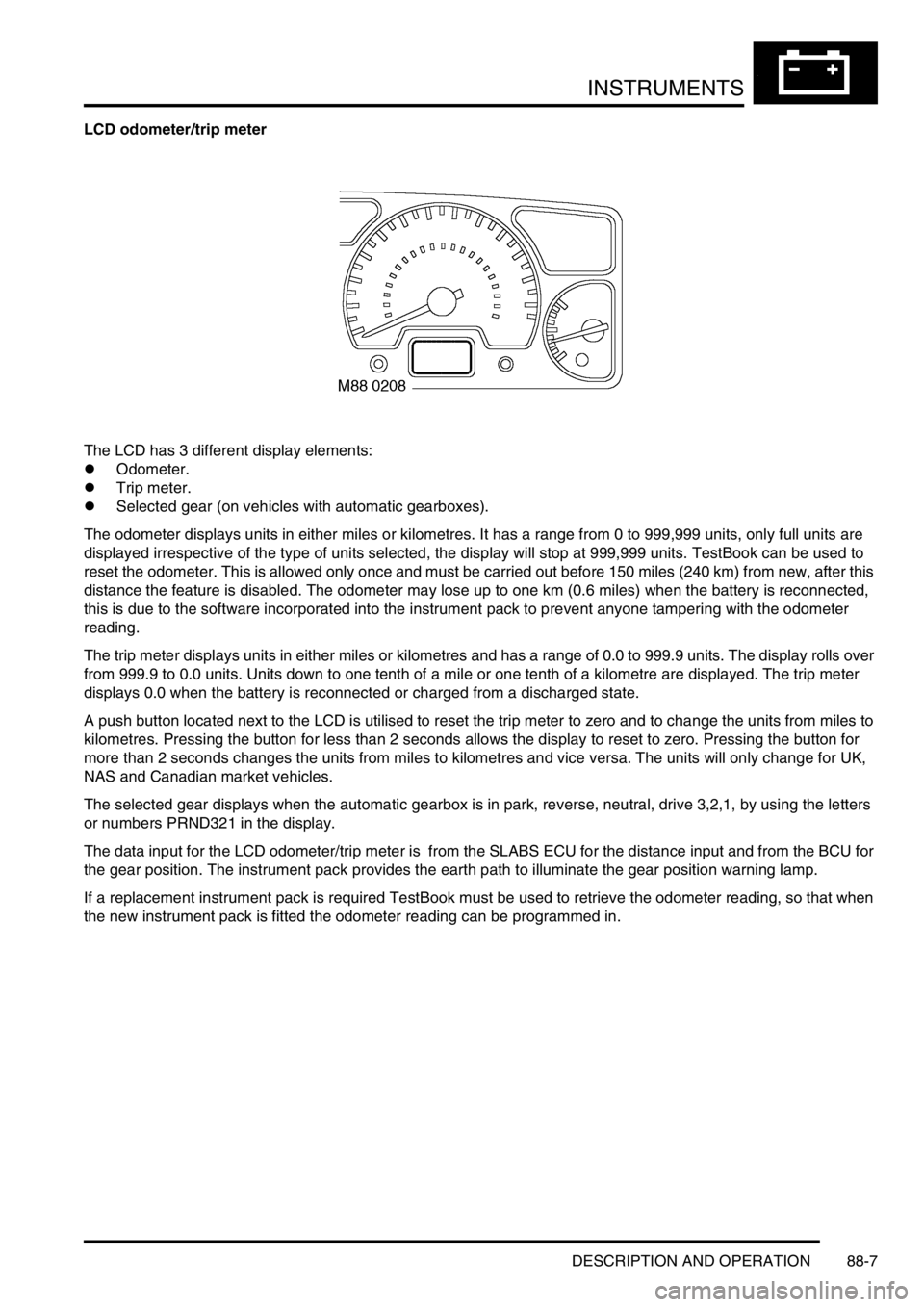
LCD odometer/trip meter
The LCD has 3 different display elements:
lOdometer.
lTrip meter.
lSelected gear (on vehicles with automatic gearboxes).
The odometer displays units in either miles or kilometres. It has a range from 0 to 999,999 units, only full units are
displayed irrespective of the type of units selected, the display will stop at 999,999 units. TestBook can be used to
reset the odometer. This is allowed only once and must be carried out before 150 miles (240 km) from new, after this
distance the feature is disabled. The odometer may lose up to one km (0.6 miles) when the battery is reconnected,
this is due to the software incorporated into the instrument pack to prevent anyone tampering with the odometer
reading.
The trip meter displays units in either miles or kilometres and has a range of 0.0 to 999.9 units. The display rolls over
from 999.9 to 0.0 units. Units down to one tenth of a mile or one tenth of a kilometre are displayed. The trip meter
displays 0.0 when the battery is reconnected or charged from a discharged state.
A push button located next to the LCD is utilised to reset the trip meter to zero and to change the units from miles to
kilometres. Pressing the button for less than 2 seconds allows the display to reset to zero. Pressing the button for
more than 2 seconds changes the units from miles to kilometres and vice versa. The units will only change for UK,
NAS and Canadian market vehicles.
The selected gear displays when the automatic gearbox is in park, reverse, neutral, drive 3,2,1, by using the letters
or numbers PRND321 in the display.
The data input for the LCD odometer/trip meter is from the SLABS ECU for the distance input and from the BCU for
the gear position. The instrument pack provides the earth path to illuminate the gear position warning lamp.
If a replacement instrument pack is required TestBook must be used to retrieve the odometer reading, so that when
the new instrument pack is fitted the odometer reading can be programmed in.
Page 1636 of 1672
INSTRUMENTS
DESCRIPTION AND OPERATION 88-9
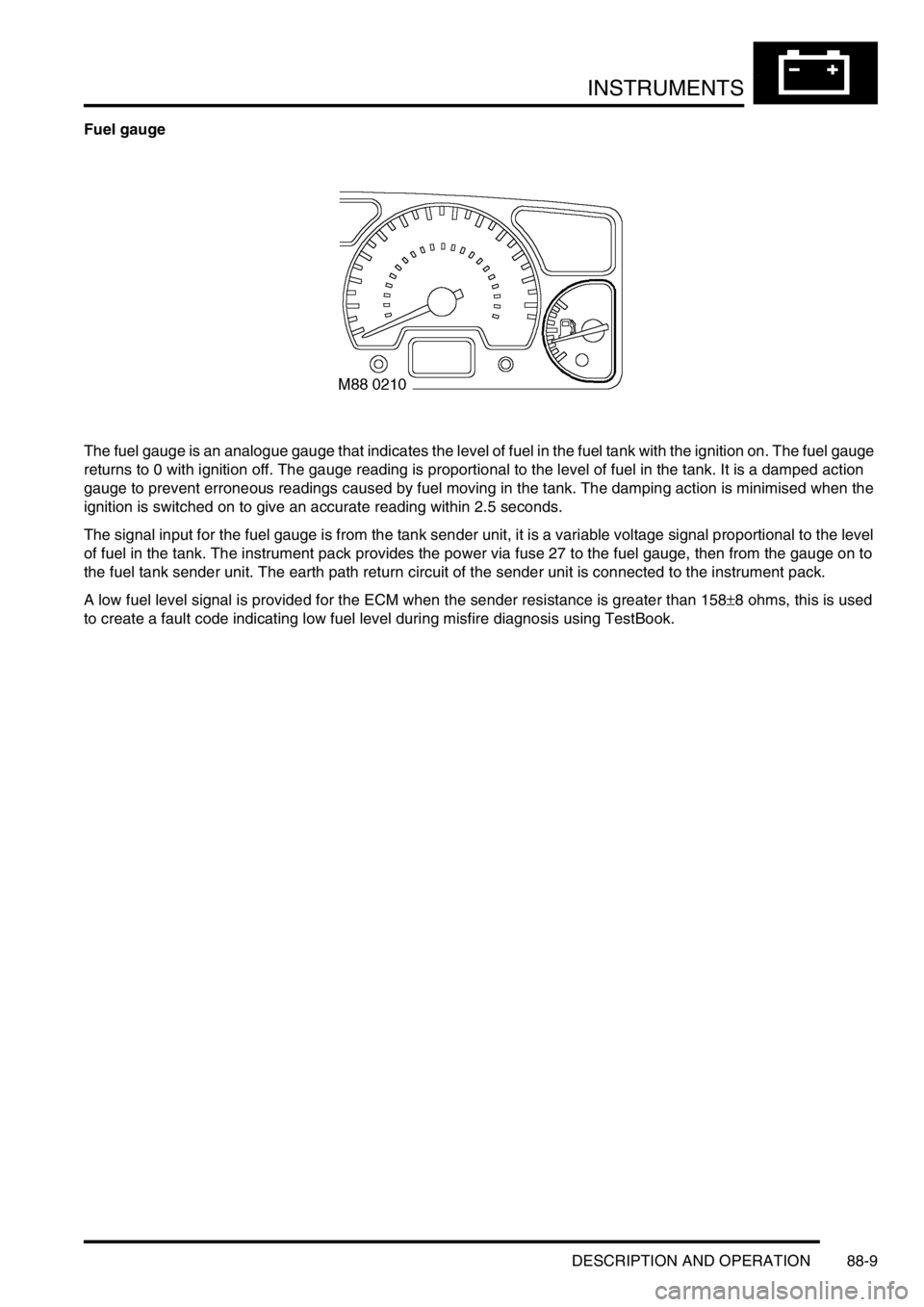
Fuel gauge
The fuel gauge is an analogue gauge that indicates the level of fuel in the fuel tank with the ignition on. The fuel gauge
returns to 0 with ignition off. The gauge reading is proportional to the level of fuel in the tank. It is a damped action
gauge to prevent erroneous readings caused by fuel moving in the tank. The damping action is minimised when the
ignition is switched on to give an accurate reading within 2.5 seconds.
The signal input for the fuel gauge is from the tank sender unit, it is a variable voltage signal proportional to the level
of fuel in the tank. The instrument pack provides the power via fuse 27 to the fuel gauge, then from the gauge on to
the fuel tank sender unit. The earth path return circuit of the sender unit is connected to the instrument pack.
A low fuel level signal is provided for the ECM when the sender resistance is greater than 158
±8 ohms, this is used
to create a fault code indicating low fuel level during misfire diagnosis using TestBook.
Page 1637 of 1672
INSTRUMENTS
88-10 DESCRIPTION AND OPERATION
Fuel tank sender unit
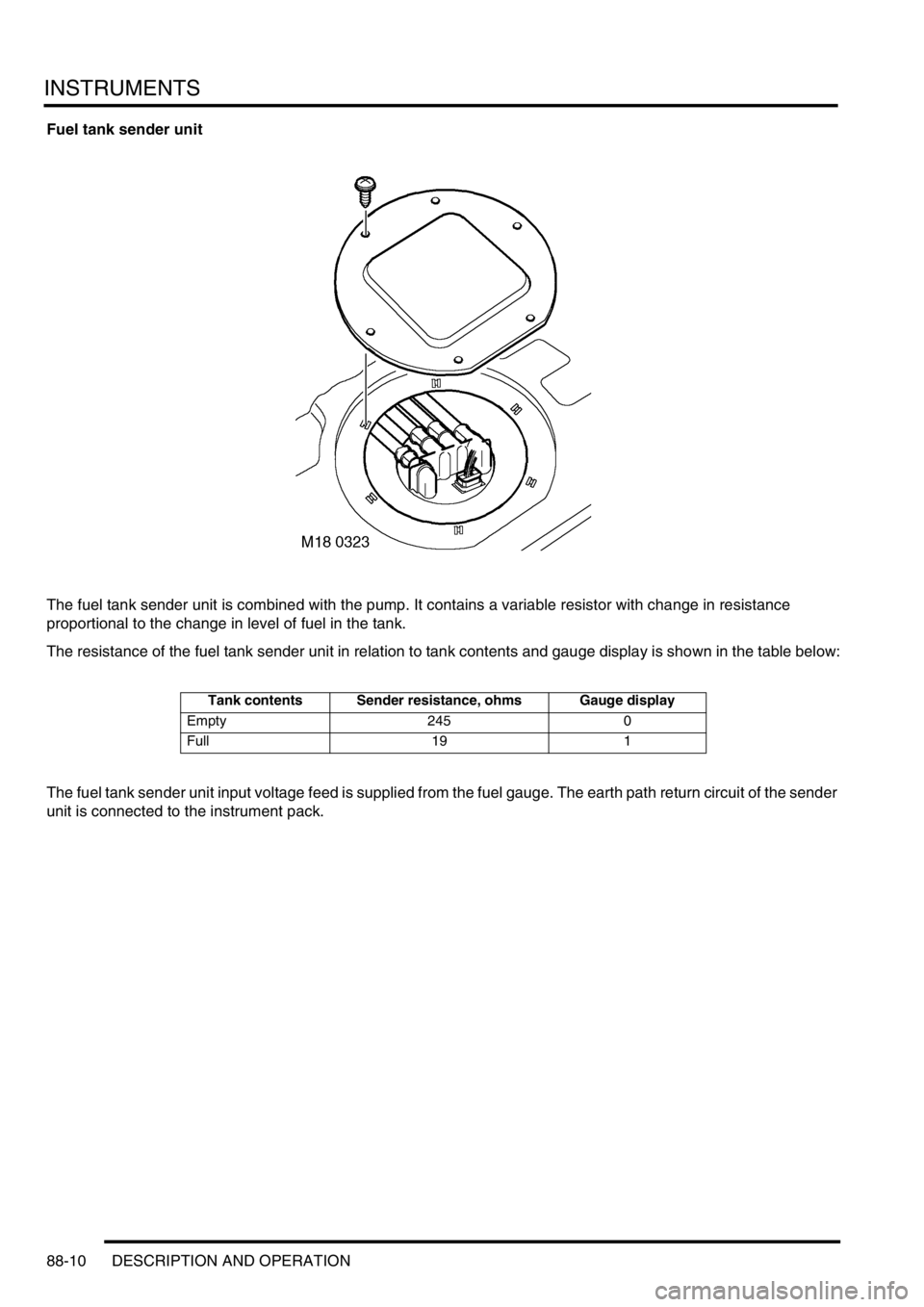
The fuel tank sender unit is combined with the pump. It contains a variable resistor with change in resistance
proportional to the change in level of fuel in the tank.
The resistance of the fuel tank sender unit in relation to tank contents and gauge display is shown in the table below:
The fuel tank sender unit input voltage feed is supplied from the fuel gauge. The earth path return circuit of the sender
unit is connected to the instrument pack.
Tank contents Sender resistance, ohms Gauge display
Empty 245 0
Full 19 1
Page 1638 of 1672
INSTRUMENTS
DESCRIPTION AND OPERATION 88-11
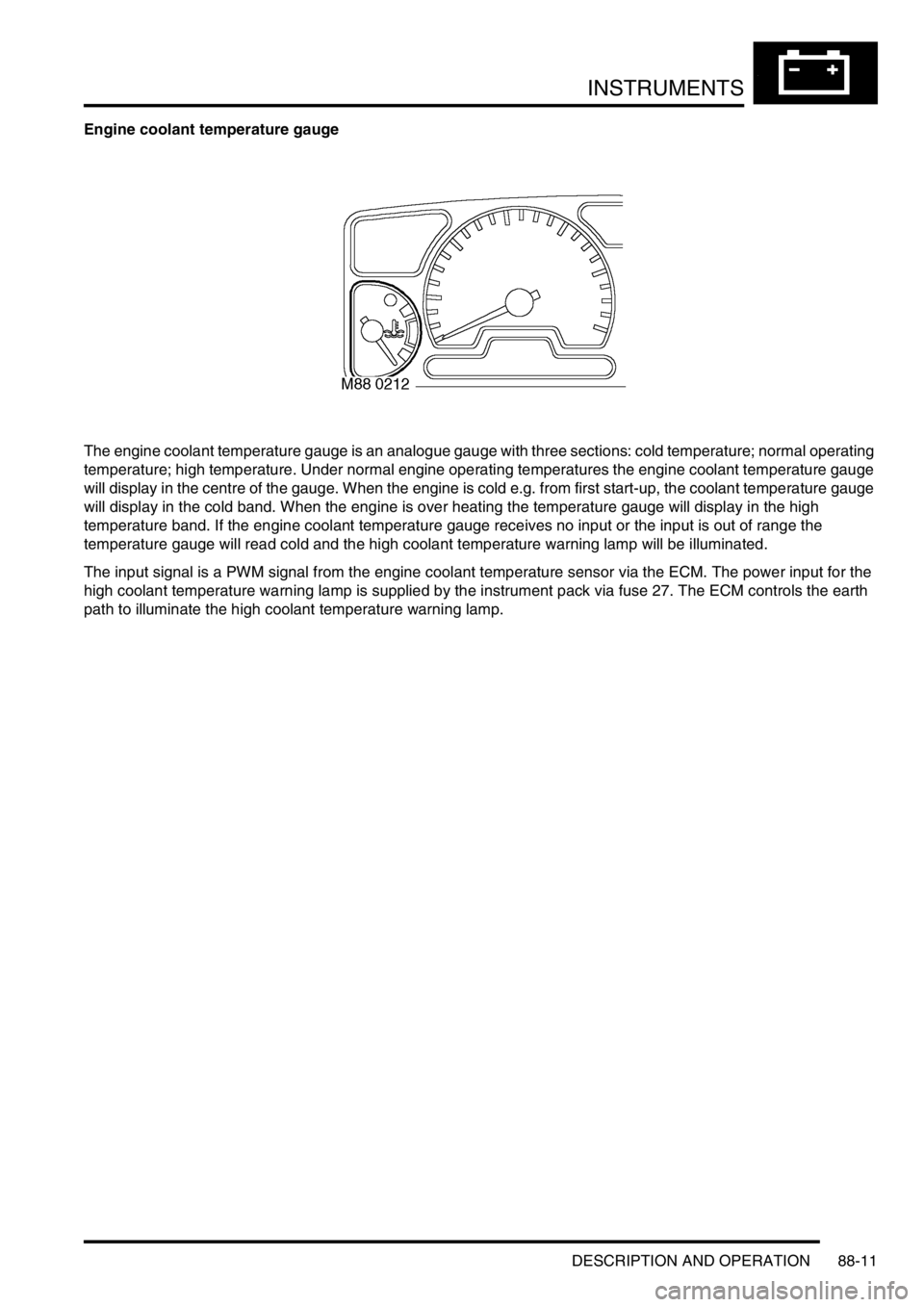
Engine coolant temperature gauge
The engine coolant temperature gauge is an analogue gauge with three sections: cold temperature; normal operating
temperature; high temperature. Under normal engine operating temperatures the engine coolant temperature gauge
will display in the centre of the gauge. When the engine is cold e.g. from first start-up, the coolant temperature gauge
will display in the cold band. When the engine is over heating the temperature gauge will display in the high
temperature band. If the engine coolant temperature gauge receives no input or the input is out of range the
temperature gauge will read cold and the high coolant temperature warning lamp will be illuminated.
The input signal is a PWM signal from the engine coolant temperature sensor via the ECM. The power input for the
high coolant temperature warning lamp is supplied by the instrument pack via fuse 27. The ECM controls the earth
path to illuminate the high coolant temperature warning lamp.
Page 1642 of 1672
INSTRUMENTS
DESCRIPTION AND OPERATION 88-15
Instrument illumination
Dimmer switch
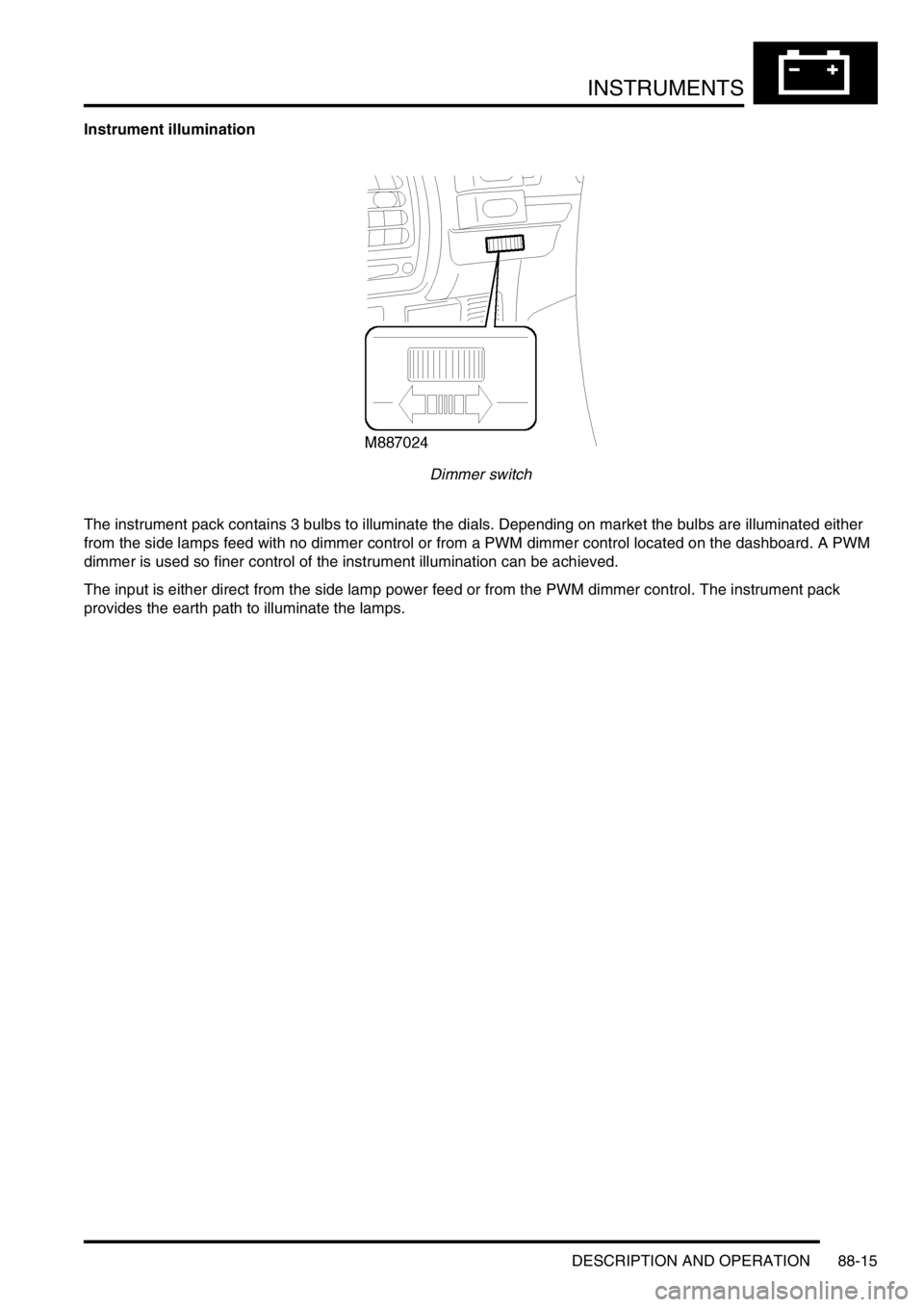
The instrument pack contains 3 bulbs to illuminate the dials. Depending on market the bulbs are illuminated either
from the side lamps feed with no dimmer control or from a PWM dimmer control located on the dashboard. A PWM
dimmer is used so finer control of the instrument illumination can be achieved.
The input is either direct from the side lamp power feed or from the PWM dimmer control. The instrument pack
provides the earth path to illuminate the lamps.
Page 1643 of 1672
INSTRUMENTS
88-16 DESCRIPTION AND OPERATION
Direction indicator warning lamps
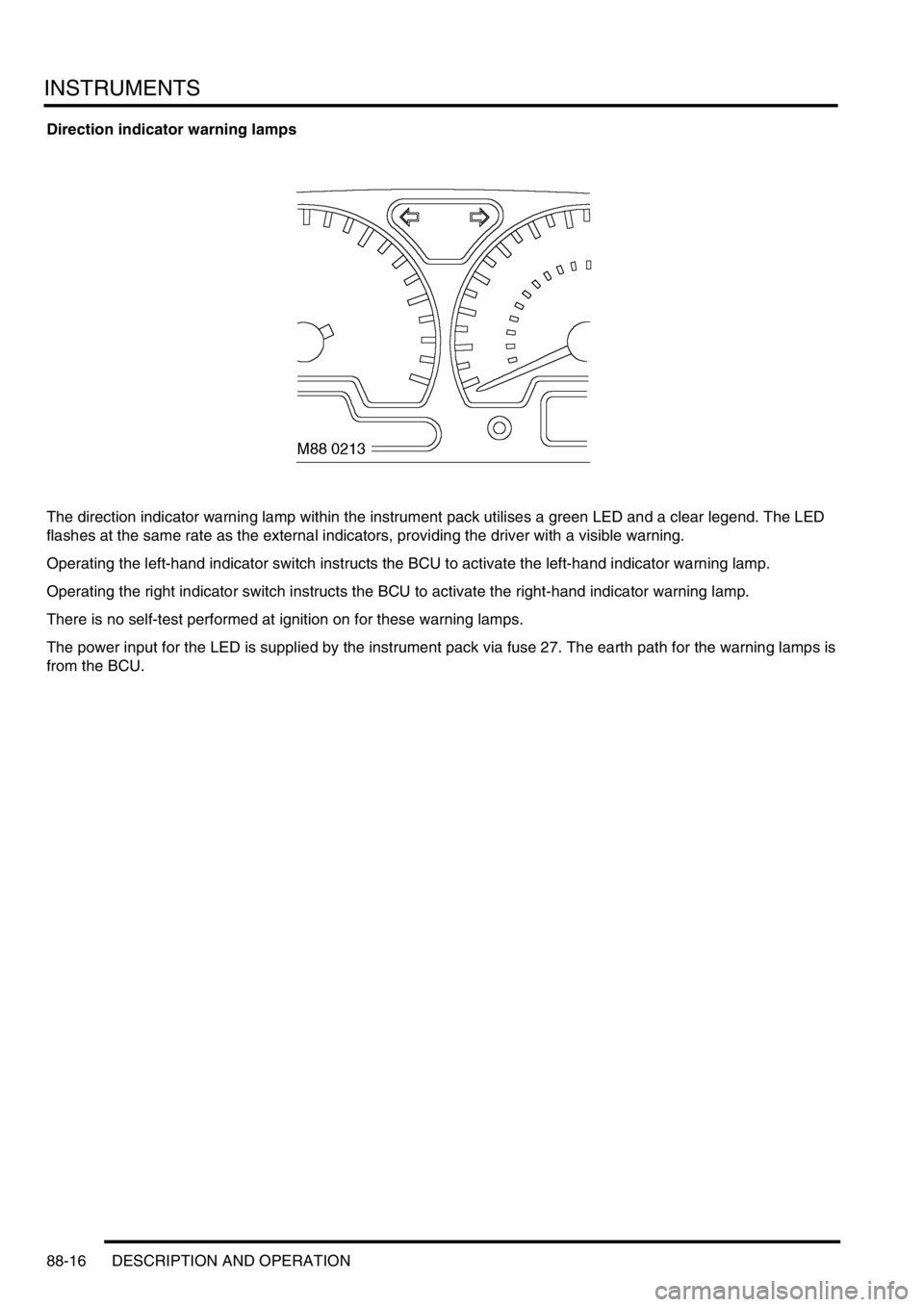
The direction indicator warning lamp within the instrument pack utilises a green LED and a clear legend. The LED
flashes at the same rate as the external indicators, providing the driver with a visible warning.
Operating the left-hand indicator switch instructs the BCU to activate the left-hand indicator warning lamp.
Operating the right indicator switch instructs the BCU to activate the right-hand indicator warning lamp.
There is no self-test performed at ignition on for these warning lamps.
The power input for the LED is supplied by the instrument pack via fuse 27. The earth path for the warning lamps is
from the BCU.
Page 1644 of 1672
INSTRUMENTS
DESCRIPTION AND OPERATION 88-17
Main beam warning lamp
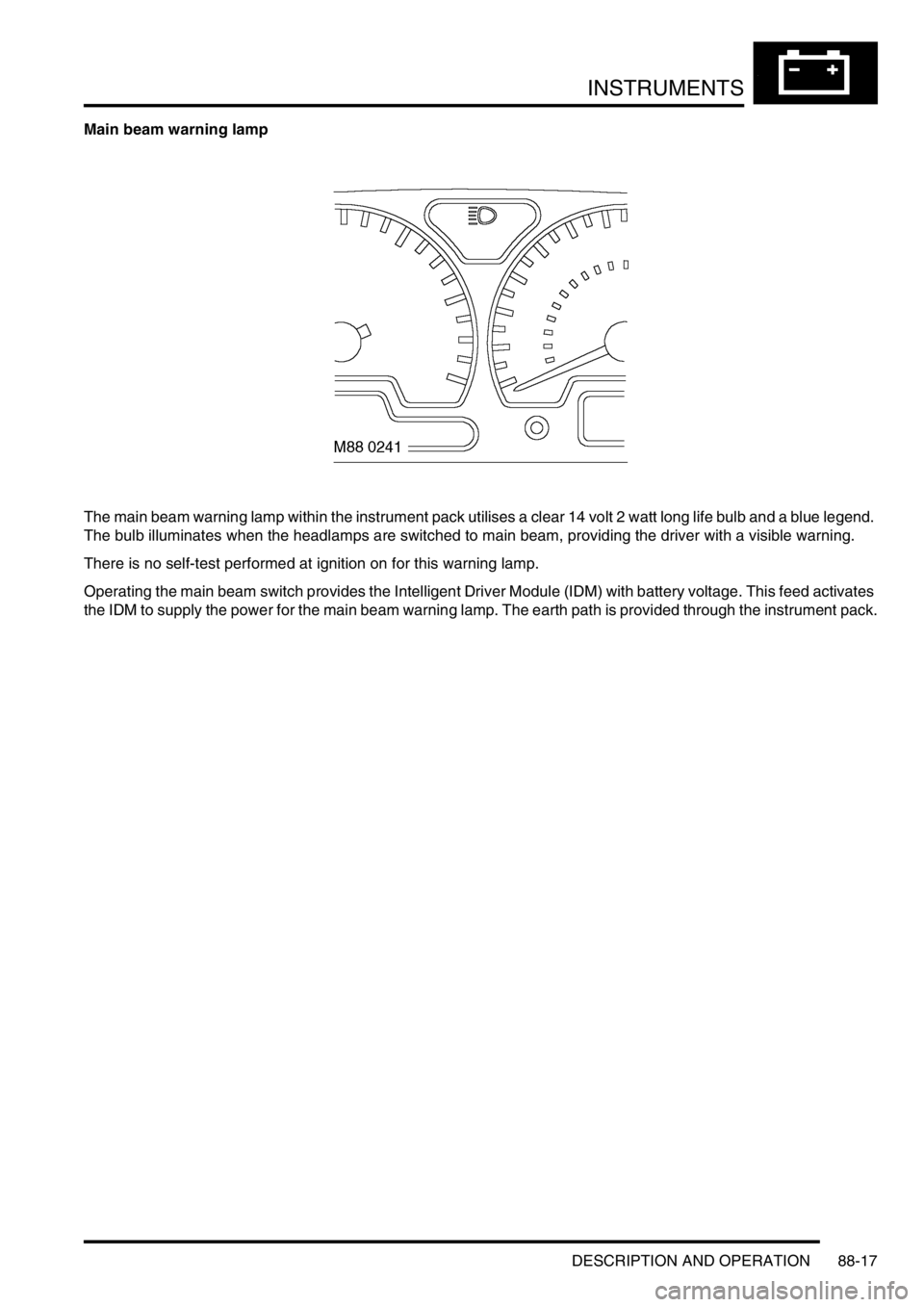
The main beam warning lamp within the instrument pack utilises a clear 14 volt 2 watt long life bulb and a blue legend.
The bulb illuminates when the headlamps are switched to main beam, providing the driver with a visible warning.
There is no self-test performed at ignition on for this warning lamp.
Operating the main beam switch provides the Intelligent Driver Module (IDM) with battery voltage. This feed activates
the IDM to supply the power for the main beam warning lamp. The earth path is provided through the instrument pack.