2002 JEEP LIBERTY evi c
[x] Cancel search: evi cPage 1 of 1803

JEEP
ž
2002
LIBERTY
SERVICE MANUAL and
2.4L GAS SUPPLEMENT
To order the special service tools used and
illustrated, please refer to the instructions on
inside back cover.
NO PART OF THIS PUBLICATION MAY BE
REPRODUCED, STORED IN A RETRIEVAL
SYSTEM, OR TRANSMITTED, IN ANY FORM OR
BY ANY MEANS, ELECTRONIC, MECHANICAL,
PHOTOCOPYING, RECORDING, OR OTHERWISE,
WITHOUT THE PRIOR WRITTEN PERMISSION
OF DAIMLERCHRYSLER CORPORATION.
DaimlerChrysler Corporation reserves the right to make changes in design or
to make additions to or improvements in its products without imposing any
obligations upon itself to install them on its products previously manufac-
tured.
Litho in U.S.A. Copyright 2001 DaimlerChrysler Corporation
7.5M0901
Page 17 of 1803

FLUID FILL/CHECK
LOCATIONS
DESCRIPTION
The fluid check/fill point locations are located in
each applicable service manual section.
MAINTENANCE SCHEDULES
DESCRIPTION
9Maintenance Schedule Information not included in
this section, is located in the appropriate Owner's
Manual.9
HOISTING
STANDARD PROCEDURE - HOISTING
RECOMMENDATIONS
Refer to the Owner's Manual for emergency vehicle
lifting procedures.
When properly positioned, a floor jack can be used
to lift a Jeep vehicle (Fig. 4). Support the vehicle in
the raised position with jack stands at the front and
rear ends of the frame rails.CAUTION: Do not attempt to lift a Jeep vehicle with
a floor jack positioned under:
²A body side sill.
²A steering linkage component.
²A drive shaft.
²The engine or transmission oil pan.
²The fuel tank.
²A front suspension arm.
²Transfer case.
NOTE: Use the correct sub-frame rail or frame rail
lifting locations only.
HOIST
Refer to the Owner's Manual for emergency vehicle
lifting procedures.
A vehicle can be lifted with:
²A single-post, frame-contact hoist.
²A twin-post, chassis hoist.
²A ramp-type, drive-on hoist.
NOTE: When a frame-contact type hoist is used,
verify that the lifting pads are positioned properly.
WARNING: THE HOISTING AND JACK LIFTING
POINTS PROVIDED ARE FOR A COMPLETE VEHI-
CLE. WHEN A CHASSIS OR DRIVETRAIN COMPO-
NENT IS REMOVED FROM A VEHICLE, THE
CENTER OF GRAVITY IS ALTERED MAKING SOME
HOISTING CONDITIONS UNSTABLE. PROPERLY
SUPPORT OR SECURE VEHICLE TO HOISTING
DEVICE WHEN THESE CONDITIONS EXIST.
Fig. 4 Correct Vehicle Lifting Locations
1 - Frame Contact Lift (Single Post)
Chassis Lift (Non-Axle Dual Post)
Outboard Lift (Dual Post)
Floor Jack
2 - Floor Jack
KJLUBRICATION & MAINTENANCE 0 - 5
Page 18 of 1803

JUMP STARTING
STANDARD PROCEDURE - JUMP STARTING
PROCEDURE
WARNING: REVIEW ALL SAFETY PRECAUTIONS
AND WARNINGS IN GROUP 8A, BATTERY/START-
ING/CHARGING SYSTEMS DIAGNOSTICS.
²DO NOT JUMP START A FROZEN BATTERY,
PERSONAL INJURY CAN RESULT.
²DO NOT JUMP START WHEN BATTERY INDI-
CATOR DOT IS YELLOW OR BRIGHT COLOR. BAT-
TERY CAN EXPLODE.
²DO NOT ALLOW JUMPER CABLE CLAMPS TO
TOUCH EACH OTHER WHEN CONNECTED TO A
BOOSTER SOURCE.
²DO NOT USE OPEN FLAME NEAR BATTERY.
²REMOVE METALLIC JEWELRY WORN ON
HANDS OR WRISTS TO AVOID INJURY BY ACCI-
DENTAL ARCHING OF BATTERY CURRENT.
²WHEN USING A HIGH OUTPUT BOOSTING
DEVICE, DO NOT ALLOW DISABLED VEHICLE'S
BATTERY TO EXCEED 16 VOLTS. PERSONAL
INJURY OR DAMAGE TO ELECTRICAL SYSTEM
CAN RESULT.
CAUTION: When using another vehicle as a
booster, do not allow vehicles to touch. Electrical
systems can be damaged on either vehicle.
TO JUMP START A DISABLED VEHICLE:
(1) Raise hood on disabled vehicle and visually
inspect engine compartment for:
²Generator drive belt condition and tension.
²Fuel fumes or leakage, correct if necessary.
²Frozen battery.
²Yellow or bright color test indicator, if equipped.
²Low battery fluid level.
CAUTION: If the cause of starting problem on dis-
abled vehicle is severe, damage to booster vehicle
charging system can result.
(2) When using another vehicle as a booster
source, turn off all accessories, place gear selector in
park or neutral, set park brake or equivalent and
operate engine at 1200 rpm.
(3) On disabled vehicle, place gear selector in park
or neutral and set park brake or equivalent. Turn
OFF all accessories.
(4) Connect jumper cables to booster battery. RED
clamp to positive terminal (+). BLACK clamp to neg-
ative terminal (-). DO NOT allow clamps at opposite
end of cables to touch, electrical arc will result (Fig.
5). Review all warnings in this procedure.(5) On disabled vehicle, connect RED jumper cable
clamp to battery positive (+) terminal. Connect
BLACK jumper cable clamp to the engine as close to
the ground cable connection as possible (Fig. 5).
CAUTION: Do not crank starter motor on disabled
vehicle for more than 15 seconds, starter will over-
heat and could fail.
(6) Allow battery in disabled vehicle to charge to
at least 12.4 volts (75% charge) before attempting to
start engine. If engine does not start within 15 sec-
onds, stop cranking engine and allow starter to cool
(15 min.), before cranking again.
DISCONNECT CABLE CLAMPS AS FOLLOWS:
²Disconnect BLACK cable clamp from engine
ground on disabled vehicle.
²When using a Booster vehicle, disconnect
BLACK cable clamp from battery negative terminal.
Disconnect RED cable clamp from battery positive
terminal.
²Disconnect RED cable clamp from battery posi-
tive terminal on disabled vehicle.
TOWING
STANDARD PROCEDURE - TOWING
A vehicle equipped with SAE approved wheel lift-
type towing equipment can be used to tow Jeep vehi-
cles. When towing a 4WD vehicle using a wheel-lift
Fig. 5 Jumper Cable Clamp Connections
1 - BOOSTER BATTERY
2 - NEGATIVE JUMPER CABLE
3 - ENGINE GROUND
4 - DO NOT ALLOW VEHICLES TO TOUCH
5 - BATTERY NEGATIVE CABLE
6 - DISCHARGED BATTERY
7 - POSITIVE JUMPER CABLE
0 - 6 LUBRICATION & MAINTENANCEKJ
Page 19 of 1803

towing device, use tow dollies under the opposite end
of the vehicle. A vehicle with flatbed device can also
be used to transport a disabled vehicle (Fig. 6).
SAFETY PRECAUTIONS
CAUTION: The following safety precautions must be
observed when towing a vehicle:
²Secure loose and protruding parts.
²Always use a safety chain system that is inde-
pendent of the lifting and towing equipment.
²Do not allow towing equipment to contact the
disabled vehicle's fuel tank.
²Do not allow anyone under the disabled vehicle
while it is lifted by the towing device.
²Do not allow passengers to ride in a vehicle
being towed.
²Always observe state and local laws regarding
towing regulations.
²Do not tow a vehicle in a manner that could
jeopardize the safety of the operator, pedestrians or
other motorists.
²Do not attach tow chains, T-hooks, or J-hooks to
a bumper, steering linkage, drive shafts or a non-re-
inforced frame hole.
²Do not tow a heavily loaded vehicle. Use a flat-
bed device to transport a loaded vehicle.
TWO-WHEEL-DRIVE VEHICLE TOWING
DaimlerChrysler Corporation recommends that a
vehicle be towed with the rear end lifted, whenever
possible.
WARNING: WHEN TOWING A DISABLED VEHICLE
AND THE DRIVE WHEELS ARE SECURED IN A
WHEEL LIFT OR TOW DOLLIES, ENSURE THE
TRANSMISSION IS IN THE PARK POSITION (AUTO-
MATIC TRANSMISSION) OR A FORWARD DRIVE
GEAR (MANUAL TRANSMISSION).WARNING: ENSURE VEHICLE IS ON A LEVEL SUR-
FACE OR THE WHEELS ARE BLOCKED TO PRE-
VENT VEHICLE FROM ROLLING.
TWO WHEEL DRIVE TOWING-REAR END LIFTED
CAUTION: Do not use steering column lock to
secure steering wheel during towing operation.
2WD vehicles can be towed with the front wheels
on the surface for extended distances at speeds not
exceeding 48 km/h (30 mph).
(1) Attach wheel lift device to rear wheels.
(2) Place the transmission in neutral.
(3) Raise vehicle to towing position.
(4) Attach safety chains. Route chains so not to
interfere with tail pipe when vehicle is lifted.
(5) Turn the ignition switch to the OFF position to
unlock the steering wheel.
CAUTION: Do not use steering column lock to
secure steering wheel during towing operation.
(6) Secure steering wheel in straight ahead posi-
tion with a clamp device designed for towing.
(7) Place transmission in park.
TWO WHEEL DRIVE TOWING-FRONT END LIFTED
CAUTION: Many vehicles are equipped with air
dams, spoilers, and/or ground effect panels. To
avoid component damage, a wheel-lift towing vehi-
cle or a flat-bed hauling vehicle is recommended.
(1) Attach wheel lift device to rear wheels.
(2) Place the transmission in neutral.
(3) Raise the rear of the vehicle off the ground and
install tow dollies under rear wheels.
(4) Attach wheel lift device to front wheels and
raise vehicle to towing position.
(5) Attach the safety chains.
CAUTION: Do not use steering column lock to
secure steering wheel during towing operation.
(6) Turn the ignition switch to the OFF position to
unlock the steering wheel.
(7) Secure steering wheel in straight ahead posi-
tion with a clamp device designed for towing.
(8) Place transmission in park.
FOUR-WHEEL-DRIVE VEHICLE TOWING
DaimlerChrysler Corporation recommends that a
4WD vehicle be transported on a flat-bed device. A
Wheel-lift device can be used providedthe trailing
wheels are off the ground and positioned in
tow dollies.
Fig. 6 Tow Vehicles With Approved Equipment
KJLUBRICATION & MAINTENANCE 0 - 7
TOWING (Continued)
Page 20 of 1803

WARNING: WHEN TOWING A DISABLED VEHICLE
AND THE DRIVE WHEELS ARE SECURED IN A
WHEEL LIFT OR TOW DOLLIES, ENSURE THE
TRANSMISSION IS IN THE PARK POSITION.
CAUTION: Many vehicles are equipped with air
dams, spoilers, and/or ground effect panels. To
avoid component damage, a wheel-lift towing vehi-
cle or a flat-bed hauling vehicle is recommended.
FOUR WHEEL DRIVE TOWINGÐREAR END LIFTED
WARNING: ENSURE VEHICLE IS ON A LEVEL SUR-
FACE OR THE WHEELS ARE BLOCKED TO PRE-
VENT VEHICLE FROM ROLLING.
(1) Attach wheel lift device to front wheels.
(2) Place the transmission in neutral.
(3) Raise the front of the vehicle off the ground
and install tow dollies under front wheels.
(4) Attach wheel lift device to rear wheels and
raise vehicle to towing position.
(5) Attach safety chains. Route chains so not to
interfere with tail pipe when vehicle is lifted.
(6) Turn the ignition switch to the OFF position to
unlock the steering wheel.
CAUTION: Do not use steering column lock to
secure steering wheel during towing operation.(7) Secure steering wheel in straight ahead posi-
tion with a clamp device designed for towing.
(8) Place transmission in park.
FOUR WHEEL DRIVE TOWINGÐFRONT END
LIFTED
WARNING: ENSURE VEHICLE IS ON A LEVEL SUR-
FACE OR THE WHEELS ARE BLOCKED TO PRE-
VENT VEHICLE FROM ROLLING.
(1) Attach wheel lift device to rear wheels.
(2) Place the transmission in neutral.
(3) Raise the rear of the vehicle off the ground and
install tow dollies under rear wheels.
(4) Attach wheel lift device to front wheels and
raise vehicle to towing position.
(5) Attach the safety chains.
CAUTION: Do not use steering column lock to
secure steering wheel during towing operation.
(6) Turn the ignition switch to the OFF position to
unlock the steering wheel.
(7) Secure steering wheel in straight ahead posi-
tion with a clamp device designed for towing.
(8) Place transmission in park.
0 - 8 LUBRICATION & MAINTENANCEKJ
TOWING (Continued)
Page 27 of 1803

FRONT
TABLE OF CONTENTS
page page
FRONT
DESCRIPTION..........................7
WARNING.............................7
SPECIFICATIONS
TORQUE CHART......................8
SPECIAL TOOLS
FRONT SUSPENSION...................8
BUSHINGS
REMOVAL - STABILIZER BAR BUSHINGS.....9
INSTALLATION - STABILIZER BAR BUSHINGS . . 9
HUB / BEARING
REMOVAL.............................9
INSTALLATION..........................9
KNUCKLE
REMOVAL.............................9
INSTALLATION..........................9
LOWER BALL JOINT
DIAGNOSIS AND TESTING - LOWER BALL
JOINT..............................10
LOWER CONTROL ARM
REMOVAL.............................10
INSTALLATION.........................10
SHOCK
REMOVAL
REMOVAL - LEFT SIDE.................11REMOVAL - RIGHT SIDE................11
INSTALLATION
INSTALLATION - LEFT SIDE.............12
INSTALLATION - RIGHT SIDE............12
SPRING
REMOVAL.............................13
INSTALLATION.........................13
CLEVIS BRACKET
REMOVAL.............................13
INSTALLATION.........................13
STABILIZER BAR
REMOVAL.............................14
INSTALLATION.........................14
STABILIZER LINK
REMOVAL.............................14
INSTALLATION.........................14
UPPER CONTROL ARM
REMOVAL
REMOVAL - RIGHT SIDE................14
REMOVAL - LEFT SIDE.................15
INSTALLATION
INSTALLATION - RIGHT SIDE............15
INSTALLATION - LEFT SIDE.............15
FRONT
DESCRIPTION
The front suspension is designed to allow each
wheel to adapt to different road surfaces indepen-
dently. The wheels are mounted to hub bearings on
the steering knuckle spindles. The double-row hub
bearings are sealed and lubricated for life. The steer-
ing knuckles turn (pivot) on ball joints riveted to the
outboard portion of the control arms. The ball joints
are lubricated for life. (Fig. 1)
WARNING
WARNING:: Suspension components with rubber
bushings must be tightened with the vehicle at nor-
mal ride height. It is important to have the springs
supporting the weight of the vehicle when the fas-
teners are torqued. If springs are not at their normal
ride position, vehicle ride comfort will be affected
and cause premature bushing wear.
Fig. 1 FRONT SUSPENSION
1-SWAYBAR
2 - SWAY BAR BUSHING/BRACKET
3 - UPPER CONTROL ARM
4 - SPRING / SHOCK ASSEMBLY
5 - STEERING KNUCKLE
6 - OUTER TIE ROD END
7 - LOWER CONTROL ARM
8 - SWAY BAR LINK
9 - CLEVIS BRACKET
KJFRONT 2 - 7
Page 28 of 1803
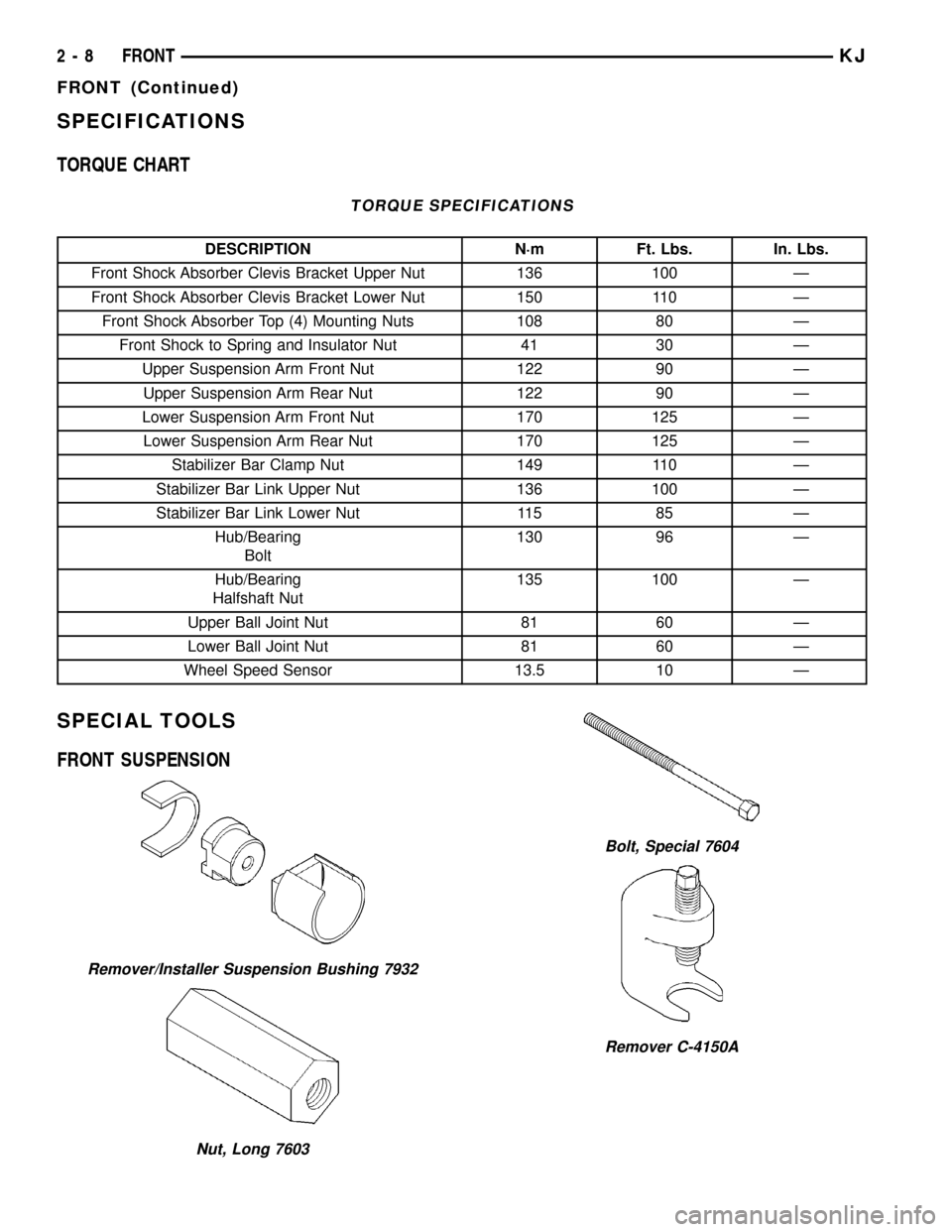
SPECIFICATIONS
TORQUE CHART
TORQUE SPECIFICATIONS
DESCRIPTION N´m Ft. Lbs. In. Lbs.
Front Shock Absorber Clevis Bracket Upper Nut 136 100 Ð
Front Shock Absorber Clevis Bracket Lower Nut 150 110 Ð
Front Shock Absorber Top (4) Mounting Nuts 108 80 Ð
Front Shock to Spring and Insulator Nut 41 30 Ð
Upper Suspension Arm Front Nut 122 90 Ð
Upper Suspension Arm Rear Nut 122 90 Ð
Lower Suspension Arm Front Nut 170 125 Ð
Lower Suspension Arm Rear Nut 170 125 Ð
Stabilizer Bar Clamp Nut 149 110 Ð
Stabilizer Bar Link Upper Nut 136 100 Ð
Stabilizer Bar Link Lower Nut 115 85 Ð
Hub/Bearing
Bolt130 96 Ð
Hub/Bearing
Halfshaft Nut135 100 Ð
Upper Ball Joint Nut 81 60 Ð
Lower Ball Joint Nut 81 60 Ð
Wheel Speed Sensor 13.5 10 Ð
SPECIAL TOOLS
FRONT SUSPENSION
Remover/Installer Suspension Bushing 7932
Nut, Long 7603
Bolt, Special 7604
Remover C-4150A
2 - 8 FRONTKJ
FRONT (Continued)
Page 30 of 1803

(5) Install the hub/bearing. (Refer to 2 - SUSPEN-
SION/FRONT/HUB / BEARING - INSTALLATION).
(6) Install the axle shaft nut. Tighten the nut to
135 N´m (96 ft.lbs.).(if equipped with four wheel
drive).
(7) Install the wheel speed sensor. (Refer to 5 -
BRAKES/ELECTRICAL/FRONT WHEEL SPEED
SENSOR - INSTALLATION).
(8) Install the disc brake rotor. (Refer to 5 -
BRAKES/HYDRAULIC/MECHANICAL/ROTORS -
INSTALLATION).
(9) Install the caliper adapter. (Refer to 5 -
BRAKES/HYDRAULIC/MECHANICAL/DISC
BRAKE CALIPER ADAPTER - INSTALLATION).
(10) Install the tire and wheel assembly. (Refer to
22 - TIRES/WHEELS/WHEELS - STANDARD PRO-
CEDURE).
(11) Perform the set toe procedure (Refer to 2 -
SUSPENSION/WHEEL ALIGNMENT - STANDARD
PROCEDURE).
LOWER BALL JOINT
DIAGNOSIS AND TESTING - LOWER BALL
JOINT
(1) Raise the vehicle on a drive-on hoist.
NOTE: If a drive-on hoist is not available, use
wooden blocks with jack stands to support the
lower control arm in the ball joint area. Place the
jack stands appropriately and lower the hoist plac-
ing weight on the lower control arm. The lower con-
trol arms should now be supporting the vehicle
weight.
(2) With the use of jack stands, lift the front end
off the hoist and position wooden blocks underneath
both lower control arms supporting the vehicles
weight.
(3) Remove the tire and wheel assembly.
(4) Attach a dial indicator to the base of the lower
control arm and align the dial indicator's contact
point with the direction of the stud axis, touch the
machined flat on the knuckle and zero the dial indi-
cator. (Fig. 2)
NOTE: Use care when applying the load to the
knuckle, so the parts are not damaged using care
not to tear the boot.
(5) From the front of the vehicle, insert a pry bar
to get it rested on the lower control arm and use
lever principle to push the knuckle up until the arm
of the dial indicator no longer moves.(6) Record the ball joint movement on each side of
the vehicle. The end play is acceptable with no more
than 1.5mm of end play back to back.LOWER CONTROL ARM
REMOVAL
(1) Raise and support the vehicle.
(2) Remove the tire and wheel assembly.
(3) Remove the lower clevis bracket bolt at the
lower control arm.
(4) Remove the stabilizer link bolt at the lower
control arm.
(5) Remove the lower ball joint nut.
(6) Separate the lower ball joint from the lower
control arm using tool C-4150A.
NOTE: Marking the lower control arm pivot bolts
front and rear will aid in the assembly procedure.
(7) Mark the lower control arm pivot bolts front
and rear.
(8) Remove the front cam/pivot bolt. (Fig. 3)
(9) Remove the rear cam/pivot bolt. (Fig. 3)
(10) Remove the lower control arm from the vehi-
cle.
INSTALLATION
(1) Install the lower control arm to the vehicle.
(2) Install the rear cam/pivot bolt.
(3) Install the front cam/pivot bolt.
(4) Install the lower ball joint nut. Tighten the nut
to 81 N´m (60 ft.lbs.)
Fig. 2 SUSPENSION IN THE CURB POSITION
1-PRYBAR
2 - BALL JOINT
3 - DIAL INDICATOR
4 - WOODEN BLOCK OR SUPPORT
5 - CLAMP
2 - 10 FRONTKJ
KNUCKLE (Continued)