2002 JEEP LIBERTY evi c
[x] Cancel search: evi cPage 31 of 1803

(5) Align the marks front and rear at the cam/
pivot bolts and tighten the bolts. Tighten the bolts to
170 N´m (125 ft.lbs.)
(6) Install the stabilizer link bolt at the lower con-
trol arm. Tighten the bolt to 136 N´m (100 ft.lbs.)
(7) Install the lower clevis bracket bolt at the
lower control arm. Tighten the bolt to 150 N´m (110
ft.lbs.)
(8) Install the tire and wheel assembly. (Refer to
22 - TIRES/WHEELS/WHEELS - STANDARD PRO-
CEDURE).
(9) Perform a full wheel alignment (Refer to 2 -
SUSPENSION/WHEEL ALIGNMENT - STANDARD
PROCEDURE).
SHOCK
REMOVAL
REMOVAL - LEFT SIDE
(1) Disconnect the battery.
(2) Remove the battery (Refer to 8 - ELECTRI-
CAL/BATTERY SYSTEM/BATTERY - REMOVAL).
(3) Unclip the power center and move it to the side
out of the way.
(4) Remove the battery tray (Refer to 8 - ELEC-
TRICAL/BATTERY SYSTEM/TRAY - REMOVAL).
(5) Disconnect the battery temperature sensor
from the battery tray.
(6) Remove the four upper shock mounting nuts.
(7) Raise and support the vehicle.(8) Remove the left tire and wheel assembly.
(9) Remove the lower bolt at the lower control
securing the clevis bracket.
(10) Remove the stabilizer link (Refer to 2 - SUS-
PENSION/FRONT/STABILIZER LINK - REMOVAL).
(11) Remove the lower ball joint nut.
(12) Seperate the lower ball joint from the lower
control arm using tool C-4150A.
(13) Rotate the lower control arm downward to
allow access.
(14) Remove the clevis bracket at the shock.
(15) Remove the shock assembly from the vehicle.
(Fig. 4)
(16) Remove the spring from the shock (if needed).
REMOVAL - RIGHT SIDE
(1) Remove the air box (Refer to 9 - ENGINE/AIR
INTAKE SYSTEM/AIR CLEANER ELEMENT -
REMOVAL).
(2) Remove the two cruise control servo mounting
nuts.
(3) Remove the upper shock mounting nuts.
(4) Raise and support the vehicle.
(5) Remove the right side tire assembly.
(6) Remove the lower bolt at the lower control
securing the clevis bracket.
(7) Remove the stabilizer link (Refer to 2 - SUS-
PENSION/FRONT/STABILIZER LINK - REMOVAL).
(8) Remove the lower ball joint nut.
(9) Seperate the lower ball joint from the lower
control arm using tool C-4150A.
(10) Rotate the lower control arm downward to
allow access.
Fig. 3 LOWER CONTROL ARM
1 - FRONT CAM BOLT
2 - OUTER TIE ROD END
3 - LOWER BALL JOINT NUT
4 - LOWER CONTROL ARM
5 - REAR CAM BOLT
Fig. 4 SHOCK ASSEMBLY
1 - SPRING
2 - JOUNCE BUMPER
3 - SHOCK
4 - UPPER CONTROL ARM
KJFRONT 2 - 11
LOWER CONTROL ARM (Continued)
Page 32 of 1803

(11) Remove the clevis bracket at the shock. (Fig.
5)
(12) Remove the shock assembly from the vehicle.
(Fig. 5)
(13) Remove the spring from the shock (if needed).
(Refer to 2 - SUSPENSION/FRONT/SPRING -
REMOVAL).
INSTALLATION
INSTALLATION - LEFT SIDE
(1) Install the spring to the shock (if removed).
(2) Install the shock assembly to the vehicle.
(3) Install the four upper shock mounting nuts.
Tighten the nuts to 108 N´m (80 ft.lbs.).
(4) Install the clevis bracket at the shock. (Refer to
2 - SUSPENSION/FRONT/CLEVIS BRACKET -
INSTALLATION). Tighten the bolt to 88 N´m (65
ft.lbs.).
(5) Raise the lower control into place and recon-
nect the lower ball joint nut. Tighten the nut to 81
N´m (60 ft.lbs.).
(6) Install the clevis bracket at the lower control
arm. (Refer to 2 - SUSPENSION/FRONT/CLEVIS
BRACKET - INSTALLATION). Tighten the bolt to
150 N´m (110 ft.lbs.).(7) Install the lower stabilizer link at the lower
control arm. Tighten the bolt to 136 N´m (100 ft.lbs.)
(Refer to 2 - SUSPENSION/FRONT/STABILIZER
LINK - INSTALLATION).
(8) Install the left tire and wheel assembly. (Refer
to 22 - TIRES/WHEELS/WHEELS - STANDARD
PROCEDURE).
(9) Lower the vehicle.
(10) Reconnect the battery temperature sensor.
(11) Install the battery tray (Refer to 8 - ELEC-
TRICAL/BATTERY SYSTEM/TRAY - INSTALLA-
TION).
(12) Install the battery (Refer to 8 - ELECTRI-
CAL/BATTERY SYSTEM/BATTERY - INSTALLA-
TION).
(13) Reconnect the battery cables.
INSTALLATION - RIGHT SIDE
(1) Install the spring to the shock (if removed).
(Refer to 2 - SUSPENSION/FRONT/SPRING -
INSTALLATION).
(2) Install the shock assembly to the vehicle.
(3) Install the four upper shock mounting nuts.
Tighten the nuts to 108 N´m (80 ft.lbs.).
(4) Install the clevis bracket at the shock. (Refer to
2 - SUSPENSION/FRONT/CLEVIS BRACKET -
INSTALLATION). Tighten the bolt to 88 N´m (65
ft.lbs.).
(5) Raise the lower control into place and recon-
nect the lower ball joint nut. Tighten the nut to 81
N´m (60 ft.lbs.).
(6) Install the clevis bracket at the lower control
arm. (Refer to 2 - SUSPENSION/FRONT/CLEVIS
BRACKET - INSTALLATION). Tighten the bolt to
150 N´m (110 ft.lbs.).
(7) Install the lower stabilizer link at the lower
control arm. Tighten the bolt to 136 N´m (100 ft.lbs.)
(Refer to 2 - SUSPENSION/FRONT/STABILIZER
LINK - INSTALLATION).
(8) Install the right tire and wheel assembly.
(Refer to 22 - TIRES/WHEELS/WHEELS - STAN-
DARD PROCEDURE).
(9) Lower the vehicle.
(10) Install the cruise control servo mounting nuts.
(11) Install the airbox (Refer to 9 - ENGINE/AIR
INTAKE SYSTEM/AIR CLEANER ELEMENT -
INSTALLATION).
Fig. 5 SHOCK & CLEVIS ASSEMBLY
1 - FRONT CRADLE
2 - SPRING & SHOCK ASSEMBLY
3 - STEERING KNUCKLE
4 - CLEVIS BRACKET
5 - LOWER CONTROL ARM
2 - 12 FRONTKJ
SHOCK (Continued)
Page 33 of 1803

SPRING
REMOVAL
(1) Raise and support the vehicle.
(2) Remove the tire and wheel assembly.
(3) Remove the shock. Refer to the proper side
shock removal procedure being worked on. (Refer to 2
- SUSPENSION/FRONT/SHOCK - REMOVAL).
(4) Secure the shock assembly into a Pentastar
Service Equipment W-7200 Spring compressor. (Fig.
6)
(5) Compress the spring.
(6) Remove the shock mount nut.
(7) Remove the shock from the spring compressor.
(8) Transfer the necessary parts to the type of
repair being done (Insulator, Spring, shock and
mount).
INSTALLATION
(1) Install the shock to the spring and spring com-
pressor, After the transfer of the necessary parts to
the type of repair being done (Insulator, Spring,
shock and mount).
(2) Install the shock mounting nut. Tighten the
bolt to 41 N´m (30 ft.lbs.).
(3) Loosen the compressed spring.
(4) Remove the shock assembly from the spring
compressor.
(5) Install the shock to the vehicle. (Refer to 2 -
SUSPENSION/FRONT/SHOCK - INSTALLATION).
(6) Install the tire and wheel assembly. (Refer to
22 - TIRES/WHEELS/WHEELS - STANDARD PRO-
CEDURE).
(7) Remove the support and lower the vehicle.
CLEVIS BRACKET
REMOVAL
(1) Raise and support the vehicle.
(2) Remove the tire and wheel assembly.
(3) Remove the lower clevis bolt at the lower con-
trol arm. (Fig. 7)
(4) Remove the upper clevis bolt at the shock. (Fig.
7)
(5) Remove the lower stabilizer link bolt at the
lower control arm.
(6) Remove the lower ball joint nut.
(7) Seperate the lower ball joint from the lower
control arm using tool C-4150A.
(8) Swing the lower control arm downward to
allow clearence to remove the clevis braket.
(9) Remove the clevis bracket from the vehicle.
INSTALLATION
(1) Install the clevis bracket to the shock. Tighten
the bolt to 136 N´m (100 ft.lbs.) (Fig. 7).
(2) Raise the lower control arm to the lower ball
joint.
(3) Install the nut to the lower ball joint. Tighten
the nut to 81 N´m (60 ft.lbs.).
(4) Install the clevis bracket to the lower control
arm. Tighten the bolt to 150 N´m (110 ft.lbs.).
(5) Install the lower stabilizer link bolt at the
lower control arm. Tighten the bolt to 115 N´m (85
ft.lbs.).
(6) Install the tire and wheel assembly. (Refer to
22 - TIRES/WHEELS/WHEELS - STANDARD PRO-
CEDURE).
(7) Lower the vehicle.
Fig. 6 SPRING COMPRESSOR
1 - SPRING COMPRESSOR
2 - SPRING
Fig. 7 CLEVIS BRACKET
1 - UPPER BOLT
2 - CLEVIS BRACKET
3 - LOWER BOLT
KJFRONT 2 - 13
Page 42 of 1803

SUSPENSION
TABLE OF CONTENTS
page page
FRONT
SPECIAL TOOLS
FRONT SUSPENSION...................1
BUSHINGS
REMOVAL
REMOVAL - LOWER CONTROL ARM
BUSHING............................2
REMOVAL - CLEVIS BRACKET BUSHING....2
REMOVAL - UPPER CONTROL ARM
BUSHINGS...........................3
INSTALLATION
INSTALLATION - LOWER CONTROL ARM
BUSHING............................3
INSTALLATION - CLEVIS BRACKET
BUSHING............................4
INSTALLATION - UPPER CONTROL ARM
BUSHINGS...........................4
LOWER BALL JOINT
REMOVAL.............................5INSTALLATION..........................5
REAR
SPECIAL TOOLS
REAR SUSPENSION....................6
UPPER BALL JOINT
REMOVAL.............................6
INSTALLATION..........................6
BUSHINGS
REMOVAL
REMOVAL - LOWER SUSPENSION ARM
BUSHING............................7
REMOVAL - UPPER SUSPENSION ARM
BUSHING............................7
INSTALLATION
INSTALLATION - LOWER SUSPENSION
ARM BUSHING........................8
INSTALLATION - UPPER SUSPENSION ARM
BUSHING............................8
FRONT
SPECIAL TOOLS
FRONT SUSPENSION
BALL JOINT PRESS - C-4212F
Remover C-4150A
REMOVER / INSTALLER FRONT LOWER BALL
JOINT - 8859
KJSUSPENSION 2s - 1
Page 43 of 1803

BUSHINGS
REMOVAL
REMOVAL - LOWER CONTROL ARM BUSHING
(1) Remove the lower control arm (Refer to 2 -
SUSPENSION/FRONT/LOWER CONTROL ARM -
REMOVAL).
(2) Secure the control arm in a vise.
NOTE: Extreme pressure lubrication must be used
on the threaded portions of the tool. This will
increase the longevity of the tool and insure proper
operation during the removal and installation pro-
cess.
(3) Press the bushing out using special tools
8858-5 (Receiver), 8858-6 (Driver) and 8839 with the
threaded rod and the bearing as shown (Fig. 1)
REMOVAL - CLEVIS BRACKET BUSHING
(1) Remove the clevis bracket from the shock
(Refer to 2 - SUSPENSION/FRONT/CLEVIS
BRACKET - REMOVAL).
NOTE: Extreme pressure lubrication must be used
on the threaded portions of the tool. This will
increase the longevity of the tool and insure proper
operation during the removal and installation pro-
cess.
FRONT LOWER CONTROL ARM & CLEVIS
BUSHING REMOVER/INSTALLER - 8858
REAR LOWER CONTROL ARM BUSHING
REMOVER/INSTALLER - 8862
FRONT LOWER CONTROL BUSHING REMOVER/
INSTALLER - 8830
Fig. 1 LOWER CONTROL ARM BUSHING -
REMOVAL
1 - 8858-5 RECEIVER
2 - 8858-6 DRIVER
3 - 8839 THREADED ROD
2s - 2 SUSPENSIONKJ
FRONT (Continued)
Page 44 of 1803
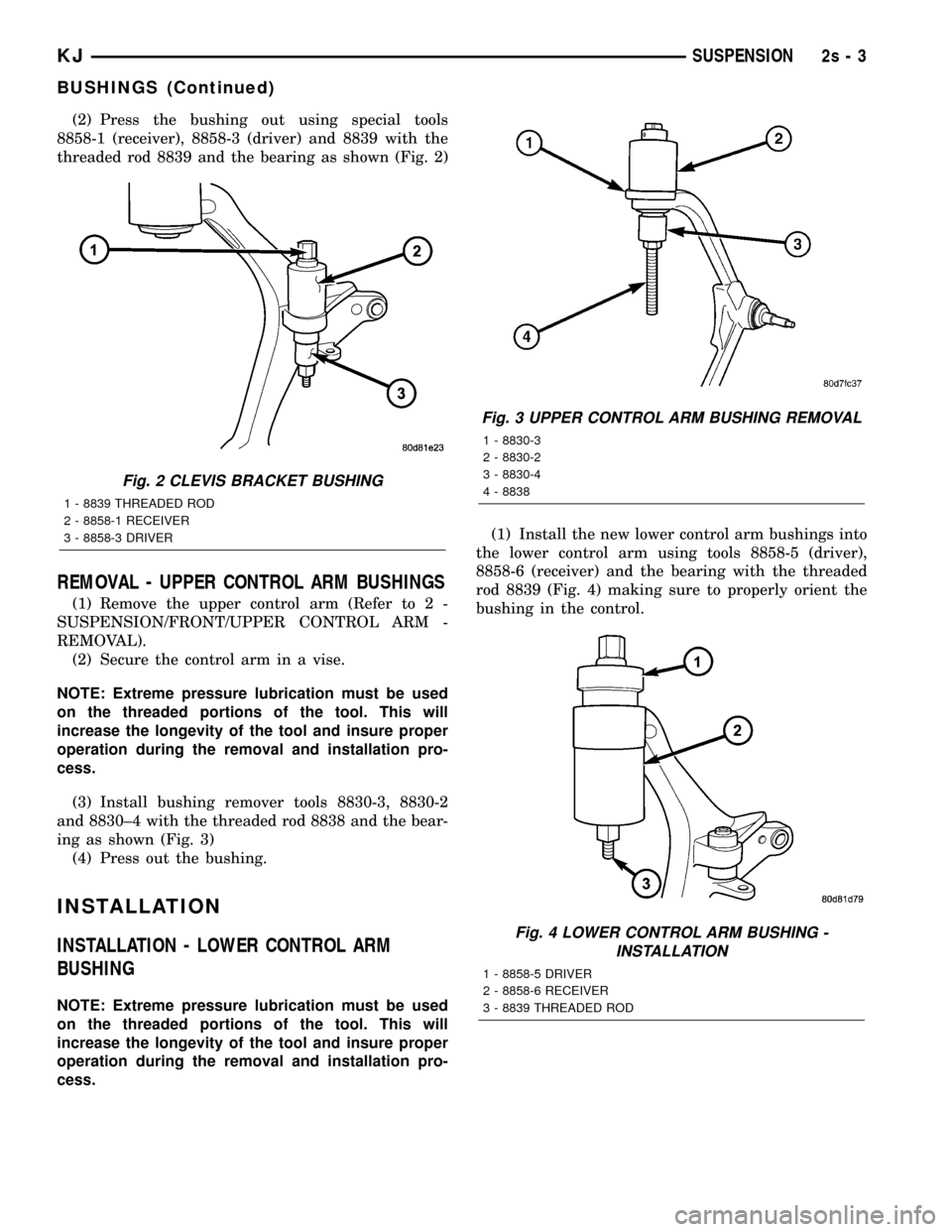
(2) Press the bushing out using special tools
8858-1 (receiver), 8858-3 (driver) and 8839 with the
threaded rod 8839 and the bearing as shown (Fig. 2)
REMOVAL - UPPER CONTROL ARM BUSHINGS
(1) Remove the upper control arm (Refer to 2 -
SUSPENSION/FRONT/UPPER CONTROL ARM -
REMOVAL).
(2) Secure the control arm in a vise.
NOTE: Extreme pressure lubrication must be used
on the threaded portions of the tool. This will
increase the longevity of the tool and insure proper
operation during the removal and installation pro-
cess.
(3) Install bushing remover tools 8830-3, 8830-2
and 8830±4 with the threaded rod 8838 and the bear-
ing as shown (Fig. 3)
(4) Press out the bushing.
INSTALLATION
INSTALLATION - LOWER CONTROL ARM
BUSHING
NOTE: Extreme pressure lubrication must be used
on the threaded portions of the tool. This will
increase the longevity of the tool and insure proper
operation during the removal and installation pro-
cess.(1) Install the new lower control arm bushings into
the lower control arm using tools 8858-5 (driver),
8858-6 (receiver) and the bearing with the threaded
rod 8839 (Fig. 4) making sure to properly orient the
bushing in the control.
Fig. 2 CLEVIS BRACKET BUSHING
1 - 8839 THREADED ROD
2 - 8858-1 RECEIVER
3 - 8858-3 DRIVER
Fig. 3 UPPER CONTROL ARM BUSHING REMOVAL
1 - 8830-3
2 - 8830-2
3 - 8830-4
4 - 8838
Fig. 4 LOWER CONTROL ARM BUSHING -
INSTALLATION
1 - 8858-5 DRIVER
2 - 8858-6 RECEIVER
3 - 8839 THREADED ROD
KJSUSPENSION 2s - 3
BUSHINGS (Continued)
Page 45 of 1803

(2) Remove the control arm from the vise.
(3) Install the lower control arm (Refer to 2 - SUS-
PENSION/FRONT/LOWER CONTROL ARM -
INSTALLATION).
(4) Reset the vehicle ride height (Refer to 2 - SUS-
PENSION/WHEEL ALIGNMENT - STANDARD
PROCEDURE).
(5) Perform a wheel alignment (Refer to 2 - SUS-
PENSION/WHEEL ALIGNMENT - STANDARD
PROCEDURE).
INSTALLATION - CLEVIS BRACKET BUSHING
NOTE: Extreme pressure lubrication must be used
on the threaded portions of the tool. This will
increase the longevity of the tool and insure proper
operation during the removal and installation pro-
cess.
(1) Install the new clevis bracket bushing into the
lower control arm using tools 8858-2 (driver), 8858-1
(receiver) and the bearing with the threaded rod
8839 (Fig. 5) making sure to properly orient the
bushing in the control.
(2) Install the clevis bracket (Refer to 2 - SUS-
PENSION/FRONT/CLEVIS BRACKET - INSTALLA-
TION).
INSTALLATION - UPPER CONTROL ARM
BUSHINGS
NOTE: Extreme pressure lubrication must be used
on the threaded portions of the tool. This will
increase the longevity of the tool and insure proper
operation during the removal and installation pro-
cess.
(1) Install the new upper control arm bushings
into the upper control arm using tools 8830-3, 8830-1
and 8830-2 the bearing with the threaded rod 8838
(Fig. 6) making sure to properly orient the bushing in
the control arm.
(2) Remove the control arm from the vise.
(3) Install the upper control arm (Refer to 2 - SUS-
PENSION/FRONT/UPPER CONTROL ARM -
INSTALLATION).
(4) Reset the vehicle ride height (Refer to 2 - SUS-
PENSION/WHEEL ALIGNMENT - STANDARD
PROCEDURE).
(5) Perform a wheel alignment (Refer to 2 - SUS-
PENSION/WHEEL ALIGNMENT - STANDARD
PROCEDURE).
Fig. 5 CLEVIS BRACKET BUSHING
1 - 8858-2 DRIVER
2 - 8858-1 RECEIVER
3 - 8839 THREADED RODFig. 6 UPPER CONTROL ARM BUSHING -
INSTALLATION
1 - 8830-3
2 - 8830-1
3 - BUSHING
4 - 8830-2
5 - 8838
2s - 4 SUSPENSIONKJ
BUSHINGS (Continued)
Page 46 of 1803

LOWER BALL JOINT
REMOVAL
(1) Remove the tire and wheel assembly.
(2) Remove the brake caliper and rotor (Refer to 5
- BRAKES/HYDRAULIC/MECHANICAL/ROTORS -
REMOVAL).
(3) Disconnect the tie rod from the steering
knuckle (Refer to 19 - STEERING/LINKAGE/TIE
ROD END - REMOVAL).
(4) Remove the steering knuckle (Refer to 2 - SUS-
PENSION/FRONT/KNUCKLE - REMOVAL).
(5) Move the halfshaft to the side and support the
halfshaft out of the way (If Equipped).
NOTE: Extreme pressure lubrication must be used
on the threaded portions of the tool. This will
increase the longevity of the tool and insure proper
operation during the removal and installation pro-
cess.
(6) Secure the steering knuckle in a vise.
(7) Press the ball joint from the steering knuckle
using special tools C-4212±F (PRESS), 8859-2
(RECEIVER) and 8859-1 (DRIVER) (Fig. 7).
INSTALLATION
NOTE: Extreme pressure lubrication must be used
on the threaded portions of the tool. This will
increase the longevity of the tool and insure proper
operation during the removal and installation pro-
cess.(1) Install the ball joint into the steering knuckle
and press in using special tools C-4212±F (press),
8859-3 (driver) and 6761 (receiver) (Fig. 8).
(2) Install the ball joint boot.
(3) Remove the support for the halfshaft and
install into position (If Equipped).
(4) Install the steering knuckle (Refer to 2 - SUS-
PENSION/FRONT/KNUCKLE - INSTALLATION).
(5) Install the tie rod end into the steering knuckle
(Refer to 19 - STEERING/LINKAGE/TIE ROD END -
INSTALLATION).
(6) Install and tighten the halfshaft nut to 136
N´m (100 ft. lbs.).
(7) Install the brake caliper and rotor (Refer to 5 -
BRAKES/HYDRAULIC/MECHANICAL/ROTORS -
INSTALLATION).
(8) Install the tire and wheel assembly (Refer to 22
- TIRES/WHEELS/WHEELS - STANDARD PROCE-
DURE).
(9) Check the vehicle ride height (Refer to 2 - SUS-
PENSION/WHEEL ALIGNMENT - STANDARD
PROCEDURE).
(10) Perform a wheel alignment (Refer to 2 - SUS-
PENSION/WHEEL ALIGNMENT - STANDARD
PROCEDURE).
Fig. 7 LOWER BALL JOINT
1 - 8859-1 DRIVER
2 - C-4212F PRESS
3 - 8859-2 RECEIVER
Fig. 8 LOWER BALL JOINT
1 - 6761 RECEIVER
2 - 8859-3 DRIVER
3 - C-4212F PRESS
KJSUSPENSION 2s - 5