2002 JEEP LIBERTY Lines
[x] Cancel search: LinesPage 16 of 1803

centage of antifreeze can cause the engine to over-
heat because specific heat of antifreeze is lower than
that of water.
CAUTION: Richer antifreeze mixtures cannot be
measured with normal field equipment and can
cause problems associated with 100 percent ethyl-
ene-glycol.
CAUTION: Do not use coolant additives that are
claimed to improve engine cooling.
OPERATION - AUTOMATIC TRANSMISSION
FLUID
The automatic transmission fluid is selected based
upon several qualities. The fluid must provide a high
level of protection for the internal components by
providing a lubricating film between adjacent metal
components. The fluid must also be thermally stable
so that it can maintain a consistent viscosity through
a large temperature range. If the viscosity stays con-
stant through the temperature range of operation,
transmission operation and shift feel will remain con-
sistent. Transmission fluid must also be a good con-
ductor of heat. The fluid must absorb heat from the
internal transmission components and transfer that
heat to the transmission case.
FLUID CAPACITIES
SPECIFICATIONS - FLUID CAPACITIES
DESCRIPTION SPECIFICATION
FUEL TANK 18.5 U.S. Gallons (70
Liters)****
ENGINE OIL
Engine Oil - with Filter -
2.4L2.4L (5.0 qts.)
Engine Oil - with Filter -
3.7L3.7L (5.0 qts.)
Engine Oil - With Filter -
2.5L Diesel6.5L (6.9 qts.)
ENGINE COOLANT
Cooling System - 2.4L 9.6L (10.1 qts.)
Cooling System - 3.7L 12.3L (13.0 qts.)
Cooling System - 2.5L
Diesel12.5L (13.2 qts.)
AUTOMATIC TRANSMISSION
Service Fill - 45RFE 4.73L (10.0 pts)
O-haul Fill - 45RFE 13.33L (28.0 pts)
Dry fill capacity Depending on type and size of
internal cooler, length and inside diameter of cooler
lines, or use of an auxiliary cooler, these figures may
vary. (Refer to 21 - TRANSMISSION/TRANSAXLE/
AUTOMATIC/FLUID - STANDARD PROCEDURE)
TRANSFER CASE
NV231 1.4L (2.95 pts.)
NV242 1.6L (3.4 pts.)
MANUAL TRANSMISSION
NV1500 (Approximate dry
fill or fill to bottom edge of
the fill plug hole.)2.28L (2.41 qts.)
NV3550 (Approximate dry
fill or fill to bottom edge of
fill plug hole.)2.28L (2.41 qts.)
FRONT AXLE
186 FIA (Model 30) 1.24L (41.9 fl. oz.)
REAR AXLE
198 RBI (Model 35) 1.78L (60.2 fl. oz.)*
8 1/4 2.08L (4.4 pts.)*
* When equipped with Trac-lok, include 4.0 ounces of
Friction Modifier.
****Nominal refill capacities are shown. A variation
may be observed from vehicle to vehicle due to
manufacturing tolerance and refill procedure.
0 - 4 LUBRICATION & MAINTENANCEKJ
FLUID TYPES (Continued)
Page 60 of 1803

(5) Remove lower clevis bolt (Fig. 2).
(6) Seperate lower ball joint from the lower control
arm (Fig. 3).
(7) Pull out on the steering knuckle and push the
half shaft out of the knuckle.
(8) With a pry bar remove the half shaft from the
axle.
NOTE: The right side has a splined axle shaft that
will stay in the axle.
INSTALLATION
(1) Apply a light coat of wheel bearing grease on
the female splines of the inner C/V joint.(2) Install half shaft on the axle shaft spline and
push firmly to engage the snap ring. Pull on the half
shaft to verify snap has engaged.
(3) Clean hub bearing bore and apply a light coat
of wheel bearing grease.
(4) Pull out on the steering knuckle and push the
half shaft through the knuckle.
(5) Install lower ball joint into the lower control
arm and tighten pinch bolt.
(6) Align clevis with knuckle. Install and tighten
lower clevis bolt.
(7) Install stabilizer link.
(8) Install half shaft hub nut.
(9) Install wheel and tire assembly.
(10) Remove support and lower vehicle.
SPECIFICATIONS
HALF SHAFT
TORQUE SPECIFICATIONS
DESCRIPTION N´m Ft. Lbs. In. Lbs.
Half Shaft Nut 136 100 -
Fig. 3 LOWER CONTROL ARM
1 - FRONT CAM BOLT
2 - OUTER TIE ROD END
3 - LOWER BALL JOINT NUT
4 - LOWER CONTROL ARM
5 - REAR CAM BOLTFig. 2 CLEVIS BRACKET
1 - UPPER BOLT
2 - CLEVIS BRACKET
3 - LOWER BOLT
KJHALF SHAFT 3 - 11
HALF SHAFT (Continued)
Page 86 of 1803

AXLE SHAFTS
REMOVAL
(1) Place the transmission in Neutral.
(2) Raise and support vehicle.
(3) Remove right wheel and tire and assembly.
(4) Remove right half shaft from vehicle.
(5) Remove snap ring from axle shaft.
(6) Assemble Remover 8420A onto the shaft (Fig.
25). Thread slid hammer into remover and remove
shaft.
(7) Slide axle shaft out of the axle tube.
NOTE: Use care to prevent damage to axle shaft
bearing and seal, which will remain in axle shaft
tube.
INSTALLATION
(1) Lubricate bearing bore and seal lip with gear
lubricant. Insert axle shaft through seal, bearing
(Fig. 26) and engage it into side gear splines.
NOTE: Use care to prevent shaft splines from dam-
aging axle shaft seal.
(2) Push on the axle shaft until the axle shaft
snap-ring passes through the side gear.
(3) Install right half shaft.
(4) Install right wheel and tire assembly.
(5) Check differential fluid level.
(6) Lower vehicle.
AXLE SHAFT SEALS
REMOVAL
(1) Remove half shaft.
(2) Remove axle shaft for right side seal removal.
(3) Remove shaft seal with Remover 7794-A and a
slide hammer (Fig. 27).
Fig. 25 AXLE SHAFT PULLER
1 - SNAP RING GROVE
2 - SLID HAMMER THREADS
3 - REMOVER BLOCKS
4 - REMOVER COLLAR
Fig. 26 AXLE SHAFT SEAL
1 - BEARING
2 - SEAL
Fig. 27 SHAFT SEAL REMOVER
1 - SHAFT SEAL
2 - REMOVER
KJFRONT AXLE - 186FIA 3 - 37
Page 126 of 1803
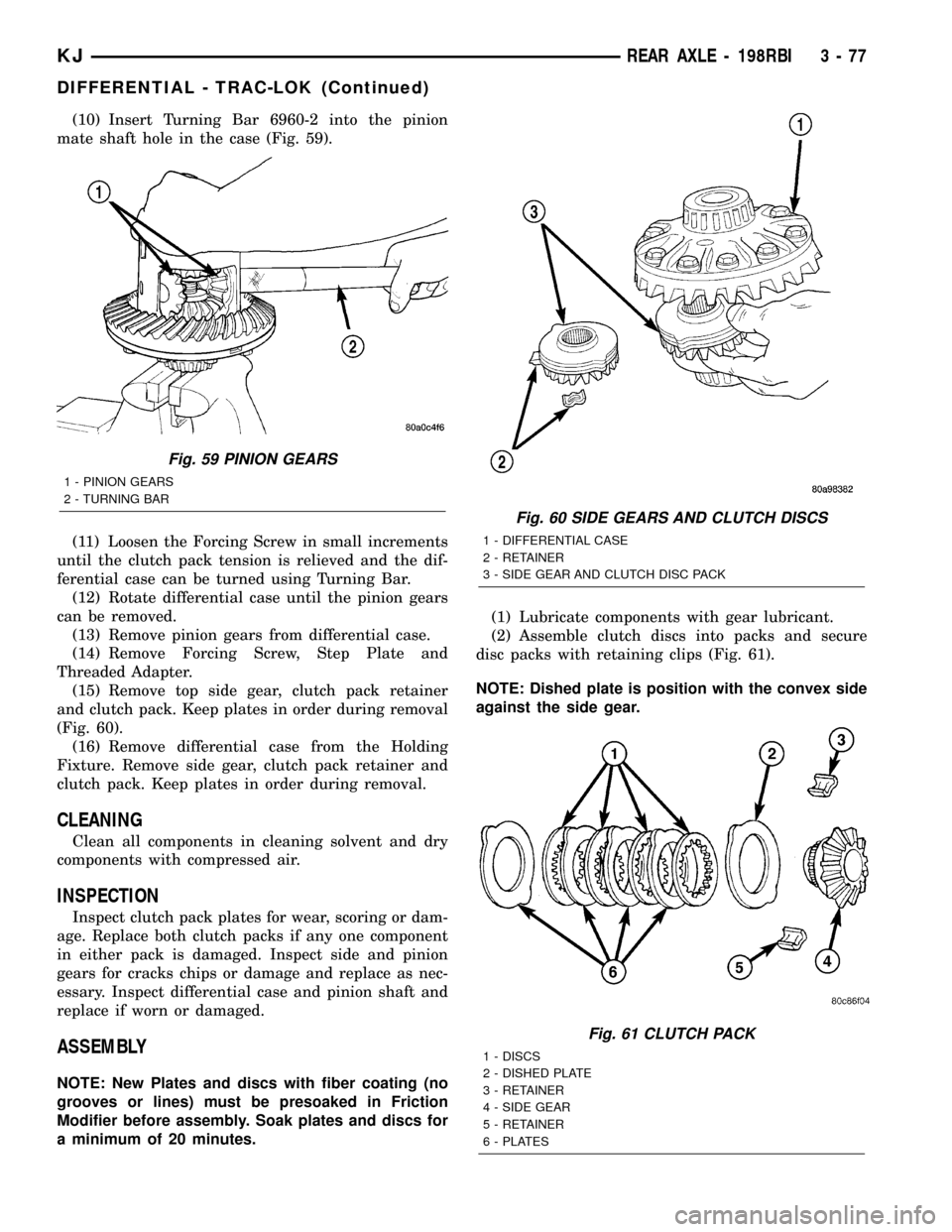
(10) Insert Turning Bar 6960-2 into the pinion
mate shaft hole in the case (Fig. 59).
(11) Loosen the Forcing Screw in small increments
until the clutch pack tension is relieved and the dif-
ferential case can be turned using Turning Bar.
(12) Rotate differential case until the pinion gears
can be removed.
(13) Remove pinion gears from differential case.
(14) Remove Forcing Screw, Step Plate and
Threaded Adapter.
(15) Remove top side gear, clutch pack retainer
and clutch pack. Keep plates in order during removal
(Fig. 60).
(16) Remove differential case from the Holding
Fixture. Remove side gear, clutch pack retainer and
clutch pack. Keep plates in order during removal.
CLEANING
Clean all components in cleaning solvent and dry
components with compressed air.
INSPECTION
Inspect clutch pack plates for wear, scoring or dam-
age. Replace both clutch packs if any one component
in either pack is damaged. Inspect side and pinion
gears for cracks chips or damage and replace as nec-
essary. Inspect differential case and pinion shaft and
replace if worn or damaged.
ASSEMBLY
NOTE: New Plates and discs with fiber coating (no
grooves or lines) must be presoaked in Friction
Modifier before assembly. Soak plates and discs for
a minimum of 20 minutes.(1) Lubricate components with gear lubricant.
(2) Assemble clutch discs into packs and secure
disc packs with retaining clips (Fig. 61).
NOTE: Dished plate is position with the convex side
against the side gear.
Fig. 59 PINION GEARS
1 - PINION GEARS
2 - TURNING BAR
Fig. 60 SIDE GEARS AND CLUTCH DISCS
1 - DIFFERENTIAL CASE
2 - RETAINER
3 - SIDE GEAR AND CLUTCH DISC PACK
Fig. 61 CLUTCH PACK
1 - DISCS
2 - DISHED PLATE
3 - RETAINER
4 - SIDE GEAR
5 - RETAINER
6 - PLATES
KJREAR AXLE - 198RBI 3 - 77
DIFFERENTIAL - TRAC-LOK (Continued)
Page 150 of 1803
AXLE SHAFTS
REMOVAL
(1) Place the transmission in NEUTRAL and raise
and support vehicle.
(2) Remove wheel and tire assembly.
(3) Remove brake drum.
(4) Remove the housing cover and drain lubricant.
(5) Rotate differential case to access the pinion
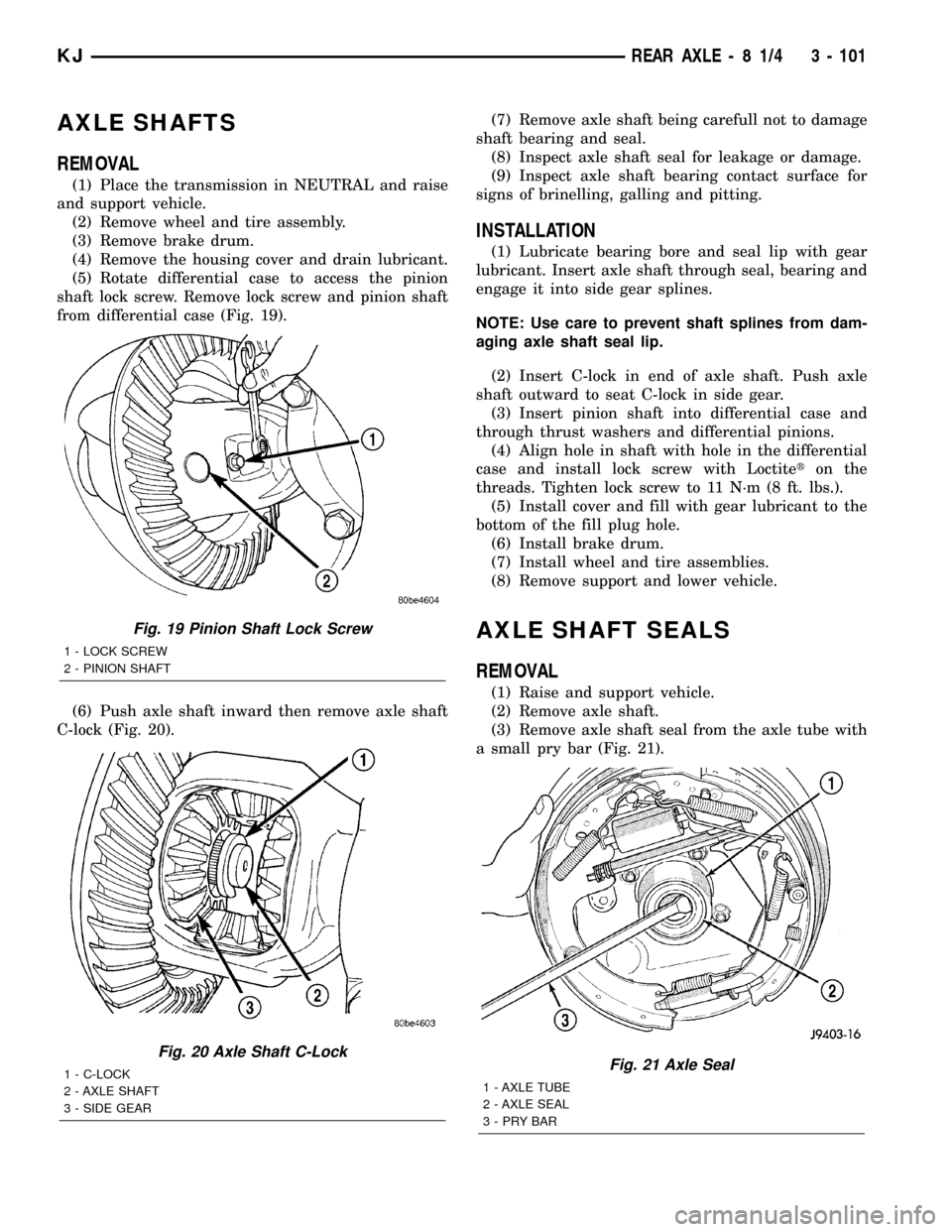
shaft lock screw. Remove lock screw and pinion shaft
from differential case (Fig. 19).
(6) Push axle shaft inward then remove axle shaft
C-lock (Fig. 20).(7) Remove axle shaft being carefull not to damage
shaft bearing and seal.
(8) Inspect axle shaft seal for leakage or damage.
(9) Inspect axle shaft bearing contact surface for
signs of brinelling, galling and pitting.
INSTALLATION
(1) Lubricate bearing bore and seal lip with gear
lubricant. Insert axle shaft through seal, bearing and
engage it into side gear splines.
NOTE: Use care to prevent shaft splines from dam-
aging axle shaft seal lip.
(2) Insert C-lock in end of axle shaft. Push axle
shaft outward to seat C-lock in side gear.
(3) Insert pinion shaft into differential case and
through thrust washers and differential pinions.
(4) Align hole in shaft with hole in the differential
case and install lock screw with Loctiteton the
threads. Tighten lock screw to 11 N´m (8 ft. lbs.).
(5) Install cover and fill with gear lubricant to the
bottom of the fill plug hole.
(6) Install brake drum.
(7) Install wheel and tire assemblies.
(8) Remove support and lower vehicle.
AXLE SHAFT SEALS
REMOVAL
(1) Raise and support vehicle.
(2) Remove axle shaft.
(3) Remove axle shaft seal from the axle tube with
a small pry bar (Fig. 21).
Fig. 19 Pinion Shaft Lock Screw
1 - LOCK SCREW
2 - PINION SHAFT
Fig. 20 Axle Shaft C-Lock
1 - C-LOCK
2 - AXLE SHAFT
3 - SIDE GEARFig. 21 Axle Seal
1 - AXLE TUBE
2 - AXLE SEAL
3-PRYBAR
KJREAR AXLE - 8 1/4 3 - 101
Page 158 of 1803
(16) Remove differential case from the fixture.
Remove side gear, clutch pack retainer and clutch
pack. Keep plates in order during removal.
CLEANING
Clean all components in cleaning solvent and dry
components with compressed air.
INSPECTION
Inspect clutch pack plates for wear, scoring or dam-
age. Replace both clutch packs if any one component
in either pack is damaged. Inspect side and pinion
gears for cracks chips or damage and replace as nec-
essary. Inspect differential case and pinion shaft and
replace if worn or damaged.
ASSEMBLY
Lubricate each component with gear lubricant
before assembly.
NOTE: New Plates and discs with fiber coating (no
grooves or lines) must be presoaked in Friction
Modifier before assembly. Soak plates and discs for
a minimum of 20 minutes.
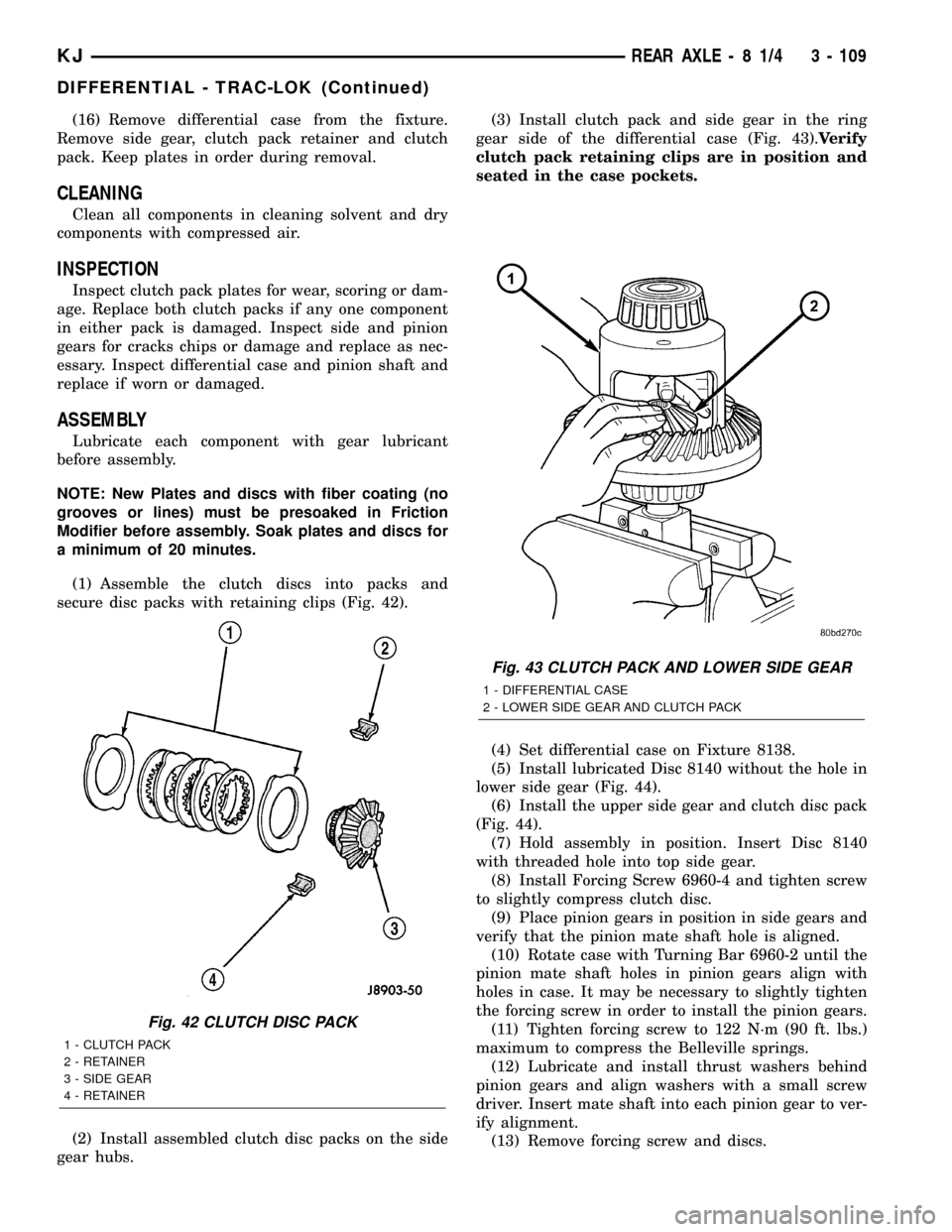
(1) Assemble the clutch discs into packs and
secure disc packs with retaining clips (Fig. 42).
(2) Install assembled clutch disc packs on the side
gear hubs.(3) Install clutch pack and side gear in the ring
gear side of the differential case (Fig. 43).Verify
clutch pack retaining clips are in position and
seated in the case pockets.
(4) Set differential case on Fixture 8138.
(5) Install lubricated Disc 8140 without the hole in
lower side gear (Fig. 44).
(6) Install the upper side gear and clutch disc pack
(Fig. 44).
(7) Hold assembly in position. Insert Disc 8140
with threaded hole into top side gear.
(8) Install Forcing Screw 6960-4 and tighten screw
to slightly compress clutch disc.
(9) Place pinion gears in position in side gears and
verify that the pinion mate shaft hole is aligned.
(10) Rotate case with Turning Bar 6960-2 until the
pinion mate shaft holes in pinion gears align with
holes in case. It may be necessary to slightly tighten
the forcing screw in order to install the pinion gears.
(11) Tighten forcing screw to 122 N´m (90 ft. lbs.)
maximum to compress the Belleville springs.
(12) Lubricate and install thrust washers behind
pinion gears and align washers with a small screw
driver. Insert mate shaft into each pinion gear to ver-
ify alignment.
(13) Remove forcing screw and discs.
Fig. 42 CLUTCH DISC PACK
1 - CLUTCH PACK
2 - RETAINER
3 - SIDE GEAR
4 - RETAINER
Fig. 43 CLUTCH PACK AND LOWER SIDE GEAR
1 - DIFFERENTIAL CASE
2 - LOWER SIDE GEAR AND CLUTCH PACK
KJREAR AXLE - 8 1/4 3 - 109
DIFFERENTIAL - TRAC-LOK (Continued)
Page 165 of 1803

BRAKES
TABLE OF CONTENTS
page page
BRAKES - BASE........................... 1BRAKES - ABS........................... 32
BRAKES - BASE
TABLE OF CONTENTS
page page
BRAKES - BASE
DESCRIPTION..........................2
WARNING.............................2
DIAGNOSIS AND TESTING - BASE BRAKE
SYSTEM.............................3
STANDARD PROCEDURE
STANDARD PROCEDURE - PRESSURE
BLEEDING............................5
STANDARD PROCEDURE - MANUAL
BLEEDING............................6
SPECIFICATIONS
BRAKE COMPONENTS..................6
TORQUE.............................7
SPECIAL TOOLS
BASE BRAKES........................7
BRAKE LINES
DESCRIPTION..........................8
DIAGNOSIS AND TESTING - BRAKE LINE
AND HOSES..........................8
STANDARD PROCEDURE
STANDARD PROCEDURE - DOUBLE
INVERTED FLARING....................8
STANDARD PROCEDURE - ISO FLARING . . . 8
REMOVAL
REMOVAL - FRONT HOSE...............9
REMOVAL - REAR BRAKE HOSE..........9
INSTALLATION
INSTALLATION - FRONT BRAKE HOSE....10
INSTALLATION - REAR BRAKE HOSE......10
BRAKE PADS / SHOES
DESCRIPTION - REAR DRUM BRAKE.......10
OPERATION - REAR DRUM BRAKE.........11
REMOVAL
REMOVAL - FRONT BRAKE PADS.........11
REMOVAL - DRUM BRAKE SHOES........11
INSTALLATION
INSTALLATION - FRONT BRAKE PADS.....11INSTALLATION - DRUM BRAKE SHOES....11
ADJUSTMENTS
ADJUSTMENT - REAR DRUM BRAKE......12
DISC BRAKE CALIPERS
DESCRIPTION.........................13
OPERATION...........................14
REMOVAL.............................14
DISASSEMBLY.........................14
CLEANING............................16
INSPECTION..........................16
ASSEMBLY............................16
INSTALLATION.........................17
DISC BRAKE CALIPER ADAPTER
REMOVAL.............................18
INSTALLATION.........................18
ROTORS
DIAGNOSIS AND TESTING - DISC BRAKE
ROTOR .............................18
STANDARD PROCEDURE - DISC BRAKE
ROTOR .............................19
REMOVAL.............................19
INSTALLATION.........................19
JUNCTION BLOCK
DESCRIPTION.........................20
OPERATION...........................20
DIAGNOSIS AND TESTING -
PROPORTIONING VALVE...............20
REMOVAL.............................20
INSTALLATION.........................20
PEDAL
DESCRIPTION.........................20
OPERATION...........................20
REMOVAL.............................20
INSTALLATION.........................20
POWER BRAKE BOOSTER
DESCRIPTION.........................21
OPERATION...........................21
KJBRAKES 5 - 1
Page 167 of 1803

CAUTION: Never use gasoline, kerosene, alcohol,
motor oil, transmission fluid, or any fluid containing
mineral oil to clean the system components. These
fluids damage rubber cups and seals. Use only
fresh brake fluid or Mopar brake cleaner to clean or
flush brake system components. These are the only
cleaning materials recommended. If system contam-
ination is suspected, check the fluid for dirt, discol-
oration, or separation into distinct layers. Also
check the reservoir cap seal for distortion. Drain
and flush the system with new brake fluid if con-
tamination is suspected.
CAUTION: Use Mopar brake fluid, or an equivalent
quality fluid meeting SAE/DOT standards J1703 and
DOT 3. Brake fluid must be clean and free of con-
taminants. Use fresh fluid from sealed containers
only to ensure proper antilock component opera-
tion.
CAUTION: Use Mopar multi-mileage or high temper-
ature grease to lubricate caliper slide surfaces,
drum brake pivot pins, and shoe contact points on
the backing plates. Use multi-mileage grease or GE
661 or Dow 111 silicone grease on caliper slide pins
to ensure proper operation.
DIAGNOSIS AND TESTING - BASE BRAKE
SYSTEM
Base brake components consist of the brake shoes,
calipers, wheel cylinders, brake drums, rotors, brake
lines, master cylinder, booster, and parking brake
components.
Brake diagnosis involves determining if the prob-
lem is related to a mechanical, hydraulic, or vacuum
operated component.
The first diagnosis step is the preliminary check.
PRELIMINARY BRAKE CHECK
(1) Check condition of tires and wheels. Damaged
wheels and worn, damaged, or underinflated tires
can cause pull, shudder, vibration, and a condition
similar to grab.
(2) If complaint was based on noise when braking,
check suspension components. Jounce front and rear
of vehicle and listen for noise that might be caused
by loose, worn or damaged suspension or steering
components.
(3) Inspect brake fluid level and condition. Note
that the brake reservoir fluid level will decrease in
proportion to normal lining wear.Also note that
brake fluid tends to darken over time. This is
normal and should not be mistaken for contam-
ination.(a) If fluid level is abnormally low, look for evi-
dence of leaks at calipers, wheel cylinders, brake
lines, and master cylinder.
(b) If fluid appears contaminated, drain out a
sample to examine. System will have to be flushed
if fluid is separated into layers, or contains a sub-
stance other than brake fluid. The system seals
and cups will also have to be replaced after flush-
ing. Use clean brake fluid to flush the system.
(4) Check parking brake operation. Verify free
movement and full release of cables and pedal. Also
note if vehicle was being operated with parking
brake partially applied.
(5) Check brake pedal operation. Verify that pedal
does not bind and has adequate free play. If pedal
lacks free play, check pedal and power booster for
being loose or for bind condition. Do not road test
until condition is corrected.
(6) Check booster vacuum check valve and hose.
(7) If components checked appear OK, road test
the vehicle.
ROAD TESTING
(1) If complaint involved low brake pedal, pump
pedal and note if it comes back up to normal height.
(2) Check brake pedal response with transmission
in Neutral and engine running. Pedal should remain
firm under constant foot pressure.
(3) During road test, make normal and firm brake
stops in 25-40 mph range. Note faulty brake opera-
tion such as low pedal, hard pedal, fade, pedal pulsa-
tion, pull, grab, drag, noise, etc.
(4) Attempt to stop the vehicle with the parking
brake only and note grab, drag, noise, etc.
PEDAL FALLS AWAY
A brake pedal that falls away under steady foot
pressure is generally the result of a system leak. The
leak point could be at a brake line, fitting, hose, or
caliper/wheel cylinder. If leakage is severe, fluid will
be evident at or around the leaking component.
Internal leakage (seal by-pass) in the master cylin-
der caused by worn or damaged piston cups, may
also be the problem cause.
An internal leak in the ABS or RWAL system may
also be the problem with no physical evidence.
LOW PEDAL
If a low pedal is experienced, pump the pedal sev-
eral times. If the pedal comes back up worn linings,
rotors, drums, or rear brakes out of adjustment are
the most likely causes. The proper course of action is
to inspect and replace all worn component and make
the proper adjustments.
KJBRAKES - BASE 5 - 3
BRAKES - BASE (Continued)