2002 JEEP LIBERTY intake air temp
[x] Cancel search: intake air tempPage 1658 of 1803

DIAGNOSIS AND TESTING - HEATER
PERFORMANCE
Before performing the following tests, refer to Cool-
ing for the procedures to check the radiator coolant
level, serpentine drive belt tension, radiator air flow
and the radiator fan operation. Also be certain that
the accessory vacuum supply line is connected at the
engine intake manifold.
MAXIMUM HEATER OUTPUT
Engine coolant is delivered to the heater core
through two heater hoses. With the engine idling atnormal operating temperature, set the temperature
control knob in the full hot position, the mode control
switch knob in the floor heat position, and the blower
motor switch knob in the highest speed position.
Using a test thermometer, check the temperature of
the air being discharged at the HVAC housing floor
outlets. Compare the test thermometer reading to the
Temperature Reference chart.
Temperature Reference
Ambient Air Temperature15.5É C
(60É F)21.1É C
(70É F)26.6É C
(80É F)32.2É C
(90É F)
Minimum Air Temperature at
Floor Outlet52.2É C
(126É F)56.1É C
(133É F)59.4É C
(139É F)62.2É C
(144É F)
If the floor outlet air temperature is too low, refer
to Cooling to check the engine coolant temperature
specifications. Both of the heater hoses should be hot
to the touch. The coolant return heater hose should
be slightly cooler than the coolant supply heater
hose. If the return hose is much cooler than the sup-
ply hose, locate and repair the engine coolant flow
obstruction in the cooling system. Refer to Cooling
for the procedures.
OBSTRUCTED COOLANT FLOW Possible loca-
tions or causes of obstructed coolant flow:
²Pinched or kinked heater hoses.
²Improper heater hose routing.
²Plugged heater hoses or supply and return ports
at the cooling system connections.
²A plugged heater core.
If proper coolant flow through the cooling system is
verified, and heater outlet air temperature is still
low, a mechanical problem may exist.
MECHANICAL PROBLEMS Possible locations or
causes of insufficient heat:
²An obstructed cowl air intake.
²Obstructed heater system outlets.
²A blend door not functioning properly.
TEMPERATURE CONTROL
If the heater outlet air temperature cannot be
adjusted with the temperature control knob on theA/C Heater control panel, the following could require
service:
²The A/C Heater control.
²The blend door actuator.
²The blend door.
²Improper engine coolant temperature.
DIAGNOSIS AND TESTING - VACUUM SYSTEM
Vacuum control is used to operate the mode doors
in the heater-only and a/c heater housings. Testing of
the heater-only and A/C Heater mode control switch
operation will determine if the vacuum, electrical,
and mechanical controls are functioning. However, it
is possible that a vacuum control system that oper-
ates perfectly at engine idle (high engine vacuum)
may not function properly at high engine speeds or
loads (low engine vacuum). This can be caused by
leaks in the vacuum system, or a faulty vacuum
check valve.
A vacuum system test will help to identify the
source of poor vacuum system performance or vac-
uum system leaks. Before starting this test, stop the
engine and make certain that the problem is not a
disconnected vacuum supply tube at the engine
intake manifold vacuum tap or at the vacuum reser-
voir.
24 - 6 HEATING & AIR CONDITIONINGKJ
HEATING & AIR CONDITIONING (Continued)
Page 1689 of 1803

DITIONING/DISTRIBUTION/MODE DOOR -
INSTALLATION - PANEL/DEMIST DOOR)
(4) Assemble the HVAC housing. (Refer to 24 -
HEATING & AIR CONDITIONING/DISTRIBUTION/
HVAC HOUSING - ASSEMBLY)
(5) Install the HVAC housing in the vehicle. (Refer
to 24 - HEATING & AIR CONDITIONING/DISTRI-
BUTION/HVAC HOUSING - INSTALLATION)
INSTALLATION - FLOOR - DEFROST DOO
(1) Install the floor-defrost door in the HVAC hous-
ing by placing the door in the lower housing.
(2) Assemble the HVAC housing. (Refer to 24 -
HEATING & AIR CONDITIONING/DISTRIBUTION/
HVAC HOUSING - ASSEMBLY)
(3) Install the floor door vacuum actuator in the
lower HVAC housing. (Refer to 24 - HEATING & AIR
CONDITIONING/CONTROLS/MODE DOOR
ACTUATOR - INSTALLATION - FLOOR DOOR
ACTUATOR)
(4) Install the HVAC housing in the vehicle. (Refer
to 24 - HEATING & AIR CONDITIONING/DISTRI-
BUTION/HVAC HOUSING - INSTALLATION)
RECIRC DOOR
REMOVAL
A recirculation door and vacuum actuator are used
only on models with the optional air conditioning sys-
tem.
WARNING: ON VEHICLES EQUIPPED WITH AIR-
BAGS, DISABLE THE AIRBAG SYSTEM BEFOREATTEMPTING ANY STEERING WHEEL, STEERING
COLUMN, OR INSTRUMENT PANEL COMPONENT
DIAGNOSIS OR SERVICE. DISCONNECT AND ISO-
LATE THE BATTERY NEGATIVE (GROUND) CABLE,
THEN WAIT TWO MINUTES FOR THE AIRBAG SYS-
TEM CAPACITOR TO DISCHARGE BEFORE PER-
FORMING FURTHER DIAGNOSIS OR SERVICE. THIS
IS THE ONLY SURE WAY TO DISABLE THE AIRBAG
SYSTEM. FAILURE TO TAKE THE PROPER PRE-
CAUTIONS COULD RESULT IN AN ACCIDENTAL
AIRBAG DEPLOYMENT AND POSSIBLE PERSONAL
INJURY.
WARNING: IF THE VEHICLE IS EQUIPPED WITH AIR
CONDITIONING, REVIEW THE WARNINGS AND
CAUTIONS IN PLUMBING BEFORE PERFORMING
THE FOLLOWING OPERATION. (Refer to 24 - HEAT-
ING & AIR CONDITIONING/PLUMBING - WARNING)
(Refer to 24 - HEATING & AIR CONDITIONING/
PLUMBING - CAUTION)
(1) Remove the HVAC housing and disassemble.
(Refer to 24 - HEATING & AIR CONDITIONING/
DISTRIBUTION/HVAC HOUSING - REMOVAL)
(Refer to 24 - HEATING & AIR CONDITIONING/
DISTRIBUTION/HVAC HOUSING - DISASSEMBLY)
(2) Remove the four screws to remove the recircu-
lation door assembly. (Refer to 24 - HEATING & AIR
CONDITIONING/CONTROLS/RECIRCULATION
DOOR ACTUATOR - REMOVAL)
(3) Insert a screwdriver into the latch hole of the
panel door pivot shaft to release the latch of the
panel door lever and pull the lever out of the pivot
shaft from the outside of the upper half of the HVAC
housing.
INSTALLATION
(1) Guide the recirculation door lever through the
air intake grille of the HVAC housing while installing
the door in the housing.
(2) Assemble the HVAC housing. (Refer to 24 -
HEATING & AIR CONDITIONING/DISTRIBUTION/
HVAC HOUSING - ASSEMBLY)
(3) Install the HVAC housing in the vehicle. (Refer
to 24 - HEATING & AIR CONDITIONING/DISTRI-
BUTION/HVAC HOUSING - INSTALLATION)
(4) Install the recirculation door vacuum actuator
on the lower HVAC housing. (Refer to 24 - HEATING
& AIR CONDITIONING/CONTROLS/RECIRCULA-
TION DOOR ACTUATOR - INSTALLATION)
Fig. 9 FLOOR DOOR (typical)
1 - LOWER HVAC HOUSING
2 - PIVOT SHAFT
3 - CRANK ARM
4 - FLOOR DOOR
KJDISTRIBUTION 24 - 37
MODE DOOR (Continued)
Page 1709 of 1803
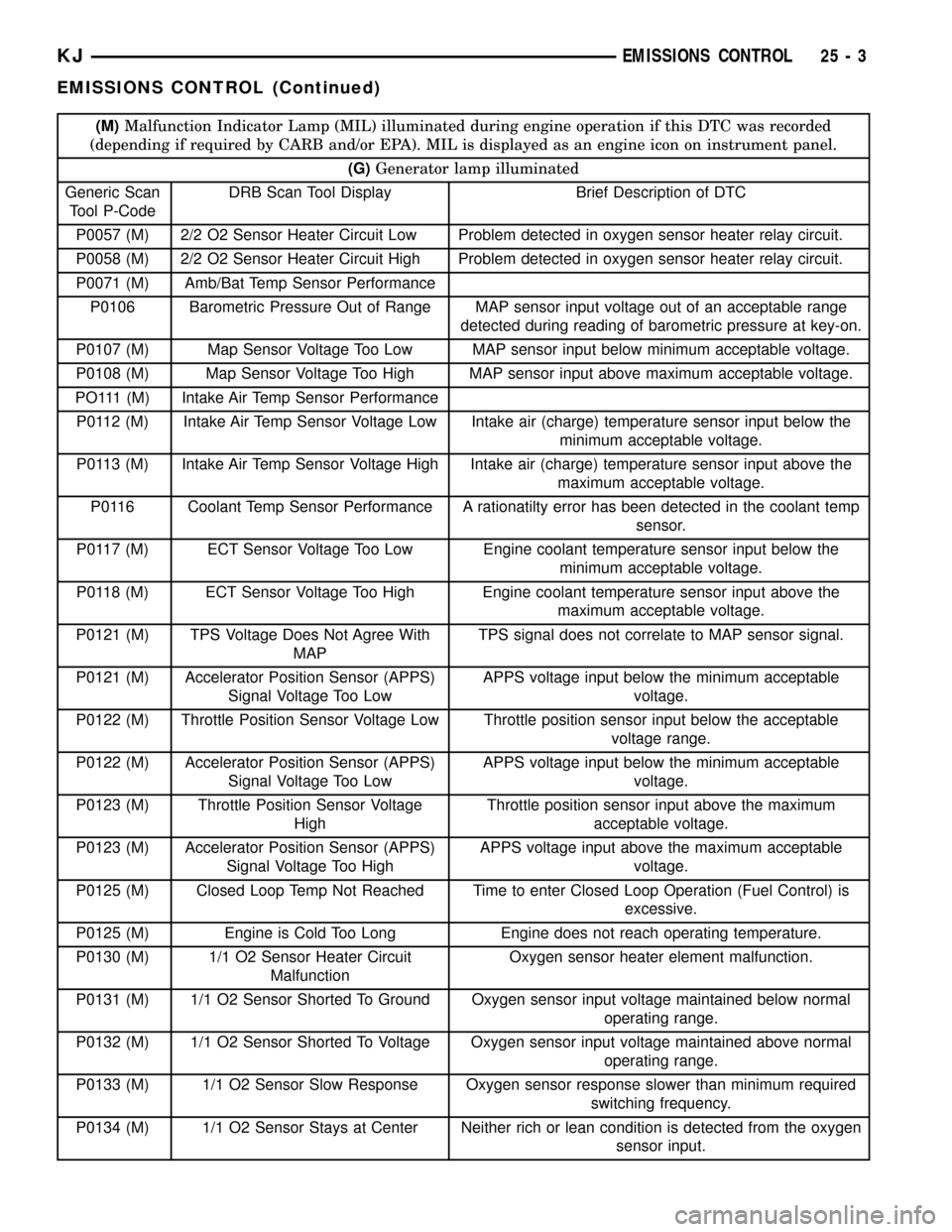
(M)Malfunction Indicator Lamp (MIL) illuminated during engine operation if this DTC was recorded
(depending if required by CARB and/or EPA). MIL is displayed as an engine icon on instrument panel.
(G)Generator lamp illuminated
Generic Scan
Tool P-CodeDRB Scan Tool Display Brief Description of DTC
P0057 (M) 2/2 O2 Sensor Heater Circuit Low Problem detected in oxygen sensor heater relay circuit.
P0058 (M) 2/2 O2 Sensor Heater Circuit High Problem detected in oxygen sensor heater relay circuit.
P0071 (M) Amb/Bat Temp Sensor Performance
P0106 Barometric Pressure Out of Range MAP sensor input voltage out of an acceptable range
detected during reading of barometric pressure at key-on.
P0107 (M) Map Sensor Voltage Too Low MAP sensor input below minimum acceptable voltage.
P0108 (M) Map Sensor Voltage Too High MAP sensor input above maximum acceptable voltage.
PO111 (M) Intake Air Temp Sensor Performance
P0112 (M) Intake Air Temp Sensor Voltage Low Intake air (charge) temperature sensor input below the
minimum acceptable voltage.
P0113 (M) Intake Air Temp Sensor Voltage High Intake air (charge) temperature sensor input above the
maximum acceptable voltage.
P0116 Coolant Temp Sensor Performance A rationatilty error has been detected in the coolant temp
sensor.
P0117 (M) ECT Sensor Voltage Too Low Engine coolant temperature sensor input below the
minimum acceptable voltage.
P0118 (M) ECT Sensor Voltage Too High Engine coolant temperature sensor input above the
maximum acceptable voltage.
P0121 (M) TPS Voltage Does Not Agree With
MAPTPS signal does not correlate to MAP sensor signal.
P0121 (M) Accelerator Position Sensor (APPS)
Signal Voltage Too LowAPPS voltage input below the minimum acceptable
voltage.
P0122 (M) Throttle Position Sensor Voltage Low Throttle position sensor input below the acceptable
voltage range.
P0122 (M) Accelerator Position Sensor (APPS)
Signal Voltage Too LowAPPS voltage input below the minimum acceptable
voltage.
P0123 (M) Throttle Position Sensor Voltage
HighThrottle position sensor input above the maximum
acceptable voltage.
P0123 (M) Accelerator Position Sensor (APPS)
Signal Voltage Too HighAPPS voltage input above the maximum acceptable
voltage.
P0125 (M) Closed Loop Temp Not Reached Time to enter Closed Loop Operation (Fuel Control) is
excessive.
P0125 (M) Engine is Cold Too Long Engine does not reach operating temperature.
P0130 (M) 1/1 O2 Sensor Heater Circuit
MalfunctionOxygen sensor heater element malfunction.
P0131 (M) 1/1 O2 Sensor Shorted To Ground Oxygen sensor input voltage maintained below normal
operating range.
P0132 (M) 1/1 O2 Sensor Shorted To Voltage Oxygen sensor input voltage maintained above normal
operating range.
P0133 (M) 1/1 O2 Sensor Slow Response Oxygen sensor response slower than minimum required
switching frequency.
P0134 (M) 1/1 O2 Sensor Stays at Center Neither rich or lean condition is detected from the oxygen
sensor input.
KJEMISSIONS CONTROL 25 - 3
EMISSIONS CONTROL (Continued)
Page 1717 of 1803
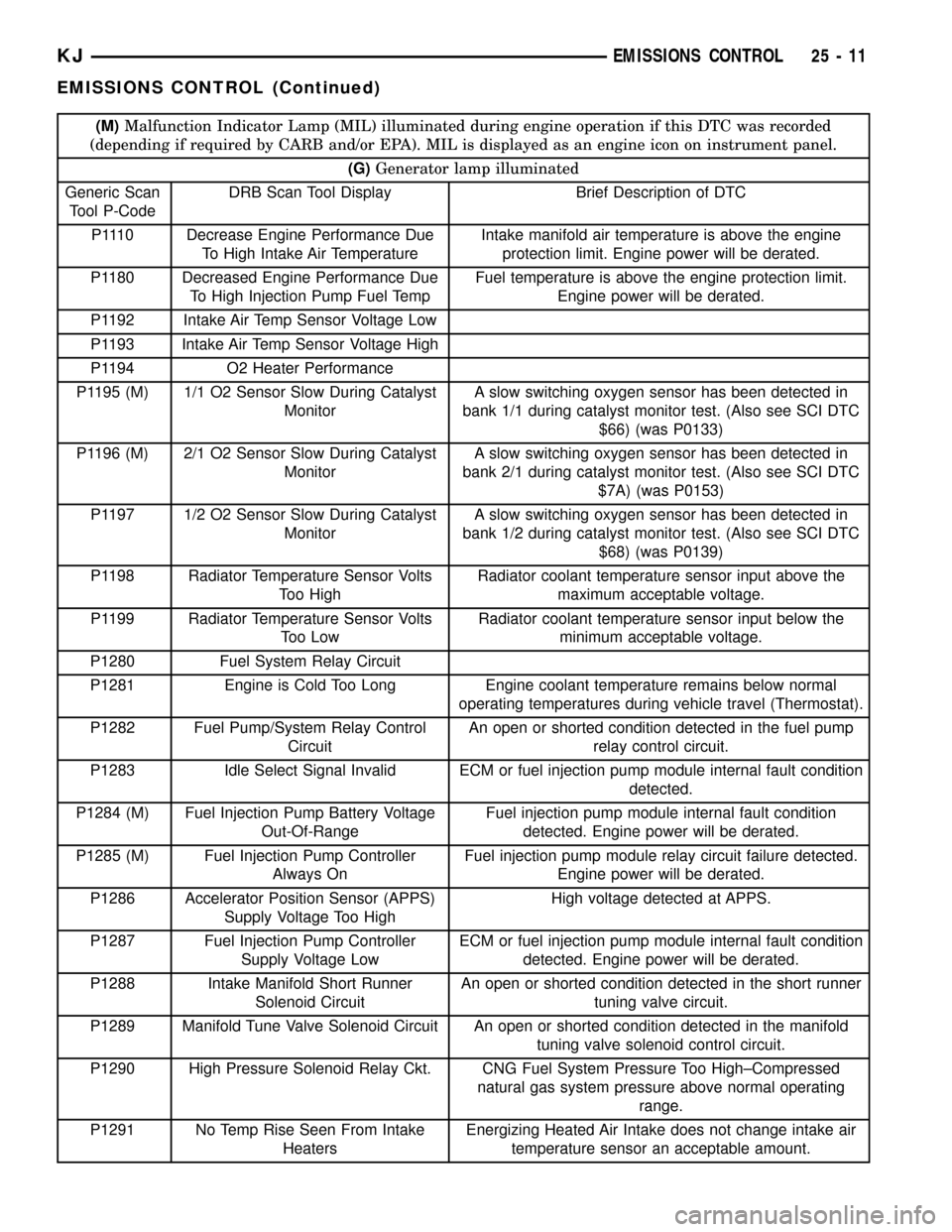
(M)Malfunction Indicator Lamp (MIL) illuminated during engine operation if this DTC was recorded
(depending if required by CARB and/or EPA). MIL is displayed as an engine icon on instrument panel.
(G)Generator lamp illuminated
Generic Scan
Tool P-CodeDRB Scan Tool Display Brief Description of DTC
P1110 Decrease Engine Performance Due
To High Intake Air TemperatureIntake manifold air temperature is above the engine
protection limit. Engine power will be derated.
P1180 Decreased Engine Performance Due
To High Injection Pump Fuel TempFuel temperature is above the engine protection limit.
Engine power will be derated.
P1192 Intake Air Temp Sensor Voltage Low
P1193 Intake Air Temp Sensor Voltage High
P1194 O2 Heater Performance
P1195 (M) 1/1 O2 Sensor Slow During Catalyst
MonitorA slow switching oxygen sensor has been detected in
bank 1/1 during catalyst monitor test. (Also see SCI DTC
$66) (was P0133)
P1196 (M) 2/1 O2 Sensor Slow During Catalyst
MonitorA slow switching oxygen sensor has been detected in
bank 2/1 during catalyst monitor test. (Also see SCI DTC
$7A) (was P0153)
P1197 1/2 O2 Sensor Slow During Catalyst
MonitorA slow switching oxygen sensor has been detected in
bank 1/2 during catalyst monitor test. (Also see SCI DTC
$68) (was P0139)
P1198 Radiator Temperature Sensor Volts
Too HighRadiator coolant temperature sensor input above the
maximum acceptable voltage.
P1199 Radiator Temperature Sensor Volts
Too LowRadiator coolant temperature sensor input below the
minimum acceptable voltage.
P1280 Fuel System Relay Circuit
P1281 Engine is Cold Too Long Engine coolant temperature remains below normal
operating temperatures during vehicle travel (Thermostat).
P1282 Fuel Pump/System Relay Control
CircuitAn open or shorted condition detected in the fuel pump
relay control circuit.
P1283 Idle Select Signal Invalid ECM or fuel injection pump module internal fault condition
detected.
P1284 (M) Fuel Injection Pump Battery Voltage
Out-Of-RangeFuel injection pump module internal fault condition
detected. Engine power will be derated.
P1285 (M) Fuel Injection Pump Controller
Always OnFuel injection pump module relay circuit failure detected.
Engine power will be derated.
P1286 Accelerator Position Sensor (APPS)
Supply Voltage Too HighHigh voltage detected at APPS.
P1287 Fuel Injection Pump Controller
Supply Voltage LowECM or fuel injection pump module internal fault condition
detected. Engine power will be derated.
P1288 Intake Manifold Short Runner
Solenoid CircuitAn open or shorted condition detected in the short runner
tuning valve circuit.
P1289 Manifold Tune Valve Solenoid Circuit An open or shorted condition detected in the manifold
tuning valve solenoid control circuit.
P1290 High Pressure Solenoid Relay Ckt. CNG Fuel System Pressure Too High±Compressed
natural gas system pressure above normal operating
range.
P1291 No Temp Rise Seen From Intake
HeatersEnergizing Heated Air Intake does not change intake air
temperature sensor an acceptable amount.
KJEMISSIONS CONTROL 25 - 11
EMISSIONS CONTROL (Continued)
Page 1718 of 1803
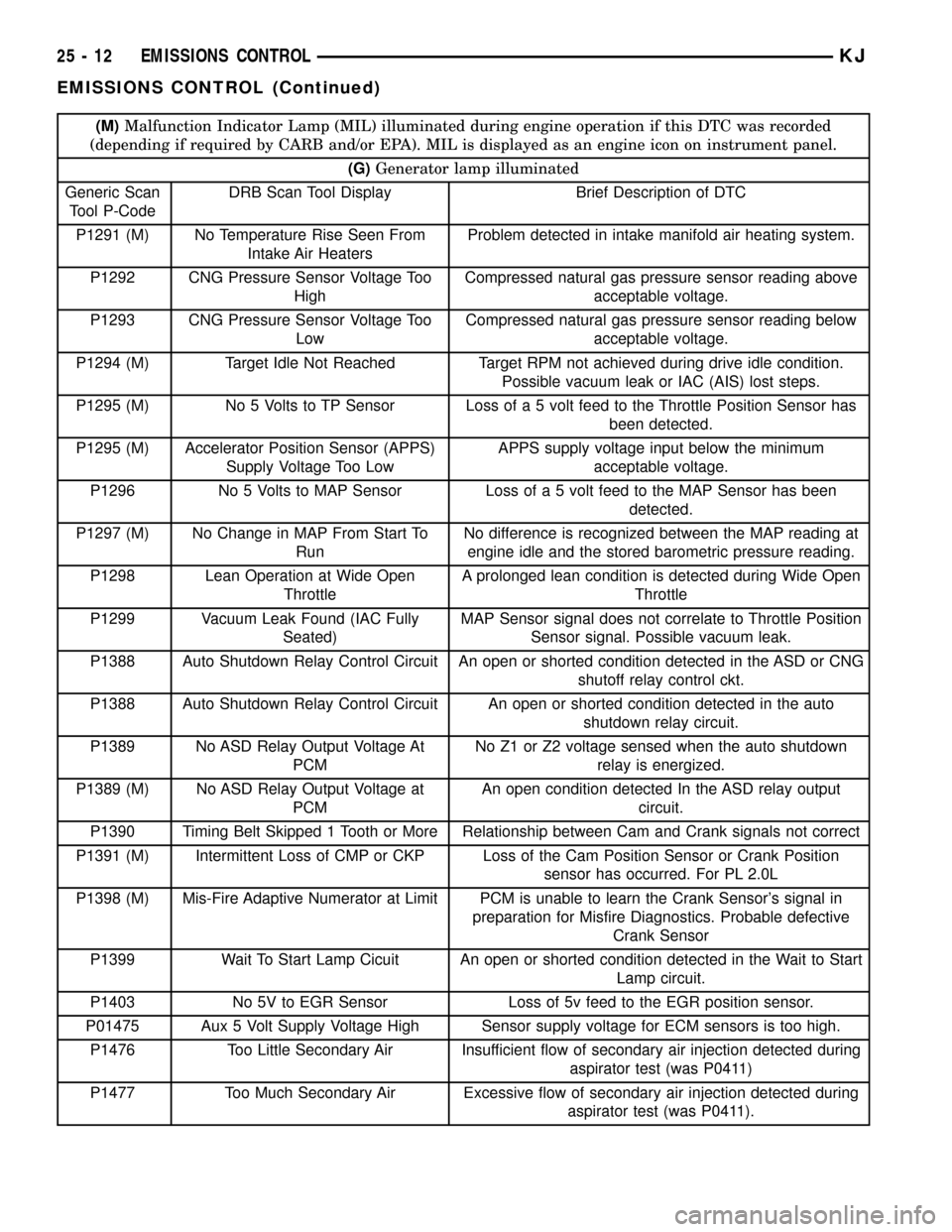
(M)Malfunction Indicator Lamp (MIL) illuminated during engine operation if this DTC was recorded
(depending if required by CARB and/or EPA). MIL is displayed as an engine icon on instrument panel.
(G)Generator lamp illuminated
Generic Scan
Tool P-CodeDRB Scan Tool Display Brief Description of DTC
P1291 (M) No Temperature Rise Seen From
Intake Air HeatersProblem detected in intake manifold air heating system.
P1292 CNG Pressure Sensor Voltage Too
HighCompressed natural gas pressure sensor reading above
acceptable voltage.
P1293 CNG Pressure Sensor Voltage Too
LowCompressed natural gas pressure sensor reading below
acceptable voltage.
P1294 (M) Target Idle Not Reached Target RPM not achieved during drive idle condition.
Possible vacuum leak or IAC (AIS) lost steps.
P1295 (M) No 5 Volts to TP Sensor Loss of a 5 volt feed to the Throttle Position Sensor has
been detected.
P1295 (M) Accelerator Position Sensor (APPS)
Supply Voltage Too LowAPPS supply voltage input below the minimum
acceptable voltage.
P1296 No 5 Volts to MAP Sensor Loss of a 5 volt feed to the MAP Sensor has been
detected.
P1297 (M) No Change in MAP From Start To
RunNo difference is recognized between the MAP reading at
engine idle and the stored barometric pressure reading.
P1298 Lean Operation at Wide Open
ThrottleA prolonged lean condition is detected during Wide Open
Throttle
P1299 Vacuum Leak Found (IAC Fully
Seated)MAP Sensor signal does not correlate to Throttle Position
Sensor signal. Possible vacuum leak.
P1388 Auto Shutdown Relay Control Circuit An open or shorted condition detected in the ASD or CNG
shutoff relay control ckt.
P1388 Auto Shutdown Relay Control Circuit An open or shorted condition detected in the auto
shutdown relay circuit.
P1389 No ASD Relay Output Voltage At
PCMNo Z1 or Z2 voltage sensed when the auto shutdown
relay is energized.
P1389 (M) No ASD Relay Output Voltage at
PCMAn open condition detected In the ASD relay output
circuit.
P1390 Timing Belt Skipped 1 Tooth or More Relationship between Cam and Crank signals not correct
P1391 (M) Intermittent Loss of CMP or CKP Loss of the Cam Position Sensor or Crank Position
sensor has occurred. For PL 2.0L
P1398 (M) Mis-Fire Adaptive Numerator at Limit PCM is unable to learn the Crank Sensor's signal in
preparation for Misfire Diagnostics. Probable defective
Crank Sensor
P1399 Wait To Start Lamp Cicuit An open or shorted condition detected in the Wait to Start
Lamp circuit.
P1403 No 5V to EGR Sensor Loss of 5v feed to the EGR position sensor.
P01475 Aux 5 Volt Supply Voltage High Sensor supply voltage for ECM sensors is too high.
P1476 Too Little Secondary Air Insufficient flow of secondary air injection detected during
aspirator test (was P0411)
P1477 Too Much Secondary Air Excessive flow of secondary air injection detected during
aspirator test (was P0411).
25 - 12 EMISSIONS CONTROLKJ
EMISSIONS CONTROL (Continued)
Page 1737 of 1803

OPERATION
The PCV system operates by engine intake mani-
fold vacuum. Filtered air is routed into the crankcase
through the air cleaner hose and crankcase breath-
er(s) (if used). The metered air, along with crankcase
vapors, are drawn through the PCV valve and into a
passage in the intake manifold. The PCV system
manages crankcase pressure and meters blow-by
gases to the intake system, reducing engine sludge
formation.
The PCV valve contains a spring loaded plunger.
This plunger meters the amount of crankcase vapors
routed into the combustion chamber based on intake
manifold vacuum.
TYPICALPCV valves are shown in (Fig. 9), (Fig.
10) and (Fig. 11).
When the engine is not operating, or during an
engine pop-back, the spring forces the plunger back
against the seat (Fig. 9). This will prevent vapors
from flowing through the valve.
During periods of high manifold vacuum, such as
idle or cruising speeds, vacuum is sufficient to com-
pletely compress spring. It will then pull the plunger
to the top of the valve (Fig. 10). In this position there
is minimal vapor flow through the valve.
During periods of moderate manifold vacuum, the
plunger is only pulled part way back from inlet. This
results in maximum vapor flow through the valve
(Fig. 11).
DIAGNOSIS AND TESTING - PCV VALVE
3.7L
(1) Disconnect PCV line/hose (Fig. 7) by discon-
necting rubber connecting hose at PCV valve fitting.
(2) Remove PCV valve at oil filler tube by rotating
PCV valve downward until locating tabs have been
freed at cam lock (Fig. 7). After tabs have cleared,
pull valve straight out from filler tube.To prevent
damage to PCV valve locating tabs, valve must
be pointed downward for removal. Do not force
valve from oil filler tube.
(3) After valve is removed, check condition of valve
o-ring (Fig. 7). Also, PCV valve should rattle when
shaken.
(4) Reconnect PCV valve to its connecting line/
hose.
(5) Start engine and bring to idle speed.
(6) If valve is not plugged, a hissing noise will be
heard as air passes through valve. Also, a strong vac-
uum should be felt with a finger placed at valve
inlet.
(7) If vacuum is not felt at valve inlet, check line/
hose for kinks or for obstruction. If necessary, clean
out intake manifold fitting at rear of manifold. Do
this by turning a 1/4 inch drill (by hand) through the
fitting to dislodge any solid particles. Blow out the
fitting with shop air. If necessary, use a smaller drill
to avoid removing any metal from the fitting.
(8)Do not attempt to clean the old PCV valve.
(9) Return PCV valve back to oil filler tube by
placing valve locating tabs (Fig. 7) into cam lock.
Press PCV valve in and rotate valve upward. A slight
click will be felt when tabs have engaged cam lock.
Valve should be pointed towards rear of vehicle.
(10) Connect PCV line/hose and connecting rubber
hose to PCV valve.
(11) Disconnect rubber hose from fresh air fitting
at air cleaner resonator box. Start engine and bring
to idle speed. Hold a piece of stiff paper (such as a
parts tag) loosely over the opening of the discon-
nected rubber hose.
(12) The paper should be drawn against the hose
opening with noticeable force. This will be after
allowing approximately one minute for crankcase
pressure to reduce.
Fig. 9 Engine Off or Engine Pop-BackÐNo Vapor
Flow
Fig. 10 High Intake Manifold VacuumÐMinimal
Vapor Flow
Fig. 11 Moderate Intake Manifold VacuumÐ
Maximum Vapor Flow
KJEVAPORATIVE EMISSIONS 25 - 31
PCV VALVE (Continued)
Page 1740 of 1803

ABS - DESCRIPTION, BRAKES...........5-32
ABS - OPERATION, BRAKES.............5-32
ABS - SPECIFICATIONS, BRAKES.........5-33
ABS BRAKE BLEEDING - STANDARD
PROCEDURE.........................5-33
ABS INDICATOR - DESCRIPTION.........8J-11
ABS INDICATOR - OPERATION..........8J-11
A/C APPLICATION TABLE,
SPECIFICATIONS......................24-9
A/C COMPRESSOR CLUTCH -
INSPECTION........................24-14
A/C COMPRESSOR CLUTCH -
INSTALLATION.......................24-14
A/C COMPRESSOR CLUTCH - REMOVAL . . 24-13
A/C COMPRESSOR CLUTCH BREAK-IN -
STANDARD PROCEDURE...............24-12
A/C COMPRESSOR CLUTCH COIL -
DIAGNOSIS AND TESTING.............24-12
A/C COMPRESSOR CLUTCH RELAY -
DESCRIPTION.......................24-15
A/C COMPRESSOR CLUTCH RELAY -
INSTALLATION.......................24-16
A/C COMPRESSOR CLUTCH RELAY -
OPERATION.........................24-15
A/C COMPRESSOR CLUTCH RELAY -
REMOVAL..........................24-16
A/C COMPRESSOR NOISE - DIAGNOSIS
AND TESTING.......................24-42
A/C CONDENSER - DESCRIPTION........24-45
A/C CONDENSER - INSTALLATION.......24-46
A/C CONDENSER - OPERATION...........24-45
A/C CONDENSER - REMOVAL...........24-45
A/C DISCHARGE LINE - INSTALLATION . . . 24-47
A/C DISCHARGE LINE - REMOVAL.......24-46
A/C EVAPORATOR - DESCRIPTION.......24-49
A/C EVAPORATOR - INSTALLATION......24-49
A/C EVAPORATOR - OPERATION.........24-49
A/C EVAPORATOR - REMOVAL..........24-49
A/C HEATER CONTROL - DESCRIPTION . . . 24-16
A/C HEATER CONTROL - INSTALLATION . . . 24-17
A/C HEATER CONTROL - REMOVAL......24-17
A/C HIGH PRESSURE SWITCH -
DESCRIPTION.......................24-17
A/C HIGH PRESSURE SWITCH -
DIAGNOSIS AND TESTING.............24-18
A/C HIGH PRESSURE SWITCH -
INSTALLATION.......................24-18
A/C HIGH PRESSURE SWITCH -
OPERATION.........................24-18
A/C HIGH PRESSURE SWITCH -
REMOVAL..........................24-18
A/C LIQUID LINE - INSTALLATION.......24-47
A/C LIQUID LINE - REMOVAL...........24-47
A/C LOW PRESSURE SWITCH -
DESCRIPTION.......................24-18
A/C LOW PRESSURE SWITCH -
DIAGNOSIS AND TESTING.............24-19
A/C LOW PRESSURE SWITCH -
INSTALLATION.......................24-19
A/C LOW PRESSURE SWITCH -
OPERATION.........................24-18
A/C LOW PRESSURE SWITCH -
REMOVAL..........................24-19
A/C ORIFICE TUBE - DESCRIPTION.......24-50
A/C ORIFICE TUBE - INSTALLATION......24-50
A/C ORIFICE TUBE - OPERATION........24-50
A/C ORIFICE TUBE - REMOVAL..........24-50
A/C PERFORMANCE - DIAGNOSIS AND
TESTING............................24-2
A/C SUCTION LINE - INSTALLATION......24-49
A/C SUCTION LINE - REMOVAL.........24-48
ACCELERATOR PEDAL - INSTALLATION . . . 14-30
ACCELERATOR PEDAL - REMOVAL.......14-29
ACCESS PANEL - DESCRIPTION, LATCH . . 23-139
ACCESS PANEL - INSTALLATION, LATCH . 23-139
ACCESS PANEL - REMOVAL, LATCH.....23-139
ACCUMULATOR - DESCRIPTION.........24-51
ACCUMULATOR - INSTALLATION........24-51
ACCUMULATOR - OPERATION..........24-51
ACCUMULATOR - REMOVAL
............24-51
ACTUATION TEST MODE - DESCRIPTION,
CIRCUIT
.............................25-2
ACTUATOR - INSTALLATION, BLEND
DOOR
.............................24-20
ACTUATOR - INSTALLATION, FLOOR -
DEFROST DOOR
.....................24-25
ACTUATOR - INSTALLATION, PANEL
DOOR
.............................24-25ACTUATOR - INSTALLATION,
RECIRCULATION DOOR................24-26
ACTUATOR - REMOVAL, BLEND DOOR....24-20
ACTUATOR - REMOVAL, FLOOR -
DEFROST DOOR.....................24-24
ACTUATOR - REMOVAL, PANEL DOOR....24-24
ACTUATOR - REMOVAL, RECIRCULATION
DOOR.............................24-26
ADAPTER - INSTALLATION, DISC BRAKE
CALIPER............................5-18
ADAPTER - REMOVAL, DISC BRAKE
CALIPER............................5-18
ADAPTER HOUSING SEAL -
INSTALLATION......................21-124
ADAPTER HOUSING SEAL - REMOVAL . . . 21-124
ADAPTOR - REMOVAL, DEFROST
DUCT/DEMISTER.....................24-32
ADHESIVE LOCATIONS -
SPECIFICATIONS, WELD AND
STRUCTURAL........................23-9
ADJUSTER - DIAGNOSIS AND TESTING,
HYDRAULIC LASH.................9-19,9-30
ADJUSTER - INSTALLATION, SEAT BELT
TURNING LOOP.....................8O-38
ADJUSTER - REMOVAL, SEAT BELT
TURNING LOOP.....................8O-37
ADJUSTMENT - STANDARD
PROCEDURE, CAMBER AND CASTER.......2-5
ADJUSTMENT - STANDARD
PROCEDURE, CAMBER, CASTER AND
TOE .................................2-5
ADJUSTMENT - STANDARD
PROCEDURE, COMPASS VARIATION......8M-3
ADJUSTMENT - STANDARD
PROCEDURE, TOE......................2-5
ADJUSTMENT, ADJUSTMENTS . . . 23-119,23-124,
23-131
ADJUSTMENT, ADJUSTMENTS...........3-55
ADJUSTMENT, ADJUSTMENTS -
SUNROOF GLASS PANEL.............23-178
ADJUSTMENT, FRONT FOG LAMP UNIT . . . 8L-25
ADJUSTMENT, HEADLAMP UNIT.........8L-42
ADJUSTMENT, LOCK OUT...............5-30
ADJUSTMENT, REAR DRUM BRAKE.......5-12
ADJUSTMENTS - ADJUSTMENT . . 23-119,23-124,
23-131
ADJUSTMENTS - ADJUSTMENT..........3-55
ADJUSTMENTS - SUNROOF GLASS
PANEL ADJUSTMENT................23-178
ADJUSTMENTS, FRONT AXLE - 186FIA....3-25
ADJUSTMENTS, GEARSHIFT CABLE.....21-130
ADJUSTMENTS, PARK-INTERLOCK
CABLE............................21-154
ADJUSTMENTS, REAR AXLE - 8 1/4 .......3-92
AFTER A SUPPLEMENTAL RESTRAINT
DEPLOYMENT - STANDARD
PROCEDURE, SERVICE.................8O-6
AIR CHECKING TRANSMISSION CLUTCH
OPERATION - DIAGNOSIS AND
TESTING...........................21-80
AIR CONDITIONER - DESCRIPTION,
HEATER .............................24-1
AIR CONDITIONER - OPERATION,
HEATER .............................24-2
AIR CONTROL MOTOR - DESCRIPTION,
IDLE...............................14-35
AIR CONTROL MOTOR - INSTALLATION,
IDLE...............................14-36
AIR CONTROL MOTOR - OPERATION,
IDLE...............................14-35
AIR CONTROL MOTOR - REMOVAL, IDLE . . 14-36
AIR TEMPERATURE SENSOR -
DESCRIPTION, INTAKE................14-36
AIR TEMPERATURE SENSOR -
INSTALLATION, INTAKE................14-38
AIR TEMPERATURE SENSOR -
OPERATION, INTAKE..................14-36
AIR TEMPERATURE SENSOR -
REMOVAL, INTAKE...................14-37
AIRBAG - DESCRIPTION, DRIVER........8O-17
AIRBAG - DESCRIPTION, PASSENGER....8O-27
AIRBAG - DESCRIPTION, SIDE CURTAIN . . 8O-38
AIRBAG - INSTALLATION, DRIVER.......8O-20
AIRBAG - INSTALLATION, PASSENGER
. . . 8O-29
AIRBAG - INSTALLATION, SIDE CURTAIN
. . 8O-41
AIRBAG - OPERATION, DRIVER
.........8O-18
AIRBAG - OPERATION, PASSENGER
......8O-27
AIRBAG - OPERATION, SIDE CURTAIN
....8O-39AIRBAG - REMOVAL, DRIVER...........8O-19
AIRBAG - REMOVAL, PASSENGER.......8O-28
AIRBAG - REMOVAL, SIDE CURTAIN.....8O-40
AIRBAG CONTROL MODULE -
DESCRIPTION........................8O-9
AIRBAG CONTROL MODULE -
DESCRIPTION, SIDE IMPACT...........8O-43
AIRBAG CONTROL MODULE -
INSTALLATION......................8O-12
AIRBAG CONTROL MODULE -
INSTALLATION, SIDE IMPACT...........8O-45
AIRBAG CONTROL MODULE -
OPERATION.........................8O-10
AIRBAG CONTROL MODULE -
OPERATION, SIDE IMPACT.............8O-43
AIRBAG CONTROL MODULE - REMOVAL . . 8O-11
AIRBAG CONTROL MODULE - REMOVAL,
SIDE IMPACT.......................8O-44
AIRBAG DOOR - INSTALLATION,
PASSENGER........................8O-30
AIRBAG DOOR - REMOVAL, PASSENGER . . 8O-29
AIRBAG INDICATOR - DESCRIPTION......8J-12
AIRBAG INDICATOR - OPERATION.......8J-12
AIRBAG MOUNTING BRACKET -
INSTALLATION, PASSENGER...........8O-31
AIRBAG MOUNTING BRACKET -
REMOVAL, PASSENGER...............8O-31
AJAR INDICATOR - DESCRIPTION, DOOR . . 8J-17
AJAR INDICATOR - DESCRIPTION, GATE . . 8J-20
AJAR INDICATOR - DESCRIPTION,
GLASS..............................8J-21
AJAR INDICATOR - OPERATION, DOOR . . . 8J-17
AJAR INDICATOR - OPERATION, GATE....8J-20
AJAR INDICATOR - OPERATION, GLASS . . . 8J-21
AJAR SWITCH - DESCRIPTION, DOOR....8L-77
AJAR SWITCH - DESCRIPTION, FLIP-UP
GLASS.............................8L-77
AJAR SWITCH - DESCRIPTION, HOOD....8Q-11
AJAR SWITCH - DESCRIPTION,
TAILGATE...........................8L-82
AJAR SWITCH - DIAGNOSIS AND
TESTING, HOOD.....................8Q-12
AJAR SWITCH - INSTALLATION, HOOD . . . 8Q-12
AJAR SWITCH - OPERATION, DOOR......8L-77
AJAR SWITCH - OPERATION, FLIP-UP
GLASS.............................8L-77
AJAR SWITCH - OPERATION, HOOD.....8Q-12
AJAR SWITCH - OPERATION, TAILGATE . . . 8L-82
AJAR SWITCH - REMOVAL, HOOD.......8Q-12
AJAR SWITCH BRACKET -
INSTALLATION, HOOD.................8Q-13
AJAR SWITCH BRACKET - REMOVAL,
HOOD.............................8Q-13
AJAR SWITCH STRIKER -
INSTALLATION, HOOD.................8Q-14
AJAR SWITCH STRIKER - REMOVAL,
HOOD.............................8Q-13
ALIGNMENT - DESCRIPTION, WHEEL.......2-3
ALIGNMENT - OPERATION, WHEEL........2-3
ALIGNMENT, SPECIFICATIONS............2-6
ALUMINUM THREAD REPAIR -
STANDARD PROCEDURE...............21-81
AMBIENT TEMP SENSOR - DESCRIPTION . . 8M-9
AMBIENT TEMP SENSOR - OPERATION . . . 8M-9
AMBIENT TEMPERATURE SENSOR -
DIAGNOSIS AND TESTING..............8M-9
AMBIENT TEMPERATURE SENSOR
CIRCUIT - DIAGNOSIS AND TESTING.....8M-9
AMPERAGE TEST - DIAGNOSIS AND
TESTING, FUEL PUMP.................14-16
AMPLIFIER CHOKE AND RELAY -
DESCRIPTION........................8A-3
AMPLIFIER CHOKE AND RELAY -
DIAGNOSIS AND TESTING..............8A-4
AMPLIFIER CHOKE AND RELAY -
INSTALLATION.......................8A-4
AMPLIFIER CHOKE AND RELAY -
OPERATION..........................8A-3
AMPLIFIER CHOKE AND RELAY -
REMOVAL...........................8A-4
ANCHOR - DESCRIPTION, CHILD TETHER
. 8O-13
ANCHOR - OPERATION, CHILD TETHER
. . . 8O-13
ANGLE - STANDARD PROCEDURES,
PROPELLER SHAFT
.....................3-3
ANTENNA BODY & CABLE -
DESCRIPTION
........................8A-4
ANTENNA BODY & CABLE -
INSTALLATION
.......................8A-6
KJINDEX 1
Description Group-Page Description Group-Page Description Group-Page
Page 1752 of 1803

HVAC CONTROL ASSEMBLY WINDOW
DEFOGGER FUNCTION - DIAGNOSIS
AND TESTING, REAR..................8G-9
HVAC HOUSING - ASSEMBLY...........24-34
HVAC HOUSING - DISASSEMBLY........24-34
HVAC HOUSING - INSTALLATION........24-34
HVAC HOUSING - REMOVAL............24-33
HYDRAULIC LASH ADJUSTER -
DIAGNOSIS AND TESTING..........9-19,9-30
HYDRAULIC PRESSURE TEST -
DIAGNOSIS AND TESTING.............21-79
HYDRAULIC SCHEMATICS, SCHEMATICS
AND DIAGRAMS....................21-100
HYDROMETER TEST - STANDARD
PROCEDURE........................8F-11
IDENTIFICATION - DESCRIPTION,
FASTENER.........................Intro.-1
IDENTIFICATION AND INFORMATION -
DESCRIPTION, SECTION.............8W-01-6
IDENTIFICATION NUMBER -
DESCRIPTION, VEHICLE..............Intro.-8
IDLE AIR CONTROL MOTOR -
DESCRIPTION.......................14-35
IDLE AIR CONTROL MOTOR -
INSTALLATION.......................14-36
IDLE AIR CONTROL MOTOR -
OPERATION.........................14-35
IDLE AIR CONTROL MOTOR - REMOVAL . . 14-36
IDLER SHAFT - INSTALLATION...........9-77
IDLER SHAFT - REMOVAL...............9-77
IGNITION CIRCUIT SENSE -
DESCRIPTION.........................8E-13
IGNITION CIRCUIT SENSE - OPERATION . . 8E-15
IGNITION COIL - DESCRIPTION...........8I-9
IGNITION COIL - INSTALLATION.........8I-10
IGNITION COIL - OPERATION.............8I-9
IGNITION COIL - REMOVAL.............8I-10
IGNITION COIL CAPACITOR -
DESCRIPTION........................8I-16
IGNITION COIL CAPACITOR -
INSTALLATION.......................8I-16
IGNITION COIL CAPACITOR - OPERATION . . 8I-16
IGNITION COIL CAPACITOR - REMOVAL . . . 8I-16
IGNITION COIL RESISTANCE, 2.4L.........8I-2
IGNITION COIL RESISTANCE, 3.7L V-6.....8I-3
IGNITION CONTROL - DESCRIPTION.......8I-1
IGNITION CONTROL - OPERATION.........8I-1
IGNITION SWITCH - DESCRIPTION........19-8
IGNITION SWITCH - DESCRIPTION,
KEY-IN.............................19-10
IGNITION SWITCH - DIAGNOSIS AND
TESTING............................19-8
IGNITION SWITCH - DIAGNOSIS AND
TESTING, KEY-IN.....................19-10
IGNITION SWITCH INSTALLATION,
INSTALLATION........................19-9
IGNITION SWITCH REMOVAL, REMOVAL . . . 19-9
IGNITION SYSTEM - TORQUE............8I-3
IGNITION TIMING - SPECIFICATIONS......8I-2
IGNITION-OFF DRAW TEST - STANDARD
PROCEDURE........................8F-14
ILLUMINATION BULB - INSTALLATION,
COMPASS MINI-TRIP
.................8L-75
ILLUMINATION BULB - INSTALLATION,
HEATER-A/C CONTROL
................8L-78
ILLUMINATION BULB - INSTALLATION,
TRANSMISSION RANGE INDICATOR
......8L-83
ILLUMINATION BULB - REMOVAL,
COMPASS MINI-TRIP
.................8L-74
ILLUMINATION BULB - REMOVAL,
HEATER-A/C CONTROL
................8L-78
ILLUMINATION BULB - REMOVAL,
TRANSMISSION RANGE INDICATOR
......8L-82
IMMOBILIZER MODULE - DESCRIPTION,
SENTRY KEY
........................8E-15
IMMOBILIZER MODULE - INSTALLATION,
SENTRY KEY
........................8E-18
IMMOBILIZER MODULE - OPERATION,
SENTRY KEY
........................8E-16
IMMOBILIZER MODULE - REMOVAL,
SENTRY KEY
........................8E-17
IMPACT AIRBAG CONTROL MODULE -
DESCRIPTION, SIDE
..................8O-43
IMPACT AIRBAG CONTROL MODULE -
INSTALLATION, SIDE
.................8O-45
IMPACT AIRBAG CONTROL MODULE -
OPERATION, SIDE
....................8O-43IMPACT AIRBAG CONTROL MODULE -
REMOVAL, SIDE.....................8O-44
IMPACT SENSOR - DESCRIPTION,
FRONT.............................8O-21
IMPACT SENSOR - INSTALLATION,
FRONT.............................8O-22
IMPACT SENSOR - OPERATION, FRONT . . . 8O-21
IMPACT SENSOR - REMOVAL, FRONT....8O-22
INCORRECT FLUID LEVEL - DIAGNOSIS
AND TESTING, EFFECTS OF............21-125
INDICATOR - DESCRIPTION, ABS........8J-11
INDICATOR - DESCRIPTION, AIRBAG.....8J-12
INDICATOR - DESCRIPTION, BRAKE/
PARK BRAKE........................8J-13
INDICATOR - DESCRIPTION, CHARGING . . . 8J-15
INDICATOR - DESCRIPTION, COOLANT
LOW...............................8J-15
INDICATOR - DESCRIPTION, CRUISE.....8J-16
INDICATOR - DESCRIPTION, DOOR AJAR . . 8J-17
INDICATOR - DESCRIPTION, FOUR LOW
MODE.............................8J-29
INDICATOR - DESCRIPTION, FRONT FOG
LAMP..............................8J-19
INDICATOR - DESCRIPTION, FULL TIME . . . 8J-29
INDICATOR - DESCRIPTION, GATE AJAR . . 8J-20
INDICATOR - DESCRIPTION, GLASS
AJAR..............................8J-21
INDICATOR - DESCRIPTION, HIGH BEAM . . 8J-22
INDICATOR - DESCRIPTION, LOW FUEL . . . 8J-22
INDICATOR - DESCRIPTION, LOW OIL
PRESSURE..........................8J-23
INDICATOR - DESCRIPTION, OVERDRIVE
OFF ...............................8J-26
INDICATOR - DESCRIPTION, PART TIME . . 8J-29
INDICATOR - DESCRIPTION, REAR FOG
LAMP..............................8J-27
INDICATOR - DESCRIPTION, SEATBELT . . . 8J-27
INDICATOR - DESCRIPTION, SECURITY . . . 8J-28
INDICATOR - DESCRIPTION, SKIS........8J-31
INDICATOR - DESCRIPTION, TRANS
TEMP..............................8J-33
INDICATOR - DESCRIPTION, TURN
SIGNAL............................8J-34
INDICATOR - DESCRIPTION, WAIT-TO-
START .............................8J-35
INDICATOR - DESCRIPTION, WASHER
FLUID..............................8J-35
INDICATOR - DESCRIPTION, WATER-IN-
FUEL..............................8J-37
INDICATOR - DIAGNOSIS AND TESTING,
BRAKE.............................8J-14
INDICATOR - DIAGNOSIS AND TESTING,
WASHER FLUID......................8J-36
INDICATOR - OPERATION, ABS..........8J-11
INDICATOR - OPERATION, AIRBAG.......8J-12
INDICATOR - OPERATION, BRAKE/PARK
BRAKE.............................8J-13
INDICATOR - OPERATION, CHARGING....8J-15
INDICATOR - OPERATION, COOLANT
LOW...............................8J-16
INDICATOR - OPERATION, CRUISE.......8J-17
INDICATOR - OPERATION, DOOR AJAR . . . 8J-17
INDICATOR - OPERATION, FOUR LOW
MODE.............................8J-30
INDICATOR - OPERATION, FRONT FOG
LAMP..............................8J-19
INDICATOR - OPERATION, FULL TIME....8J-30
INDICATOR - OPERATION, GATE AJAR....8J-20
INDICATOR - OPERATION, GLASS AJAR . . . 8J-21
INDICATOR - OPERATION, HIGH BEAM
....8J-22
INDICATOR - OPERATION, LOW FUEL
.....8J-22
INDICATOR - OPERATION, LOW OIL
PRESSURE
..........................8J-23
INDICATOR - OPERATION, OVERDRIVE
OFF
...............................8J-26
INDICATOR - OPERATION, PART TIME
....8J-29
INDICATOR - OPERATION, REAR FOG
LAMP
..............................8J-27
INDICATOR - OPERATION, SEATBELT
.....8J-28
INDICATOR - OPERATION, SECURITY
.....8J-28
INDICATOR - OPERATION, SKIS
.........8J-31
INDICATOR - OPERATION, TRANS TEMP
. . 8J-34
INDICATOR - OPERATION, TURN SIGNAL
. . 8J-34
INDICATOR - OPERATION, WAIT-TO-
START
.............................8J-35
INDICATOR - OPERATION, WASHER
FLUID
..............................8J-36INDICATOR - OPERATION, WATER-IN-
FUEL..............................8J-37
INDICATOR ILLUMINATION BULB -
INSTALLATION, TRANSMISSION
RANGE.............................8L-83
INDICATOR ILLUMINATION BULB -
REMOVAL, TRANSMISSION RANGE......8L-82
INDICATOR LAMP (MIL) - DESCRIPTION,
MALFUNCTION.......................8J-24
INDICATOR LAMP (MIL) - OPERATION,
MALFUNCTION.......................8J-24
INDICATOR TEST - STANDARD
PROCEDURE, BUILT-IN................8F-10
INDICATORS - DIAGNOSIS AND
TESTING, TREAD WEAR................22-8
INFLATION - DIAGNOSIS AND TESTING,
TIRE................................22-7
INITIAL OPERATION - STANDARD
PROCEDURE, POWER STEERING
PUMP.............................19-18
INITIALIZATION - STANDARD
PROCEDURE, SKIS....................8Q-8
INJECTION - DESCRIPTION, FUEL........14-29
INJECTOR - DESCRIPTION, FUEL........14-33
INJECTOR - DIAGNOSIS AND TESTING,
FUEL..............................14-33
INJECTOR - OPERATION, FUEL..........14-33
INLET FILTER - INSTALLATION..........14-28
INLET FILTER - REMOVAL..............14-28
INPUT - OPERATION, ASD SENSE - PCM . . . 8I-4
INPUT CLUTCH ASSEMBLY - ASSEMBLY . 21-138
INPUT CLUTCH ASSEMBLY -
DESCRIPTION......................21-133
INPUT CLUTCH ASSEMBLY -
DISASSEMBLY......................21-135
INPUT CLUTCH ASSEMBLY - OPERATION . 21-135
INPUT SPEED SENSOR - DESCRIPTION . . 21-143
INPUT SPEED SENSOR - INSTALLATION . 21-143
INPUT SPEED SENSOR - OPERATION....21-143
INPUT SPEED SENSOR - REMOVAL.....21-143
INSTRUMENT CLUSTER - ASSEMBLY.....8J-10
INSTRUMENT CLUSTER - DESCRIPTION . . . 8J-2
INSTRUMENT CLUSTER - DIAGNOSIS
AND TESTING........................8J-7
INSTRUMENT CLUSTER - DISASSEMBLY . . . 8J-9
INSTRUMENT CLUSTER - INSTALLATION . . 8J-11
INSTRUMENT CLUSTER - OPERATION.....8J-4
INSTRUMENT CLUSTER - REMOVAL......8J-9
INSTRUMENT PANEL ANTENNA CABLE -
INSTALLATION.......................8A-8
INSTRUMENT PANEL ANTENNA CABLE -
REMOVAL...........................8A-7
INSTRUMENT PANEL ASSEMBLY -
INSTALLATION......................23-151
INSTRUMENT PANEL ASSEMBLY -
REMOVAL.........................23-149
INSTRUMENT PANEL CENTER BEZEL -
INSTALLATION......................23-154
INSTRUMENT PANEL CENTER BEZEL -
REMOVAL.........................23-154
INSTRUMENT PANEL DRIVER SIDE
BEZELS - INSTALLATION..............23-154
INSTRUMENT PANEL DRIVER SIDE
BEZELS - REMOVAL.................23-153
INSTRUMENT PANEL END CAP -
INSTALLATION
......................23-153
INSTRUMENT PANEL END CAP -
REMOVAL
.........................23-153
INSTRUMENT PANEL PASSENGER SIDE
BEZEL - INSTALLATION
...............23-154
INSTRUMENT PANEL PASSENGER SIDE
BEZEL - REMOVAL
..................23-154
INSTRUMENT PANEL TOP COVER -
INSTALLATION
......................23-153
INSTRUMENT PANEL TOP COVER -
REMOVAL
.........................23-152
INTAKE AIR TEMPERATURE SENSOR -
DESCRIPTION
.......................14-36
INTAKE AIR TEMPERATURE SENSOR -
INSTALLATION
.......................14-38
INTAKE AIR TEMPERATURE SENSOR -
OPERATION
.........................14-36
INTAKE AIR TEMPERATURE SENSOR -
REMOVAL
..........................14-37
INTAKE MANIFOLD - DESCRIPTION
.......9-68
INTAKE MANIFOLD - INSTALLATION
.......9-69
INTAKE MANIFOLD - REMOVAL
..........9-68
KJINDEX 13
Description Group-Page Description Group-Page Description Group-Page